PRESENTED BY : A.SHARATH
ROOL NO, : 16011BB003
 What is MODBUS?
 What is it used for?
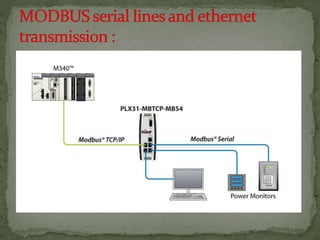
 MODBUS transmission
 How does it work?
 Communication between MODBUS devices
 Modbus frames
 Modbus Data Types
 QUERY
Modbus is a serial communications protocol originally
published by Modicon (now Schneider Electric) in 1979 for
use with its programmable logic controllers (PLCs).
Modbus has become a de facto standard communication
protocol and is now a commonly available means of
connecting industrial electronic devices.
The main reasons for the use of Modbus in the industrial
environment are:
 developed with industrial applications in mind,
 openly published and royalty-free,
 easy to deploy and maintain,
 moves raw bits or words without placing many restrictions
on vendors.
 Modbus is typically used to transmit signals from
instrumentation and control devices back to a main
controller or data gathering system
 for example a system that measures temperature and
humidity and communicates the results to a computer.
 Modbus is often used to connect a supervisory computer
with a remote terminal unit (RTU) in supervisory control
and data acquisition (SCADA) systems.
 Versions of the Modbus protocol exist for serial lines
(Modbus RTU and Modbus ASCII) and for Ethernet
(Modbus TCP).
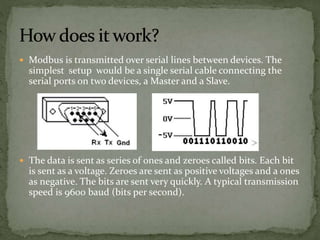
 Modbus is transmitted over serial lines between devices. The
simplest setup would be a single serial cable connecting the
serial ports on two devices, a Master and a Slave.
 The data is sent as series of ones and zeroes called bits. Each bit
is sent as a voltage. Zeroes are sent as positive voltages and a ones
as negative. The bits are sent very quickly. A typical transmission
speed is 9600 baud (bits per second).
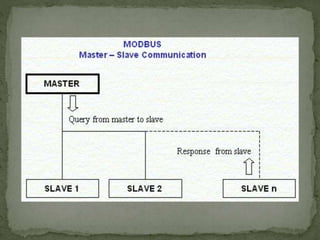
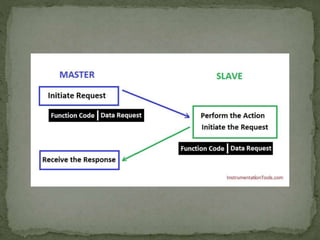
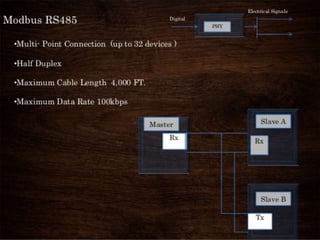
 • MODBUS devices communicate using a master-slave
technique in which only one device (the master) can
initiate transactions (called queries).
 The other devices (slaves) respond by supplying the
requested data to the master.
 A slave is any peripheral device (I/O transducer, valve,
network or other measuring device), which processes
information and sends its output to the master .
 Masters can address individual slaves, or can initiate a
broadcast message to all slaves.
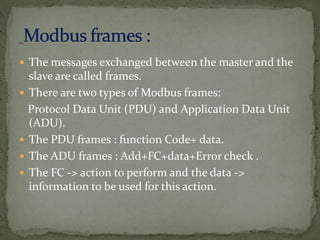
 The messages exchanged between the master and the
slave are called frames.
 There are two types of Modbus frames:
Protocol Data Unit (PDU) and Application Data Unit
(ADU).
 The PDU frames : function Code+ data.
 The ADU frames : Add+FC+data+Error check .
 The FC -> action to perform and the data ->
information to be used for this action.
 • Modbus transactions always perform a set of actions
by reading or writing to a set of four data ,used by the
Modbus application layer.
 A Master’s query will consist of a Slave address,
a function code defining the
requested action, any required
data and an error-checking field.
 A Slave’s response consists of fields
confirming the action taken, any
data to be returned, and an error-checking field.
 The master can individually address and send message
to each slave (unicast model) or can send message to
all slaves (broadcast model).
 Slaves respond to unicast messages but do not respond
to broadcast messages.
 MODBUS supports 4 basic data types :
analog inputs, analog outputs, digital inputs & digital
outputs.
 Transmission mode defines bit definitions of message bytes
& method of packing & decoding the message information
into message stream.
 2 types of transmission modes for MODBUS
communication :
i) ASCII transmission mode and
ii) RTU transmission mode
 Different versions of Modbus used today include-
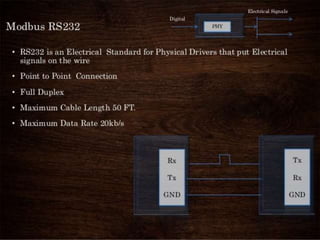
 MODBUS RTU (based on serial communication like RS485
& RS232),
 MODBUS ASCII
 MODBUS TCP, which is the MODBUS RTU Protocol
embedded into TCIP packets.
 When devices are set up to communicate on modbus
serial line using ASCII mode.
 Each 8-bit byte in a message is sent as 2 ASCII
characters.
 The main advantage is that it allows time intervals of
up to 1 second to occur between characters without
causing any error.
 Transmission speed : 300 KHZ – 800 GHZ.
 Modbus RTU is a open or serial (RS-232 or RS-
485)protocol.
 Modbus RTU messages are a simple 16-bit CRC(cyclic
redundunt checksum).
 the main advantage of modbus RTU is the grater
character density allows better data throughput than
modbus ASCII for same baud rate.
 Transmission speed : 1MHZ – 1.5 GHZ.
https://www.slideshare.net/ShivamSingh59/basic-of-
modbus-communicationprotocol
https://www.slideshare.net/PremSanil/modbus-
introduction-73457070
https://www.slideshare.net/Manoj89p/modbus-
43773546
https://www.slideshare.net/pupenasan/modbus-
40938993
https://www.slideshare.net/vp3892/1909383-
635125123716188750
https://en.wikipedia.org/wiki/Modbus
THANK YOU

Modbus protocol

  • 1.
    PRESENTED BY :A.SHARATH ROOL NO, : 16011BB003
  • 2.
     What isMODBUS?  What is it used for?  MODBUS transmission  How does it work?  Communication between MODBUS devices  Modbus frames  Modbus Data Types  QUERY
  • 3.
    Modbus is aserial communications protocol originally published by Modicon (now Schneider Electric) in 1979 for use with its programmable logic controllers (PLCs). Modbus has become a de facto standard communication protocol and is now a commonly available means of connecting industrial electronic devices. The main reasons for the use of Modbus in the industrial environment are:  developed with industrial applications in mind,  openly published and royalty-free,  easy to deploy and maintain,  moves raw bits or words without placing many restrictions on vendors.
  • 4.
     Modbus istypically used to transmit signals from instrumentation and control devices back to a main controller or data gathering system  for example a system that measures temperature and humidity and communicates the results to a computer.  Modbus is often used to connect a supervisory computer with a remote terminal unit (RTU) in supervisory control and data acquisition (SCADA) systems.  Versions of the Modbus protocol exist for serial lines (Modbus RTU and Modbus ASCII) and for Ethernet (Modbus TCP).
  • 6.
     Modbus istransmitted over serial lines between devices. The simplest setup would be a single serial cable connecting the serial ports on two devices, a Master and a Slave.  The data is sent as series of ones and zeroes called bits. Each bit is sent as a voltage. Zeroes are sent as positive voltages and a ones as negative. The bits are sent very quickly. A typical transmission speed is 9600 baud (bits per second).
  • 8.
     • MODBUSdevices communicate using a master-slave technique in which only one device (the master) can initiate transactions (called queries).  The other devices (slaves) respond by supplying the requested data to the master.  A slave is any peripheral device (I/O transducer, valve, network or other measuring device), which processes information and sends its output to the master .  Masters can address individual slaves, or can initiate a broadcast message to all slaves.
  • 10.
     The messagesexchanged between the master and the slave are called frames.  There are two types of Modbus frames: Protocol Data Unit (PDU) and Application Data Unit (ADU).  The PDU frames : function Code+ data.  The ADU frames : Add+FC+data+Error check .  The FC -> action to perform and the data -> information to be used for this action.
  • 11.
     • Modbustransactions always perform a set of actions by reading or writing to a set of four data ,used by the Modbus application layer.
  • 12.
     A Master’squery will consist of a Slave address, a function code defining the requested action, any required data and an error-checking field.  A Slave’s response consists of fields confirming the action taken, any data to be returned, and an error-checking field.
  • 13.
     The mastercan individually address and send message to each slave (unicast model) or can send message to all slaves (broadcast model).  Slaves respond to unicast messages but do not respond to broadcast messages.  MODBUS supports 4 basic data types : analog inputs, analog outputs, digital inputs & digital outputs.
  • 14.
     Transmission modedefines bit definitions of message bytes & method of packing & decoding the message information into message stream.  2 types of transmission modes for MODBUS communication : i) ASCII transmission mode and ii) RTU transmission mode  Different versions of Modbus used today include-  MODBUS RTU (based on serial communication like RS485 & RS232),  MODBUS ASCII  MODBUS TCP, which is the MODBUS RTU Protocol embedded into TCIP packets.
  • 15.
     When devicesare set up to communicate on modbus serial line using ASCII mode.  Each 8-bit byte in a message is sent as 2 ASCII characters.  The main advantage is that it allows time intervals of up to 1 second to occur between characters without causing any error.  Transmission speed : 300 KHZ – 800 GHZ.
  • 16.
     Modbus RTUis a open or serial (RS-232 or RS- 485)protocol.  Modbus RTU messages are a simple 16-bit CRC(cyclic redundunt checksum).  the main advantage of modbus RTU is the grater character density allows better data throughput than modbus ASCII for same baud rate.  Transmission speed : 1MHZ – 1.5 GHZ.
  • 19.
  • 20.