Engineering your Future
Difference between
MODBUS RTU &
MODBUS TCP
©AutomationTechnologyDivision-2
ABB
 What is MODBUS ?
 MODBUS is a serial communication protocol.
 Published by Modicon (now Schneider Electric).
 Reasons for the use of MODBUS in the industrial Environment ?
 Developed with industrial application in mind.
 Openly published and royalty free.
 Easy to deploy and maintain.
 Moves raw bits or words without placing many restriction on
vendors.
 It enables communication among many devices connected to the
same network.
©AutomationTechnologyDivision-3
ABB
Protocol Version
 MODBUS RTU.
 MODBUS ASCII.
 MODBUS TCP/IP.
 MODBUS OVER UDP.
 MODBUS+.
 MODBUS PEMEX
 ENRON MODBUS
©AutomationTechnologyDivision-4
ABB
MODBUS RTU
 Modbus RTU is an open,serial(RS-232 or RS-485) protocol derived
from the master slave architecture.
 It is a widely accepted protocol due to its ease of use and reliability.
 MODBUS RTU is widely used within Building Management
system(BMS) and industrial automation system.
 MODBUS RTU messages are a simple 16-bit CRC(cyclic –
redundant Checksum).
 The simplicity of these messages is to ensure reliability.
©AutomationTechnologyDivision-5
ABB
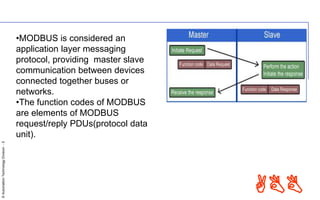
•MODBUS is considered an
application layer messaging
protocol, providing master slave
communication between devices
connected together buses or
networks.
•The function codes of MODBUS
are elements of MODBUS
request/reply PDUs(protocol data
unit).
©AutomationTechnologyDivision-6
ABB
Data Object Properties
 MODBUS RTU packets are only intended to send data; they do not
have the capability to send parameters such as point name,
resolution, units, etc.
 If the ability to send such parameters is needed, one should
investigate a BACnet, EtherNet/IP, or other modern protocols.
MODBUS RTU ADDRESS REQUIREMENT
 Standard RTU node addresses are 1-254, with 0 being reserved for
broadcast messages and write only.
 ‘0’ address is rarely used due to the fact there is no confirmation that
the message was properly received at this slave node.
 If physical layer is RS-232 as only one node can be implemented
anyway.
©AutomationTechnologyDivision-7
ABB
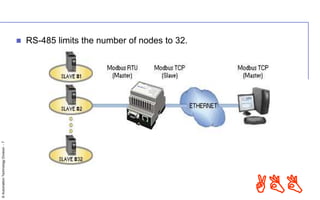
 RS-485 limits the number of nodes to 32.
©AutomationTechnologyDivision-8
ABB
©AutomationTechnologyDivision-9
ABB
MODBUS TCP/IP
 MODBUS TCP/IP is a variant of the MODBUS family of simple ,
vendor – neutral communication protocols intended for supervision
and control of automation equipment.
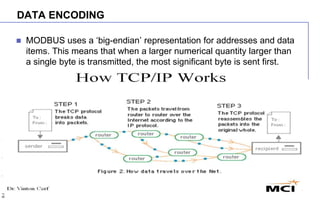
 It covers the use of MODBUS messaging in an ‘Intranet’ or ‘internet’
environment using the TCP/IP protocols.
 The MODBUS TCP/IP is being published as a automation standard.
 In MODBUS, data transaction are traditionally stateless, making
them highly resistant.
 TCP/IP allows a very large number of concurrent connections.
©AutomationTechnologyDivision-10
ABB
DATA ENCODING
 MODBUS uses a ‘big-endian’ representation for addresses and data
items. This means that when a larger numerical quantity larger than
a single byte is transmitted, the most significant byte is sent first.
©AutomationTechnologyDivision-11
ABB

RTU vs TCP

  • 1.
    Engineering your Future Differencebetween MODBUS RTU & MODBUS TCP
  • 2.
    ©AutomationTechnologyDivision-2 ABB  What isMODBUS ?  MODBUS is a serial communication protocol.  Published by Modicon (now Schneider Electric).  Reasons for the use of MODBUS in the industrial Environment ?  Developed with industrial application in mind.  Openly published and royalty free.  Easy to deploy and maintain.  Moves raw bits or words without placing many restriction on vendors.  It enables communication among many devices connected to the same network.
  • 3.
    ©AutomationTechnologyDivision-3 ABB Protocol Version  MODBUSRTU.  MODBUS ASCII.  MODBUS TCP/IP.  MODBUS OVER UDP.  MODBUS+.  MODBUS PEMEX  ENRON MODBUS
  • 4.
    ©AutomationTechnologyDivision-4 ABB MODBUS RTU  ModbusRTU is an open,serial(RS-232 or RS-485) protocol derived from the master slave architecture.  It is a widely accepted protocol due to its ease of use and reliability.  MODBUS RTU is widely used within Building Management system(BMS) and industrial automation system.  MODBUS RTU messages are a simple 16-bit CRC(cyclic – redundant Checksum).  The simplicity of these messages is to ensure reliability.
  • 5.
    ©AutomationTechnologyDivision-5 ABB •MODBUS is consideredan application layer messaging protocol, providing master slave communication between devices connected together buses or networks. •The function codes of MODBUS are elements of MODBUS request/reply PDUs(protocol data unit).
  • 6.
    ©AutomationTechnologyDivision-6 ABB Data Object Properties MODBUS RTU packets are only intended to send data; they do not have the capability to send parameters such as point name, resolution, units, etc.  If the ability to send such parameters is needed, one should investigate a BACnet, EtherNet/IP, or other modern protocols. MODBUS RTU ADDRESS REQUIREMENT  Standard RTU node addresses are 1-254, with 0 being reserved for broadcast messages and write only.  ‘0’ address is rarely used due to the fact there is no confirmation that the message was properly received at this slave node.  If physical layer is RS-232 as only one node can be implemented anyway.
  • 7.
  • 8.
  • 9.
    ©AutomationTechnologyDivision-9 ABB MODBUS TCP/IP  MODBUSTCP/IP is a variant of the MODBUS family of simple , vendor – neutral communication protocols intended for supervision and control of automation equipment.  It covers the use of MODBUS messaging in an ‘Intranet’ or ‘internet’ environment using the TCP/IP protocols.  The MODBUS TCP/IP is being published as a automation standard.  In MODBUS, data transaction are traditionally stateless, making them highly resistant.  TCP/IP allows a very large number of concurrent connections.
  • 10.
    ©AutomationTechnologyDivision-10 ABB DATA ENCODING  MODBUSuses a ‘big-endian’ representation for addresses and data items. This means that when a larger numerical quantity larger than a single byte is transmitted, the most significant byte is sent first.
  • 11.