MODALs VERBs
1.Claudya Rahmadini
2.Erwan
3.Eva Anggraini
4.Yusuf Agung Viranda
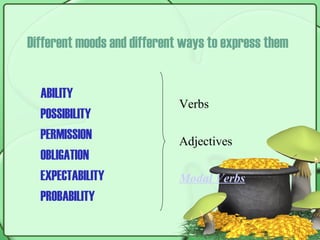
Different moods and different ways to express them


  ABILITY
                             Verbs
  POSSIBILITY
  PERMISSION                 Adjectives
  OBLIGATION
  EXPECTABILITY              Modal Verbs
  PROBABILITY
Present, past and future

I am                                          I
                      I / he / she / it was
You /we /they are                             You /we /they    will be
                      You /we /they were
He /she /it is                                He /she /it

There is              There was
                                              There will be
There are             There were

                       I                      I
                       You       wrote        You
I /you /we /they write
                       He                     He          will write
He / she / it writes
                       We          lived      We
                       They                   They
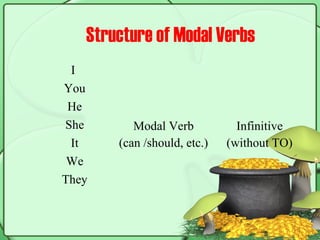
Structure of Modal Verbs
 I
You
 He
She       Modal Verb           Infinitive
 It    (can /should, etc.)   (without TO)
 We
They
CAN used to indicate the possession of an ABILITY


e.g. He can speak German fluently
     (He’s able to speak German fluently)
I Rewrite the sentences use “CAN” for ability
1.He’s able to drive a car.
         He can drive a car.
2.My daughter is capable of playing the piano beautifully.
           My daughter can play the piano beautifully
3.She’s an excellent secretary. She has the ability to type 80 words a minute.
         She can type 80 words a minute.
4.   Most adults are unable to use a computer.

      Most adults can’t use a computer.

5.   A recent investigation shows that 65% of high school students don’t know
     how to use a calculator.
        ... 65% of high school students can’t use a calculator.
Different ways to express the ability


Can
Be able to
Be capable of (ING)
Have the ability to
Know how to
CAN/MAY are used to indicate a present or future
                          possibility


e.g.     The solution may / can be found at the
         back of the book
         ( It’s possible to find the solution at the back of the
         book)
II Rewrite the Sentences use “CAN” or “MAY” for possibility

1.Due to the repairs, trains are possibly subject to delays.
          Due to the repairs, trains may be subject to delays.

2.It’s possible that we face an energy crisis this winter.
          We may face an energy crisis this winter.


3.Maybe we’ll change change rooms for the next test since the room ...
         We may
                     rooms for the next test since the room is very small.
4.   Perhaps agronomists will have to test the soil because they’ve found traces
     of pollutants.
        Agronomists may have to test the soil because ...

5.   Let’s not wait any longer. It’s possible that he won’t come today.
         He may not come today.


6.   It’s possible that ships won’t dock in the harbor because of the rain.
        Ships may not dock in the harbor because of the rain.
CAN/MAY are also used to give permission

e.g. You can / may speak to the patient just a few
     minutes.
     (You’re allowed to speak to the patient just a
     few minutes)
III. Rewrite the sentences used “MAY” or “CAN” for permission


1.He has permission to play after doing his homework.
             He may play after doing hid homework


2.You’re allowed to miss classes if you get 85% on the first test.
             You may miss classes if you get 85% on the first test.


3.Do I have permissionsmoke?
             May I
                       to smoke?
4.   You’re allowed to call me by my nickname.
          You may call me by my nickname.


5.    I gave her permission to leave the class earlier since she has stomach
     cramps.
           She may leave the class earlier since she has ...
SHOULD is often used to indicate what is regarded as
            probable or reasonably expected


e.g. The introduction of new machinery
  should contribute greatly to better results.
     (It’s expected that the introduction of new
     machinery will contribute greatly…)
IV Rewrite the sentences use “SHOULD” for what is probable or expected


1.They expect the meeting to be finishing right now.
             The meeting should be finishing right now.


2.The Conservatives are expected to win the next election. election.
            The Conservatives should win the next


3.We don’t expect that it willtake long tolong to get there.
             It shouldn’t take (us) get there.
4.   It probably won’t be difficult to pass the test.
     It shouldn’t be difficult to pass the test.

5.   The new regulation probably won’t affect the old students.
     The new regulation shouldn’t affect the old students.
MUST is often used to indicate OBLIGATION


e.g.    You must obtain a visa to travel to USA.
        ( It’s compulsory that you obtain a visa to travel to
   USA )
V Rewrite the sentences use “MUST” for obligation

1.There’s no gravity in space. Astronauts have to take showers inside big
plastic bags.
          Astronauts must take showers inside plastic bags.


2.Astronauts are also obliged to drink through tubes.
          Astronauts must also drink through tubes.


3.It’s compulsory that students write the test in ink.
         Students must write the test in ink.
4.   I feel obliged to visit them again.

      I must visit them again.

5.   It’s obligatory that he works at the weekend.
       He must work at the weekend.


6.   She’s to answeranswer all thebefore the jury.
       She must all the questions questions before the jury.


7.      He must make a choice.
     He’s forced to make a choice.
VI These sentences are wrong correct the correct the mistakes


1.He can playing tennis very well.
           He can play tennis very well.


2.We must to hurry or we’ll be late.
           We must hurry or we’ll be late.


3.At the meeting tomorrow hetomorrow hethe problem. the problem.
          At the meeting may mentioned may mention
4.   He’s been here for hours. He must been tired.
         He’s been here for hours. He must be tired.


5.   She should knows the answer.
         She should know the answer.
EXERCIsE
___ you speak any foreign languages?
a. May
b. Can
c. Have

Liz ___ get tired of her job. It is so boring.
a. has to
b. must
c. should

Where's Nick? He ___ be in his office.
a. might
b. mustn't
c. is to
Take an umbrella. It ___ rain later.
a. has to
b. need
c. might

Jack ___ go to hospital yesterday.
a. must
b. had to
c. need

You look tired. You ___ go to bed.
a. should
b. ought
c. are to

You ___ do it. I've already done it.
a. must not
b. need not
c. ought not
___ it be true?
a. Must
b. May
c. Can

___ we stay or leave?
a. Will
b. Would
c. Shall

Jane was so tired. She ___ have worked days and nights.
a. should
b. must
c. need
Modalverbs

  • 1.
    MODALs VERBs 1.Claudya Rahmadini 2.Erwan 3.EvaAnggraini 4.Yusuf Agung Viranda
  • 2.
    Different moods anddifferent ways to express them ABILITY Verbs POSSIBILITY PERMISSION Adjectives OBLIGATION EXPECTABILITY Modal Verbs PROBABILITY
  • 3.
    Present, past andfuture I am I I / he / she / it was You /we /they are You /we /they will be You /we /they were He /she /it is He /she /it There is There was There will be There are There were I I You wrote You I /you /we /they write He He will write He / she / it writes We lived We They They
  • 4.
    Structure of ModalVerbs I You He She Modal Verb Infinitive It (can /should, etc.) (without TO) We They
  • 5.
    CAN used toindicate the possession of an ABILITY e.g. He can speak German fluently (He’s able to speak German fluently)
  • 6.
    I Rewrite thesentences use “CAN” for ability 1.He’s able to drive a car. He can drive a car. 2.My daughter is capable of playing the piano beautifully. My daughter can play the piano beautifully 3.She’s an excellent secretary. She has the ability to type 80 words a minute. She can type 80 words a minute.
  • 7.
    4. Most adults are unable to use a computer. Most adults can’t use a computer. 5. A recent investigation shows that 65% of high school students don’t know how to use a calculator. ... 65% of high school students can’t use a calculator.
  • 8.
    Different ways toexpress the ability Can Be able to Be capable of (ING) Have the ability to Know how to
  • 9.
    CAN/MAY are usedto indicate a present or future possibility e.g. The solution may / can be found at the back of the book ( It’s possible to find the solution at the back of the book)
  • 10.
    II Rewrite theSentences use “CAN” or “MAY” for possibility 1.Due to the repairs, trains are possibly subject to delays. Due to the repairs, trains may be subject to delays. 2.It’s possible that we face an energy crisis this winter. We may face an energy crisis this winter. 3.Maybe we’ll change change rooms for the next test since the room ... We may rooms for the next test since the room is very small.
  • 11.
    4. Perhaps agronomists will have to test the soil because they’ve found traces of pollutants. Agronomists may have to test the soil because ... 5. Let’s not wait any longer. It’s possible that he won’t come today. He may not come today. 6. It’s possible that ships won’t dock in the harbor because of the rain. Ships may not dock in the harbor because of the rain.
  • 12.
    CAN/MAY are alsoused to give permission e.g. You can / may speak to the patient just a few minutes. (You’re allowed to speak to the patient just a few minutes)
  • 13.
    III. Rewrite thesentences used “MAY” or “CAN” for permission 1.He has permission to play after doing his homework. He may play after doing hid homework 2.You’re allowed to miss classes if you get 85% on the first test. You may miss classes if you get 85% on the first test. 3.Do I have permissionsmoke? May I to smoke?
  • 14.
    4. You’re allowed to call me by my nickname. You may call me by my nickname. 5. I gave her permission to leave the class earlier since she has stomach cramps. She may leave the class earlier since she has ...
  • 15.
    SHOULD is oftenused to indicate what is regarded as probable or reasonably expected e.g. The introduction of new machinery should contribute greatly to better results. (It’s expected that the introduction of new machinery will contribute greatly…)
  • 16.
    IV Rewrite thesentences use “SHOULD” for what is probable or expected 1.They expect the meeting to be finishing right now. The meeting should be finishing right now. 2.The Conservatives are expected to win the next election. election. The Conservatives should win the next 3.We don’t expect that it willtake long tolong to get there. It shouldn’t take (us) get there.
  • 17.
    4. It probably won’t be difficult to pass the test. It shouldn’t be difficult to pass the test. 5. The new regulation probably won’t affect the old students. The new regulation shouldn’t affect the old students.
  • 18.
    MUST is oftenused to indicate OBLIGATION e.g. You must obtain a visa to travel to USA. ( It’s compulsory that you obtain a visa to travel to USA )
  • 19.
    V Rewrite thesentences use “MUST” for obligation 1.There’s no gravity in space. Astronauts have to take showers inside big plastic bags. Astronauts must take showers inside plastic bags. 2.Astronauts are also obliged to drink through tubes. Astronauts must also drink through tubes. 3.It’s compulsory that students write the test in ink. Students must write the test in ink.
  • 20.
    4. I feel obliged to visit them again. I must visit them again. 5. It’s obligatory that he works at the weekend. He must work at the weekend. 6. She’s to answeranswer all thebefore the jury. She must all the questions questions before the jury. 7. He must make a choice. He’s forced to make a choice.
  • 21.
    VI These sentencesare wrong correct the correct the mistakes 1.He can playing tennis very well. He can play tennis very well. 2.We must to hurry or we’ll be late. We must hurry or we’ll be late. 3.At the meeting tomorrow hetomorrow hethe problem. the problem. At the meeting may mentioned may mention
  • 22.
    4. He’s been here for hours. He must been tired. He’s been here for hours. He must be tired. 5. She should knows the answer. She should know the answer.
  • 23.
    EXERCIsE ___ you speakany foreign languages? a. May b. Can c. Have Liz ___ get tired of her job. It is so boring. a. has to b. must c. should Where's Nick? He ___ be in his office. a. might b. mustn't c. is to
  • 24.
    Take an umbrella.It ___ rain later. a. has to b. need c. might Jack ___ go to hospital yesterday. a. must b. had to c. need You look tired. You ___ go to bed. a. should b. ought c. are to You ___ do it. I've already done it. a. must not b. need not c. ought not
  • 25.
    ___ it betrue? a. Must b. May c. Can ___ we stay or leave? a. Will b. Would c. Shall Jane was so tired. She ___ have worked days and nights. a. should b. must c. need