Modals of :Ability / Possibility / Permission
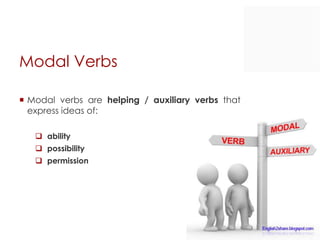
Modal VerbsModal verbs are helping / auxiliary verbs that express ideas of:ability
possibility
permission1- Modals for AbilityUse can, be able toand could to show that someone has (or doesn’t have) an ability to do something.The verbs after the modals of ability are always in the simple form.Alan can swim well.
Shaun was able to complete the assignment.
Paul could speak Chinese when he was a child.2- Modals for PossibilityThe verbs must, might / mayand could show possibility now and in the future. Use 'must‘ when you are 100% (or almost 100%) sure that something is the case.Use 'might‘ or 'may' for an opinion that has a good possibility of being true.Use 'could' to express a possibility which is one of many chances.
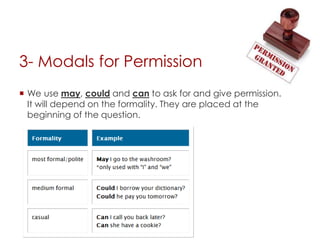
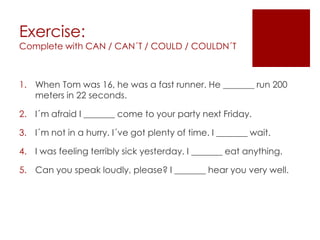
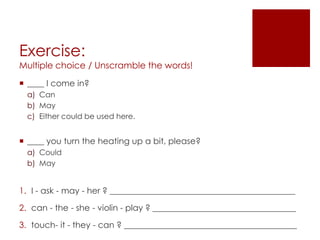
3- Modals for PermissionWe use may, could and can to ask for and give permission. It will depend on the formality. They are placed at the beginning of the question.

Modals

  • 1.
    Modals of :Ability/ Possibility / Permission
  • 2.
    Modal VerbsModal verbsare helping / auxiliary verbs that express ideas of:ability
  • 3.
  • 4.
    permission1- Modals forAbilityUse can, be able toand could to show that someone has (or doesn’t have) an ability to do something.The verbs after the modals of ability are always in the simple form.Alan can swim well.
  • 5.
    Shaun was ableto complete the assignment.
  • 6.
    Paul could speakChinese when he was a child.2- Modals for PossibilityThe verbs must, might / mayand could show possibility now and in the future. Use 'must‘ when you are 100% (or almost 100%) sure that something is the case.Use 'might‘ or 'may' for an opinion that has a good possibility of being true.Use 'could' to express a possibility which is one of many chances.
  • 7.
    3- Modals forPermissionWe use may, could and can to ask for and give permission. It will depend on the formality. They are placed at the beginning of the question.