Teacher: Kátia Rosa Azevedo2ªsérie matutino3ºbimestreSlide 1VERBOS MODAIS (MODAL VERBS)
The modal verbs are Can = poderCould = poder (passado)May = poderMight = poderMust = dever Should = dever Ought to = dever
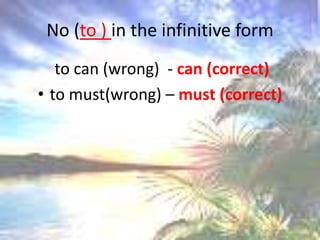
No (to ) in theinfinitiveform to can (wrong)  - can (correct)to must(wrong) – must (correct)
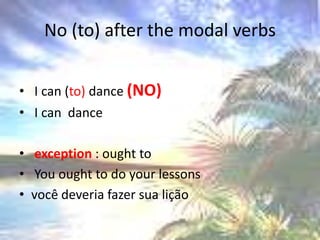
No (to) afterthe modal verbs I can (to) dance (NO) I can  danceexception : ought to Youought to do yourlessonsvocê deveria fazer sua lição
NegativeformCan = can´t, cannotCould = couldnot – couldn´tMay = maynotMight = mightnot, mightn´tMust = mustn´t, mustnotShould = shouldnot, shouldn´tOught to = oughtnot to, oughtn´t
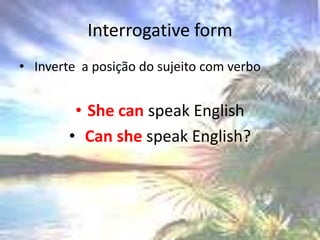
Interrogativeform Inverte  a posição do sujeito com verboShecanspeakEnglishCanshespeakEnglish?
No s in thethirdperson I canYoucanHe canShecanIt canWecanTheycan
 MODAL VERBSverbos auxiliares modais são verbos que só ocorrem na presença de outro verboI can ride a bikeYoumayberightShemuststayherYoushouldread
Não têm passado nem futuro (com exceção do can).Devido à alta freqüência com que ocorrem na língua, os verbos modais tornam-se imprescindíveis
Can - Couldability:I canspeakEnglish - Eu consigo falar inglês.Wecanseethelakefromourbedroom. (Nós podemos ver o lago da janela do nosso quarto). permission: Can I smokehere? - Posso fumar aqui?Can I leaveearly?Deduction (can´t)Steve can´t havegone to church. He ´s anatheist
Can - CouldPedidos e SolicitaçõesCanyouchangethis light bulb for me?DeductionBrad can´t besick. I spoke to himten minutes ago.
Could funciona como passado e como futuro do pretérito de can:passado: I couldn'tspeakEnglishbeforegoing to England. Youcouldn'tsmoke in thepresenceofyourparentsatthat time. Eu não sabia falar inglês antes de ir para a Inglaterra. Não se podia fumar na presença dos pais, naquela época.
Could- futuro do pretéritoYoucouldhavecalled me. Couldyou do me a favor? Pedir e dar permissão- Você poderia ter me ligado. Você poderia me fazer um favor?
MayPermission:May I smokehere? Posso fumar aqui?May I take some ofyourpainkiller?Possibility:It mayraintoday.  Pode ser que chova hoje I maybesufferingfromaneatingdisorder.
Mightremotepossibility:It mightrainthis weekend. É capaz de chover no próximo fim de semana.
ShouldAdvice: Youshouldstudy more. Youshouldn´t overeatVocê deveria estudar mais.
MustProhibition: Youmustn'tget out ofbed.  Você não pode sair da cama.Obligation/necessidadeYoumuststop smoking. Você tem que parar de fumar.
MUST: é usado para dizermos que alguma coisa que temos certeza é verdadeira.Inference, logicaldeduction.Linda mustgetverybored in herjob. She does thesamethingeveryday. (Linda deve ficar muito chateada em seu emprego. Ela faz a mesma coisa o dia todo). He musthavetheflu. He hasallthetypicalsymptoms.You’vebeentravellingallday. Youmustbetired. (Você viajou o dia todo. Você deve estar cansado).
HAVE TO:é usado para dizermos que realmente é necessário fazer alguma coisa. (ter que)Exemplos: Youcan’tturnrighthere. Youhave toturnleft. (Você não pode virar a direita aqui. Você tem de virar a esquerda). Myeyesightisn’tverygood. I have towearglasses for reading. (Minha visão não está muito boa. Eu tenho de usar óculos para ler). 
Must / have towe use mustandhave to toexplainthatsomething is necessaryI have to phone Jan at 9:00I mustfinishmyhomeworkbefore 8:00
SHOULD: é usado para dar conselhos ou opiniões.Exemplos: Youlooktired. Youshouldgo to bed. (Você parece cansado. Você deveria ir para a cama). Youshouldn’tbelieveeverythingyouread in thenewspapers. (Você não deveria acreditar em tudo que você lê nos jornais).
Mustn´t/ don´t have tohavedifferentmeaningsMustn´t describes na actionwhich is prohibitedyoumustn´t crosstheroadwhenthered light is showingDon´t have to describesanactionwhich is notnecessary –youhave a choiceyoudon´t have to do that
Fill in the blanks with MUST or MUSTN’T1. She is ill , so she____  see the doctor.2. It is raining. You______  take your umbrella.3. You _____ throw litter on the stairs.  4. This is a secret. You _______ tell anybody. 5. You ______ make noise in the library.   . 6. We  hurry or we will miss the bus. 7. You  _____eat fruit and vegetables.  8. The baby is sleeping. You _____ shout. 9. You ______ be friendly to everybody.  10. You______  walk on the grass.  
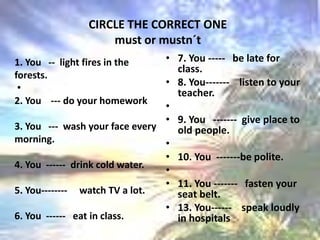
CIRCLE THE CORRECT ONE must or mustn´t 1. You   --  light fires in the forests. 2. You    --- do your homework 3. You   ---  wash your face every morning.  4. You  ------  drink cold water. 5. You--------     watch TV a lot. 6. You  ------   eat in class. 7. You -----   be late for class.8. You-------    listen to your teacher. 9. You   -------  give place to old people. 10. You  -------be polite. 11. You -------   fasten your seat belt.13. You------    speak loudly in hospitals
Use should / shouldn't / mustn't 1. We______  invite the Nortons to our party. They are nice people.2. Young children_______ stay at home on their own.3. Before you go to the dentist's, you_______  brush your teeth.4. You________  smoke in bed!5. You ___________ shut the windows because it is raining.6. You_______  forget her birthday again.7. You_______  go to the theatre when you are in Vienna. It's great.8. They______ tell her about John's accident. She could break down.9. You________  cross the street when the traffic lights are red.
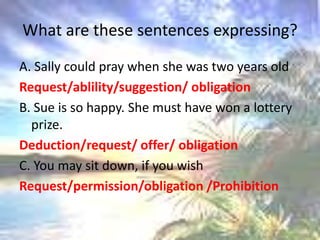
What are thesesentencesexpressing?A. Sally couldpraywhenshewastwoyearsoldRequest/ablility/suggestion/ obligationB. Sue is sohappy. Shemusthavewon a lotteryprize.Deduction/request/ offer/ obligationC. Youmaysitdown, ifyouwishRequest/permission/obligation /Prohibition
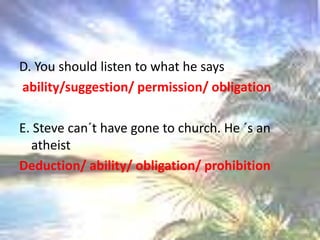
D. Youshouldlisten to what hesaysability/suggestion/ permission/ obligationE. Steve can´t havegone to church. He ´s anatheistDeduction/ ability/ obligation/ prohibition

Modal verbs

  • 1.
    Teacher: Kátia RosaAzevedo2ªsérie matutino3ºbimestreSlide 1VERBOS MODAIS (MODAL VERBS)
  • 2.
    The modal verbsare Can = poderCould = poder (passado)May = poderMight = poderMust = dever Should = dever Ought to = dever
  • 3.
    No (to )in theinfinitiveform to can (wrong) - can (correct)to must(wrong) – must (correct)
  • 4.
    No (to) afterthemodal verbs I can (to) dance (NO) I can danceexception : ought to Youought to do yourlessonsvocê deveria fazer sua lição
  • 5.
    NegativeformCan = can´t,cannotCould = couldnot – couldn´tMay = maynotMight = mightnot, mightn´tMust = mustn´t, mustnotShould = shouldnot, shouldn´tOught to = oughtnot to, oughtn´t
  • 6.
    Interrogativeform Inverte a posição do sujeito com verboShecanspeakEnglishCanshespeakEnglish?
  • 7.
    No s inthethirdperson I canYoucanHe canShecanIt canWecanTheycan
  • 8.
    MODAL VERBSverbosauxiliares modais são verbos que só ocorrem na presença de outro verboI can ride a bikeYoumayberightShemuststayherYoushouldread
  • 9.
    Não têm passadonem futuro (com exceção do can).Devido à alta freqüência com que ocorrem na língua, os verbos modais tornam-se imprescindíveis
  • 10.
    Can - Couldability:IcanspeakEnglish - Eu consigo falar inglês.Wecanseethelakefromourbedroom. (Nós podemos ver o lago da janela do nosso quarto). permission: Can I smokehere? - Posso fumar aqui?Can I leaveearly?Deduction (can´t)Steve can´t havegone to church. He ´s anatheist
  • 11.
    Can - CouldPedidose SolicitaçõesCanyouchangethis light bulb for me?DeductionBrad can´t besick. I spoke to himten minutes ago.
  • 12.
    Could funciona comopassado e como futuro do pretérito de can:passado: I couldn'tspeakEnglishbeforegoing to England. Youcouldn'tsmoke in thepresenceofyourparentsatthat time. Eu não sabia falar inglês antes de ir para a Inglaterra. Não se podia fumar na presença dos pais, naquela época.
  • 13.
    Could- futuro dopretéritoYoucouldhavecalled me. Couldyou do me a favor? Pedir e dar permissão- Você poderia ter me ligado. Você poderia me fazer um favor?
  • 14.
    MayPermission:May I smokehere?Posso fumar aqui?May I take some ofyourpainkiller?Possibility:It mayraintoday. Pode ser que chova hoje I maybesufferingfromaneatingdisorder.
  • 15.
    Mightremotepossibility:It mightrainthis weekend.É capaz de chover no próximo fim de semana.
  • 16.
    ShouldAdvice: Youshouldstudy more.Youshouldn´t overeatVocê deveria estudar mais.
  • 17.
    MustProhibition: Youmustn'tget outofbed. Você não pode sair da cama.Obligation/necessidadeYoumuststop smoking. Você tem que parar de fumar.
  • 18.
    MUST: é usadopara dizermos que alguma coisa que temos certeza é verdadeira.Inference, logicaldeduction.Linda mustgetverybored in herjob. She does thesamethingeveryday. (Linda deve ficar muito chateada em seu emprego. Ela faz a mesma coisa o dia todo). He musthavetheflu. He hasallthetypicalsymptoms.You’vebeentravellingallday. Youmustbetired. (Você viajou o dia todo. Você deve estar cansado).
  • 19.
    HAVE TO:é usadopara dizermos que realmente é necessário fazer alguma coisa. (ter que)Exemplos: Youcan’tturnrighthere. Youhave toturnleft. (Você não pode virar a direita aqui. Você tem de virar a esquerda). Myeyesightisn’tverygood. I have towearglasses for reading. (Minha visão não está muito boa. Eu tenho de usar óculos para ler). 
  • 20.
    Must / havetowe use mustandhave to toexplainthatsomething is necessaryI have to phone Jan at 9:00I mustfinishmyhomeworkbefore 8:00
  • 21.
    SHOULD: é usadopara dar conselhos ou opiniões.Exemplos: Youlooktired. Youshouldgo to bed. (Você parece cansado. Você deveria ir para a cama). Youshouldn’tbelieveeverythingyouread in thenewspapers. (Você não deveria acreditar em tudo que você lê nos jornais).
  • 22.
    Mustn´t/ don´t havetohavedifferentmeaningsMustn´t describes na actionwhich is prohibitedyoumustn´t crosstheroadwhenthered light is showingDon´t have to describesanactionwhich is notnecessary –youhave a choiceyoudon´t have to do that
  • 23.
    Fill in theblanks with MUST or MUSTN’T1. She is ill , so she____  see the doctor.2. It is raining. You______  take your umbrella.3. You _____ throw litter on the stairs.  4. This is a secret. You _______ tell anybody. 5. You ______ make noise in the library.   . 6. We  hurry or we will miss the bus. 7. You  _____eat fruit and vegetables.  8. The baby is sleeping. You _____ shout. 9. You ______ be friendly to everybody.  10. You______  walk on the grass.  
  • 24.
    CIRCLE THE CORRECTONE must or mustn´t 1. You   --  light fires in the forests. 2. You    --- do your homework 3. You   ---  wash your face every morning.  4. You  ------  drink cold water. 5. You--------     watch TV a lot. 6. You  ------   eat in class. 7. You -----   be late for class.8. You-------    listen to your teacher. 9. You   -------  give place to old people. 10. You  -------be polite. 11. You -------   fasten your seat belt.13. You------    speak loudly in hospitals
  • 25.
    Use should /shouldn't / mustn't 1. We______  invite the Nortons to our party. They are nice people.2. Young children_______ stay at home on their own.3. Before you go to the dentist's, you_______  brush your teeth.4. You________  smoke in bed!5. You ___________ shut the windows because it is raining.6. You_______  forget her birthday again.7. You_______  go to the theatre when you are in Vienna. It's great.8. They______ tell her about John's accident. She could break down.9. You________  cross the street when the traffic lights are red.
  • 26.
    What are thesesentencesexpressing?A.Sally couldpraywhenshewastwoyearsoldRequest/ablility/suggestion/ obligationB. Sue is sohappy. Shemusthavewon a lotteryprize.Deduction/request/ offer/ obligationC. Youmaysitdown, ifyouwishRequest/permission/obligation /Prohibition
  • 27.
    D. Youshouldlisten towhat hesaysability/suggestion/ permission/ obligationE. Steve can´t havegone to church. He ´s anatheistDeduction/ ability/ obligation/ prohibition