-Can: to express ability, possibility and
 permission and to make requests.
-Example: I can take pictures with my new
 mobile phone.

-Could: to express ability in the
 past, possibility and to make requests.
-Example: Could you please answer the
 phone?

-Might: to show possibility in the future.
-Example: I might be late for school.
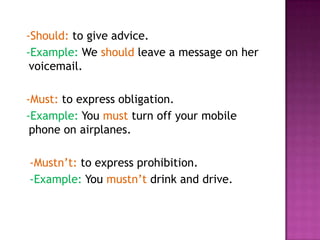
-Should: to give advice.
-Example: We should leave a message on her
 voicemail.

-Must: to express obligation.
-Example: You must turn off your mobile
 phone on airplanes.

-Mustn’t: to express prohibition.
-Example: You mustn’t drink and drive.
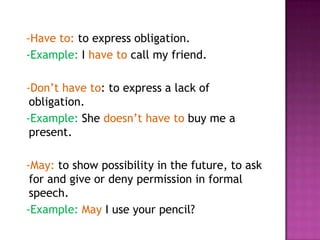
-Have to: to express obligation.
-Example: I have to call my friend.

-Don’t have to: to express a lack of
 obligation.
-Example: She doesn’t have to buy me a
 present.

-May: to show possibility in the future, to ask
 for and give or deny permission in formal
 speech.
-Example: May I use your pencil?
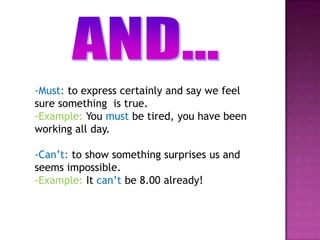
-Must: to express certainly and say we feel
sure something is true.
-Example: You must be tired, you have been
working all day.

-Can’t: to show something surprises us and
seems impossible.
-Example: It can’t be 8.00 already!
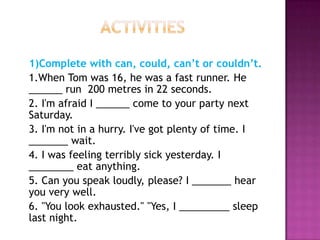
1)Complete with can, could, can’t or couldn’t.
1.When Tom was 16, he was a fast runner. He
______ run 200 metres in 22 seconds.
2. I'm afraid I ______ come to your party next
Saturday.
3. I'm not in a hurry. I've got plenty of time. I
_______ wait.
4. I was feeling terribly sick yesterday. I
________ eat anything.
5. Can you speak loudly, please? I _______ hear
you very well.
6. "You look exhausted." "Yes, I _________ sleep
last night.
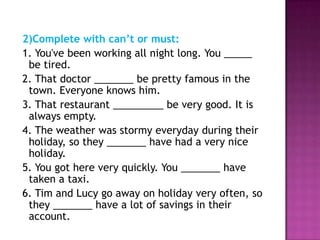
2)Complete with can’t or must:
1. You've been working all night long. You _____
 be tired.
2. That doctor _______ be pretty famous in the
 town. Everyone knows him.
3. That restaurant _________ be very good. It is
 always empty.
4. The weather was stormy everyday during their
 holiday, so they _______ have had a very nice
 holiday.
5. You got here very quickly. You _______ have
 taken a taxi.
6. Tim and Lucy go away on holiday very often, so
 they _______ have a lot of savings in their
 account.
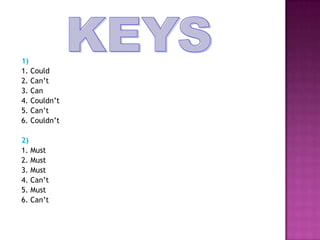
1)
1. Could
2. Can’t
3. Can
4. Couldn’t
5. Can’t
6. Couldn’t

2)
1. Must
2. Must
3. Must
4. Can’t
5. Must
6. Can’t

Unit 5, modals

  • 2.
    -Can: to expressability, possibility and permission and to make requests. -Example: I can take pictures with my new mobile phone. -Could: to express ability in the past, possibility and to make requests. -Example: Could you please answer the phone? -Might: to show possibility in the future. -Example: I might be late for school.
  • 3.
    -Should: to giveadvice. -Example: We should leave a message on her voicemail. -Must: to express obligation. -Example: You must turn off your mobile phone on airplanes. -Mustn’t: to express prohibition. -Example: You mustn’t drink and drive.
  • 4.
    -Have to: toexpress obligation. -Example: I have to call my friend. -Don’t have to: to express a lack of obligation. -Example: She doesn’t have to buy me a present. -May: to show possibility in the future, to ask for and give or deny permission in formal speech. -Example: May I use your pencil?
  • 5.
    -Must: to expresscertainly and say we feel sure something is true. -Example: You must be tired, you have been working all day. -Can’t: to show something surprises us and seems impossible. -Example: It can’t be 8.00 already!
  • 6.
    1)Complete with can,could, can’t or couldn’t. 1.When Tom was 16, he was a fast runner. He ______ run 200 metres in 22 seconds. 2. I'm afraid I ______ come to your party next Saturday. 3. I'm not in a hurry. I've got plenty of time. I _______ wait. 4. I was feeling terribly sick yesterday. I ________ eat anything. 5. Can you speak loudly, please? I _______ hear you very well. 6. "You look exhausted." "Yes, I _________ sleep last night.
  • 7.
    2)Complete with can’tor must: 1. You've been working all night long. You _____ be tired. 2. That doctor _______ be pretty famous in the town. Everyone knows him. 3. That restaurant _________ be very good. It is always empty. 4. The weather was stormy everyday during their holiday, so they _______ have had a very nice holiday. 5. You got here very quickly. You _______ have taken a taxi. 6. Tim and Lucy go away on holiday very often, so they _______ have a lot of savings in their account.
  • 8.
    1) 1. Could 2. Can’t 3.Can 4. Couldn’t 5. Can’t 6. Couldn’t 2) 1. Must 2. Must 3. Must 4. Can’t 5. Must 6. Can’t