D •
                                                                                                                                                                               TE E E
                                                                                                                                                                             SI AD L
                                                                                                                                                                           EB LO B
                                                                                                                                                                          W N IA
                                                                                                                                                                        M W P
                                                                                                                                                                       O DO O


This page has been downloaded from www.onestopclil.com. Written by Marcelino Palacios Álvarez and Paco Santos Juanes © Copyright Macmillan Publishers Ltd 2006.
                                                                                                                                                                     FR BE C
                                                                                                                                                                      N TO
                                                                                                                                                                    CA O
                                                                                                                                                                     H
                                                                                                                                                                  •P
TEACHER’S NOTES
                                                               Making the cut-out
     WILD ANIMALS
                                                               •   Hand out the worksheet and ask the children
     Art and crafts                                                to colour the wild animals following these
                                                                   instructions (which you can write on the
    Aim                                                            board):
    • To introduce or revise the parts of the body                      - Tigers are orange.
      of wild animals.                                                  - Crocodiles are green.
    Materials                                                           - Elephants are grey.
    • Coloured pencils.                                                 - Whales are blue.
    • Scissors.                                                •   Ask the children to colour the animal labels
                                                                   using the same colours as for the animals.
    • Glue.
                                                                   Then they cut out the four animal labels.
    • Worksheet (enlargement to A3
                                                               •   The children match the labels with the
      recommended).
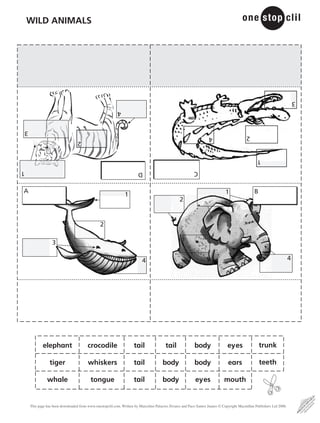
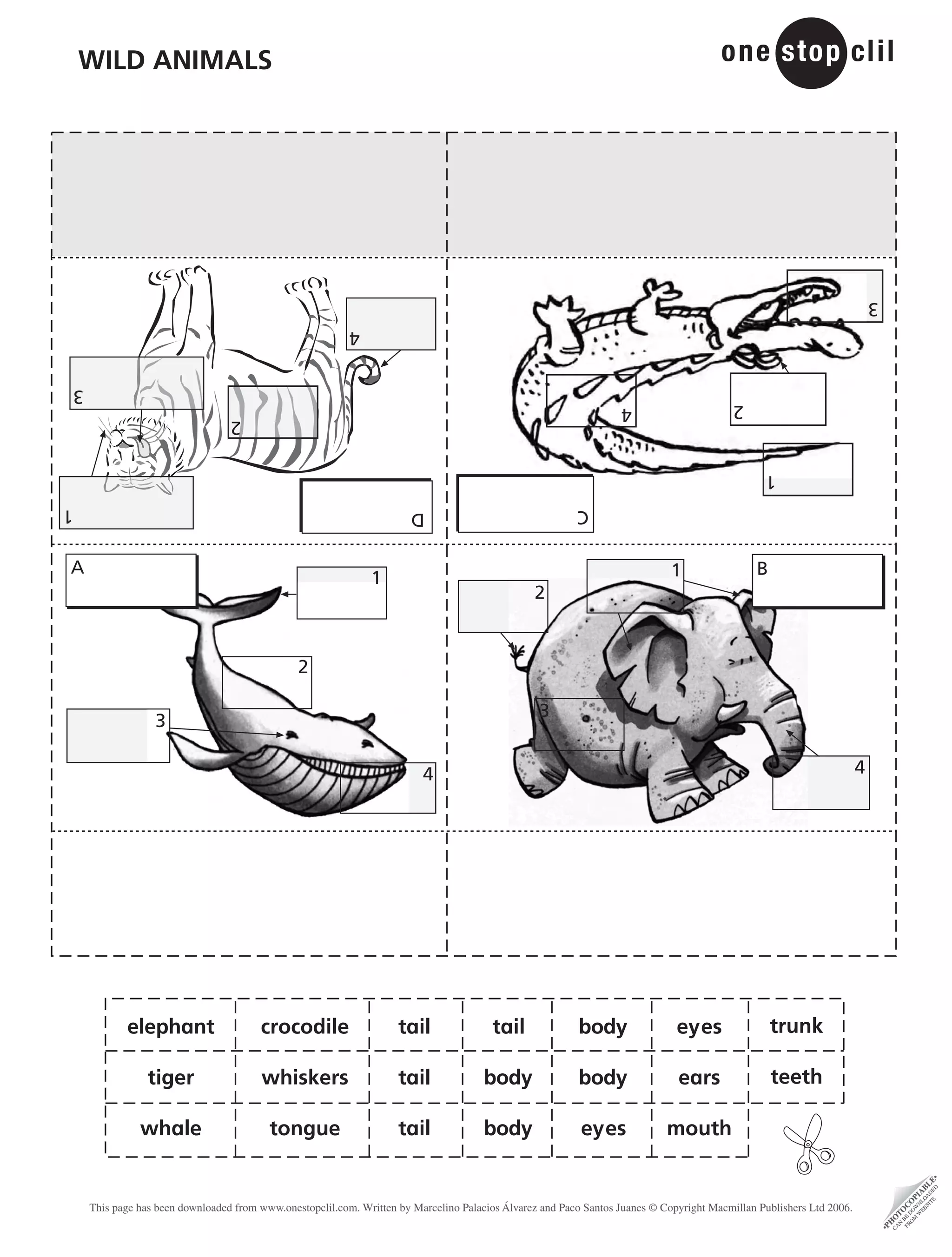
                                                                   animals and glue them on rectangles A, B, C
    Duration
                                                                   and D.
    30 minutes.
                                                               •   Review the parts of the body, animal by
    Language focus
                                                                   animal: Look at the whale. What part of the
    • Wild animals: whale, tiger elephant, crocodile.
                                ,
                                                                   body is number 1? And number 3? etc.
    • Parts of the body: tongue, tail, body,
                                                               •   Ask the children to colour the labels using the
      whiskers, mouth, eyes, ears, teeth, trunk.
                                                                   same colour as the animal they belong to (the
    Cross-curricular content
                                                                   tiger is orange, so all the parts of the body for
    • Art and crafts.
                                                                   the tiger will be orange, etc).
    • Following instructions to assemble the                   •   The children to cut out the labels and glue
      cut-out.                                                     them on the appropriate rectangles for each
    • Wild animals.                                                animal.
                                                               •   Ask the children to cut out the animals along
Preparation                                                        the dashed lines.
•    Mime the wild animals and encourage                       •   The children fold each big rectangle along the
     children to guess which animals they are:                     dotted lines and then put glue on the shaded
     Whale: hold both arms together and pretend to                 area of each rectangle and stick them together
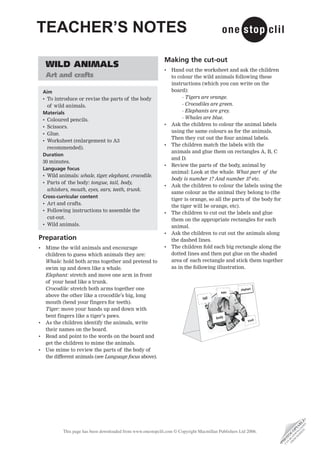
     swim up and down like a whale.                                as in the following illustration.
     Elephant: stretch and move one arm in front
     of your head like a trunk.
     Crocodile: stretch both arms together one
     above the other like a crocodile’s big, long
     mouth (bend your fingers for teeth).
     Tiger: move your hands up and down with
     bent fingers like a tiger’s paws.
•    As the children identify the animals, write
     their names on the board.
•    Read and point to the words on the board and
     get the children to mime the animals.
•    Use mime to review the parts of the body of
     the different animals (see Language focus above).
                                                                                                                                  D •
                                                                                                                              TE E E
                                                                                                                            SI AD L
                                                                                                                          EB LO B
                                                                                                                         W N IA
                                                                                                                       M W P


             This page has been downloaded from www.onestopclil.com © Copyright Macmillan Publishers Ltd 2006.
                                                                                                                      O DO O
                                                                                                                    FR BE C
                                                                                                                     N TO
                                                                                                                   CA O
                                                                                                                  H
                                                                                                                  •P

500582

  • 1.
    D • TE E E SI AD L EB LO B W N IA M W P O DO O This page has been downloaded from www.onestopclil.com. Written by Marcelino Palacios Álvarez and Paco Santos Juanes © Copyright Macmillan Publishers Ltd 2006. FR BE C N TO CA O H •P
  • 2.
    TEACHER’S NOTES Making the cut-out WILD ANIMALS • Hand out the worksheet and ask the children Art and crafts to colour the wild animals following these instructions (which you can write on the Aim board): • To introduce or revise the parts of the body - Tigers are orange. of wild animals. - Crocodiles are green. Materials - Elephants are grey. • Coloured pencils. - Whales are blue. • Scissors. • Ask the children to colour the animal labels using the same colours as for the animals. • Glue. Then they cut out the four animal labels. • Worksheet (enlargement to A3 • The children match the labels with the recommended). animals and glue them on rectangles A, B, C Duration and D. 30 minutes. • Review the parts of the body, animal by Language focus animal: Look at the whale. What part of the • Wild animals: whale, tiger elephant, crocodile. , body is number 1? And number 3? etc. • Parts of the body: tongue, tail, body, • Ask the children to colour the labels using the whiskers, mouth, eyes, ears, teeth, trunk. same colour as the animal they belong to (the Cross-curricular content tiger is orange, so all the parts of the body for • Art and crafts. the tiger will be orange, etc). • Following instructions to assemble the • The children to cut out the labels and glue cut-out. them on the appropriate rectangles for each • Wild animals. animal. • Ask the children to cut out the animals along Preparation the dashed lines. • Mime the wild animals and encourage • The children fold each big rectangle along the children to guess which animals they are: dotted lines and then put glue on the shaded Whale: hold both arms together and pretend to area of each rectangle and stick them together swim up and down like a whale. as in the following illustration. Elephant: stretch and move one arm in front of your head like a trunk. Crocodile: stretch both arms together one above the other like a crocodile’s big, long mouth (bend your fingers for teeth). Tiger: move your hands up and down with bent fingers like a tiger’s paws. • As the children identify the animals, write their names on the board. • Read and point to the words on the board and get the children to mime the animals. • Use mime to review the parts of the body of the different animals (see Language focus above). D • TE E E SI AD L EB LO B W N IA M W P This page has been downloaded from www.onestopclil.com © Copyright Macmillan Publishers Ltd 2006. O DO O FR BE C N TO CA O H •P