Model Transformation from BPMN to DEVS
in the MDD4MS Framework
Deniz Cetinkaya, Alexander Verbraeck and Mamadou D. Seck
27 March 2012,Orlando, FL
Outline
•MDD4MS Framework
  • M&S Life-cycle
  • Metamodeling: Models and Metamodels
  • Model Transformations
  • Tool Architecture for MDD4MS
•BPMN to DEVS Transformation
  • BPMN Metamodel
  • DEVS Metamodel
  • Transformation Rules from BPMN to DEVS
•Conclusion

        Model Transformation from BPMN to DEVS in the MDD4MS Framework   2/25
1.
 MDD4MS Framework


     Model Transformation from BPMN to DEVS in the MDD4MS Framework   3/25
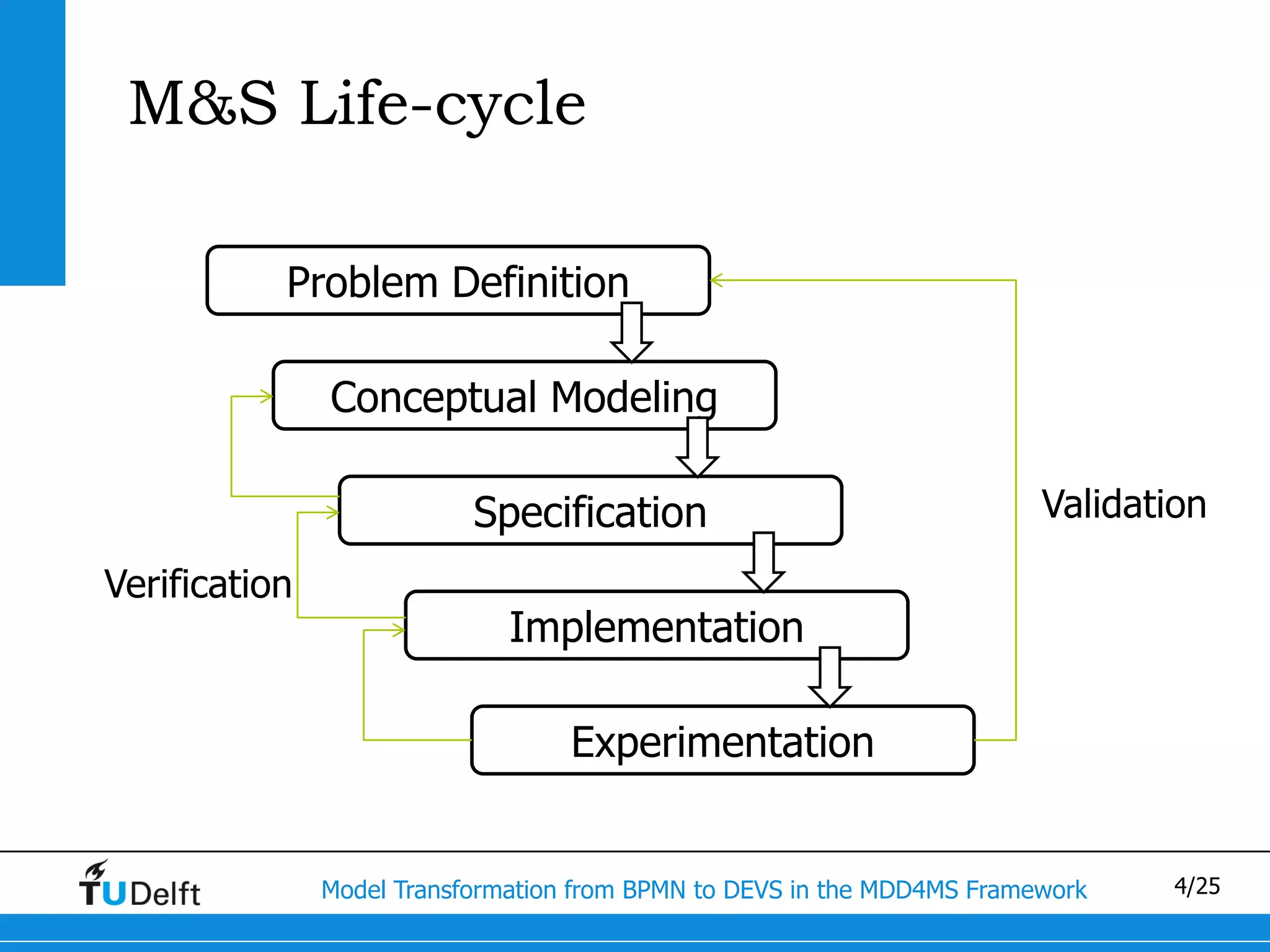
M&S Life-cycle

           Problem Definition

               Conceptual Modeling

                           Specification                                 Validation

Verification
                              Implementation

                                   Experimentation


               Model Transformation from BPMN to DEVS in the MDD4MS Framework    4/25
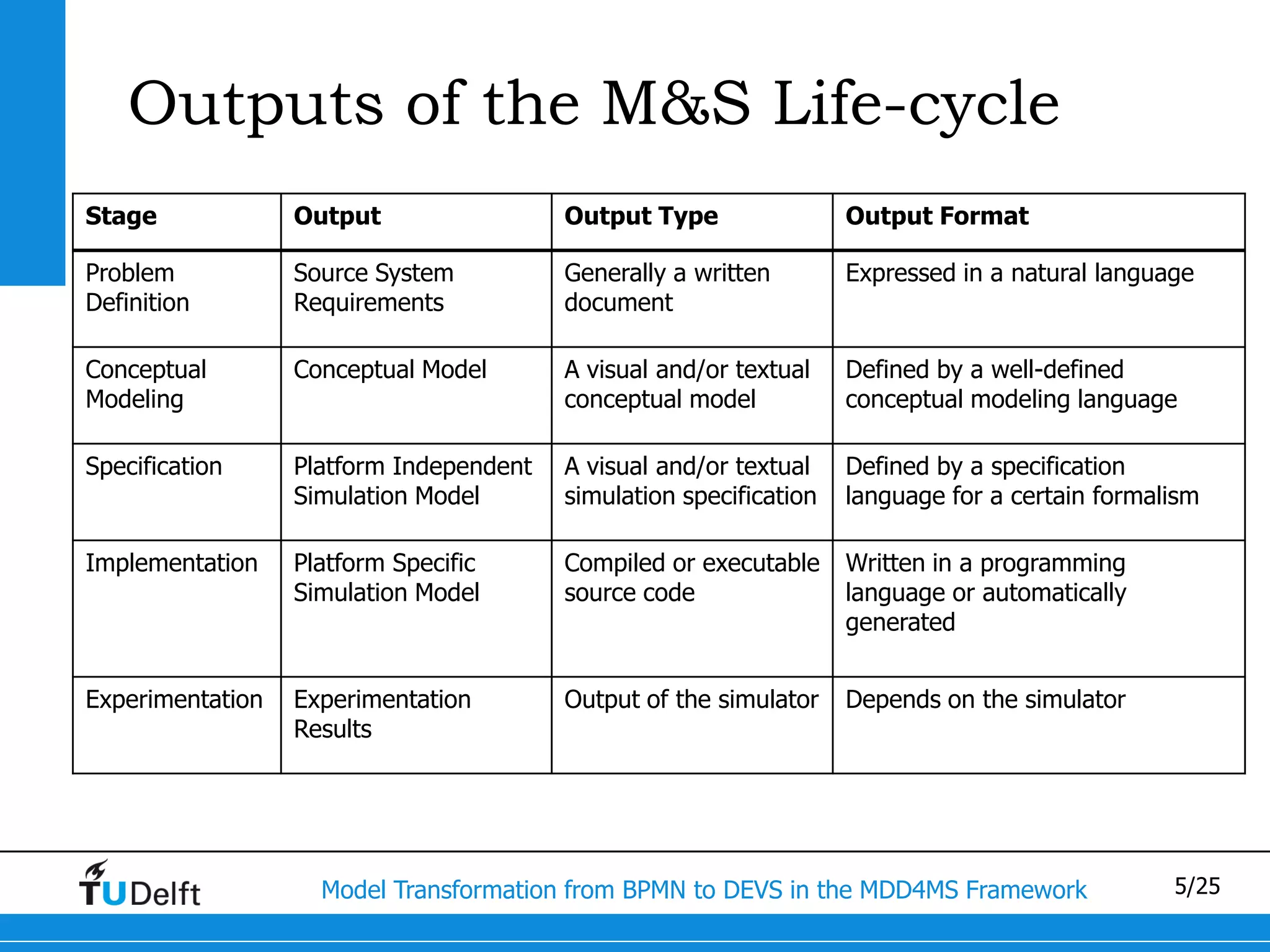
Outputs of the M&S Life-cycle
Stage             Output                 Output Type                Output Format

Problem           Source System          Generally a written        Expressed in a natural language
Definition        Requirements           document

Conceptual        Conceptual Model       A visual and/or textual    Defined by a well-defined
Modeling                                 conceptual model           conceptual modeling language

Specification     Platform Independent   A visual and/or textual    Defined by a specification
                  Simulation Model       simulation specification   language for a certain formalism

Implementation    Platform Specific      Compiled or executable     Written in a programming
                  Simulation Model       source code                language or automatically
                                                                    generated


Experimentation   Experimentation        Output of the simulator    Depends on the simulator
                  Results


                    Model Transformation from BPMN to DEVS in the MDD4MS Framework               5/25
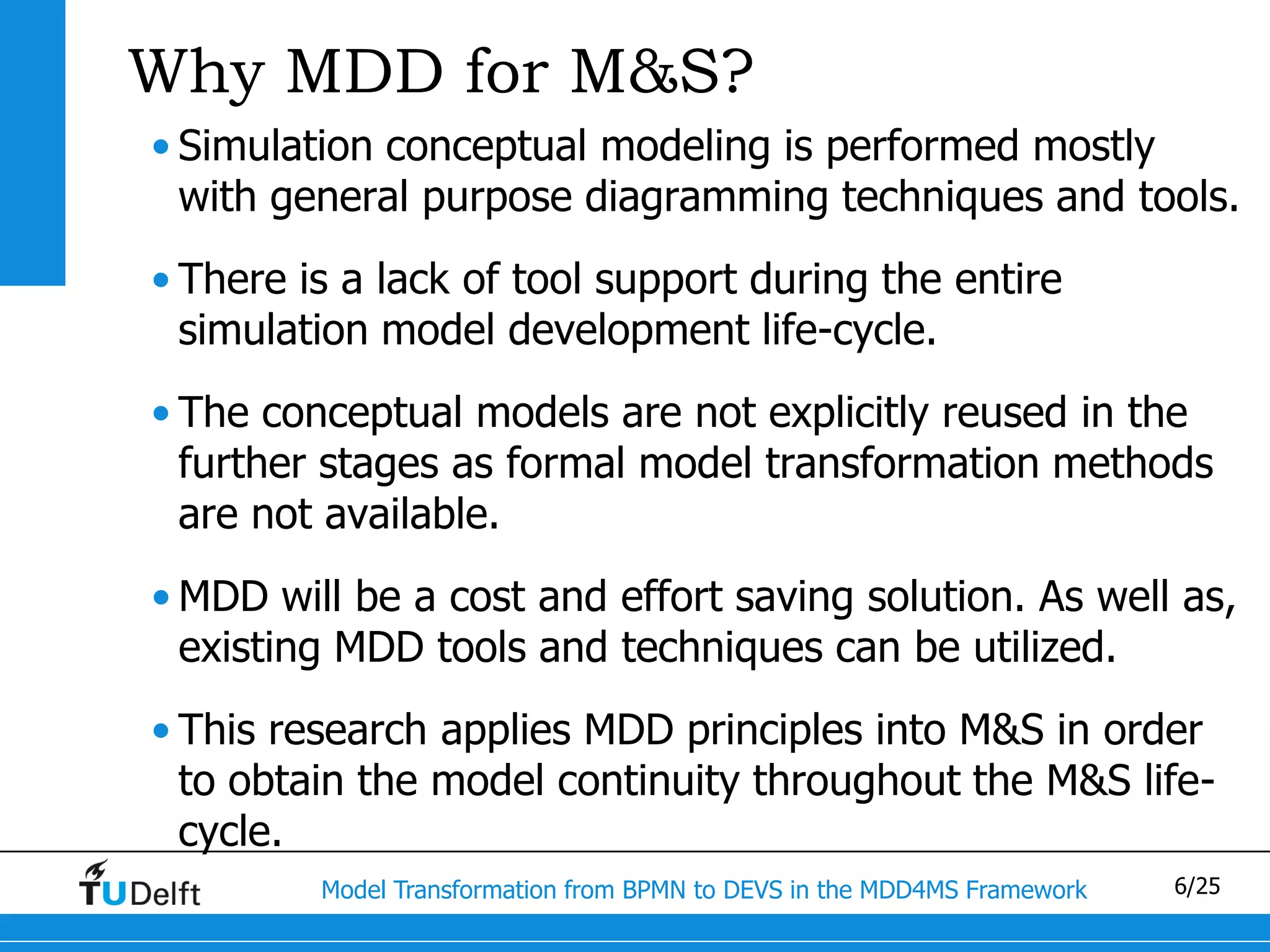
Why MDD for M&S?
• Simulation conceptual modeling is performed mostly
  with general purpose diagramming techniques and tools.
• There is a lack of tool support during the entire
  simulation model development life-cycle.
• The conceptual models are not explicitly reused in the
  further stages as formal model transformation methods
  are not available.
• MDD will be a cost and effort saving solution. As well as,
  existing MDD tools and techniques can be utilized.
• This research applies MDD principles into M&S in order
  to obtain the model continuity throughout the M&S life-
  cycle.
         Model Transformation from BPMN to DEVS in the MDD4MS Framework   6/25
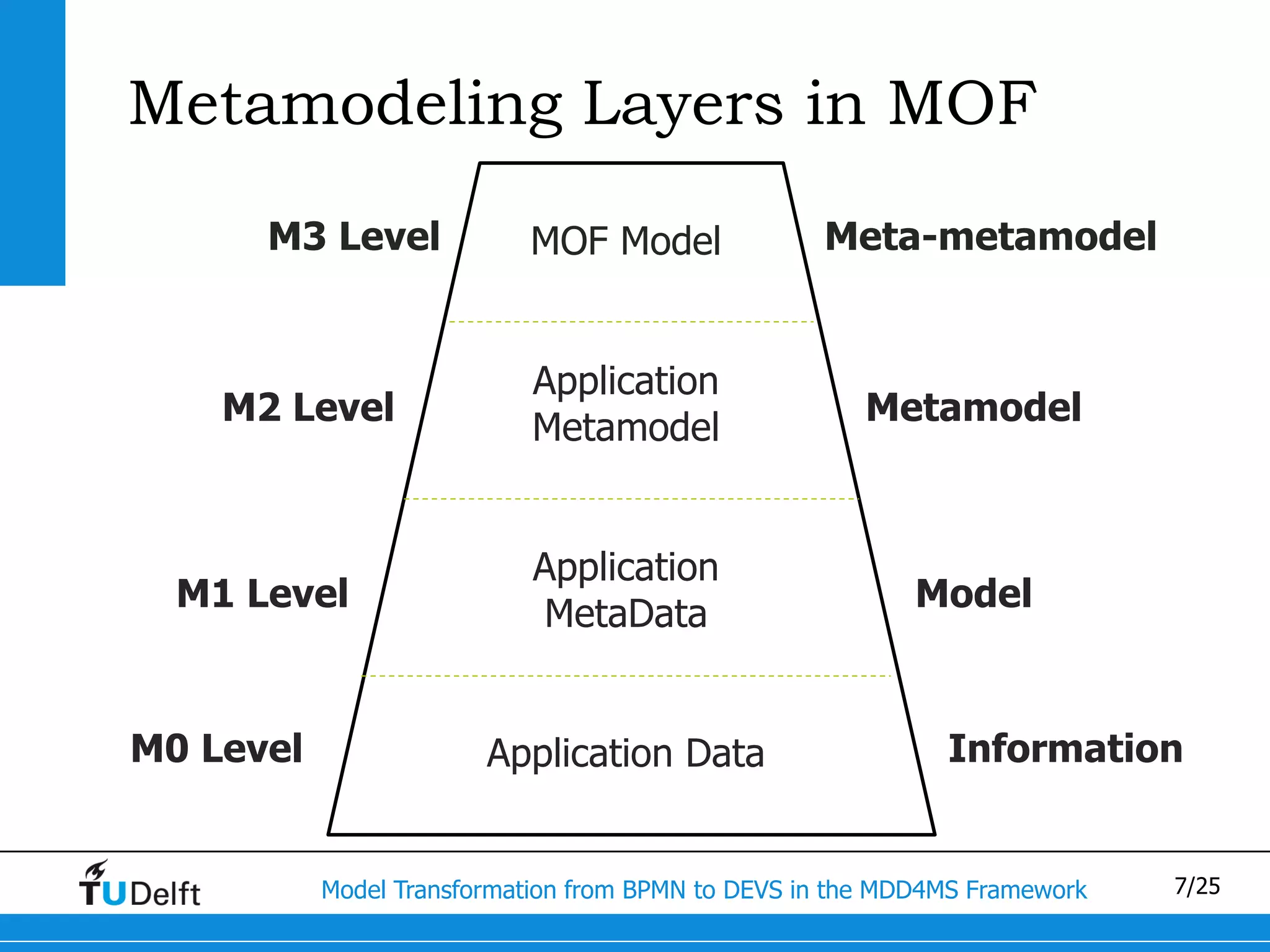
Metamodeling Layers in MOF
      M3 Level             MOF Model               Meta-metamodel


                            Application
    M2 Level                                           Metamodel
                            Metamodel


                            Application
  M1 Level                                                 Model
                             MetaData


M0 Level                Application Data                     Information


           Model Transformation from BPMN to DEVS in the MDD4MS Framework   7/25
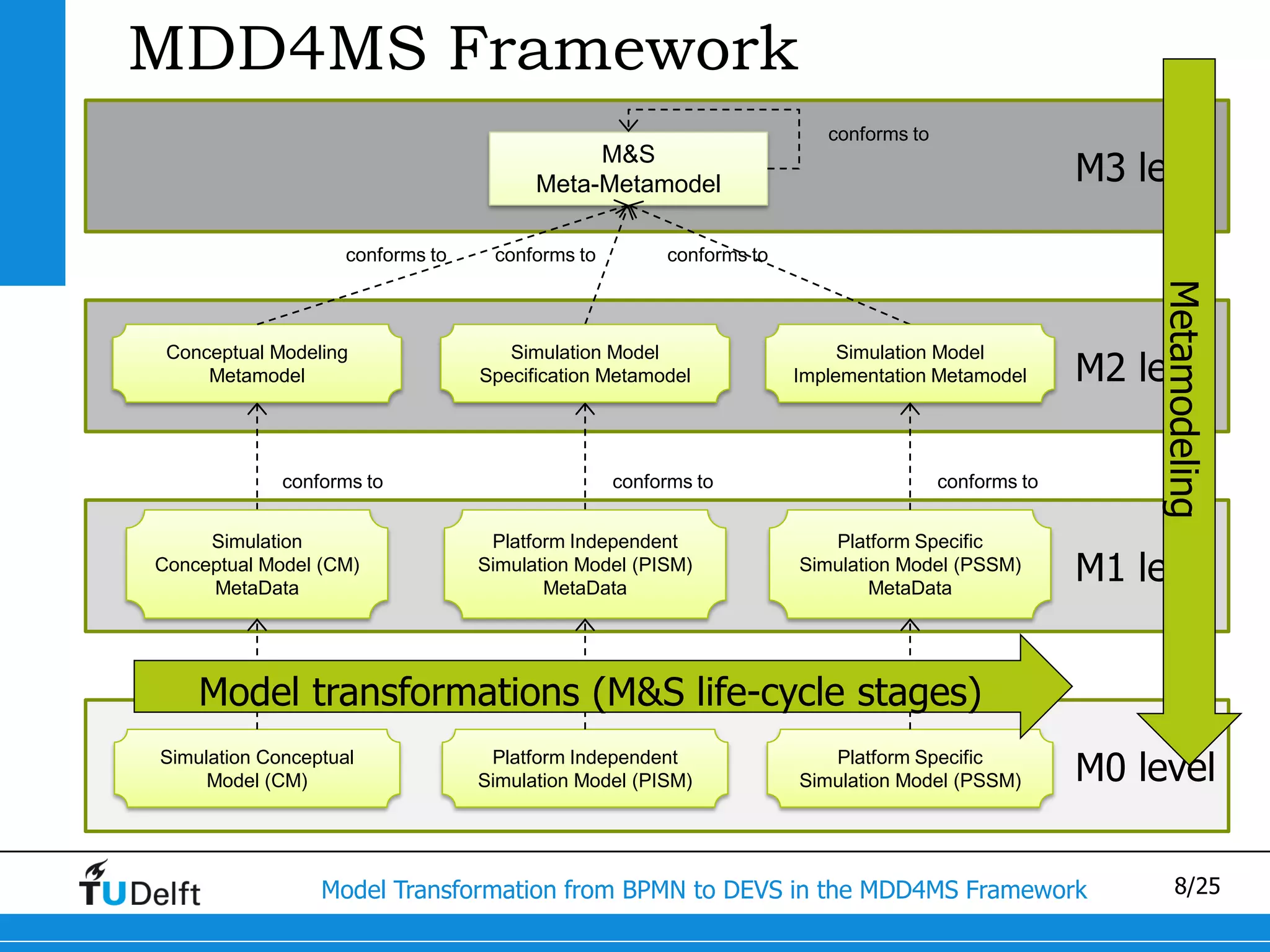
MDD4MS Framework
                                                                        conforms to
                                             M&S
                                        Meta-Metamodel                                              M3 level

                    conforms to    conforms to         conforms to


                                                                                                        Metamodeling
                                                                                                    M2 level
 Conceptual Modeling                 Simulation Model                     Simulation Model
     Metamodel                    Specification Metamodel            Implementation Metamodel


             conforms to                         conforms to                          conforms to


     Simulation                    Platform Independent                 Platform Specific
Conceptual Model (CM)
     MetaData
                                  Simulation Model (PISM)
                                         MetaData
                                                                     Simulation Model (PSSM)
                                                                             MetaData
                                                                                                    M1 level


    Model transformations (M&S life-cycle stages)
             instance of                         instance of                          instance of


Simulation Conceptual
     Model (CM)
                                   Platform Independent
                                  Simulation Model (PISM)
                                                                        Platform Specific
                                                                     Simulation Model (PSSM)        M0 level


                 Model Transformation from BPMN to DEVS in the MDD4MS Framework                            8/25
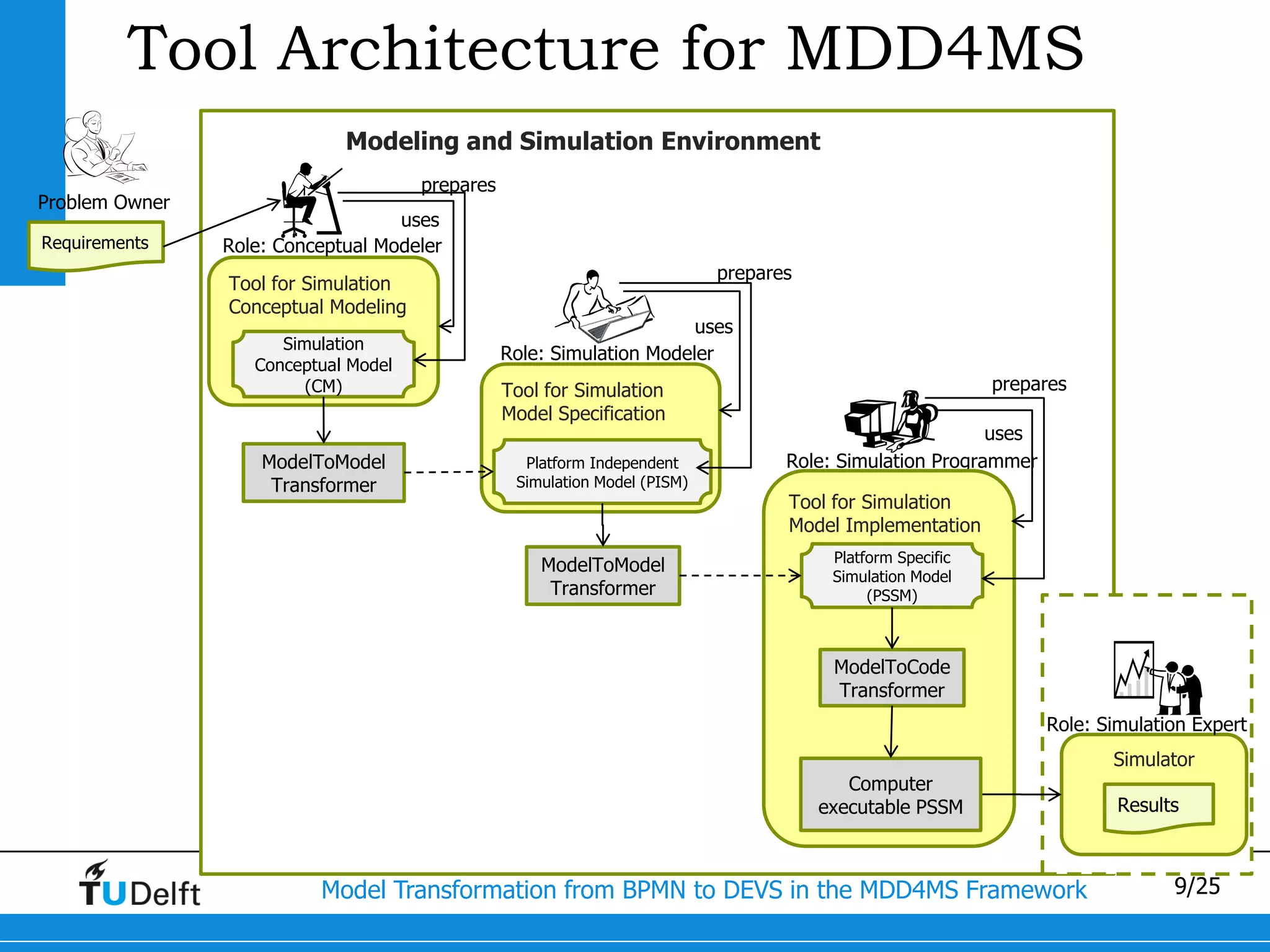
Tool Architecture for MDD4MS
                             Modeling and Simulation Environment
                                      prepares
Problem Owner
                                   uses
Requirements    Role: Conceptual Modeler
                                                                            prepares
                Tool for Simulation
                Conceptual Modeling
                                                                       uses
                      Simulation
                                                 Role: Simulation Modeler
                   Conceptual Model
                         (CM)                    Tool for Simulation                                        prepares
                                                 Model Specification
                                                                                                          uses
                    ModelToModel                   Platform Independent            Role: Simulation Programmer
                     Transformer                  Simulation Model (PISM)
                                                                                   Tool for Simulation
                                                                                   Model Implementation
                                                                                        Platform Specific
                                                     ModelToModel
                                                                                        Simulation Model
                                                      Transformer                            (PSSM)


                                                                                        ModelToCode
                                                                                        Transformer
                                                                                                                 Role: Simulation Expert
                                                                                                                        Simulator
                                                                                          Computer
                                                                                       executable PSSM                   Results


                          Model Transformation from BPMN to DEVS in the MDD4MS Framework                                       9/25
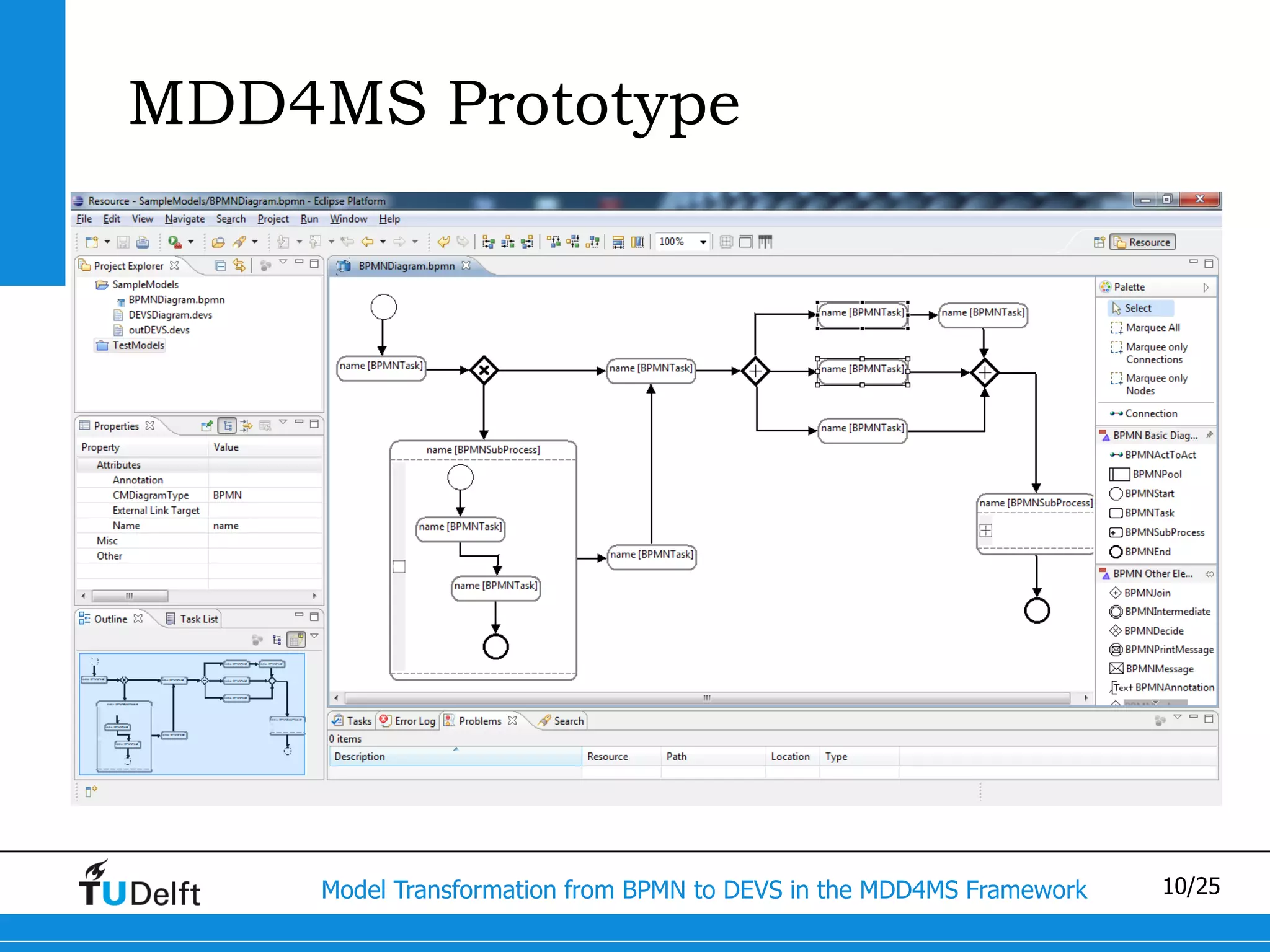
MDD4MS Prototype


     Model Transformation from BPMN to DEVS in the MDD4MS Framework   10/25
2.
 BPMN to DEVS Transformation


     Model Transformation from BPMN to DEVS in the MDD4MS Framework   11/25
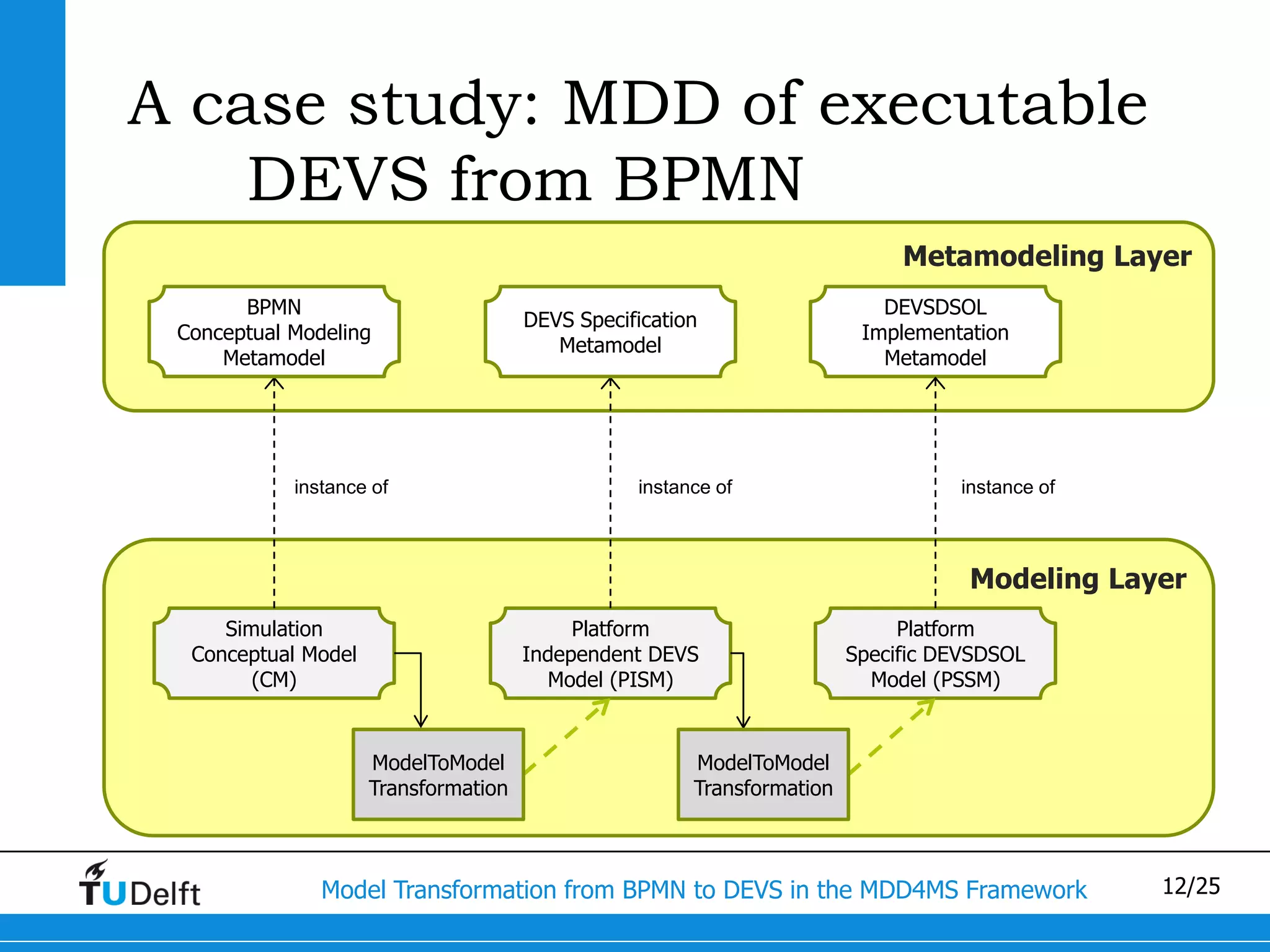
A case study: MDD of executable
    DEVS from BPMN
                                                                             Metamodeling Layer
       BPMN                                                                DEVSDSOL
                                      DEVS Specification
 Conceptual Modeling                                                     Implementation
                                         Metamodel
     Metamodel                                                             Metamodel


            instance of                          instance of                      instance of


                                                                                   Modeling Layer
     Simulation                            Platform                          Platform
  Conceptual Model                    Independent DEVS                  Specific DEVSDSOL
        (CM)                            Model (PISM)                      Model (PSSM)


                     ModelToModel                      ModelToModel
                     Transformation                    Transformation


               Model Transformation from BPMN to DEVS in the MDD4MS Framework                   12/25
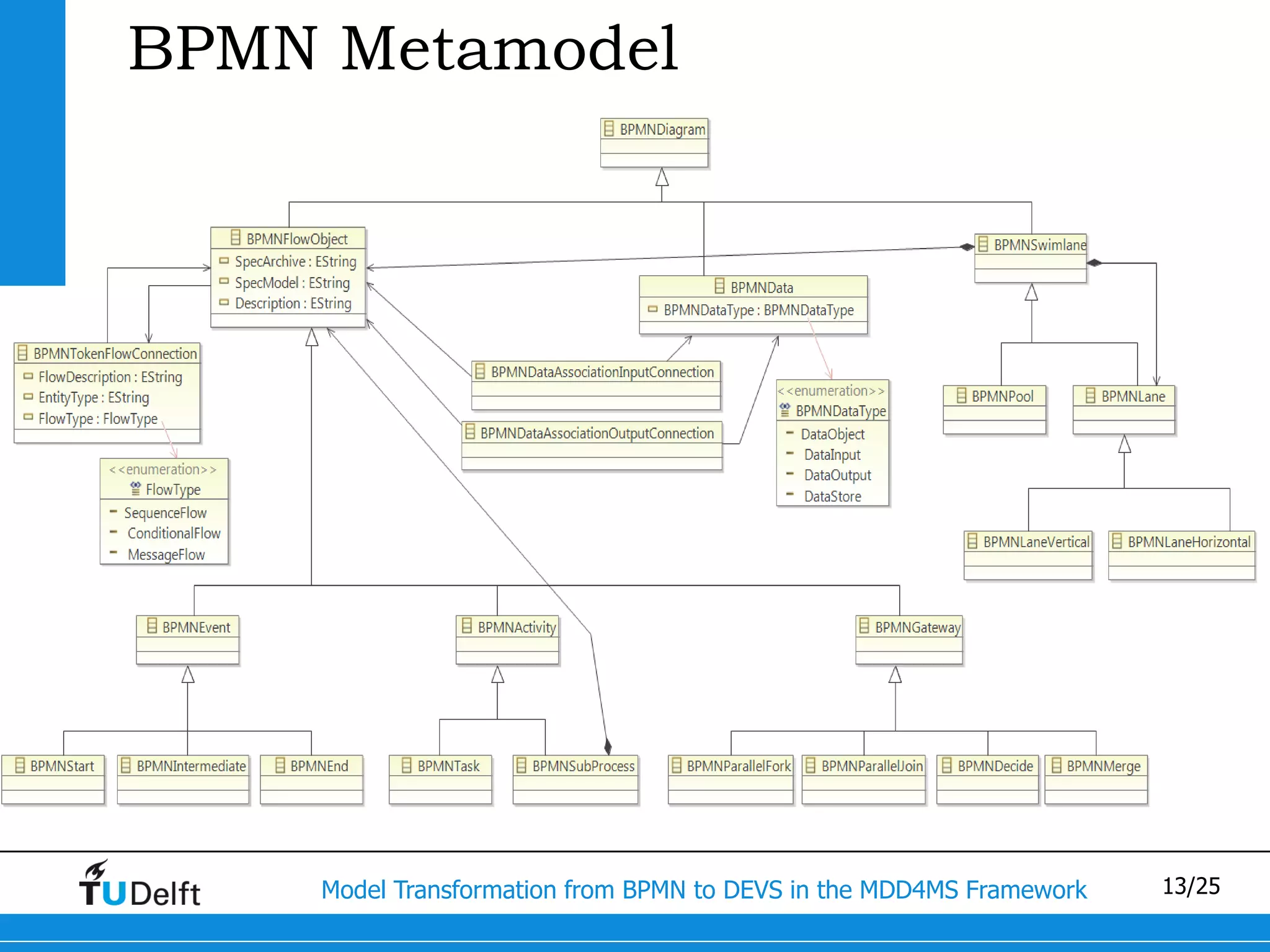
BPMN Metamodel


    Model Transformation from BPMN to DEVS in the MDD4MS Framework   13/25
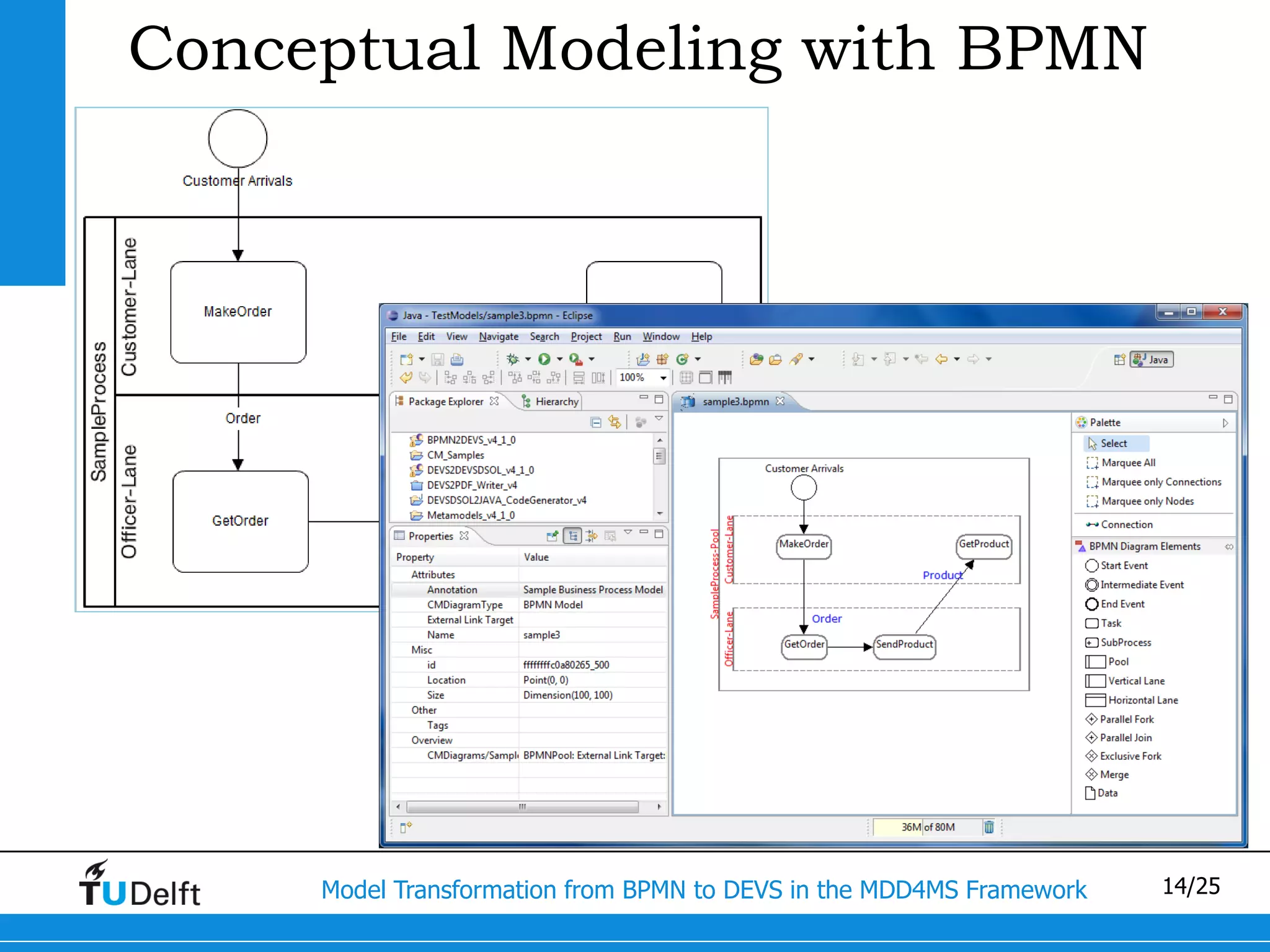
Conceptual Modeling with BPMN


     Model Transformation from BPMN to DEVS in the MDD4MS Framework   14/25
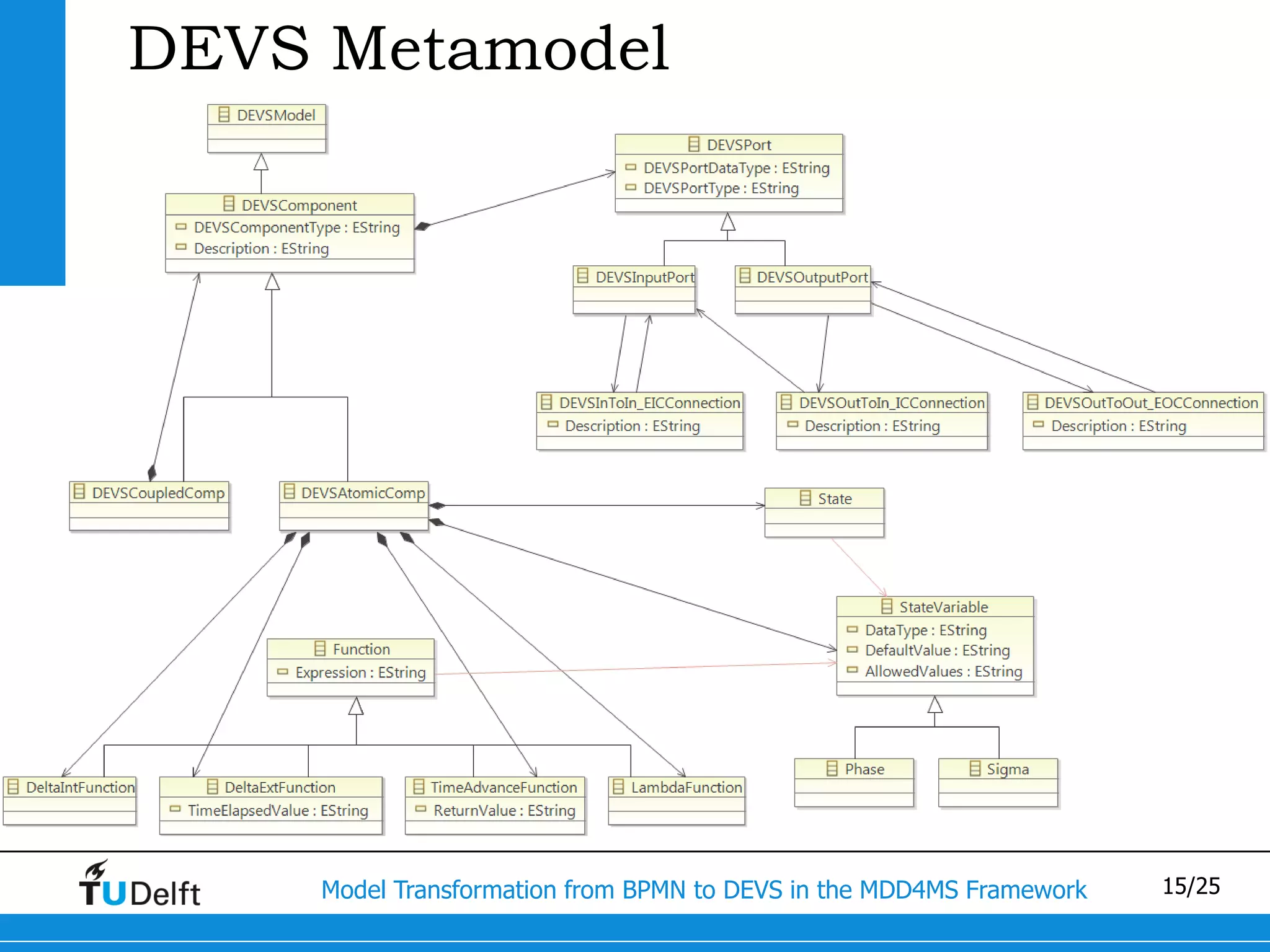
DEVS Metamodel


     Model Transformation from BPMN to DEVS in the MDD4MS Framework   15/25
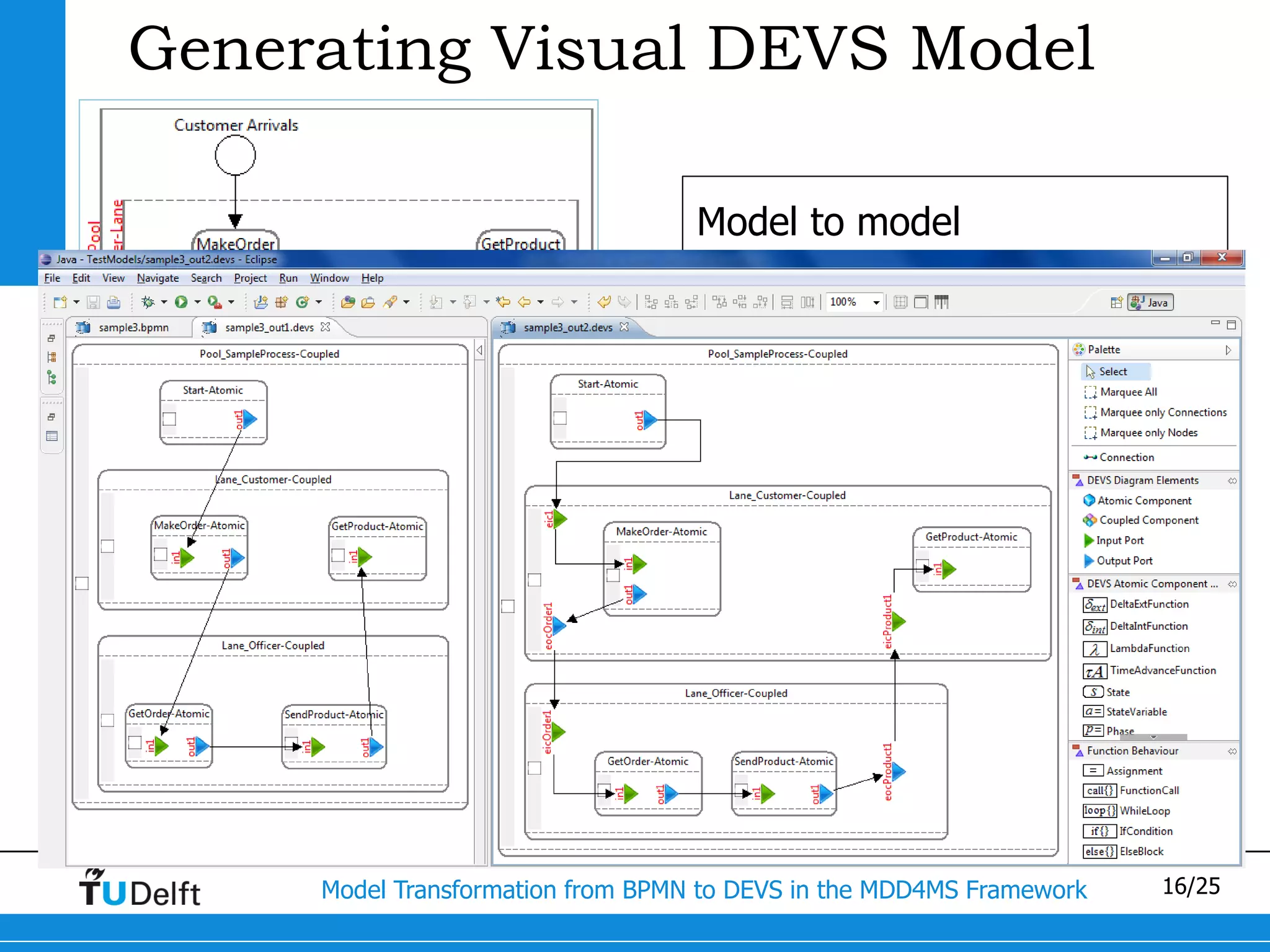
Generating Visual DEVS Model

                                   Model to model
                                   transformation with ATL


     Model Transformation from BPMN to DEVS in the MDD4MS Framework   16/25
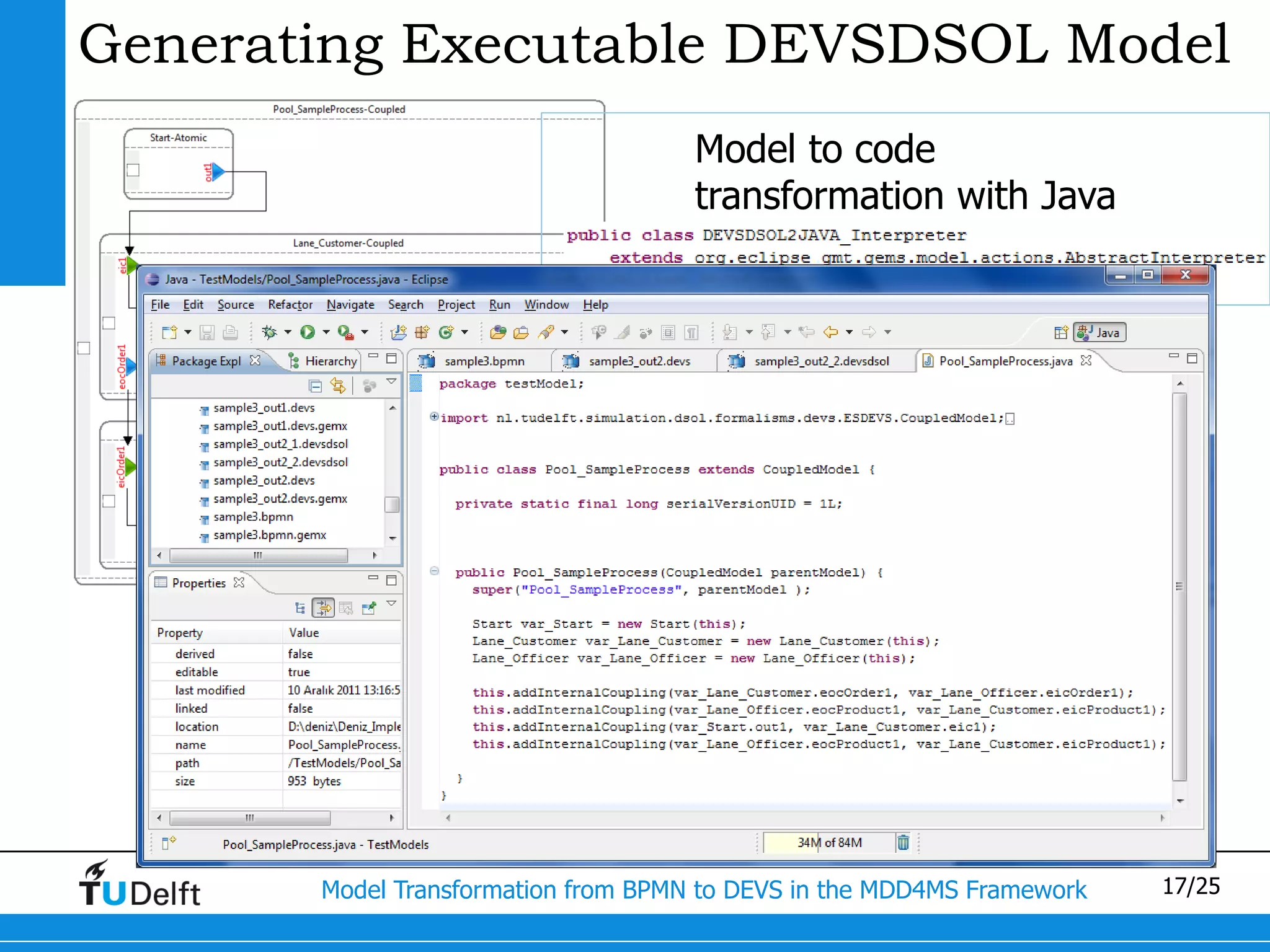
Generating Executable DEVSDSOL Model
                                     Model to code
                                     transformation with Java


       Model Transformation from BPMN to DEVS in the MDD4MS Framework   17/25
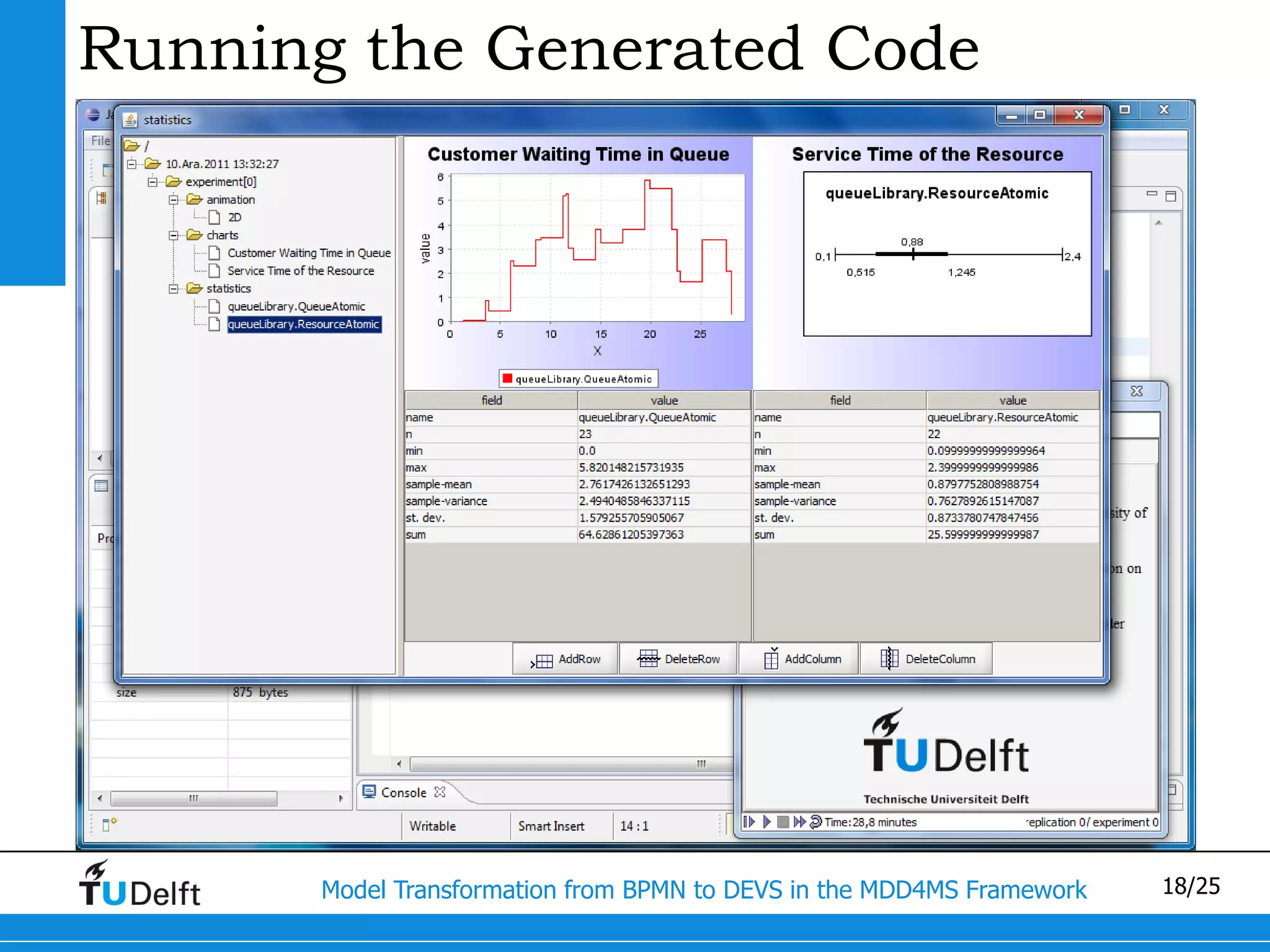
Running the Generated Code


       Model Transformation from BPMN to DEVS in the MDD4MS Framework   18/25
Transformation Rules from
   BPMN to DEVS
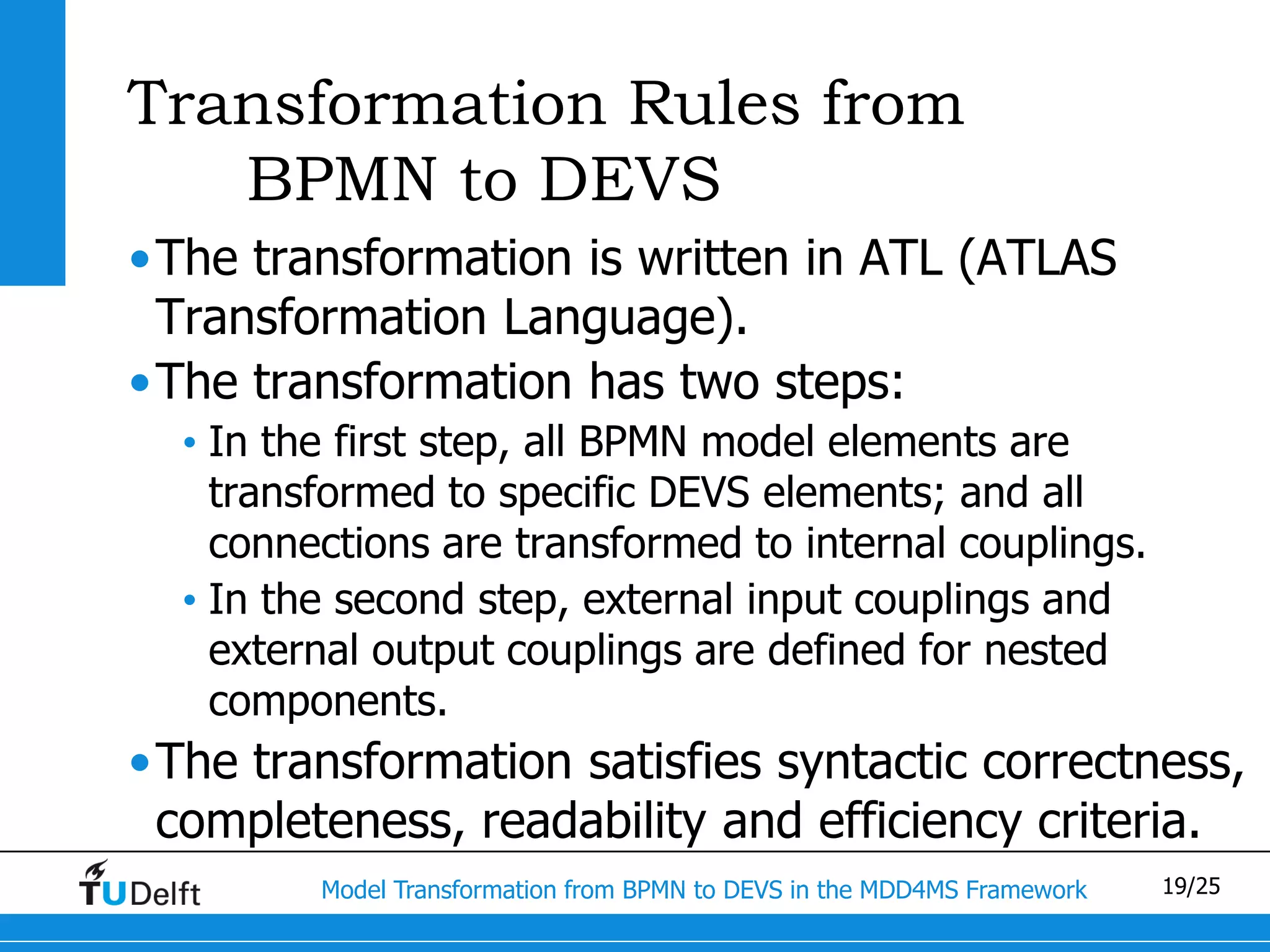
•The transformation is written in ATL (ATLAS
 Transformation Language).
•The transformation has two steps:
  • In the first step, all BPMN model elements are
    transformed to specific DEVS elements; and all
    connections are transformed to internal couplings.
  • In the second step, external input couplings and
    external output couplings are defined for nested
    components.
•The transformation satisfies syntactic correctness,
 completeness, readability and efficiency criteria.
         Model Transformation from BPMN to DEVS in the MDD4MS Framework   19/25
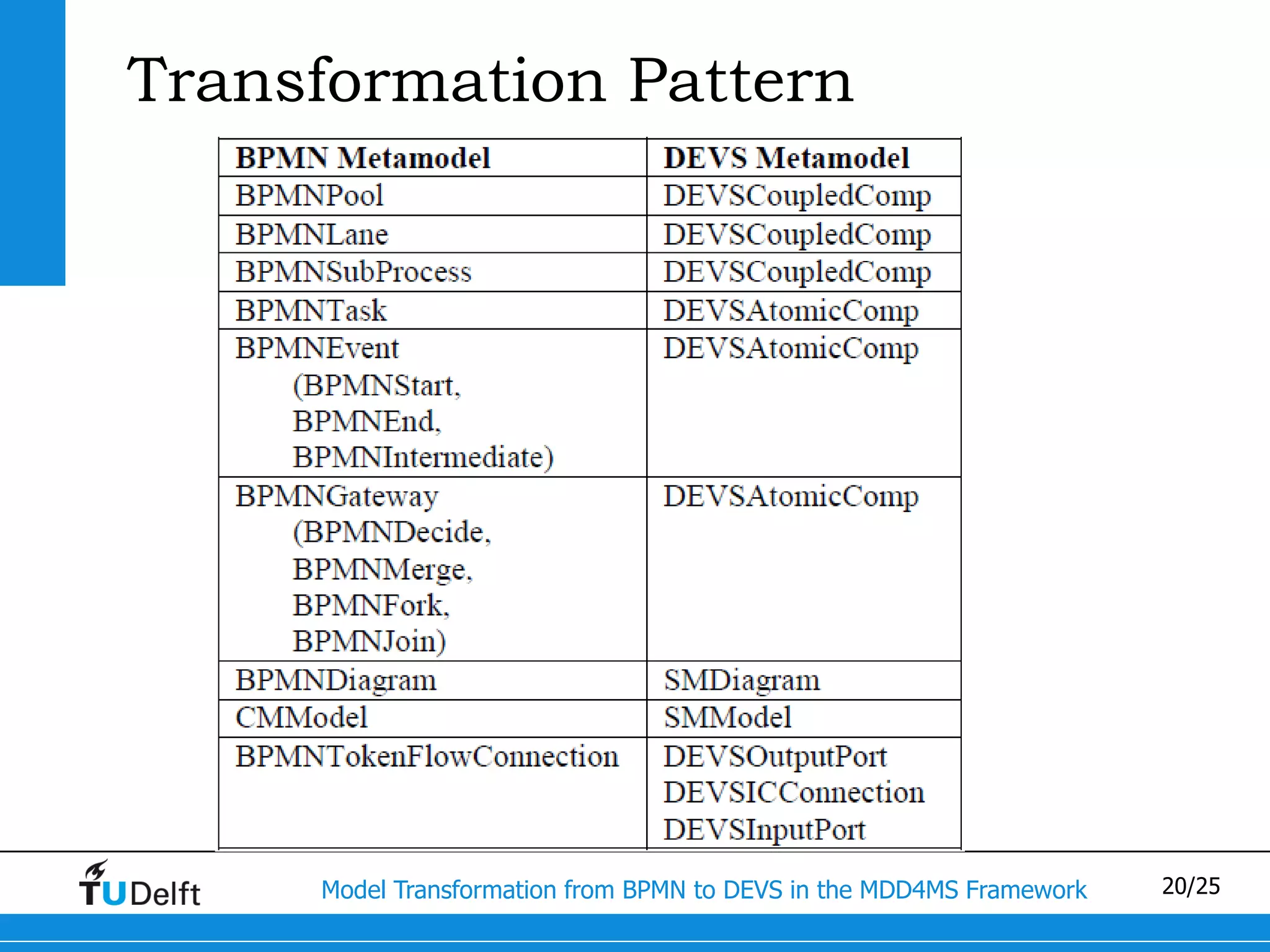
Transformation Pattern


     Model Transformation from BPMN to DEVS in the MDD4MS Framework   20/25
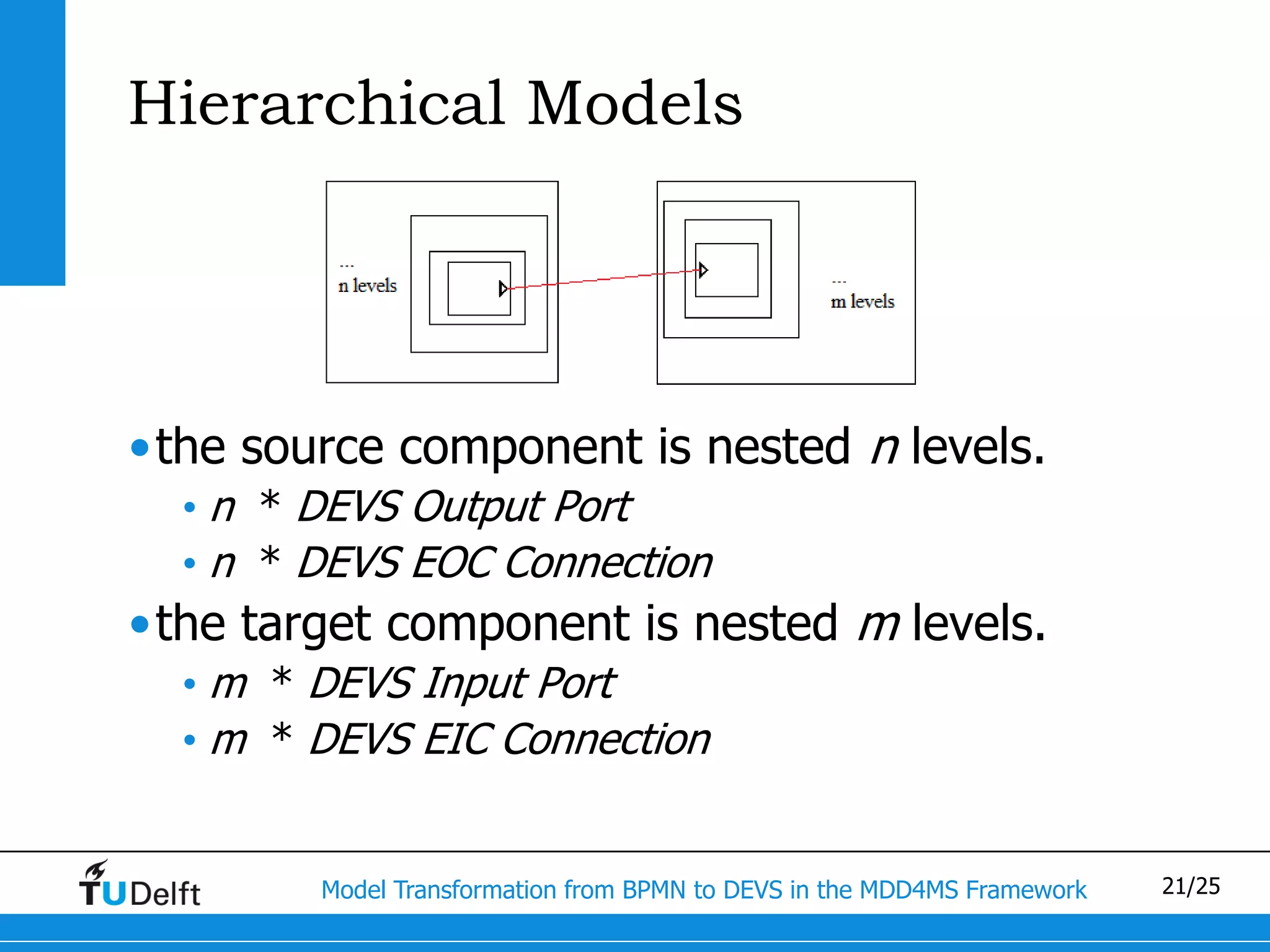
Hierarchical Models


•the source component is nested n levels.
  • n * DEVS Output Port
  • n * DEVS EOC Connection
•the target component is nested m levels.
  • m * DEVS Input Port
  • m * DEVS EIC Connection


        Model Transformation from BPMN to DEVS in the MDD4MS Framework   21/25
3.
 Conclusion


     Model Transformation from BPMN to DEVS in the MDD4MS Framework   22/25
Advantages of MDD Approach

•Availability of the existing MDD tools and
 techniques.
•Formal definition of the models and modeling
 languages.
•Good understanding of the conceptual models
 by different parties.
•More efficient and error-free simulation model
 implementation.


        Model Transformation from BPMN to DEVS in the MDD4MS Framework   23/25
Conclusion
•This research applies MDD principles into M&S
 in order to obtain the model continuity
 throughout the M&S life-cycle.
•In this work, a procedural DEVS metamodel, a
 BPMN metamodel and a model transformation
 from BPMN to DEVS are presented.
•The BPMN to DEVS transformation proves that
 the gap between the conceptual modeling and
 specification stages can be filled in by MDD
 approach.
       Model Transformation from BPMN to DEVS in the MDD4MS Framework   24/25
Thank you.
          Questions?
                                        Deniz Cetinkaya
                                 D.Cetinkaya@tudelft.nl

                                   Alexander Verbraeck
                                 A.Verbraeck@tudelft.nl

                                      Mamadou D. Seck
                                     m.d.seck@tudelft.nl


    Model Transformation from BPMN to DEVS in the MDD4MS Framework   25/25

Model Transformation from BPMN to DEVS in a Prototype Implementation of the MDD4MS Framework

  • 1.
    Model Transformation fromBPMN to DEVS in the MDD4MS Framework Deniz Cetinkaya, Alexander Verbraeck and Mamadou D. Seck 27 March 2012,Orlando, FL
  • 2.
    Outline •MDD4MS Framework • M&S Life-cycle • Metamodeling: Models and Metamodels • Model Transformations • Tool Architecture for MDD4MS •BPMN to DEVS Transformation • BPMN Metamodel • DEVS Metamodel • Transformation Rules from BPMN to DEVS •Conclusion Model Transformation from BPMN to DEVS in the MDD4MS Framework 2/25
  • 3.
    1. MDD4MS Framework Model Transformation from BPMN to DEVS in the MDD4MS Framework 3/25
  • 4.
    M&S Life-cycle Problem Definition Conceptual Modeling Specification Validation Verification Implementation Experimentation Model Transformation from BPMN to DEVS in the MDD4MS Framework 4/25
  • 5.
    Outputs of theM&S Life-cycle Stage Output Output Type Output Format Problem Source System Generally a written Expressed in a natural language Definition Requirements document Conceptual Conceptual Model A visual and/or textual Defined by a well-defined Modeling conceptual model conceptual modeling language Specification Platform Independent A visual and/or textual Defined by a specification Simulation Model simulation specification language for a certain formalism Implementation Platform Specific Compiled or executable Written in a programming Simulation Model source code language or automatically generated Experimentation Experimentation Output of the simulator Depends on the simulator Results Model Transformation from BPMN to DEVS in the MDD4MS Framework 5/25
  • 6.
    Why MDD forM&S? • Simulation conceptual modeling is performed mostly with general purpose diagramming techniques and tools. • There is a lack of tool support during the entire simulation model development life-cycle. • The conceptual models are not explicitly reused in the further stages as formal model transformation methods are not available. • MDD will be a cost and effort saving solution. As well as, existing MDD tools and techniques can be utilized. • This research applies MDD principles into M&S in order to obtain the model continuity throughout the M&S life- cycle. Model Transformation from BPMN to DEVS in the MDD4MS Framework 6/25
  • 7.
    Metamodeling Layers inMOF M3 Level MOF Model Meta-metamodel Application M2 Level Metamodel Metamodel Application M1 Level Model MetaData M0 Level Application Data Information Model Transformation from BPMN to DEVS in the MDD4MS Framework 7/25
  • 8.
    MDD4MS Framework conforms to M&S Meta-Metamodel M3 level conforms to conforms to conforms to Metamodeling M2 level Conceptual Modeling Simulation Model Simulation Model Metamodel Specification Metamodel Implementation Metamodel conforms to conforms to conforms to Simulation Platform Independent Platform Specific Conceptual Model (CM) MetaData Simulation Model (PISM) MetaData Simulation Model (PSSM) MetaData M1 level Model transformations (M&S life-cycle stages) instance of instance of instance of Simulation Conceptual Model (CM) Platform Independent Simulation Model (PISM) Platform Specific Simulation Model (PSSM) M0 level Model Transformation from BPMN to DEVS in the MDD4MS Framework 8/25
  • 9.
    Tool Architecture forMDD4MS Modeling and Simulation Environment prepares Problem Owner uses Requirements Role: Conceptual Modeler prepares Tool for Simulation Conceptual Modeling uses Simulation Role: Simulation Modeler Conceptual Model (CM) Tool for Simulation prepares Model Specification uses ModelToModel Platform Independent Role: Simulation Programmer Transformer Simulation Model (PISM) Tool for Simulation Model Implementation Platform Specific ModelToModel Simulation Model Transformer (PSSM) ModelToCode Transformer Role: Simulation Expert Simulator Computer executable PSSM Results Model Transformation from BPMN to DEVS in the MDD4MS Framework 9/25
  • 10.
    MDD4MS Prototype Model Transformation from BPMN to DEVS in the MDD4MS Framework 10/25
  • 11.
    2. BPMN toDEVS Transformation Model Transformation from BPMN to DEVS in the MDD4MS Framework 11/25
  • 12.
    A case study:MDD of executable DEVS from BPMN Metamodeling Layer BPMN DEVSDSOL DEVS Specification Conceptual Modeling Implementation Metamodel Metamodel Metamodel instance of instance of instance of Modeling Layer Simulation Platform Platform Conceptual Model Independent DEVS Specific DEVSDSOL (CM) Model (PISM) Model (PSSM) ModelToModel ModelToModel Transformation Transformation Model Transformation from BPMN to DEVS in the MDD4MS Framework 12/25
  • 13.
    BPMN Metamodel Model Transformation from BPMN to DEVS in the MDD4MS Framework 13/25
  • 14.
    Conceptual Modeling withBPMN Model Transformation from BPMN to DEVS in the MDD4MS Framework 14/25
  • 15.
    DEVS Metamodel Model Transformation from BPMN to DEVS in the MDD4MS Framework 15/25
  • 16.
    Generating Visual DEVSModel Model to model transformation with ATL Model Transformation from BPMN to DEVS in the MDD4MS Framework 16/25
  • 17.
    Generating Executable DEVSDSOLModel Model to code transformation with Java Model Transformation from BPMN to DEVS in the MDD4MS Framework 17/25
  • 18.
    Running the GeneratedCode Model Transformation from BPMN to DEVS in the MDD4MS Framework 18/25
  • 19.
    Transformation Rules from BPMN to DEVS •The transformation is written in ATL (ATLAS Transformation Language). •The transformation has two steps: • In the first step, all BPMN model elements are transformed to specific DEVS elements; and all connections are transformed to internal couplings. • In the second step, external input couplings and external output couplings are defined for nested components. •The transformation satisfies syntactic correctness, completeness, readability and efficiency criteria. Model Transformation from BPMN to DEVS in the MDD4MS Framework 19/25
  • 20.
    Transformation Pattern Model Transformation from BPMN to DEVS in the MDD4MS Framework 20/25
  • 21.
    Hierarchical Models •the sourcecomponent is nested n levels. • n * DEVS Output Port • n * DEVS EOC Connection •the target component is nested m levels. • m * DEVS Input Port • m * DEVS EIC Connection Model Transformation from BPMN to DEVS in the MDD4MS Framework 21/25
  • 22.
    3. Conclusion Model Transformation from BPMN to DEVS in the MDD4MS Framework 22/25
  • 23.
    Advantages of MDDApproach •Availability of the existing MDD tools and techniques. •Formal definition of the models and modeling languages. •Good understanding of the conceptual models by different parties. •More efficient and error-free simulation model implementation. Model Transformation from BPMN to DEVS in the MDD4MS Framework 23/25
  • 24.
    Conclusion •This research appliesMDD principles into M&S in order to obtain the model continuity throughout the M&S life-cycle. •In this work, a procedural DEVS metamodel, a BPMN metamodel and a model transformation from BPMN to DEVS are presented. •The BPMN to DEVS transformation proves that the gap between the conceptual modeling and specification stages can be filled in by MDD approach. Model Transformation from BPMN to DEVS in the MDD4MS Framework 24/25
  • 25.
    Thank you. Questions? Deniz Cetinkaya D.Cetinkaya@tudelft.nl Alexander Verbraeck A.Verbraeck@tudelft.nl Mamadou D. Seck m.d.seck@tudelft.nl Model Transformation from BPMN to DEVS in the MDD4MS Framework 25/25