AFIS
  Association Française d’Ingénierie Système
           (French INCOSE Chapter)

Alain Kerbrat (Alain.Kerbrat@collesys.com)
AFIS representative
Coordinator of the MBSE Technical Committee
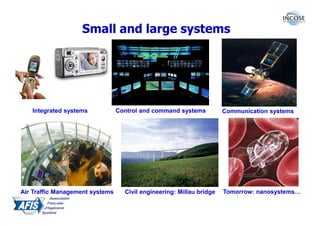
Small and large systems


   Integrated systems            Control and command systems          Communication systems


Air Traffic Management systems     Civil engineering: Millau bridge   Tomorrow: nanosystems…
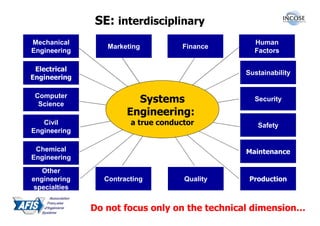
SE: interdisciplinary
Mechanical                                       Human
                  Marketing          Finance
Engineering                                      Factors

 Electrical
                                               Sustainability
Engineering

 Computer
  Science
                         Systems                 Security

                       Engineering:
   Civil                a true conductor          Safety
Engineering

 Chemical                                      Maintenance
Engineering
   Other
engineering      Contracting         Quality    Production
 specialties


               Do not focus only on the technical dimension…
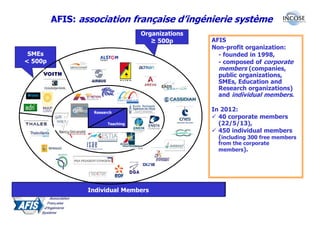
AFIS: association française d’ingénierie système
                                  Organizations
                                     ≥ 500p       AFIS
                                                  Non-profit organization:
 SMEs                                               - founded in 1998,
< 500p                                              - composed of corporate
                                                    members (companies,
                                                    public organizations,
                                                    SMEs, Education and
                                                    Research organizations)
                                                    and individual members.

                                                  In 2012:
                 Recherche
                 Recherche
                  Research
                                                    40 corporate members
                 Enseignement
                  Enseignement
                       Teaching                     (22/5/13),
                                                    450 individual members
                                                    (including 300 free members
                                                    from the corporate
                                                    members).


                 Individual Members
Goals of AFIS
           Promote Systems Engineering
presenting its principles aiming at delivering the right products to
customers.

Favor the use of SE within public and private organizations.

Promote education in SE within the corresponding communities:
students, teachers, training organizations, research labs…

Favor exchanges between end-users and enhance the knowledge
base of SE, while focusing on its adaptation to various application
domains.

Represent users within professional meetings at national,
European, international levels.
Technical Committees
–   Global Processes. Coordinator: Alain Le Put
    Definition, use, adaptation of processes throughout all lifecycle activities.
–   Model Based Systems Engineering. Coordinator: Alain Kerbrat, David Lesens (EADS)
    Methods, practices, tools (simulation, virtual integration) to design and validate a system.
–   SE Management. Coordinator: Roland Mazzella (THALES), Gilles Meuriot (AREVA)
    Methods, models, practices, tools used to manage SE within the global project management.
–   Training and Skills. Coordinator: Eric Bonjour (ENSGSI), Patricia Pancher (THALES)
    Identification of the skills to acquire, from student level to employee within a company; continuing training;
    certifying/labeling professional skills.
–   Emerging Technologies, Innovation and SE. Coordinator: Catherine Devic (EDF), Gérard
    Morel (Univ. Nancy), Dominique Seguela (CNES), Bruno Vallespir (Univ. Bordeaux), Frédéric Kratz
    (ENSI Bourges)
–   Human Factors and SE. Coordinator: Régis Mollard et Marion Wolff (Univ. Paris Descartes)
–   Systems-of-systems and services. Coordinator: Jean-Luc Garnier (Thales), Claude Pourcel
    Architecture and engineering of SoS and Service-intensive systems.
–   Safety, maintainability, validation of systems. Coordinator: Tony Hutinet (Dassault
    Systèmes), Eric Levrat (Univ. Nancy), François Peres (ENIT)
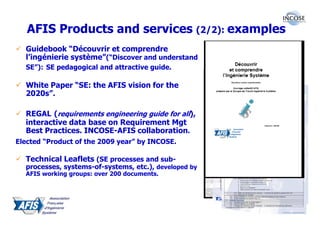
AFIS Products and services (2/2): examples
  Guidebook “Découvrir et comprendre
  l’ingénierie système”(“Discover and understand
  SE”): SE pedagogical and attractive guide.

  White Paper “SE: the AFIS vision for the
  2020s”.

  REGAL (requirements engineering guide for all),
  interactive data base on Requirement Mgt
  Best Practices. INCOSE-AFIS collaboration.
Elected “Product of the 2009 year” by INCOSE.          http://www.incose.org/REGAL


  Technical Leaflets (SE processes and sub-
  processes, systems-of-systems, etc.), developed by
  AFIS working groups: over 200 documents.
Partnerships and on-going actions
CSDM’10 and ’11: sponsor of conference, invited talk.
ICSSEA’10 and ’11: sponsor of conference, invited talk.
ERGOIA’11: sponsor of conference, invited talk.

AFIA: sponsor of conference AFIA’11, joint thematic day ISIA’11 (Nov. 11).
SEE: joint thematic day “management & trust in complex systems” (Sep. 11).
SYNTEC : invited talk on AFIS.

Participation to BKCASE project (4th Workshop in Toulouse 2010).
Journal Génie Logiciel (special issue March 11, papers in other issues).

BNAé: working groups (open systems…).
AFNOR: active member, participation to standardization commissions.

Regional Chapters: Midi-Pyrénées (conference lunches, meeting students-
enterprises Dec. 10), Grand Est.
On-going: French-speaking chapters (Quebec Montréal; Morocco).
AFIS: access to a worldwide network
         through the MOU with INCOSE


INCOSE:
–   7000 members,
–   a worldwide coverage of over 100 countries.


AFIS and INCOSE:
–   an exclusive MOU since 1999,
–   every AFIS member is INCOSE “International Affiliate”.

   Access to publications (Insight, System Engineering Journal), to
international exchange and working groups, and to unique services
such as the certification of system engineers.
Synthesis of the workshop “Modélisation”
AFIS seminar, Mont-Griffon, october 2011

SE MODELING TRENDS
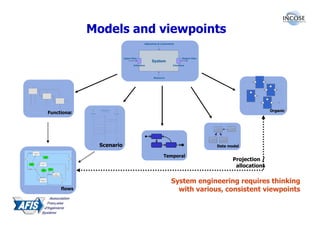
Models and viewpoints
                                                                             Objectives & Constraints


                                                              Input Flow                                  Output Flow
                                                                                   System
                                                                     Interface                      Interface


                                                                                    Resource


                                   :Mon Système
                                                                                                                                                            Organic
Functional         X:Utilisateur                  S1:System


                                                                                                                             Parent        Foo


                                                                                                                        ChildA    ChildB


                                   Scenario                                                                                      Data model

                                                                                            Temporal
                                                                                                                                             Projection /
                                                                                                                                              allocations

                                                                                                  System engineering requires thinking
     flows                                                                                          with various, consistent viewpoints


   Source: Alain FAISANDIER, MAP système - alain.faisandier@mapsysteme.com
Workshop « Modeling »

Which modeling approaches are needed
        for the engineering of
      future complex systems ?
Objective:
    Identify trends and necessary improvements
          in modeling techniques and tools


Attendance:
– 40 persons, 70% industry
                                                 25
Topics (1/4)

                  « One (model) to rule them all ?»
               A universal/unified SE modeling language,
              Or a combination of specialized languages ?

    Modeling dimensions:
•    Multi-disciplines,
•    Multi-levels, concurrent engineering,
•    Covering the whole system life-cycle

Combining specialized languages              Common meta-model ?

How to manage changes coming from one viewpoint, and
impacting others ?


                                                               26
Synthesis (1/4)

                A universal/unified SE modeling language,
               Or a combination of specialized languages ?

    Domain Specific languages for domain engineers
•     A system level model can be considered as intrusive
•     Any generic, universal language will end up being customized per domain

    Transverse techniques for transverse disciplines
•     Using safety, performances modeling in addition to functional modeling

    Organising the consistency of multi-dimension modeling
•     Simplified models for the communciation between domains
•     Synthesis/abstraction for upper level modellng
•     Requirements as the simplest, minimal exchange model ?


                                                                               27
Topics (2/4)

      Is the precise (formal) definition of language semantics
         helping or hampering a wide usage of modeling ?

Plus:
– Better tools   accuracy, interoperability, automation
– Formal proof, simulation and test generation while keeping the
  exact semantics
– Now recognized as a credit for aeronautical certification
– ….
Minus:
–   Accuracy and rigidity can hamper a creation process
–   Limitation of the usage scope
–   Higher cost (training, competences, tools)
–   …

                                                                   28
Synthesis(2/4)

    Is the precise (formal) definition of language semantics
       helping or hampering a wide usage of modeling ?

Two distinct class of needs
– Exchange with stakeholders, understand, negociate, « What »
     Formalism shall be open, flexible, easy to understand
– Design, Verify& validate, « How »
     Formalism shall be precise, simulation ready

Bridge between the two worlds « Contratualize »
– Two different viewpoints
– Synthesis/abstraction from the formal level, to communicate with
  stakeholder using an appropriate formalism
– Manage traceability

                                                                29
Topics (3/4)

      Is a standardized language like SysML appropriate
                  for an efficient modeling ?

Does « standardization » bring value ?
o E.g.: SDL standardized by ITU-T, but limited usage by the industry

A bridge between vairous industrial approaches:
o SysML and Architecture Frameworks,
o Scade-SysML, Matlab/SysML, SysML and Modélica ?

Is SysML still seen as an IT language ?

Should it be used in continuity with UML ?
                                                                       30
Synthesis (3/4)

             Is a standardized language like SysML appropriate
                         for an efficient modeling ?
    SysML:
•        SysML being a « standard » is a major reason for the growing interest
         –    Risk minimisation: « Being wrong alone » < « Being wrong together » <
              « Being right alone »
    SysML acceptance is variable
•        For computer science people, it is a generic language
•        For non IT people, it is a sowtware oriented language
•        No standard methodology
     –       Need for CSEP/OCSMP engineers
    Efficent use
•        Reuse is a must (design patterns, products line modeling)
Standardized Domain Specific Languages ?

                                                                                      31
Topics (4/4)

          What is missing for system-level validation
           based on simulation ? Or formal proof ?

Level of details necessary for simulation

Simulation partial models, abstract models

Relationship with the real world
o Real-time, human factors, non-determinism, dysfunctionnal …

Modeling properties is an additional cost
o Learning an additional language
o Doubling the modeling effort
                                                                32
Synthèse(4/4)
                 What is missing for system-level validation
                  based on simulation ? Or formal proof ?

Not so many feedbacks for system-level simulation
o ROI hard to evaluate
o Large gap between a descriptive model and a simulated model
o Modeling transverse aspects is hard(eg: Human Factors)
  Most of the simulation is done at sub-systems level, with domain specific languages
  and tools
  System-level simulation is applied when mandatory (e.g.: Safety)


Property verification
– Identification of emerging properties
     • Dimension constraints, constraints on environment
– Some isolated exampels of projects using formal verification

                                                                                   33
To join AFIS:


Dominique Luzeaux: President of AFIS
dominique.luzeaux@polytechnique.org


Catherine Devic: Vice-President of AFIS
catherine.devic@edf.fr


 Website:   http://www.afis.fr/
 Contact:   afis@afis.fr
AFIS membership conditions
Corporate Members
    Companies and public organizations ≥ 500 personnel
      •  9800€ yearly fees with 10 free members
      •  Vote weight: 6

    SMEs < 500 personnel
      •   3000€ yearly fees with 5 free members
      •   Vote weight: 2
    Education & Research
      •    Education : 1000€ yearly fees with 25 free members (23 students plus 2 professors)
      •    Vote weight: 1
       •    Research: 1000€ yearly fees with 10 free members
       •    Vote weight: 1

Individual Members
    Regular: 150€ yearly fees
    Retired: 50€ yearly fees
    Student: 30€ yearly fees (not including INCOSE fee)

AFIS ambassodorship presentation

  • 1.
    AFIS AssociationFrançaise d’Ingénierie Système (French INCOSE Chapter) Alain Kerbrat (Alain.Kerbrat@collesys.com) AFIS representative Coordinator of the MBSE Technical Committee
  • 2.
    Small and largesystems Integrated systems Control and command systems Communication systems Air Traffic Management systems Civil engineering: Millau bridge Tomorrow: nanosystems…
  • 3.
    SE: interdisciplinary Mechanical Human Marketing Finance Engineering Factors Electrical Sustainability Engineering Computer Science Systems Security Engineering: Civil a true conductor Safety Engineering Chemical Maintenance Engineering Other engineering Contracting Quality Production specialties Do not focus only on the technical dimension…
  • 4.
    AFIS: association françaised’ingénierie système Organizations ≥ 500p AFIS Non-profit organization: SMEs - founded in 1998, < 500p - composed of corporate members (companies, public organizations, SMEs, Education and Research organizations) and individual members. In 2012: Recherche Recherche Research 40 corporate members Enseignement Enseignement Teaching (22/5/13), 450 individual members (including 300 free members from the corporate members). Individual Members
  • 5.
    Goals of AFIS Promote Systems Engineering presenting its principles aiming at delivering the right products to customers. Favor the use of SE within public and private organizations. Promote education in SE within the corresponding communities: students, teachers, training organizations, research labs… Favor exchanges between end-users and enhance the knowledge base of SE, while focusing on its adaptation to various application domains. Represent users within professional meetings at national, European, international levels.
  • 6.
    Technical Committees – Global Processes. Coordinator: Alain Le Put Definition, use, adaptation of processes throughout all lifecycle activities. – Model Based Systems Engineering. Coordinator: Alain Kerbrat, David Lesens (EADS) Methods, practices, tools (simulation, virtual integration) to design and validate a system. – SE Management. Coordinator: Roland Mazzella (THALES), Gilles Meuriot (AREVA) Methods, models, practices, tools used to manage SE within the global project management. – Training and Skills. Coordinator: Eric Bonjour (ENSGSI), Patricia Pancher (THALES) Identification of the skills to acquire, from student level to employee within a company; continuing training; certifying/labeling professional skills. – Emerging Technologies, Innovation and SE. Coordinator: Catherine Devic (EDF), Gérard Morel (Univ. Nancy), Dominique Seguela (CNES), Bruno Vallespir (Univ. Bordeaux), Frédéric Kratz (ENSI Bourges) – Human Factors and SE. Coordinator: Régis Mollard et Marion Wolff (Univ. Paris Descartes) – Systems-of-systems and services. Coordinator: Jean-Luc Garnier (Thales), Claude Pourcel Architecture and engineering of SoS and Service-intensive systems. – Safety, maintainability, validation of systems. Coordinator: Tony Hutinet (Dassault Systèmes), Eric Levrat (Univ. Nancy), François Peres (ENIT)
  • 7.
    AFIS Products andservices (2/2): examples Guidebook “Découvrir et comprendre l’ingénierie système”(“Discover and understand SE”): SE pedagogical and attractive guide. White Paper “SE: the AFIS vision for the 2020s”. REGAL (requirements engineering guide for all), interactive data base on Requirement Mgt Best Practices. INCOSE-AFIS collaboration. Elected “Product of the 2009 year” by INCOSE. http://www.incose.org/REGAL Technical Leaflets (SE processes and sub- processes, systems-of-systems, etc.), developed by AFIS working groups: over 200 documents.
  • 8.
    Partnerships and on-goingactions CSDM’10 and ’11: sponsor of conference, invited talk. ICSSEA’10 and ’11: sponsor of conference, invited talk. ERGOIA’11: sponsor of conference, invited talk. AFIA: sponsor of conference AFIA’11, joint thematic day ISIA’11 (Nov. 11). SEE: joint thematic day “management & trust in complex systems” (Sep. 11). SYNTEC : invited talk on AFIS. Participation to BKCASE project (4th Workshop in Toulouse 2010). Journal Génie Logiciel (special issue March 11, papers in other issues). BNAé: working groups (open systems…). AFNOR: active member, participation to standardization commissions. Regional Chapters: Midi-Pyrénées (conference lunches, meeting students- enterprises Dec. 10), Grand Est. On-going: French-speaking chapters (Quebec Montréal; Morocco).
  • 9.
    AFIS: access toa worldwide network through the MOU with INCOSE INCOSE: – 7000 members, – a worldwide coverage of over 100 countries. AFIS and INCOSE: – an exclusive MOU since 1999, – every AFIS member is INCOSE “International Affiliate”. Access to publications (Insight, System Engineering Journal), to international exchange and working groups, and to unique services such as the certification of system engineers.
  • 10.
    Synthesis of theworkshop “Modélisation” AFIS seminar, Mont-Griffon, october 2011 SE MODELING TRENDS
  • 11.
    Models and viewpoints Objectives & Constraints Input Flow Output Flow System Interface Interface Resource :Mon Système Organic Functional X:Utilisateur S1:System Parent Foo ChildA ChildB Scenario Data model Temporal Projection / allocations System engineering requires thinking flows with various, consistent viewpoints Source: Alain FAISANDIER, MAP système - alain.faisandier@mapsysteme.com
  • 12.
    Workshop « Modeling» Which modeling approaches are needed for the engineering of future complex systems ? Objective: Identify trends and necessary improvements in modeling techniques and tools Attendance: – 40 persons, 70% industry 25
  • 13.
    Topics (1/4) « One (model) to rule them all ?» A universal/unified SE modeling language, Or a combination of specialized languages ? Modeling dimensions: • Multi-disciplines, • Multi-levels, concurrent engineering, • Covering the whole system life-cycle Combining specialized languages Common meta-model ? How to manage changes coming from one viewpoint, and impacting others ? 26
  • 14.
    Synthesis (1/4) A universal/unified SE modeling language, Or a combination of specialized languages ? Domain Specific languages for domain engineers • A system level model can be considered as intrusive • Any generic, universal language will end up being customized per domain Transverse techniques for transverse disciplines • Using safety, performances modeling in addition to functional modeling Organising the consistency of multi-dimension modeling • Simplified models for the communciation between domains • Synthesis/abstraction for upper level modellng • Requirements as the simplest, minimal exchange model ? 27
  • 15.
    Topics (2/4) Is the precise (formal) definition of language semantics helping or hampering a wide usage of modeling ? Plus: – Better tools accuracy, interoperability, automation – Formal proof, simulation and test generation while keeping the exact semantics – Now recognized as a credit for aeronautical certification – …. Minus: – Accuracy and rigidity can hamper a creation process – Limitation of the usage scope – Higher cost (training, competences, tools) – … 28
  • 16.
    Synthesis(2/4) Is the precise (formal) definition of language semantics helping or hampering a wide usage of modeling ? Two distinct class of needs – Exchange with stakeholders, understand, negociate, « What » Formalism shall be open, flexible, easy to understand – Design, Verify& validate, « How » Formalism shall be precise, simulation ready Bridge between the two worlds « Contratualize » – Two different viewpoints – Synthesis/abstraction from the formal level, to communicate with stakeholder using an appropriate formalism – Manage traceability 29
  • 17.
    Topics (3/4) Is a standardized language like SysML appropriate for an efficient modeling ? Does « standardization » bring value ? o E.g.: SDL standardized by ITU-T, but limited usage by the industry A bridge between vairous industrial approaches: o SysML and Architecture Frameworks, o Scade-SysML, Matlab/SysML, SysML and Modélica ? Is SysML still seen as an IT language ? Should it be used in continuity with UML ? 30
  • 18.
    Synthesis (3/4) Is a standardized language like SysML appropriate for an efficient modeling ? SysML: • SysML being a « standard » is a major reason for the growing interest – Risk minimisation: « Being wrong alone » < « Being wrong together » < « Being right alone » SysML acceptance is variable • For computer science people, it is a generic language • For non IT people, it is a sowtware oriented language • No standard methodology – Need for CSEP/OCSMP engineers Efficent use • Reuse is a must (design patterns, products line modeling) Standardized Domain Specific Languages ? 31
  • 19.
    Topics (4/4) What is missing for system-level validation based on simulation ? Or formal proof ? Level of details necessary for simulation Simulation partial models, abstract models Relationship with the real world o Real-time, human factors, non-determinism, dysfunctionnal … Modeling properties is an additional cost o Learning an additional language o Doubling the modeling effort 32
  • 20.
    Synthèse(4/4) What is missing for system-level validation based on simulation ? Or formal proof ? Not so many feedbacks for system-level simulation o ROI hard to evaluate o Large gap between a descriptive model and a simulated model o Modeling transverse aspects is hard(eg: Human Factors) Most of the simulation is done at sub-systems level, with domain specific languages and tools System-level simulation is applied when mandatory (e.g.: Safety) Property verification – Identification of emerging properties • Dimension constraints, constraints on environment – Some isolated exampels of projects using formal verification 33
  • 21.
    To join AFIS: DominiqueLuzeaux: President of AFIS dominique.luzeaux@polytechnique.org Catherine Devic: Vice-President of AFIS catherine.devic@edf.fr Website: http://www.afis.fr/ Contact: afis@afis.fr
  • 22.
    AFIS membership conditions CorporateMembers Companies and public organizations ≥ 500 personnel • 9800€ yearly fees with 10 free members • Vote weight: 6 SMEs < 500 personnel • 3000€ yearly fees with 5 free members • Vote weight: 2 Education & Research • Education : 1000€ yearly fees with 25 free members (23 students plus 2 professors) • Vote weight: 1 • Research: 1000€ yearly fees with 10 free members • Vote weight: 1 Individual Members Regular: 150€ yearly fees Retired: 50€ yearly fees Student: 30€ yearly fees (not including INCOSE fee)