Validation of Spacecraft
Behaviour Concept using a
Collaborative Approach
Ana Rugina, Cristiano Leorato, Elena Tremolizzo
ESA-ESTEC
26/06/2012


ESA UNCLASSIFIED – For Official Use
Context


•     Space system engineering domains of knowledge
              •       Attitude and Orbit Control (AOCS)
              •       Power Control
              •       Thermal Control
              •       Payload
              •       Failure Detection Isolation and Recovery (FDIR)
•     Early validation and analysis
              •       Usually performed independently per domain
              •       More or less heavy depending on project objectives
                         •       Galileo navigation satellites  very high availability
•     Approach
              •       Integrated model-based simulation to give confidence in
                      command/control and FDIR (functional and timing aspects)
Validation of Spacecraft Behaviour Concept | Ana Rugina | ESA-ESTEC | 26/06/2012 | TEC | Slide 2

ESA UNCLASSIFIED – For Official Use
Outline


1. Objectives
2. Perimeter of Early Validation Activities
3. Constraints and Choices
4. Modelling Insights
5. Results
6. Conclusions


Validation of Spacecraft Behaviour Concept | Ana Rugina | ESA-ESTEC | 26/06/2012 | TEC | Slide 3

ESA UNCLASSIFIED – For Official Use
Global Objectives


•     Validate the FDIR strategy
              •       Behaviour « as expected » in the presence of faults
                         –       Single fault tolerance (not considering fault combinations)
              •       Logical correctness
              •       Temporal consistency (including functional algorithms)
•     Subsystems FDIR
              •       Consistency: no contradiction, no shading
              •       Completeness: no missing info to achieve executable specification
              •       Correctness: sound reaction to feared events
•     System-level FDIR (Cross-subsystems)
              •       Consistency between subsystems’ modes
              •       Analyse impact of dependencies between the subsystems


Validation of Spacecraft Behaviour Concept | Ana Rugina | ESA-ESTEC | 26/06/2012 | TEC | Slide 4

ESA UNCLASSIFIED – For Official Use
Perimeter of Validation Activities


•     Functional validation
              •       AOCS, Thermal, Power subsystems
•     Command/Control and FDIR
              •       Mode management for subsystems
                         –       AOCS
                         –       Power
                         –       Thermal
                         –       TTC
                         –       Payload
              •       System control application
              •       Hardware reconfiguration module


Validation of Spacecraft Behaviour Concept | Ana Rugina | ESA-ESTEC | 26/06/2012 | TEC | Slide 5

ESA UNCLASSIFIED – For Official Use
Functional Validation


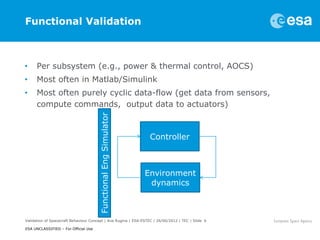
•     Per subsystem (e.g., power & thermal control, AOCS)
•     Most often in Matlab/Simulink
•     Most often purely cyclic data-flow (get data from sensors,
      compute commands, output data to actuators)
                                       Functional Eng Simulator


                                                                   Controller


                                                                  Environment
                                                                   dynamics


Validation of Spacecraft Behaviour Concept | Ana Rugina | ESA-ESTEC | 26/06/2012 | TEC | Slide 6

ESA UNCLASSIFIED – For Official Use
Command/Control and FDIR


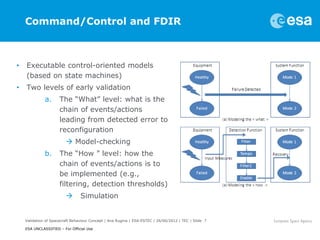
•   Executable control-oriented models
    (based on state machines)
•   Two levels of early validation
              a.      The “What” level: what is the
                      chain of events/actions
                      leading from detected error to
                      reconfiguration
                          Model-checking
              b.      The “How ” level: how the
                      chain of events/actions is to
                      be implemented (e.g.,
                      filtering, detection thresholds)
                                Simulation


    Validation of Spacecraft Behaviour Concept | Ana Rugina | ESA-ESTEC | 26/06/2012 | TEC | Slide 7

    ESA UNCLASSIFIED – For Official Use
Constraints (Legacy)


•     AOCS model
              •       Existing functional model
                         –       Algorithms for most of the modes
                         –       Environment dynamics (continuous)
              •       In Simulink
•     Power and Thermal models
              •       Part of functional engineering simulator
              •       In Simulink
•     FDIR models for power and thermal subsystems
              •       In RTDS (SDL language)


Validation of Spacecraft Behaviour Concept | Ana Rugina | ESA-ESTEC | 26/06/2012 | TEC | Slide 8

ESA UNCLASSIFIED – For Official Use
Integration Choices


•    Integration backbone: Simulink
              •     Functional Engineering Simulator infrastructure
              •     Matlab scripts to launch simulations with particular parameters (fault
                    injections) and to log results
•    Power and Thermal FDIR  legacy RTDS models
              •       Integration in Simulink using S-functions (black boxes in the
                      Simulink model)
              •       TASTE toolset for integration of heterogeneous models
                         •       Description of model architecture and interfaces
                         •       Manages code generation and interfaces
•    AOCS & System FDIR  Simulink (+ Stateflow and Embedded Matlab)
              •     Native model  white box
              •     Interfaces as bus objects (defined in Excel, processed automatically)

Validation of Spacecraft Behaviour Concept | Ana Rugina | ESA-ESTEC | 26/06/2012 | TEC | Slide 9

ESA UNCLASSIFIED – For Official Use
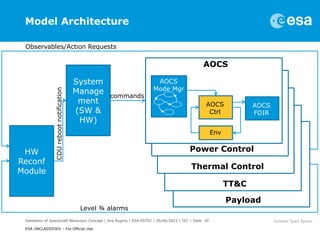
Model Architecture

 Observables/Action Requests

                                                                                               AOCS

                                          System                     AOCS
                                          Manage                    Mode Mgr
                CDU reboot notification


                                                   commands
                                           ment                                                 AOCS              AOCS
                                          (SW &                                                  Ctrl             FDIR
                                           HW)
                                                                                                     Env


 HW                                                                                    Power Control
Reconf
                                                                                        Thermal Control
Module
                                                                                                           TT&C

                                                                                                           Payload
                                           Level ¾ alarms
 Validation of Spacecraft Behaviour Concept | Ana Rugina | ESA-ESTEC | 26/06/2012 | TEC | Slide 10

 ESA UNCLASSIFIED – For Official Use
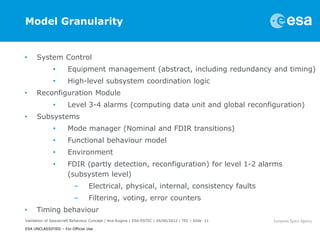
Model Granularity


•     System Control
              •       Equipment management (abstract, including redundancy and timing)
              •       High-level subsystem coordination logic
•     Reconfiguration Module
              •       Level 3-4 alarms (computing data unit and global reconfiguration)
•     Subsystems
              •       Mode manager (Nominal and FDIR transitions)
              •       Functional behaviour model
              •       Environment
              •       FDIR (partly detection, reconfiguration) for level 1-2 alarms
                      (subsystem level)
                         –       Electrical, physical, internal, consistency faults
                         –       Filtering, voting, error counters
•     Timing behaviour
Validation of Spacecraft Behaviour Concept | Ana Rugina | ESA-ESTEC | 26/06/2012 | TEC | Slide 11

ESA UNCLASSIFIED – For Official Use
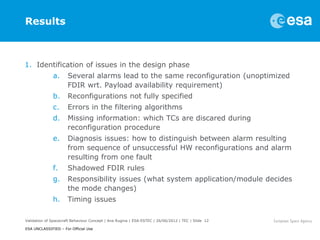
Results


1. Identification of issues in the design phase
              a.      Several alarms lead to the same reconfiguration (unoptimized
                      FDIR wrt. Payload availability requirement)
              b.      Reconfigurations not fully specified
              c.      Errors in the filtering algorithms
              d.      Missing information: which TCs are discared during
                      reconfiguration procedure
              e.      Diagnosis issues: how to distinguish between alarm resulting
                      from sequence of unsuccessful HW reconfigurations and alarm
                      resulting from one fault
              f.      Shadowed FDIR rules
              g.      Responsibility issues (what system application/module decides
                      the mode changes)
              h.      Timing issues

Validation of Spacecraft Behaviour Concept | Ana Rugina | ESA-ESTEC | 26/06/2012 | TEC | Slide 12

ESA UNCLASSIFIED – For Official Use
Conclusions & Perspectives


1. Conclusions
              a.      Pragmatic collaborative modelling and simulation approach in
                      the context of a challenging space project
              b.      Constraints related to legacy, schedule, organizational issues
2. Perspectives
              a.      Scalability of model-checking techniques
              b.      Test case generation from the simulation activity
              c.      Modelling patterns favouring integration
              d.      Modern collaborative platforms for multi-team/multi-site work


Validation of Spacecraft Behaviour Concept | Ana Rugina | ESA-ESTEC | 26/06/2012 | TEC | Slide 13

ESA UNCLASSIFIED – For Official Use

Validation of Spacecraft Behaviour Using a Collaborative Approach

  • 1.
    Validation of Spacecraft BehaviourConcept using a Collaborative Approach Ana Rugina, Cristiano Leorato, Elena Tremolizzo ESA-ESTEC 26/06/2012 ESA UNCLASSIFIED – For Official Use
  • 2.
    Context • Space system engineering domains of knowledge • Attitude and Orbit Control (AOCS) • Power Control • Thermal Control • Payload • Failure Detection Isolation and Recovery (FDIR) • Early validation and analysis • Usually performed independently per domain • More or less heavy depending on project objectives • Galileo navigation satellites  very high availability • Approach • Integrated model-based simulation to give confidence in command/control and FDIR (functional and timing aspects) Validation of Spacecraft Behaviour Concept | Ana Rugina | ESA-ESTEC | 26/06/2012 | TEC | Slide 2 ESA UNCLASSIFIED – For Official Use
  • 3.
    Outline 1. Objectives 2. Perimeterof Early Validation Activities 3. Constraints and Choices 4. Modelling Insights 5. Results 6. Conclusions Validation of Spacecraft Behaviour Concept | Ana Rugina | ESA-ESTEC | 26/06/2012 | TEC | Slide 3 ESA UNCLASSIFIED – For Official Use
  • 4.
    Global Objectives • Validate the FDIR strategy • Behaviour « as expected » in the presence of faults – Single fault tolerance (not considering fault combinations) • Logical correctness • Temporal consistency (including functional algorithms) • Subsystems FDIR • Consistency: no contradiction, no shading • Completeness: no missing info to achieve executable specification • Correctness: sound reaction to feared events • System-level FDIR (Cross-subsystems) • Consistency between subsystems’ modes • Analyse impact of dependencies between the subsystems Validation of Spacecraft Behaviour Concept | Ana Rugina | ESA-ESTEC | 26/06/2012 | TEC | Slide 4 ESA UNCLASSIFIED – For Official Use
  • 5.
    Perimeter of ValidationActivities • Functional validation • AOCS, Thermal, Power subsystems • Command/Control and FDIR • Mode management for subsystems – AOCS – Power – Thermal – TTC – Payload • System control application • Hardware reconfiguration module Validation of Spacecraft Behaviour Concept | Ana Rugina | ESA-ESTEC | 26/06/2012 | TEC | Slide 5 ESA UNCLASSIFIED – For Official Use
  • 6.
    Functional Validation • Per subsystem (e.g., power & thermal control, AOCS) • Most often in Matlab/Simulink • Most often purely cyclic data-flow (get data from sensors, compute commands, output data to actuators) Functional Eng Simulator Controller Environment dynamics Validation of Spacecraft Behaviour Concept | Ana Rugina | ESA-ESTEC | 26/06/2012 | TEC | Slide 6 ESA UNCLASSIFIED – For Official Use
  • 7.
    Command/Control and FDIR • Executable control-oriented models (based on state machines) • Two levels of early validation a. The “What” level: what is the chain of events/actions leading from detected error to reconfiguration  Model-checking b. The “How ” level: how the chain of events/actions is to be implemented (e.g., filtering, detection thresholds)  Simulation Validation of Spacecraft Behaviour Concept | Ana Rugina | ESA-ESTEC | 26/06/2012 | TEC | Slide 7 ESA UNCLASSIFIED – For Official Use
  • 8.
    Constraints (Legacy) • AOCS model • Existing functional model – Algorithms for most of the modes – Environment dynamics (continuous) • In Simulink • Power and Thermal models • Part of functional engineering simulator • In Simulink • FDIR models for power and thermal subsystems • In RTDS (SDL language) Validation of Spacecraft Behaviour Concept | Ana Rugina | ESA-ESTEC | 26/06/2012 | TEC | Slide 8 ESA UNCLASSIFIED – For Official Use
  • 9.
    Integration Choices • Integration backbone: Simulink • Functional Engineering Simulator infrastructure • Matlab scripts to launch simulations with particular parameters (fault injections) and to log results • Power and Thermal FDIR  legacy RTDS models • Integration in Simulink using S-functions (black boxes in the Simulink model) • TASTE toolset for integration of heterogeneous models • Description of model architecture and interfaces • Manages code generation and interfaces • AOCS & System FDIR  Simulink (+ Stateflow and Embedded Matlab) • Native model  white box • Interfaces as bus objects (defined in Excel, processed automatically) Validation of Spacecraft Behaviour Concept | Ana Rugina | ESA-ESTEC | 26/06/2012 | TEC | Slide 9 ESA UNCLASSIFIED – For Official Use
  • 10.
    Model Architecture Observables/ActionRequests AOCS System AOCS Manage Mode Mgr CDU reboot notification commands ment AOCS AOCS (SW & Ctrl FDIR HW) Env HW Power Control Reconf Thermal Control Module TT&C Payload Level ¾ alarms Validation of Spacecraft Behaviour Concept | Ana Rugina | ESA-ESTEC | 26/06/2012 | TEC | Slide 10 ESA UNCLASSIFIED – For Official Use
  • 11.
    Model Granularity • System Control • Equipment management (abstract, including redundancy and timing) • High-level subsystem coordination logic • Reconfiguration Module • Level 3-4 alarms (computing data unit and global reconfiguration) • Subsystems • Mode manager (Nominal and FDIR transitions) • Functional behaviour model • Environment • FDIR (partly detection, reconfiguration) for level 1-2 alarms (subsystem level) – Electrical, physical, internal, consistency faults – Filtering, voting, error counters • Timing behaviour Validation of Spacecraft Behaviour Concept | Ana Rugina | ESA-ESTEC | 26/06/2012 | TEC | Slide 11 ESA UNCLASSIFIED – For Official Use
  • 12.
    Results 1. Identification ofissues in the design phase a. Several alarms lead to the same reconfiguration (unoptimized FDIR wrt. Payload availability requirement) b. Reconfigurations not fully specified c. Errors in the filtering algorithms d. Missing information: which TCs are discared during reconfiguration procedure e. Diagnosis issues: how to distinguish between alarm resulting from sequence of unsuccessful HW reconfigurations and alarm resulting from one fault f. Shadowed FDIR rules g. Responsibility issues (what system application/module decides the mode changes) h. Timing issues Validation of Spacecraft Behaviour Concept | Ana Rugina | ESA-ESTEC | 26/06/2012 | TEC | Slide 12 ESA UNCLASSIFIED – For Official Use
  • 13.
    Conclusions & Perspectives 1.Conclusions a. Pragmatic collaborative modelling and simulation approach in the context of a challenging space project b. Constraints related to legacy, schedule, organizational issues 2. Perspectives a. Scalability of model-checking techniques b. Test case generation from the simulation activity c. Modelling patterns favouring integration d. Modern collaborative platforms for multi-team/multi-site work Validation of Spacecraft Behaviour Concept | Ana Rugina | ESA-ESTEC | 26/06/2012 | TEC | Slide 13 ESA UNCLASSIFIED – For Official Use