THOUGHT LEADERS FOR MANUFACTURING & SUPPLY CHAIN
ARC INSIGHTS
By Sid Snitkin
Accurate and Comprehensive Asset
Information is vital to developing an
effective CALM Strategy. This must be
one of your first priorities.
INSIGHT# 2003-21E
MAY 21, 2003
Best Practices for Managing Asset Information
Keywords
CALM, EAM, Asset Information Management, CEC
Summary
Although the effort required to develop and maintain accurate databases of
currently deployed assets remains a major barrier to broader Enterprise As-
set Management (EAM) adoption, solutions are appearing that address this
critical issue and EAM provides an ideal structure for organizing asset in-
formation. Many of these solutions offer deep
visualization tools that enhance stakeholder access
to asset information. ARC considers the use of as
EAM a Best Practice in Asset Information Man-
agement.
Analysis
Capital Equipment Assets have unique characteristics that complicate in-
formation management. They are complex, often custom-engineered, and
include many components that must be individually managed to achieve
maximum Asset Lifecycle Value. Large operations, such as Tier 1 Chemical
Plants (e.g., Dow Freeport) have thousands of assets to manage, and the
associated asset information comes in a multitude of paper-based and elec-
tronic forms, such as bills of material (BOMs), instruction manuals,
drawings, maintenance instructions, and parts lists that must be inter-
related.
EAM systems use asset hierarchies to relate assets to component parts, to
associated documentation, and to other assets in the same process. They
also support enhanced asset visualization tools that facilitate rapid naviga-
tion through the information trees to access specific part, work order, and
inventory information. This greatly extends the ability to use asset infor-
mation for more effective planning and execution. But even the most
powerful EAM solution provides little support for developing a compre-
hensive and accurate asset information database that enables this
functionality.
ARC Insights, Page 2
©2003 • ARC • 3 Allied Drive • Dedham, MA 02026 USA • 781-471-1000 • ARCweb.com
A Multi-Stage Process for Getting a Good Information Base
Developing such a database can be daunting. Most suppliers and system
integrators have developed methodologies for managing this heavily man-
ual process and making it more efficient. The following list identifies the
key activities and some of the Best Practices that are being used:
• Asset Hierarchy Development – Develop a complete list of all of the
assets that should be managed and structure them into a hierarchy that
captures relevant interrelationships. Included in this will be a criticality
assessment to identify those assets that are deemed essential to overall
good performance. Best Practices include tools to extract information
from existing Computerized Maintenance Management Systems
(CMMS) and help users organize this information into structures that
facilitate physical audit.
• Physical Asset Audit – This will verify the status of all assets as well as
their nameplate information. Best Practices for this activity include use
of pre-defined audit forms for each asset class to ensure consistency and
that all relevant information is gathered on a single inspection.
• Documentation Audit, Assessment and Conversion – This means lo-
cating and cataloging all documentation that the organization has for
their capital assets. Documentation is identified, assessed for relevant
content, and converted to electronic form in whole or in part. Specific
expertise and care is required to ensure such documentation can be effi-
ciently accessed by operators in the future.
• Document Content Structuring – This requires matching of each asset
to their related documents. This step converts unstructured asset in-
formation into structured content that can support more effective
stakeholder access.
• Asset Information System Upload - Upload asset information into the
EAM system and any associated visualization solutions to facilitate on-
line access by all stakeholders.
Maintaining Information Integrity Is Equally Important
Capital assets can be long-lived, and an effective asset information man-
agement strategy must recognize the need for change management and
periodic auditing of physical assets and documentation.
ARC Insights, Page 3
©2003 • ARC • 3 Allied Drive • Dedham, MA 02026 USA • 781-471-1000 • ARCweb.com
Change management is a special challenge for asset information. Today, a
common practice is for service technicians to replace parts with newer, bet-
ter versions but not update the information until after purchasing has
restocked stores with obsolete parts. This may not be discovered until the
next time the part is needed, which can be a problem years later. What is
required is the interlocking of business processes for maintaining the integ-
rity of asset information. Tying information updates in near real time to
work order completions by enabling such changes directly from the field is
the ideal.
New Solutions Enable Better Asset Information
Despite the importance of comprehensive and accurate asset information,
little effort has been given to developing solutions that can help organiza-
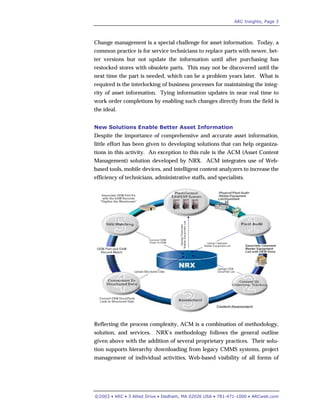
tions in this activity. An exception to this rule is the ACM (Asset Content
Management) solution developed by NRX. ACM integrates use of Web-
based tools, mobile devices, and intelligent content analyzers to increase the
efficiency of technicians, administrative staffs, and specialists.
Reflecting the process complexity, ACM is a combination of methodology,
solution, and services. NRX’s methodology follows the general outline
given above with the addition of several proprietary practices. Their solu-
tion supports hierarchy downloading from legacy CMMS systems, project
management of individual activities, Web-based visibility of all forms of
ARC Insights, Page 4
©2003 • ARC • 3 Allied Drive • Dedham, MA 02026 USA • 781-471-1000 • ARCweb.com
electronic documents, content structuring, and uploading of final informa-
tion to EAM solutions. Their services include agreements with off-shore
shops for data cleansing and cataloging.
Recommendations
• Get everyone in your organization to recognize the critical importance
of comprehensive, accurate asset information.
• Develop an internal strategy for improving your asset information data
base and maintaining its integrity.
• Continually monitor Best Practice developments in this and other Asset
Management processes. Participating in organizations like ARC’s
CALM Executive Council (CEC) can help you maintain awareness.
Please help us improve our deliverables to you – take our survey linked to this
transmittal e-mail or at www.arcweb.com/myarc in the Client Area. For further
information, contact your account manager or the author at srsnitkin@arcweb.com.
Recommended circulation: All EAS clients. ARC Insights are published and
copyrighted by ARC Advisory Group. The information is proprietary to ARC and
no part of it may be reproduced without prior permission from ARC.

Best Practices for Managing Asset Information

  • 1.
    THOUGHT LEADERS FORMANUFACTURING & SUPPLY CHAIN ARC INSIGHTS By Sid Snitkin Accurate and Comprehensive Asset Information is vital to developing an effective CALM Strategy. This must be one of your first priorities. INSIGHT# 2003-21E MAY 21, 2003 Best Practices for Managing Asset Information Keywords CALM, EAM, Asset Information Management, CEC Summary Although the effort required to develop and maintain accurate databases of currently deployed assets remains a major barrier to broader Enterprise As- set Management (EAM) adoption, solutions are appearing that address this critical issue and EAM provides an ideal structure for organizing asset in- formation. Many of these solutions offer deep visualization tools that enhance stakeholder access to asset information. ARC considers the use of as EAM a Best Practice in Asset Information Man- agement. Analysis Capital Equipment Assets have unique characteristics that complicate in- formation management. They are complex, often custom-engineered, and include many components that must be individually managed to achieve maximum Asset Lifecycle Value. Large operations, such as Tier 1 Chemical Plants (e.g., Dow Freeport) have thousands of assets to manage, and the associated asset information comes in a multitude of paper-based and elec- tronic forms, such as bills of material (BOMs), instruction manuals, drawings, maintenance instructions, and parts lists that must be inter- related. EAM systems use asset hierarchies to relate assets to component parts, to associated documentation, and to other assets in the same process. They also support enhanced asset visualization tools that facilitate rapid naviga- tion through the information trees to access specific part, work order, and inventory information. This greatly extends the ability to use asset infor- mation for more effective planning and execution. But even the most powerful EAM solution provides little support for developing a compre- hensive and accurate asset information database that enables this functionality.
  • 2.
    ARC Insights, Page2 ©2003 • ARC • 3 Allied Drive • Dedham, MA 02026 USA • 781-471-1000 • ARCweb.com A Multi-Stage Process for Getting a Good Information Base Developing such a database can be daunting. Most suppliers and system integrators have developed methodologies for managing this heavily man- ual process and making it more efficient. The following list identifies the key activities and some of the Best Practices that are being used: • Asset Hierarchy Development – Develop a complete list of all of the assets that should be managed and structure them into a hierarchy that captures relevant interrelationships. Included in this will be a criticality assessment to identify those assets that are deemed essential to overall good performance. Best Practices include tools to extract information from existing Computerized Maintenance Management Systems (CMMS) and help users organize this information into structures that facilitate physical audit. • Physical Asset Audit – This will verify the status of all assets as well as their nameplate information. Best Practices for this activity include use of pre-defined audit forms for each asset class to ensure consistency and that all relevant information is gathered on a single inspection. • Documentation Audit, Assessment and Conversion – This means lo- cating and cataloging all documentation that the organization has for their capital assets. Documentation is identified, assessed for relevant content, and converted to electronic form in whole or in part. Specific expertise and care is required to ensure such documentation can be effi- ciently accessed by operators in the future. • Document Content Structuring – This requires matching of each asset to their related documents. This step converts unstructured asset in- formation into structured content that can support more effective stakeholder access. • Asset Information System Upload - Upload asset information into the EAM system and any associated visualization solutions to facilitate on- line access by all stakeholders. Maintaining Information Integrity Is Equally Important Capital assets can be long-lived, and an effective asset information man- agement strategy must recognize the need for change management and periodic auditing of physical assets and documentation.
  • 3.
    ARC Insights, Page3 ©2003 • ARC • 3 Allied Drive • Dedham, MA 02026 USA • 781-471-1000 • ARCweb.com Change management is a special challenge for asset information. Today, a common practice is for service technicians to replace parts with newer, bet- ter versions but not update the information until after purchasing has restocked stores with obsolete parts. This may not be discovered until the next time the part is needed, which can be a problem years later. What is required is the interlocking of business processes for maintaining the integ- rity of asset information. Tying information updates in near real time to work order completions by enabling such changes directly from the field is the ideal. New Solutions Enable Better Asset Information Despite the importance of comprehensive and accurate asset information, little effort has been given to developing solutions that can help organiza- tions in this activity. An exception to this rule is the ACM (Asset Content Management) solution developed by NRX. ACM integrates use of Web- based tools, mobile devices, and intelligent content analyzers to increase the efficiency of technicians, administrative staffs, and specialists. Reflecting the process complexity, ACM is a combination of methodology, solution, and services. NRX’s methodology follows the general outline given above with the addition of several proprietary practices. Their solu- tion supports hierarchy downloading from legacy CMMS systems, project management of individual activities, Web-based visibility of all forms of
  • 4.
    ARC Insights, Page4 ©2003 • ARC • 3 Allied Drive • Dedham, MA 02026 USA • 781-471-1000 • ARCweb.com electronic documents, content structuring, and uploading of final informa- tion to EAM solutions. Their services include agreements with off-shore shops for data cleansing and cataloging. Recommendations • Get everyone in your organization to recognize the critical importance of comprehensive, accurate asset information. • Develop an internal strategy for improving your asset information data base and maintaining its integrity. • Continually monitor Best Practice developments in this and other Asset Management processes. Participating in organizations like ARC’s CALM Executive Council (CEC) can help you maintain awareness. Please help us improve our deliverables to you – take our survey linked to this transmittal e-mail or at www.arcweb.com/myarc in the Client Area. For further information, contact your account manager or the author at srsnitkin@arcweb.com. Recommended circulation: All EAS clients. ARC Insights are published and copyrighted by ARC Advisory Group. The information is proprietary to ARC and no part of it may be reproduced without prior permission from ARC.