Presented by: 
Zahari Mohd Amin 
MOBILE OPAC PROTOTYPE BASED ON KOHA OPEN SOURCE INTEGRATED LIBRARY SYSTEM
Why mobile? 
Availabilityofdevices–mobilephone,tabletetc. 
Userbehaviortowardsinformationsearching 
Tomakelifeeasier. 
AccordingtoMills(2009),staffatCambridgeUniversityLibraryhaveobservedcustomersusingtheircameraphonestotakepicturesofthecatalogueresultsscreen,ratherthannotingclassmarksonapieceofpaper.50%ofrespondentsatbothuniversitiessaidtheytakephotosofsigns,books,etctosaveinformationforlaterreference. 
Inaddition55%oftotalrespondentswereinfavourofbeingabletoaccessthelibrarycataloguefromamobilephone(Mills,2009).
Cont… 
Lackofunderstandingonmobiledevicesandapplicationamonglibraries. 
Whilethesetechnologicaladvancessuggestavarietyofpromisingopportunities,librarycommunitylacksadetailedunderstandingofthecapabilitiescatalogaccessapplicationsforthislatestgenerationofmobiledevices(Broussard,YongyiZhou&Lease,2010). 
ThefirstofitskindinMalaysia.
MobileOPACbasicallyisnotsomethingnewinthelibrary.JapanisoneofthecountrieswhichhavemobileOPACaspartoftheirlibraryservices. 
AccordingtoMurakamiandKanata(2008),inJapanmobilephoneOPACs(OnlinePublicAccessCatalog)havebeenrapidlyspreadinginuniversityandpubliclibraries. 
McKiernan(2009),in“wirelessinternetuse”surveyfoundthatone- thirdofAmericansaccessedtheinternetviacellphoneorsmartphone. 
AccordingtoOfcom,86%ofadultsintheUKownamobilephonethattheyusemorethanonceamonth.Howeverthemajorityofpeopleprimarilyusethemformakingcallsandsendingtextmessages(Ofcom,2008).
About Mobile OPAC 
PrototypedevelopedusingtheKOHAplatform–anopensourcelibrarysystem. 
Kohaversion3.2asitisthelateststableversionatthetimeofdevelopment. 
Kohaversion3.2waschosenbecause 
-theopensourcesoftwareframeworksallowflexibilityintermofaccessingthesourcecode. 
-itisafullywebbasedILSwhereKohahasofferedsuitableplatformformobileplatform. 
CurrentlyKohauserhasreachedmorethan1,000librariesworldwideinvolveshundredsofthousandspatrons.Atleasthalfofthemisusingversion3.2.xandwillbenefitsfromthiswork.
DEVELOPMENT OF MOBILE OPAC PROTOTYPE 
Duplicationof„prog‟templateandrenameitas„prog-mobile‟.TheprocessofdevelopingmobileOPACprototypeasfollows: 
TemplateCleaning–Removingunnecessarylayout,images,andmenufromthetemplate. 
Adaptationtomobiledevice–OPACtemplatehasbeenadjustedtomobiledevices. 
Removeunnecessaryfeatures-Unnecessaryfeatureswhichwefeeldonotsuitableformobileuserhasbeenremoved. 
Whileremovingunnecessaryfeatures,wetrytoretainasmuchfeaturesrelatedtouser,whichwethinktheywilluseusingtheirmobiledevices.
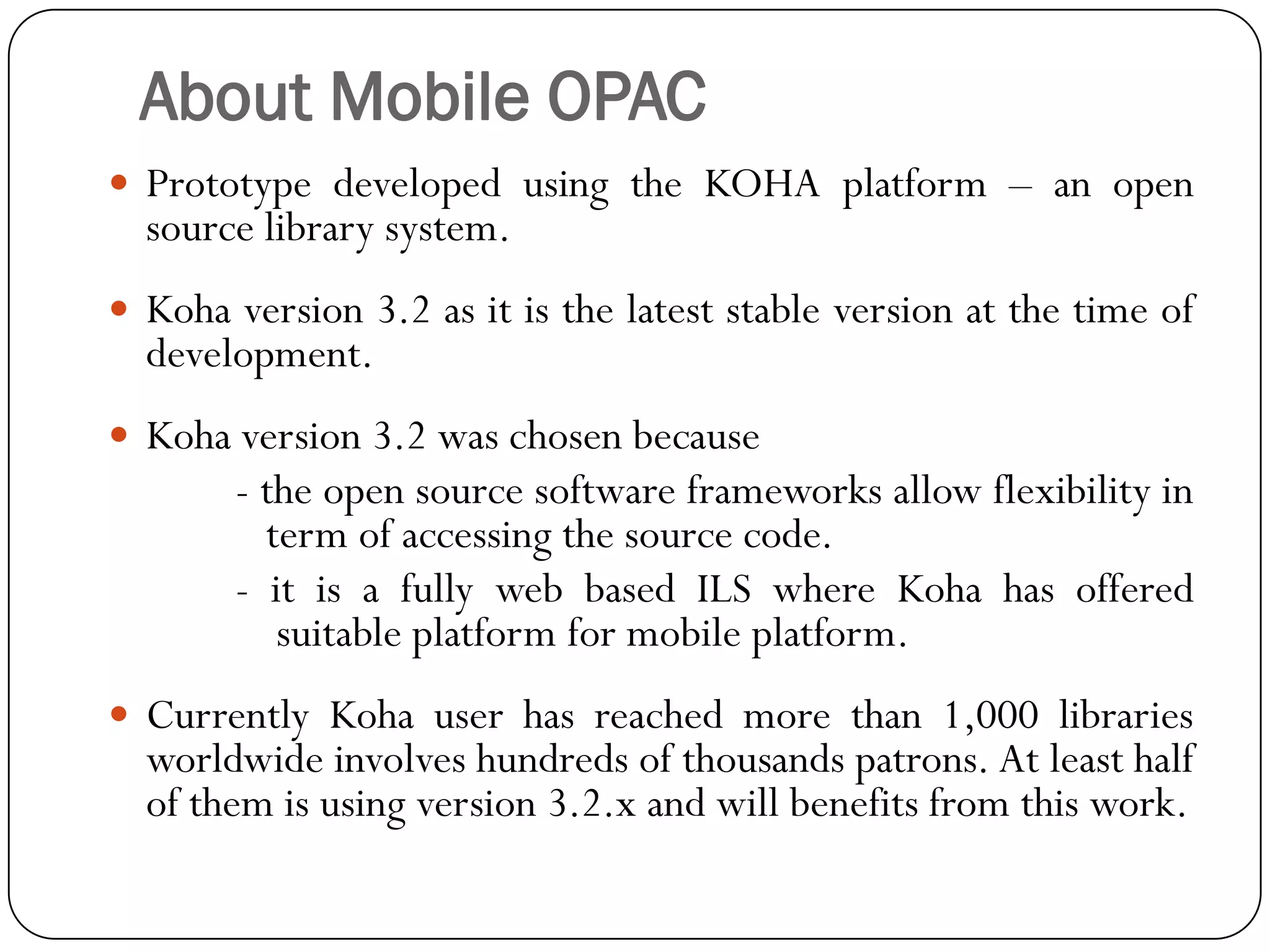
Screenshot of mobile OPAC prototype Figure 1. Hierarchy Browser – User can browse by Call Number 
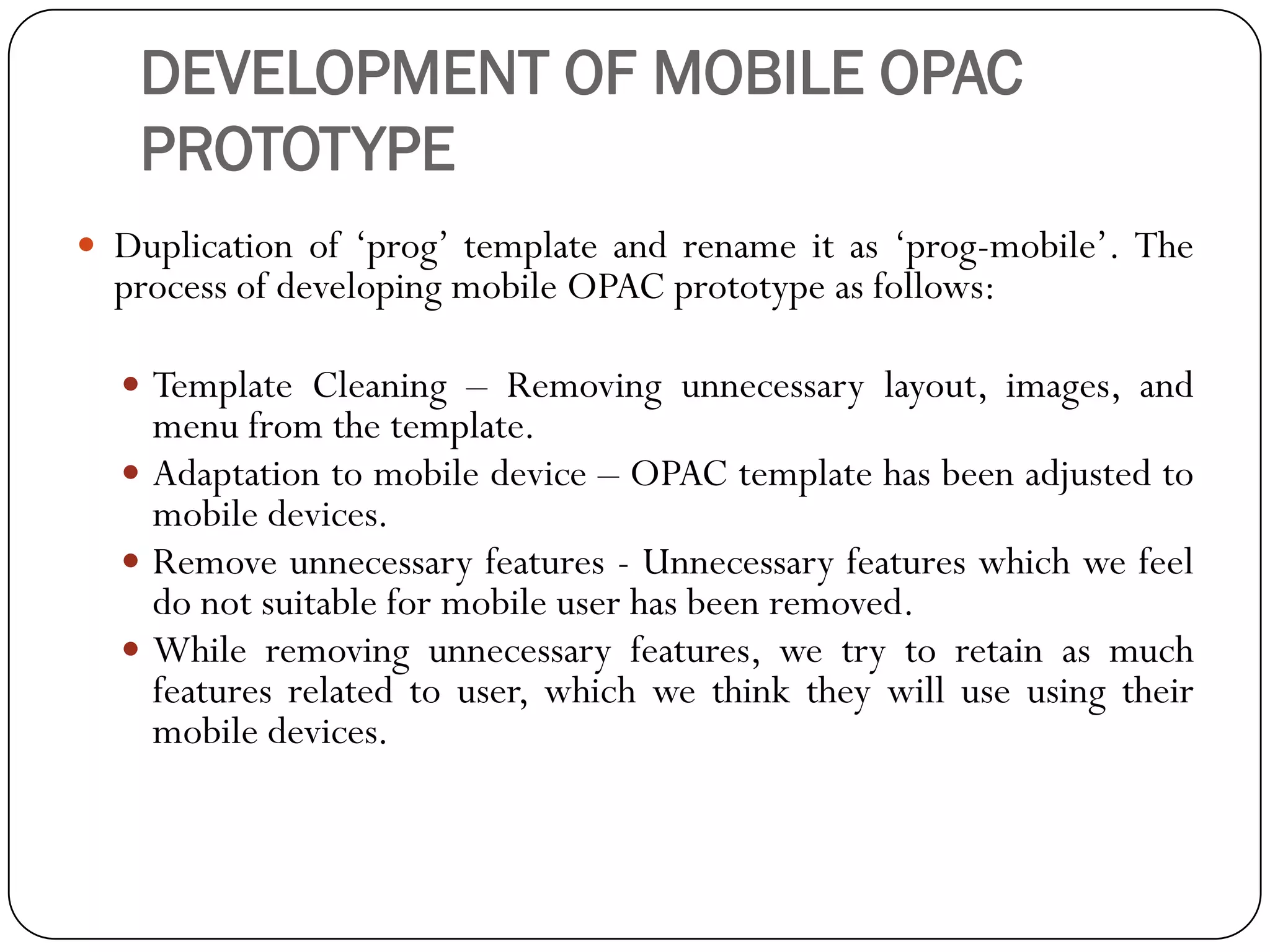
Figure 2. Search Result view on web devices
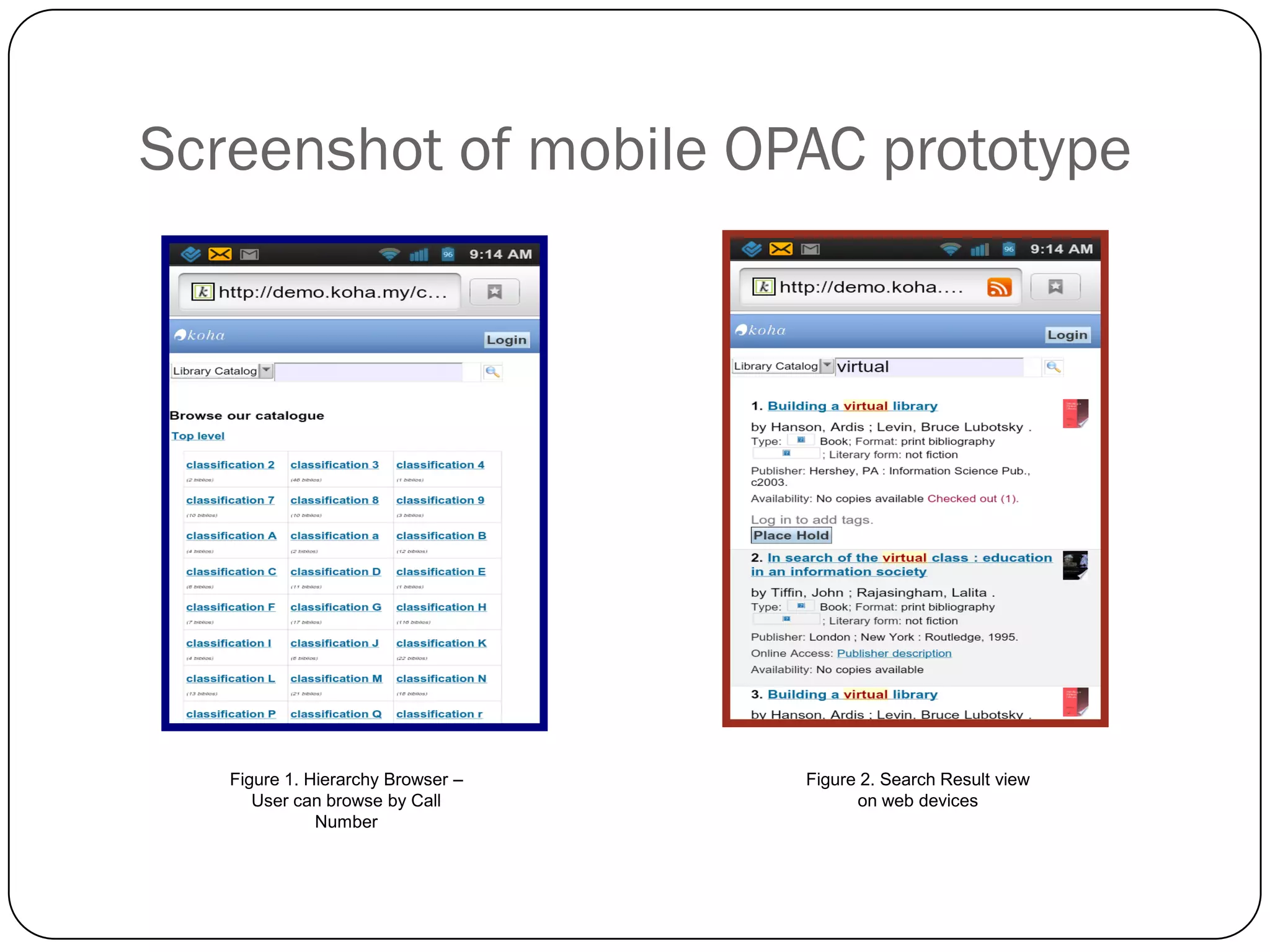
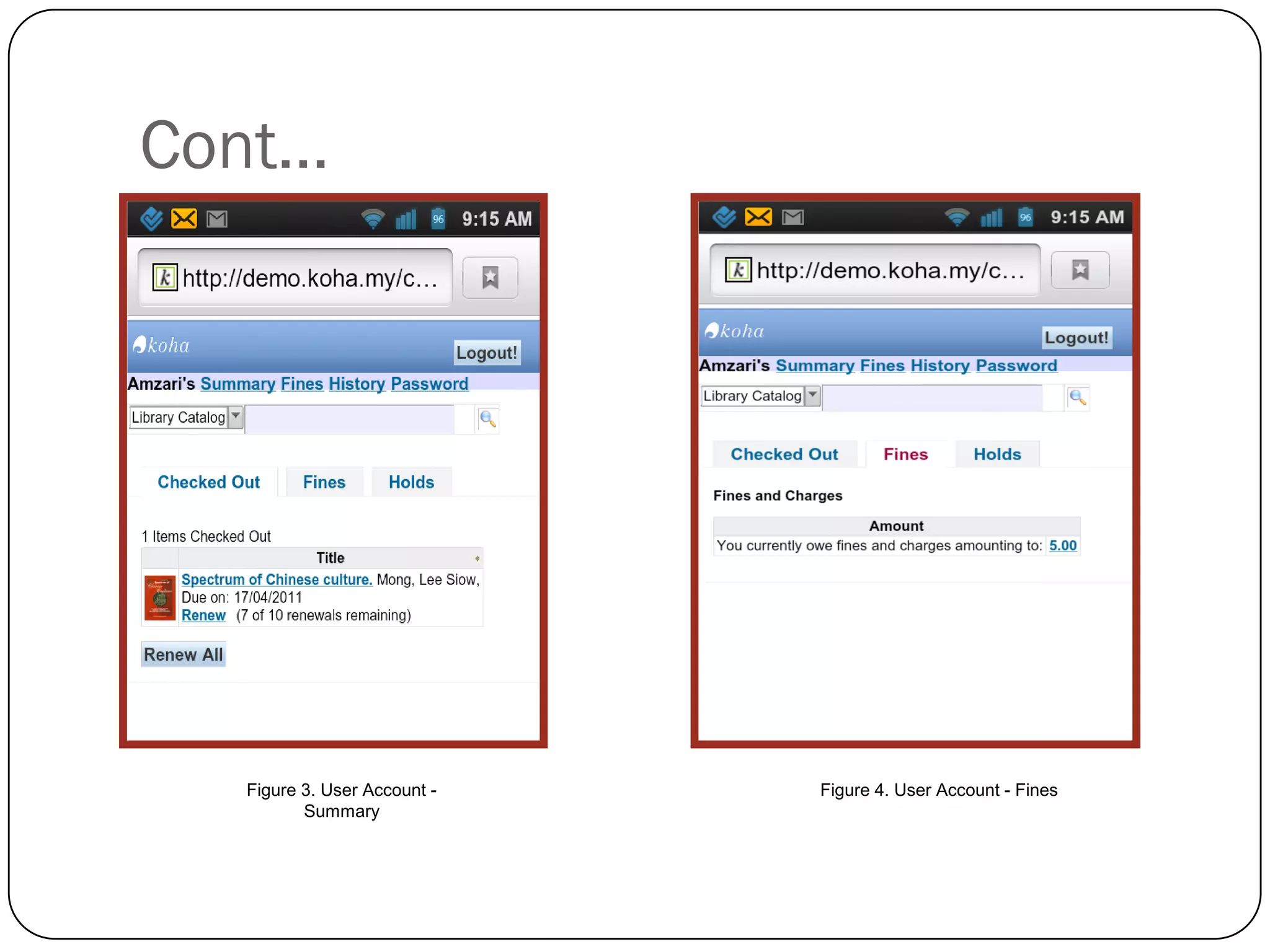
Cont… Figure 3. User Account - SummaryFigure 4. User Account -Fines
Cont… 
ThemobileOPAChasbeensuccessfullydeployedon13thApril2011athttp://demo.koha.my.IthasbeenpresentedatInvention,InnovationandDesign(IID) 2011on14thApril2011atUniversitiTeknologiMARA, ShahAlam,Malaysia. 
ThemobileOPACsourcecodewillbereleasedbacktotheKohaOpenSourceCommunity.
CONCLUSION 
MobileOPACPrototypeisessentialprojectwherebyitbecomesoneofpopulartoolamonglibraryusersnowadays.Itshowsthatanewtechnologyisneededforlibrary. 
Inaddition,Kohaisopensourceandveryappropriateinordertodevelopintegratedlibrarysystem. 
InthefutureitishopedthatthisprojectcouldbeoneofimportanttoolthatcanbeusedinalllibrariesinMalaysiaandatthesametimeitwillfacilitatelibraryusersinfindinginformationorcollectionsinthoselibraries.
REFERENCES 
Bridges, L., Rempel, G. & Griggs, K. Information wants to be free. Education Libraries, 33 (2). Retrieved on 8 May 2011 from World Wide Web: http://units.sla.org/division/ded/educationlibraries/33-2.pdf 
Broussard, R., YongyiZhou & Lease, M. (2010). Mobile Phone Search for Library Catalogs. In Proceedings of the 73rd Annual Meeting of the American Society for Information Science and Technology (ASIS&T). Retrieved on 8 May 2011 from World Wide Web: http:// www.ischool.utexas.edu/~ml/papers/broussard-asist10.pdf 
Coyle, K & Hillmann, D. (2007). RecourceDescription and Access (RDA): cataloging rules for the 20th century. D-Lib Magazine, 13(1/2). Retrieved on 8 May 2011 from World Wide Web: http://www.dlib.org/dlib/january07/coyle/01coyle.html 
Koha-Community. (2011). Retrieved on 8 May 2011 from World Wide Web: http://koha-community.org 
Kulkarni, S. N. (2004). Web OPAC: an effective tool for management of reprints of ARI scientists. Retrieved on 8 May 2011 from World Wide Web: http://shodhganga.inflibnet.ac.in/dxml/bitstream/handle/1944/225/cali_56.pdf? 
Luca, E. W. D., & Nürnberger, A. (2005). Supportinginformation retrievalon mobile devices. In Proceedings of the 7th international conference on Human computer interaction with mobile devices & services, 347-348. Salzburg, Austria: ACM. 
McKiernan, G. (2009). Current mobile trends in library. Iowa State University Library. Retrieved on 8 May 2011 from World Wide Web: http://www.public.iastate.edu/~gerrymck/M-Is-For-Service.ppt 
Mills, K. (2009). M-Libraries: information use on the move. A report from the Arcadia Programme. Retrieved on 8 May 2011 from World Wide Web: http://arcadiaproject.lib.cam.ac.uk/docs/M-Libraries_report.pdf 
Murakami, H. & Kanata, C. Transaction Log Analysis of a Japanese Mobile Phone OPAC. Retrieved on 8 May 2011 from World Wide Web: http:// murakami.media.osaka-cu.ac.jp/papers/ICCS08.pdf 
Ofcom. 2008. The Consumer Experience: 2008 Research Report. Retrieved on 8 May 2011 from World Wide Web: http://www.ofcom.org.uk/research/tce/ce08/research.pdf 
Willis, C & Bowman, S. (2011). The future is here, but do news media companies see it? NiemanReports. Retrieved on 8 May 2011 from World Wide Web: http://www.nieman.harvard.edu/reports/article/100558/The-Future-Is-Here-But-Do-News-Media- Companies-See-It.aspx

Mobile OPAC Prototype Based On Koha Open Source Integrated Library System