‫االسم‬:‫جالل‬ ‫محمد‬ ‫شريف‬ ‫مؤمن‬
‫المستوى‬:‫مدنى‬ ‫ثالث‬
‫الماده‬:‫مساحه‬2
‫الى‬ ‫مقدم‬:‫د‬.‫امين‬ ‫احمد‬
MOBILE MAPPING
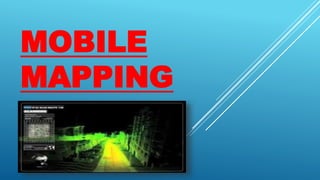
MOBILE
MAPPING
CONCEPT
CONCEPT
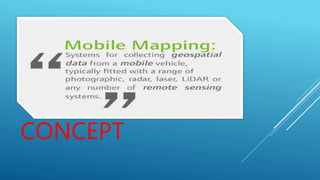
 Mobile mapping refers to the collection of geospatial
data using mapping sensors mounted on moving
platforms such as cars, marine vessels or airplanes.
 Mobile mapping systems utilize GNSS technology
combined with Inertial Navigation Systems (INS) to
enable the rapid and accurate calculation of continuous
3D position, velocity and attitude (roll, pitch and yaw).
 The time synchronized navigation sensors integrate with
digital imaging sensors to enable the direct and precise
mapping of landscapes, objects or features.
GNSS (Global Navigation Satellite System)
 GNSS is a satellite system that is used to pinpoint the geographic
location of a user's receiver anywhere in the world
 Inertial Navigation Systems (INS)
 Inertial navigation is a self-contained navigation technique in which
measurements provided by accelerometers and gyroscopes are used to
track the position and orientation of an object relative to a known
starting point, orientation and velocity.
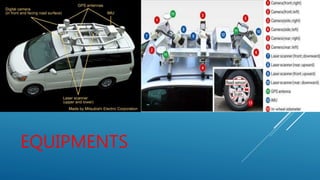
EQUIPMENTS
EQUIPMENTS
 inertial measurement unit (IMU) is an electronic device
that measures and reports a body's specific force, angular
and sometimes the magnetic field surrounding the body,
combination of accelerometers and gyroscopes,
also magnetometers
EQUIPMENTS
Odometer is an instrument that indicates distance traveled by a
vehicle, such as a bicycle or automobile. The device may be electronic,
mechanical, or a combination of the two
ADVANTAGES
• Safety – Like any other MMS, the user is safely out of the roadway and inside their vehicle during collection.
• 24x7 Collection – The LiDAR data can be collected day or night.
• Huge Projects – Unlike static scanning, a huge job (one to thousands of miles) project can be collected in just a short time using mobile
scanning.
• Non–invasive – Scan along with the traffic without an escort or slowing traffic.
• Accessibility – Put the scanner on a boat and scan an otherwise inaccessible river bank, etc.
• Imagery – Static scanners cannot provide imagery such as can be provided on a MMS.
• Data Density – In static scans points are collected radially outward with the point density dropping off sharply with distance. In MMS the points
only drop in density perpendicular to the line of travel.
• Speed – A static scanner can very accurately collect one or two miles of data in a day, but a mobile mapping system can do the same in
minutes.
• Green friendly – Because a lot less time is required to collect the data than by alterative means, we would definitely consider this a very green
friendly technology.
• Rapid Response – In the advent of some form of natural disaster, accident, or crime scene, a MMS can capture the surroundings much more
comprehensively and rapidly than by alternative means.
• Price Per Mile – The price per mile of collected data for longer projects will definitely be significantly less with a MMS than by any other
means.
• Data Re–use – Data may be collected for a single purpose and later used for many others.
DISADVANTAGES
 Purchase Price – Since there are many more components involved, a MMS will generally cost much
more than a static scanner.
 Skill Required – Whether doing static or mobile scanning, the operators need some technical skills.
The biggest difference is knowledge of the GPS/GNSS and IMU processing (and planning).
 Data Quantity – Both static and mobile LIDAR systems create huge amounts of data compared to
conventional surveying and GIS collection. This problem becomes less of an issue every day as TB hard
drives are plentiful and cheap.
 Loss of GPS – Losing GPS can be a major problem with MMS. This is where planning is a must.
Alternative solutions for this are in the works for Scan Look.
 ROI – Obviously a more expensive piece of equipment better generate a lot more income. Market
research in your geographic area is key to your success on any kind of investment.
 Prove it! – Since MMS is not very common, there are many skeptics. As is always the case, the EDM
had to prove itself, then GPS, and now LiDAR and particularly MMS.
EXAMPLES OF MAPPING APPLICATIONS
 Accurate assessment of road or highway conditions for emergency response planning
 Internet mapping applications incorporate aerial photographs and satellite images to develop online
mapping systems and street level views
 Location aware PDA systems (think applications that alert you when you are approaching your favorite
coffee chain)
 Road mapping and highway facilities management by local and federal governments
 Military and defense applications that survey changes in landscapes or movement of assets or troops
 Corporate asset and infrastructure management

Mobile mapping

  • 1.
    ‫االسم‬:‫جالل‬ ‫محمد‬ ‫شريف‬‫مؤمن‬ ‫المستوى‬:‫مدنى‬ ‫ثالث‬ ‫الماده‬:‫مساحه‬2 ‫الى‬ ‫مقدم‬:‫د‬.‫امين‬ ‫احمد‬ MOBILE MAPPING
  • 2.
  • 3.
  • 4.
    CONCEPT  Mobile mappingrefers to the collection of geospatial data using mapping sensors mounted on moving platforms such as cars, marine vessels or airplanes.  Mobile mapping systems utilize GNSS technology combined with Inertial Navigation Systems (INS) to enable the rapid and accurate calculation of continuous 3D position, velocity and attitude (roll, pitch and yaw).  The time synchronized navigation sensors integrate with digital imaging sensors to enable the direct and precise mapping of landscapes, objects or features.
  • 5.
    GNSS (Global NavigationSatellite System)  GNSS is a satellite system that is used to pinpoint the geographic location of a user's receiver anywhere in the world  Inertial Navigation Systems (INS)  Inertial navigation is a self-contained navigation technique in which measurements provided by accelerometers and gyroscopes are used to track the position and orientation of an object relative to a known starting point, orientation and velocity.
  • 6.
  • 7.
    EQUIPMENTS  inertial measurementunit (IMU) is an electronic device that measures and reports a body's specific force, angular and sometimes the magnetic field surrounding the body, combination of accelerometers and gyroscopes, also magnetometers
  • 8.
    EQUIPMENTS Odometer is aninstrument that indicates distance traveled by a vehicle, such as a bicycle or automobile. The device may be electronic, mechanical, or a combination of the two
  • 9.
    ADVANTAGES • Safety –Like any other MMS, the user is safely out of the roadway and inside their vehicle during collection. • 24x7 Collection – The LiDAR data can be collected day or night. • Huge Projects – Unlike static scanning, a huge job (one to thousands of miles) project can be collected in just a short time using mobile scanning. • Non–invasive – Scan along with the traffic without an escort or slowing traffic. • Accessibility – Put the scanner on a boat and scan an otherwise inaccessible river bank, etc. • Imagery – Static scanners cannot provide imagery such as can be provided on a MMS. • Data Density – In static scans points are collected radially outward with the point density dropping off sharply with distance. In MMS the points only drop in density perpendicular to the line of travel. • Speed – A static scanner can very accurately collect one or two miles of data in a day, but a mobile mapping system can do the same in minutes. • Green friendly – Because a lot less time is required to collect the data than by alterative means, we would definitely consider this a very green friendly technology. • Rapid Response – In the advent of some form of natural disaster, accident, or crime scene, a MMS can capture the surroundings much more comprehensively and rapidly than by alternative means. • Price Per Mile – The price per mile of collected data for longer projects will definitely be significantly less with a MMS than by any other means. • Data Re–use – Data may be collected for a single purpose and later used for many others.
  • 10.
    DISADVANTAGES  Purchase Price– Since there are many more components involved, a MMS will generally cost much more than a static scanner.  Skill Required – Whether doing static or mobile scanning, the operators need some technical skills. The biggest difference is knowledge of the GPS/GNSS and IMU processing (and planning).  Data Quantity – Both static and mobile LIDAR systems create huge amounts of data compared to conventional surveying and GIS collection. This problem becomes less of an issue every day as TB hard drives are plentiful and cheap.  Loss of GPS – Losing GPS can be a major problem with MMS. This is where planning is a must. Alternative solutions for this are in the works for Scan Look.  ROI – Obviously a more expensive piece of equipment better generate a lot more income. Market research in your geographic area is key to your success on any kind of investment.  Prove it! – Since MMS is not very common, there are many skeptics. As is always the case, the EDM had to prove itself, then GPS, and now LiDAR and particularly MMS.
  • 11.
    EXAMPLES OF MAPPINGAPPLICATIONS  Accurate assessment of road or highway conditions for emergency response planning  Internet mapping applications incorporate aerial photographs and satellite images to develop online mapping systems and street level views  Location aware PDA systems (think applications that alert you when you are approaching your favorite coffee chain)  Road mapping and highway facilities management by local and federal governments  Military and defense applications that survey changes in landscapes or movement of assets or troops  Corporate asset and infrastructure management