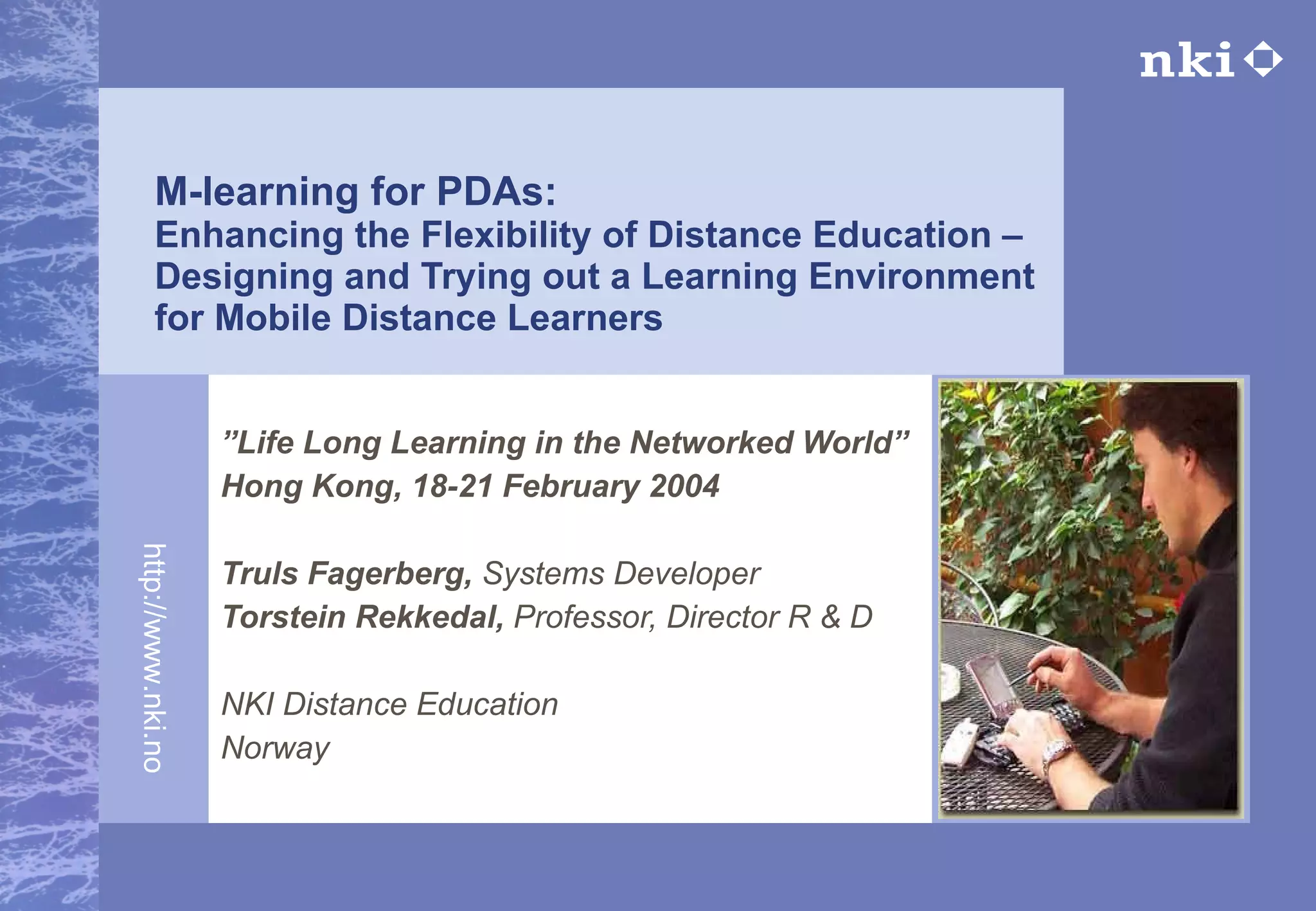
M-learning for PDAs: Enhancing the Flexibility of Distance Education –  Designing and Trying out  a Learning Environment for Mobile Distance Learners ” Life Long Learning in the Networked World”  Hong Kong, 18-21 February 2004 Truls Fagerberg,  Systems Developer   Torstein Rekkedal,  Professor,   Director R & D NKI Distance Education Norway
M-learning for PDAs: Overview NKI Distance Education and Online Education Basic philosophies when developing system for m-learning Developing the environment for m-learning The two courses developed and trialled Experiences
NKI The NKI Group – a non-profit foundation in education: NKI Distance Education: Each year around 15,000 active students 100 programmes and 400 courses 60 programmes and 380 courses on the Internet The Norwegian School of Information Technology (NITH) The Business Training Centre (NA) NKI Publishing House NKI Distance Education
NKI and Online Education NKI Distance Education/NKI Internet College Online distance teaching since 1987 In continuous operation Integrated research/educational development/technological development ’ Mainstream’ technology 5800  students in  40  countries   380  courses/ 6 0 study programmes    
Distance Learning – Flexibility and Mobility D-learning, e-learning and m-learning “ E-learning is the collection of teaching – and information packages – in further education which is available at any time and any place and are delivered to learners electronically. They contain units of information, self-testing batteries and tests, which allow a quick self-evaluation for quick placement. E-learning offers more lower level learning goals. Higher order goals like understanding, reasoning and (moral) judging are more difficult to achieve. They require an individualised interactive discourse and can hardly be planned”  (Dichantz 2001) “ The term ‘mLearning’ has lately emerged to be associated with the use of mobile technology in education. It seems, however, that it is used in commercial purposes rather than as an educational concept. We wonder if the term is a commercial trick to market technology and educational services or if it is an emerging concept that educationalists should take seriously.”  (Sariola et al. 2001 )
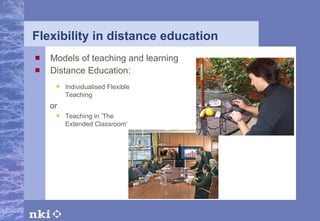
Flexibility in distance education Models of teaching and learning Distance Education: Individualised Flexible Teaching  or  Teaching in ’The Extended Classroom’
NKI basic philosophies concerning distance learning Student autonomy and flexibility Flexible and individual distance teaching with the student group as social and academic support for learning Views of knowledge and learning The result of learning is a change in the student’s perceptions Learning is a qualitative change in understanding Learning is an active process Learning is a socially supported individual process
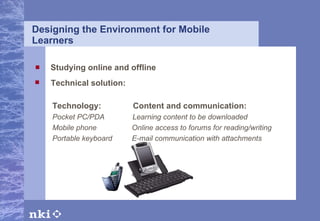
Designing the Environment for Mobile Learners Studying online and offline Technical solution: Technology:  Content and communication: Pocket PC/PDA     Learning content to be downloaded Mobile phone     Online access to forums for reading/writing  Portable keyboard     E-mail communication with attachments
Students’ and tutor’s use of technology when mobile When mobile the students must be able to: Study the course materials Make notes Write assignments Access Forum to read Access Forum to submit contributions Send e-mail to fellow students  Receive e-mail from fellow students Submit assignments by e-mail including attachments  Receiv e  assignments corrected and commented on by the tutor
The  t rials The courses :   The tutor in distance education (Norwegian version) SPICE 603 Online Teaching and Learning
The trials Experimental conditions: First trial: Simulated learning situation Evaluation methods and procedures: Field study Qualitative process evaluation Final ’quantitative’ questionnaire Second trial: Real course with real students in real setting
Results Assignment for submission via mobile technology : Few problems, acceptable costs The participant’s study situation Students and tutors working with the course at home, at the office and on travel   Downloading and synchronizing learning content Technology: Broadband, LAN, modem, ISDN and mobile – few problems Reading and studying on the PDA : E-book version preferred before HTML Contribution to Forum via PDA and mobile phone : Direct access to Forum, preprepared message, fast connection
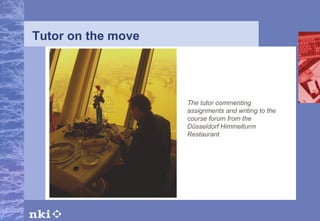
Tutor on the move The tutor commenting assignments and writing to the course forum from the Düsseldorf Himmelturm Restaurant
Conclusions Mobile technology may increase the flexibility of distance teaching The technology functioned according to expectations Participants’ views varied – from enthusiastic to quite reserved The students expressed very different views concerning reading from a small screen Institutional challenges for systems development to cater for mobile and not mobile learners Technical problems exist, but are continuously reduced through software and hardware developments Portable keyboard is necessary for efficient use of the PDA as a teaching and learning tool We need better solutions for browsing web pages Mobile communication is still expensive – especially from abroad We are uncertain whether a future solution for mobile learning is solved by Mobile phone and pda Hybrid (pocket phone/computer) Laptop with mobile connection Other solutions (?)
The New Project M-learning – the next generation of learning NKI main goal: Research solutions to i ncrease  the  flexibility of online distance education The main challenge is to  design solutions for learners who are users of mobile technology and wish to study also when on the move, that also allow other students to apply standard technology.  The solutions must be designed in ways to allow both groups to participate in the same course.  W e  must  look for solutions that are optimal for distributing content and communication in courses, independent on whether the students and tutors apply mobile technology or standard PC and Internet connection for teaching or learning. There is no doubt that NKI Distance Education faces a large challenge in further developing server side solutions and methodology that include the use of mobile technology for serving our mobile distance learners more efficiently.
Thank you! NKI Internet College:   http://www.nettskolen.com/ Powerpoint Presentation:   http://home.nettskolen.com/~torstein/m-learningICDE2004.ppt Presentation   http://home.nettskolen.com/~torstein/ICDE2004finalpaper.doc Torstein Rekkedal home page:   http://home.nettskolen.nki.no/~torstein/

Mobile learning for PDAs 2004

  • 1.
    M-learning for PDAs:Enhancing the Flexibility of Distance Education – Designing and Trying out a Learning Environment for Mobile Distance Learners ” Life Long Learning in the Networked World” Hong Kong, 18-21 February 2004 Truls Fagerberg, Systems Developer Torstein Rekkedal, Professor, Director R & D NKI Distance Education Norway
  • 2.
    M-learning for PDAs:Overview NKI Distance Education and Online Education Basic philosophies when developing system for m-learning Developing the environment for m-learning The two courses developed and trialled Experiences
  • 3.
    NKI The NKIGroup – a non-profit foundation in education: NKI Distance Education: Each year around 15,000 active students 100 programmes and 400 courses 60 programmes and 380 courses on the Internet The Norwegian School of Information Technology (NITH) The Business Training Centre (NA) NKI Publishing House NKI Distance Education
  • 4.
    NKI and OnlineEducation NKI Distance Education/NKI Internet College Online distance teaching since 1987 In continuous operation Integrated research/educational development/technological development ’ Mainstream’ technology 5800 students in 40 countries   380 courses/ 6 0 study programmes  
  • 5.
    Distance Learning –Flexibility and Mobility D-learning, e-learning and m-learning “ E-learning is the collection of teaching – and information packages – in further education which is available at any time and any place and are delivered to learners electronically. They contain units of information, self-testing batteries and tests, which allow a quick self-evaluation for quick placement. E-learning offers more lower level learning goals. Higher order goals like understanding, reasoning and (moral) judging are more difficult to achieve. They require an individualised interactive discourse and can hardly be planned” (Dichantz 2001) “ The term ‘mLearning’ has lately emerged to be associated with the use of mobile technology in education. It seems, however, that it is used in commercial purposes rather than as an educational concept. We wonder if the term is a commercial trick to market technology and educational services or if it is an emerging concept that educationalists should take seriously.” (Sariola et al. 2001 )
  • 6.
    Flexibility in distanceeducation Models of teaching and learning Distance Education: Individualised Flexible Teaching or Teaching in ’The Extended Classroom’
  • 7.
    NKI basic philosophiesconcerning distance learning Student autonomy and flexibility Flexible and individual distance teaching with the student group as social and academic support for learning Views of knowledge and learning The result of learning is a change in the student’s perceptions Learning is a qualitative change in understanding Learning is an active process Learning is a socially supported individual process
  • 8.
    Designing the Environmentfor Mobile Learners Studying online and offline Technical solution: Technology: Content and communication: Pocket PC/PDA Learning content to be downloaded Mobile phone Online access to forums for reading/writing Portable keyboard E-mail communication with attachments
  • 9.
    Students’ and tutor’suse of technology when mobile When mobile the students must be able to: Study the course materials Make notes Write assignments Access Forum to read Access Forum to submit contributions Send e-mail to fellow students Receive e-mail from fellow students Submit assignments by e-mail including attachments Receiv e assignments corrected and commented on by the tutor
  • 10.
    The trials The courses :   The tutor in distance education (Norwegian version) SPICE 603 Online Teaching and Learning
  • 11.
    The trials Experimentalconditions: First trial: Simulated learning situation Evaluation methods and procedures: Field study Qualitative process evaluation Final ’quantitative’ questionnaire Second trial: Real course with real students in real setting
  • 12.
    Results Assignment forsubmission via mobile technology : Few problems, acceptable costs The participant’s study situation Students and tutors working with the course at home, at the office and on travel Downloading and synchronizing learning content Technology: Broadband, LAN, modem, ISDN and mobile – few problems Reading and studying on the PDA : E-book version preferred before HTML Contribution to Forum via PDA and mobile phone : Direct access to Forum, preprepared message, fast connection
  • 13.
    Tutor on themove The tutor commenting assignments and writing to the course forum from the Düsseldorf Himmelturm Restaurant
  • 14.
    Conclusions Mobile technologymay increase the flexibility of distance teaching The technology functioned according to expectations Participants’ views varied – from enthusiastic to quite reserved The students expressed very different views concerning reading from a small screen Institutional challenges for systems development to cater for mobile and not mobile learners Technical problems exist, but are continuously reduced through software and hardware developments Portable keyboard is necessary for efficient use of the PDA as a teaching and learning tool We need better solutions for browsing web pages Mobile communication is still expensive – especially from abroad We are uncertain whether a future solution for mobile learning is solved by Mobile phone and pda Hybrid (pocket phone/computer) Laptop with mobile connection Other solutions (?)
  • 15.
    The New ProjectM-learning – the next generation of learning NKI main goal: Research solutions to i ncrease the flexibility of online distance education The main challenge is to design solutions for learners who are users of mobile technology and wish to study also when on the move, that also allow other students to apply standard technology. The solutions must be designed in ways to allow both groups to participate in the same course. W e must look for solutions that are optimal for distributing content and communication in courses, independent on whether the students and tutors apply mobile technology or standard PC and Internet connection for teaching or learning. There is no doubt that NKI Distance Education faces a large challenge in further developing server side solutions and methodology that include the use of mobile technology for serving our mobile distance learners more efficiently.
  • 16.
    Thank you! NKIInternet College: http://www.nettskolen.com/ Powerpoint Presentation: http://home.nettskolen.com/~torstein/m-learningICDE2004.ppt Presentation http://home.nettskolen.com/~torstein/ICDE2004finalpaper.doc Torstein Rekkedal home page: http://home.nettskolen.nki.no/~torstein/