Mobile
Computing
by
Muhammad Abdullah
What is Mobile Computing?
Mobile Computing is a technology that allows
transmission of data, voice and video via a computer
or any other wireless enabled device without having
to be connected to a fixed physical link.
Mobile Computing is an umbrella term used to
describe technologies that enable people to access
network services anyplace, anytime, and anywhere.
Mobile Computing Devices
Tablets Laptops:
Mobile
Phones: Palmtop:
PDA : Notebook
PC’S:
HISTORY
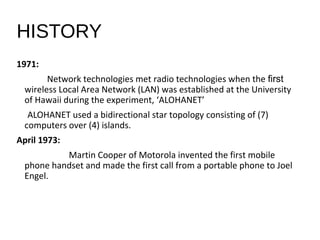
1971:
Network technologies met radio technologies when the first
wireless Local Area Network (LAN) was established at the University
of Hawaii during the experiment, ‘ALOHANET’
ALOHANET used a bidirectional star topology consisting of (7)
computers over (4) islands.
April 1973:
Martin Cooper of Motorola invented the first mobile
phone handset and made the first call from a portable phone to Joel
Engel.
HISTORY
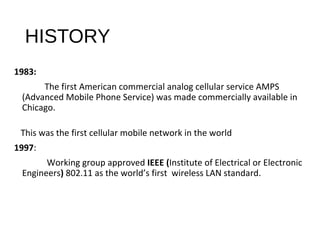
1983:
The first American commercial analog cellular service AMPS
(Advanced Mobile Phone Service) was made commercially available in
Chicago.
This was the first cellular mobile network in the world
1997:
Working group approved IEEE (Institute of Electrical or Electronic
Engineers) 802.11 as the world’s first wireless LAN standard.
Key Features
1) Portability
2) Social Interactivity
3) Context Sensitivity
4) Connectivity
5) Individual
Applications of Mobile
Computing
• 1) Cellular Digital Packet Data (CDPD)
• 2) Useful to Executives
• 3) Stock information Collation/Control
• 4) Credit Card Verification
• 5) Entertainment
• 6) WEB Access
• 7) Location Aware Services
Advantages
• 1) Increase in Productivity
• 2) Entertainment
• 3) Portability
• 4) Cloud Computing
Disadvantages
• 1) Range and bandwidth
• 2) Security standards
• 3) Power consumption
• 4) Transmission interferences
Mobile computing

Mobile computing

  • 1.
  • 2.
    What is MobileComputing? Mobile Computing is a technology that allows transmission of data, voice and video via a computer or any other wireless enabled device without having to be connected to a fixed physical link. Mobile Computing is an umbrella term used to describe technologies that enable people to access network services anyplace, anytime, and anywhere.
  • 3.
    Mobile Computing Devices TabletsLaptops: Mobile Phones: Palmtop: PDA : Notebook PC’S:
  • 4.
    HISTORY 1971: Network technologies metradio technologies when the first wireless Local Area Network (LAN) was established at the University of Hawaii during the experiment, ‘ALOHANET’ ALOHANET used a bidirectional star topology consisting of (7) computers over (4) islands. April 1973: Martin Cooper of Motorola invented the first mobile phone handset and made the first call from a portable phone to Joel Engel.
  • 5.
    HISTORY 1983: The first Americancommercial analog cellular service AMPS (Advanced Mobile Phone Service) was made commercially available in Chicago. This was the first cellular mobile network in the world 1997: Working group approved IEEE (Institute of Electrical or Electronic Engineers) 802.11 as the world’s first wireless LAN standard.
  • 6.
    Key Features 1) Portability 2)Social Interactivity 3) Context Sensitivity 4) Connectivity 5) Individual
  • 7.
    Applications of Mobile Computing •1) Cellular Digital Packet Data (CDPD) • 2) Useful to Executives • 3) Stock information Collation/Control • 4) Credit Card Verification • 5) Entertainment • 6) WEB Access • 7) Location Aware Services
  • 8.
    Advantages • 1) Increasein Productivity • 2) Entertainment • 3) Portability • 4) Cloud Computing
  • 9.
    Disadvantages • 1) Rangeand bandwidth • 2) Security standards • 3) Power consumption • 4) Transmission interferences