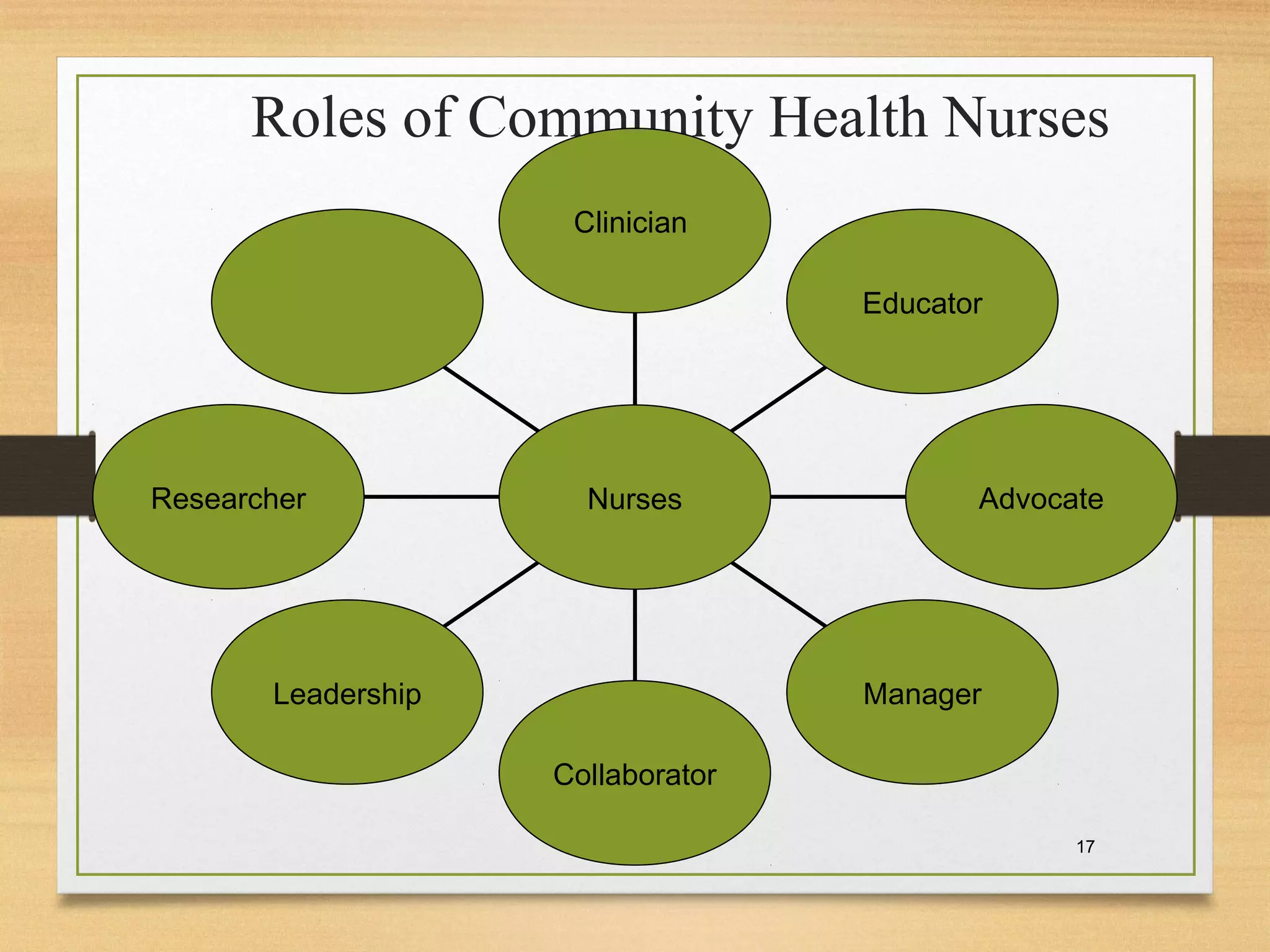
Unit I provides an introduction to community health nursing. It defines key terms and discusses the historical development of community health nursing from its origins in public health nursing. The objectives, philosophy, and concept of health are explained. The roles of community health nurses in various settings like homes, schools, and occupational settings are outlined. These roles include clinician, educator, advocate, manager, and collaborator. The document also discusses models of primary, secondary and tertiary prevention used in community health nursing to promote health and prevent illness.
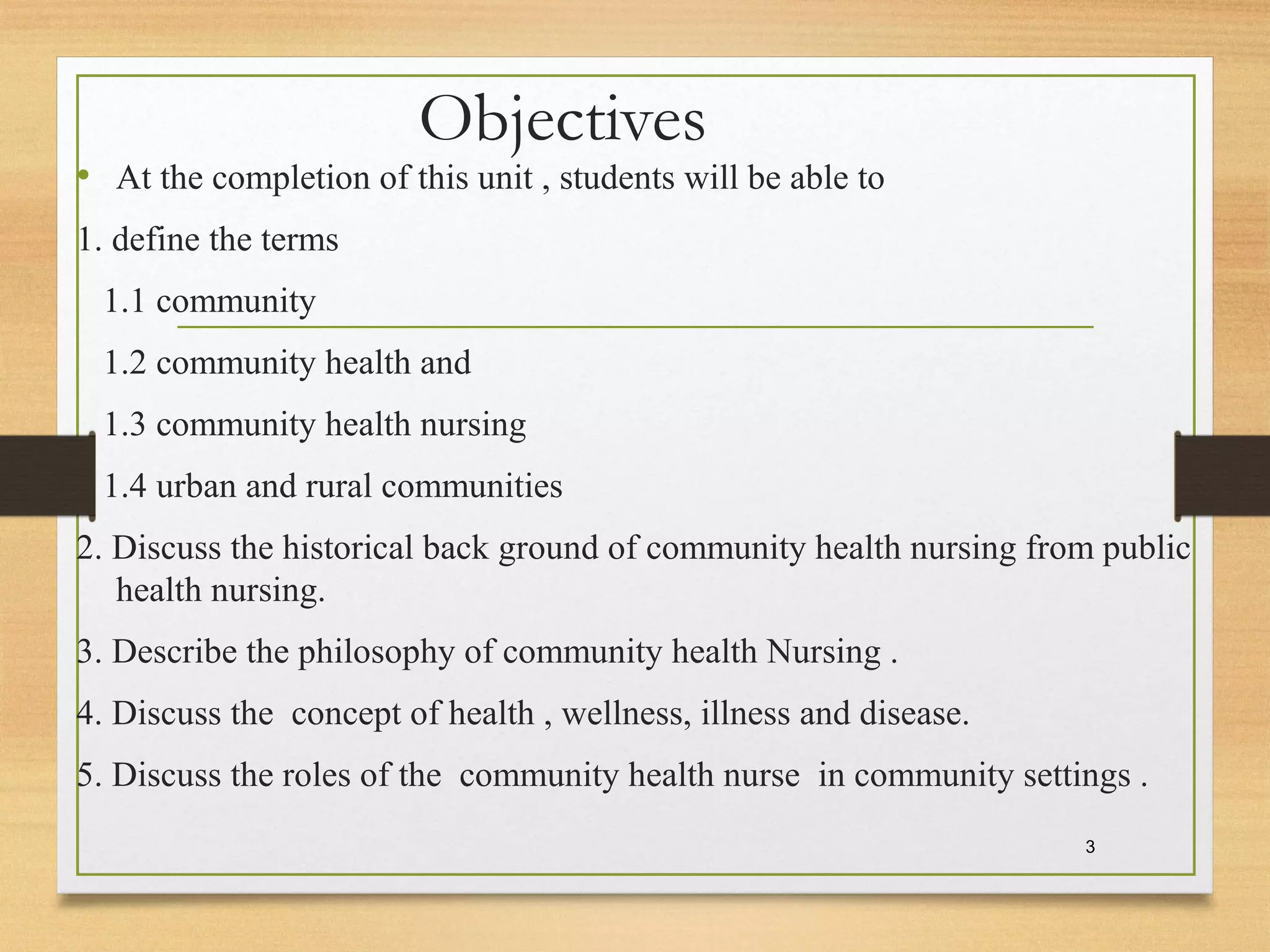
Objectives
• At thecompletion of this unit , students will be able to
1. define the terms
1.1 community
1.2 community health and
1.3 community health nursing
1.4 urban and rural communities
2. Discuss the historical back ground of community health nursing from public
health nursing.
3. Describe the philosophy of community health Nursing .
4. Discuss the concept of health , wellness, illness and disease.
5. Discuss the roles of the community health nurse in community settings .
3
4.
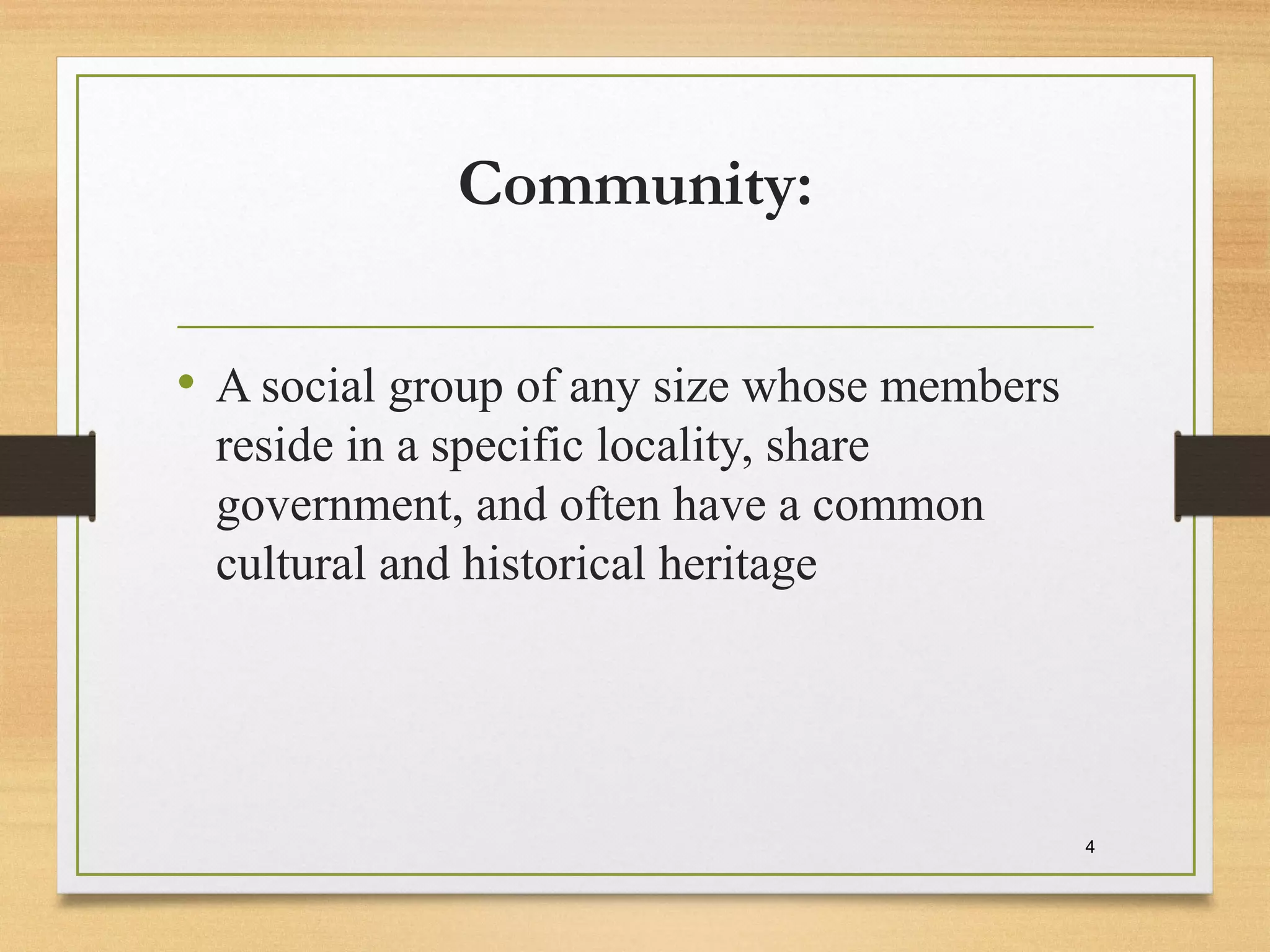
Community:
• A socialgroup of any size whose members
reside in a specific locality, share
government, and often have a common
cultural and historical heritage
4
5.
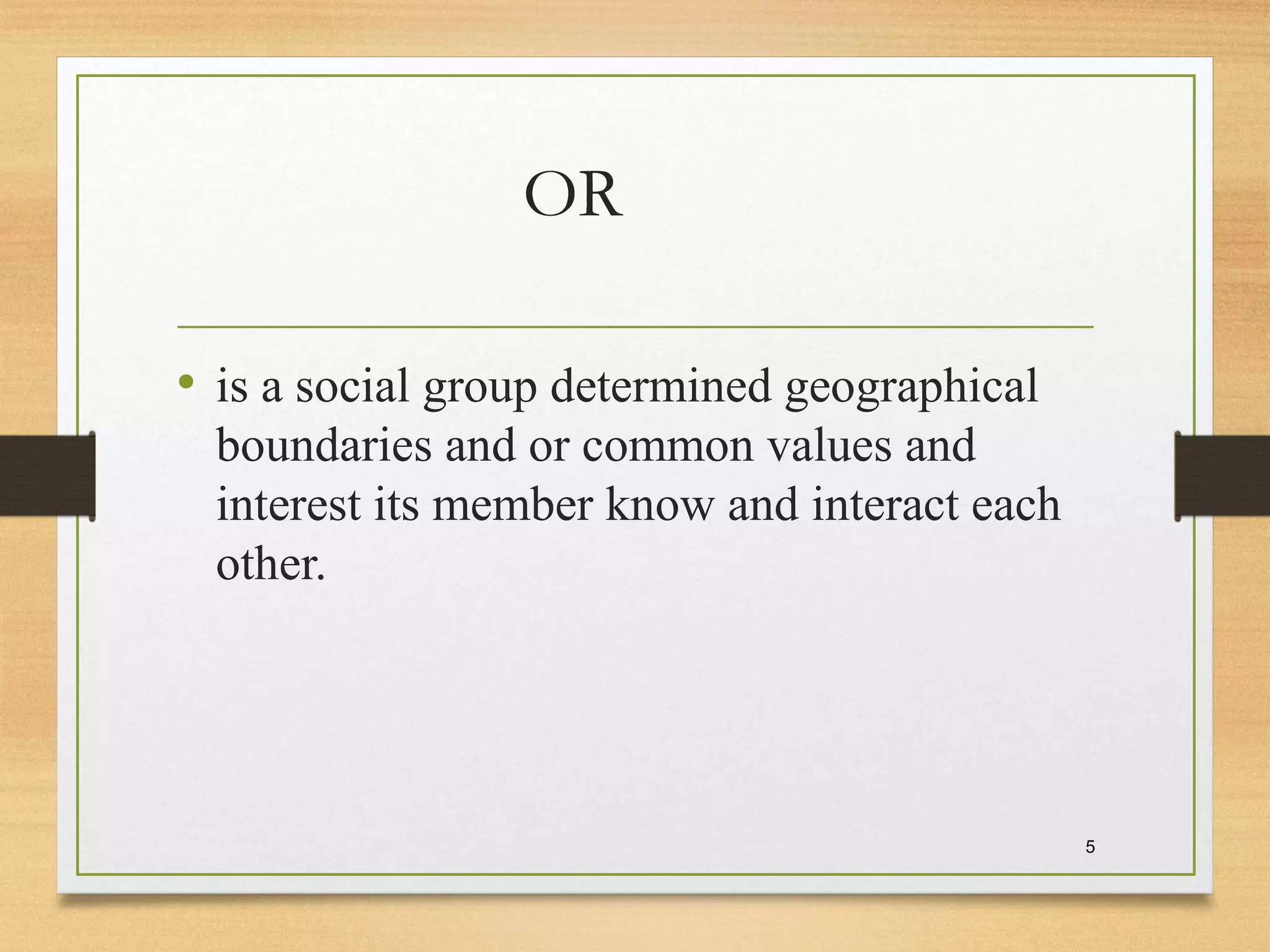
OR
• is asocial group determined geographical
boundaries and or common values and
interest its member know and interact each
other.
5
6.
Community Health
• Isthe science and art of preventing disease,
prolonging life and promoting health and
efficiency through organized efforts.
6
7.
Community health nursing
•Community health nursing is synthesis of
nursing practice and public health practice
applied to promoting and preserving the
health of population.
7
8.
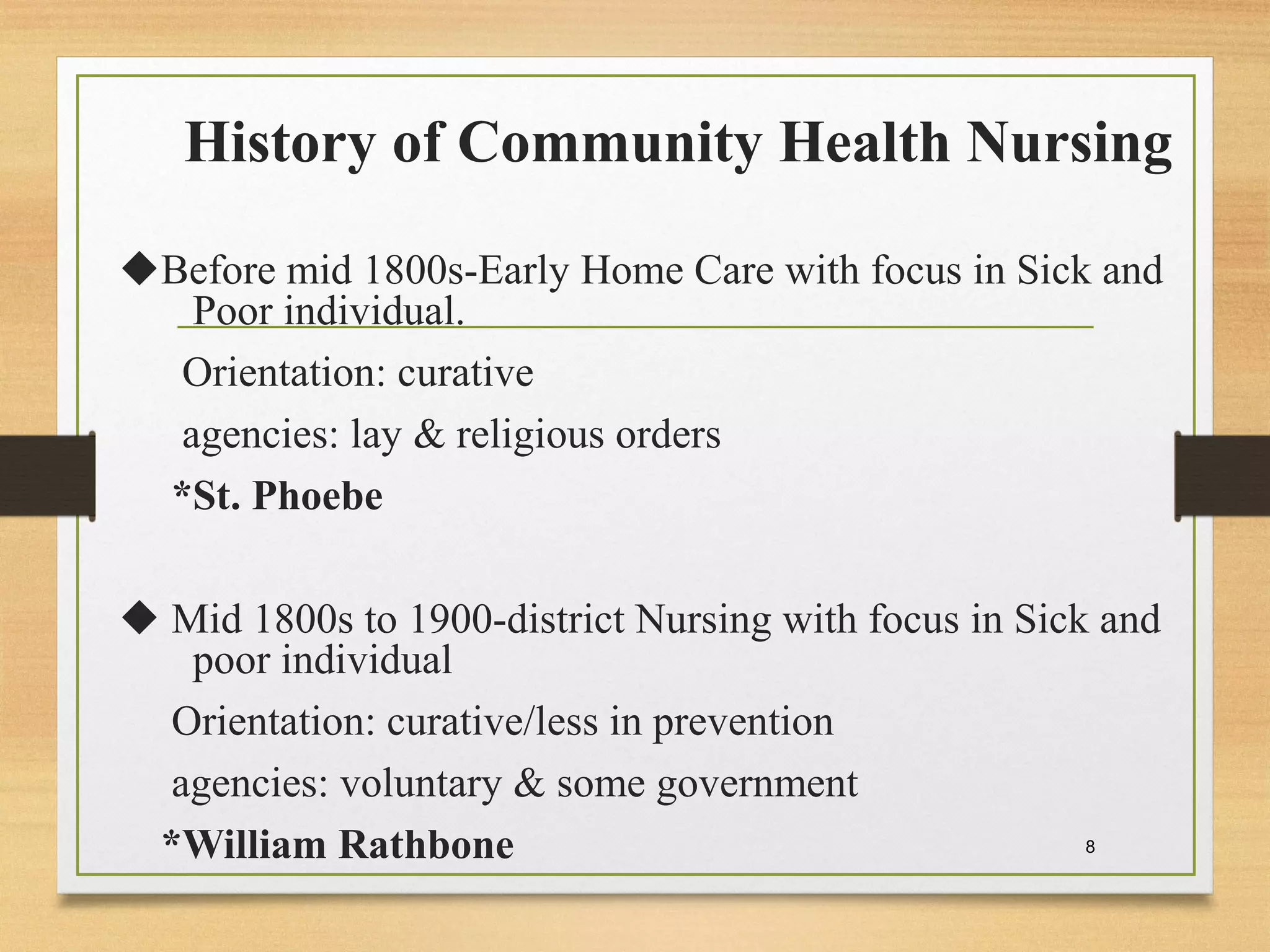
History of CommunityHealth Nursing
Before mid 1800s-Early Home Care with focus in Sick and
Poor individual.
Orientation: curative
agencies: lay & religious orders
*St. Phoebe
Mid 1800s to 1900-district Nursing with focus in Sick and
poor individual
Orientation: curative/less in prevention
agencies: voluntary & some government
*William Rathbone 8
9.
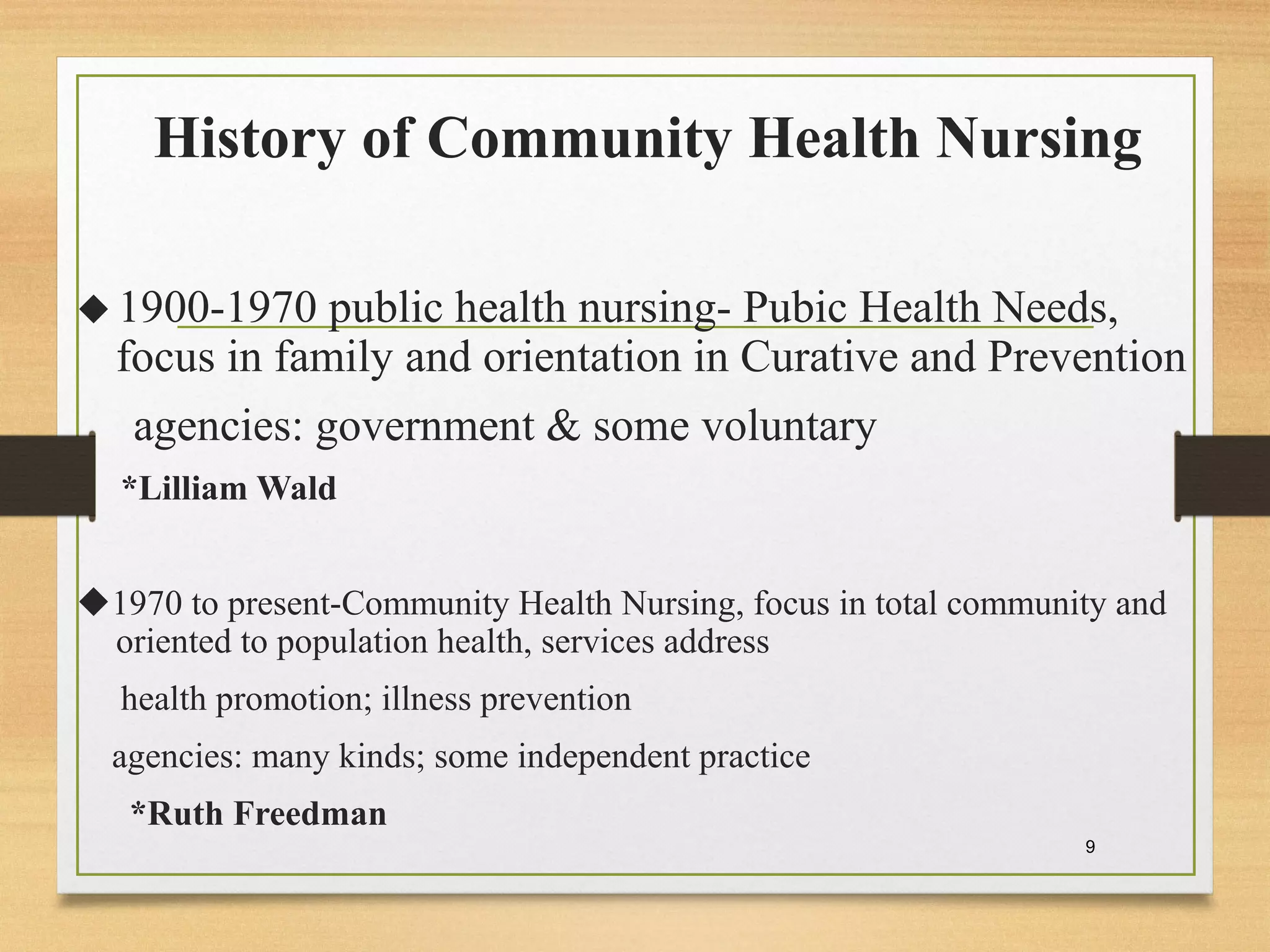
History of CommunityHealth Nursing
1900-1970 public health nursing- Pubic Health Needs,
focus in family and orientation in Curative and Prevention
agencies: government & some voluntary
*Lilliam Wald
1970 to present-Community Health Nursing, focus in total community and
oriented to population health, services address
health promotion; illness prevention
agencies: many kinds; some independent practice
*Ruth Freedman
9
10.
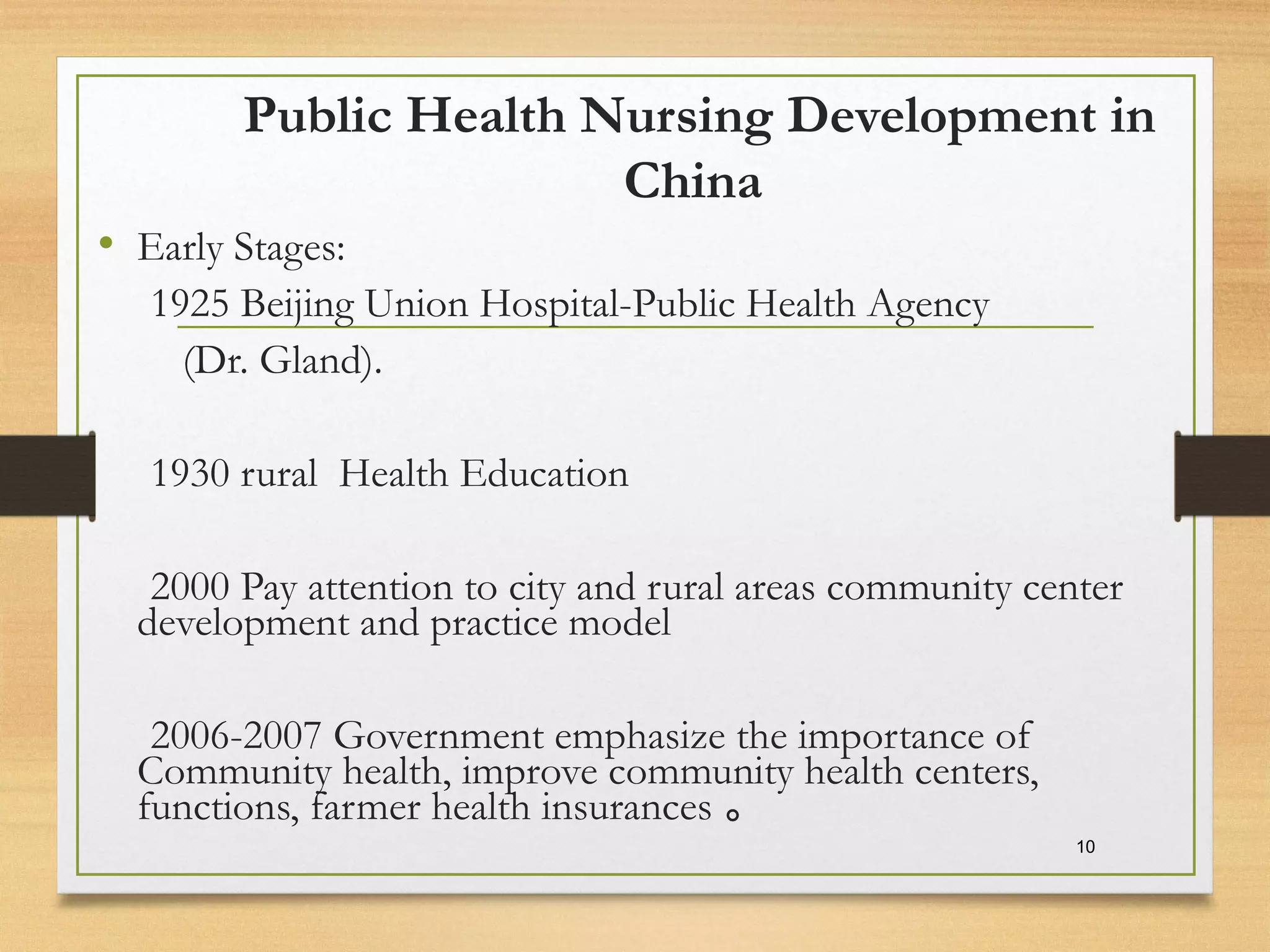
Public Health NursingDevelopment in
China
• Early Stages:
1925 Beijing Union Hospital-Public Health Agency
(Dr. Gland).
1930 rural Health Education
2000 Pay attention to city and rural areas community center
development and practice model
2006-2007 Government emphasize the importance of
Community health, improve community health centers,
functions, farmer health insurances 。
10
11.
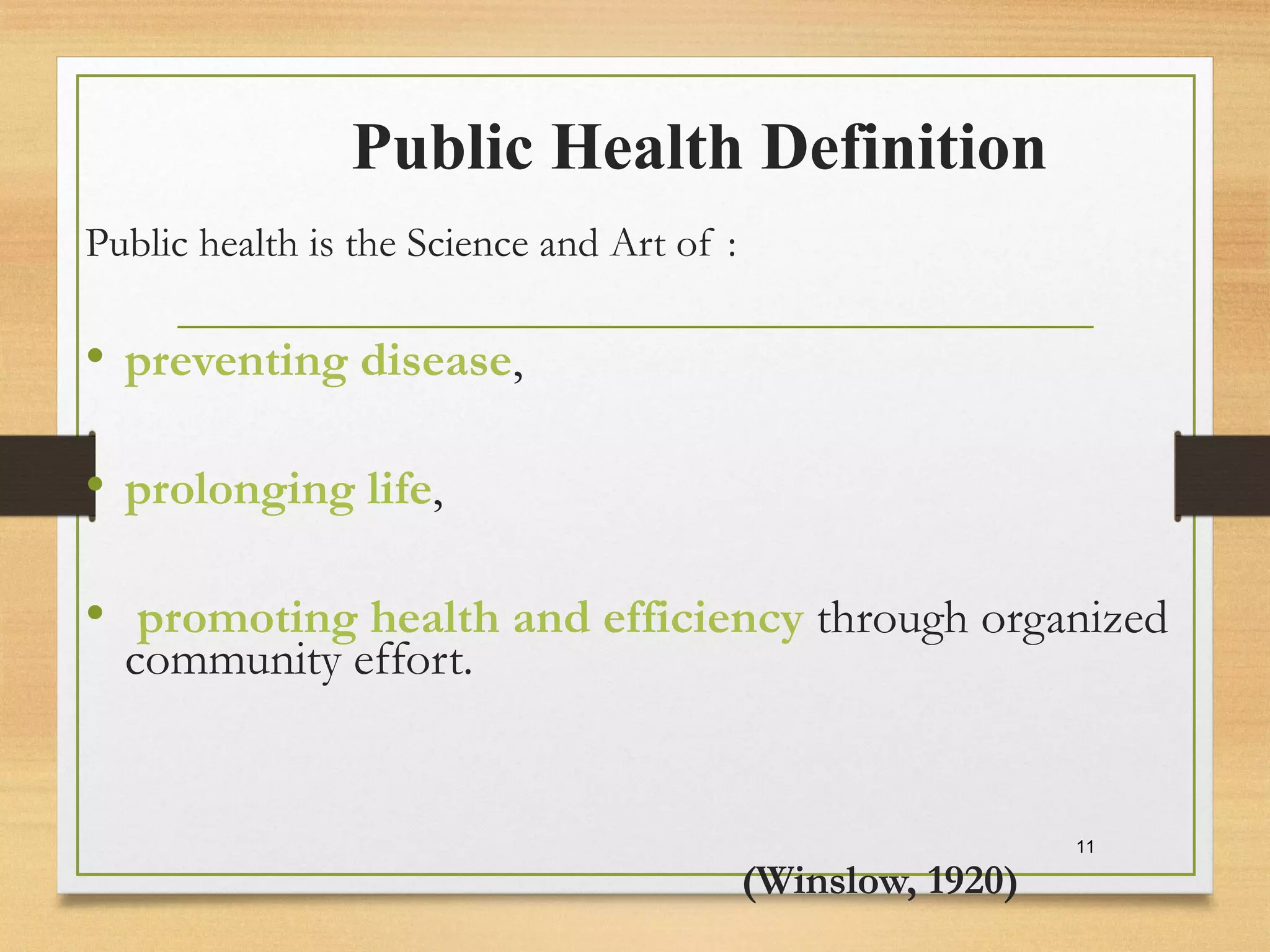
Public Health Definition
Publichealth is the Science and Art of :
• preventing disease,
• prolonging life,
• promoting health and efficiency through organized
community effort.
(Winslow, 1920)
11
12.
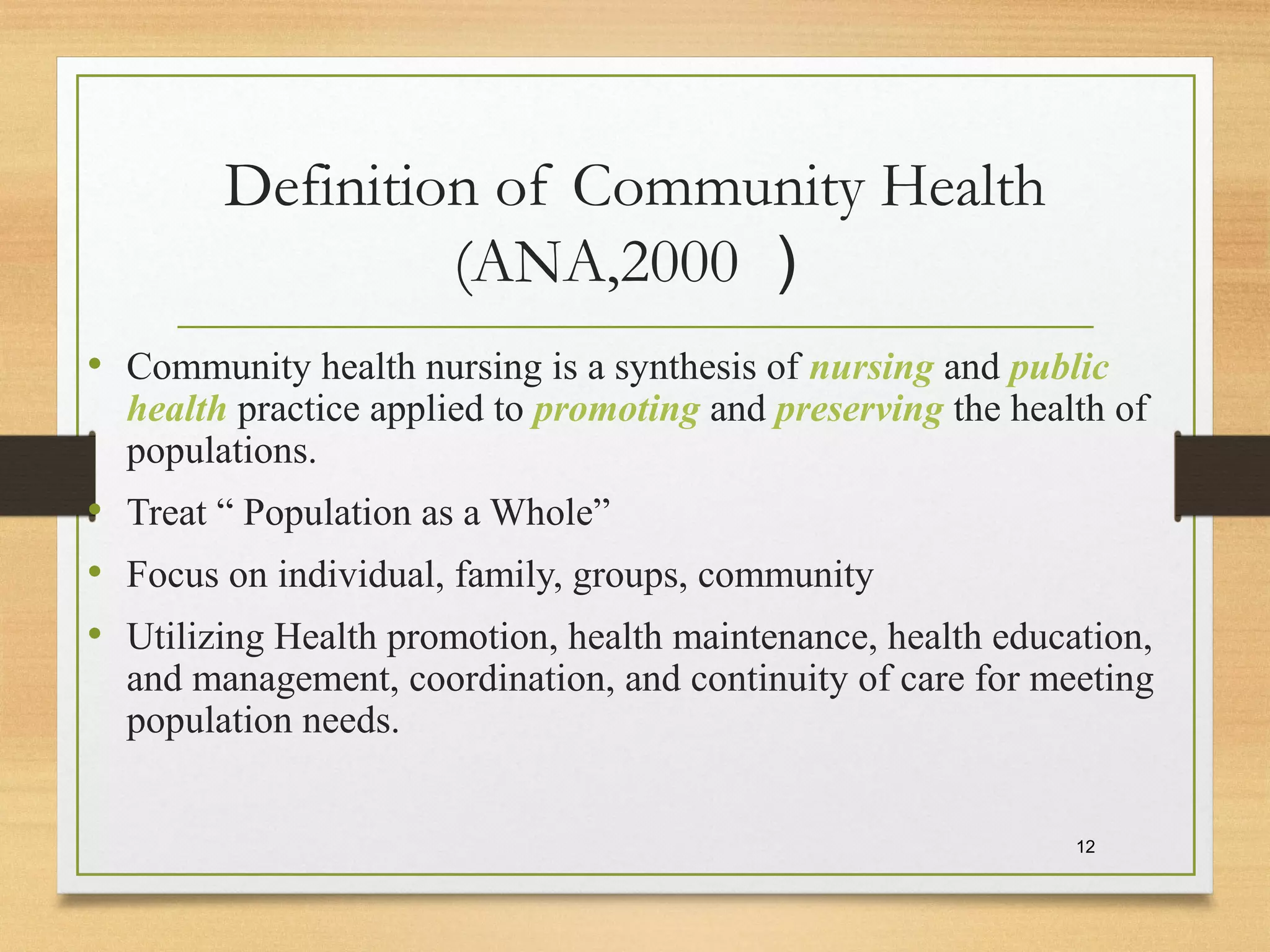
Definition of CommunityHealth
(ANA,2000 )
• Community health nursing is a synthesis of nursing and public
health practice applied to promoting and preserving the health of
populations.
• Treat “ Population as a Whole”
• Focus on individual, family, groups, community
• Utilizing Health promotion, health maintenance, health education,
and management, coordination, and continuity of care for meeting
population needs.
12
13.
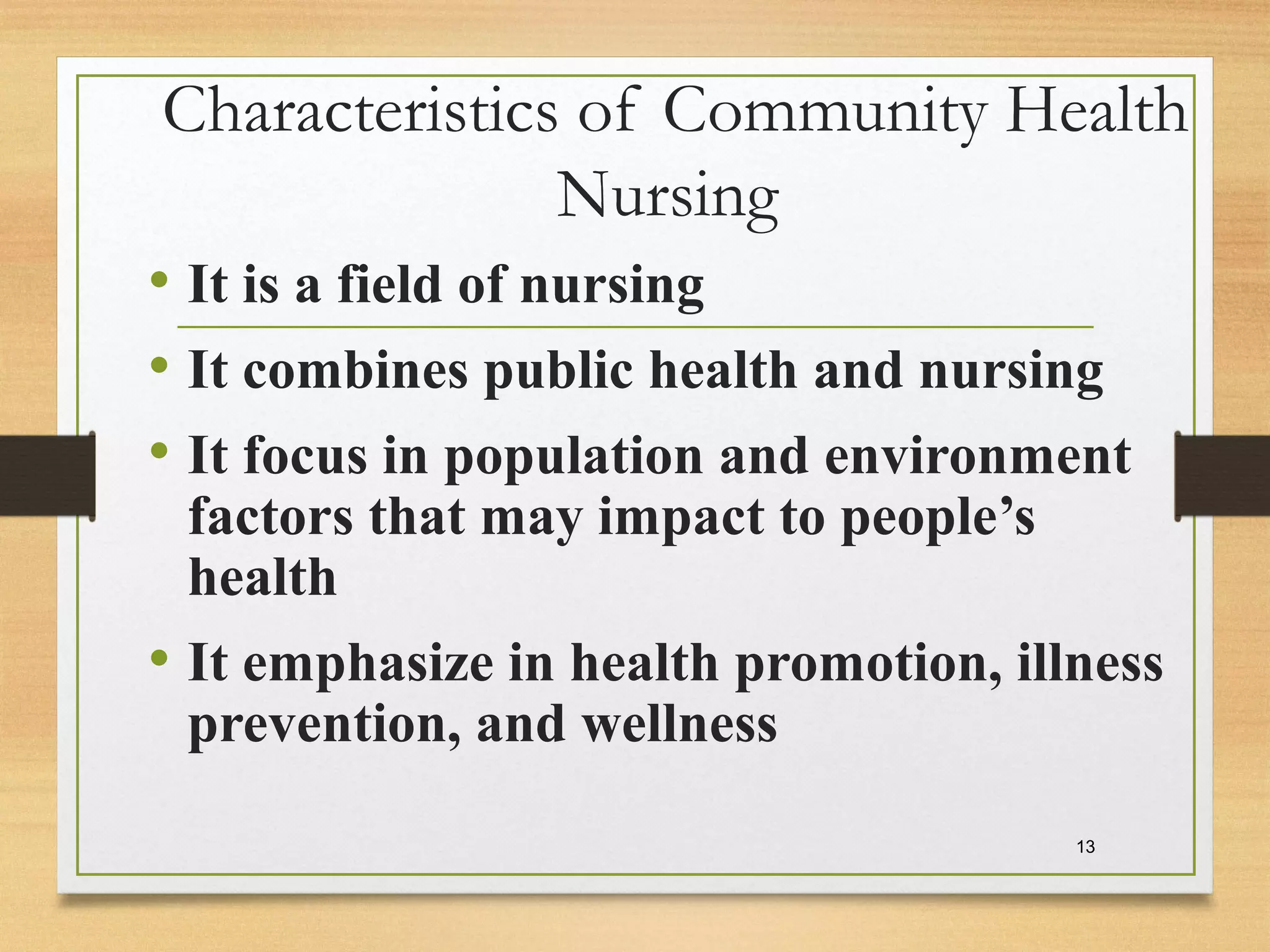
Characteristics of CommunityHealth
Nursing
• It is a field of nursing
• It combines public health and nursing
• It focus in population and environment
factors that may impact to people’s
health
• It emphasize in health promotion, illness
prevention, and wellness
13
14.
Characteristics of Community
HealthNursing
• It promotes client responsibility and self-care
It uses aggregate measurement and analysis
It use principle of organizational theory
• It involves inter-professional collaboration.
14
15.
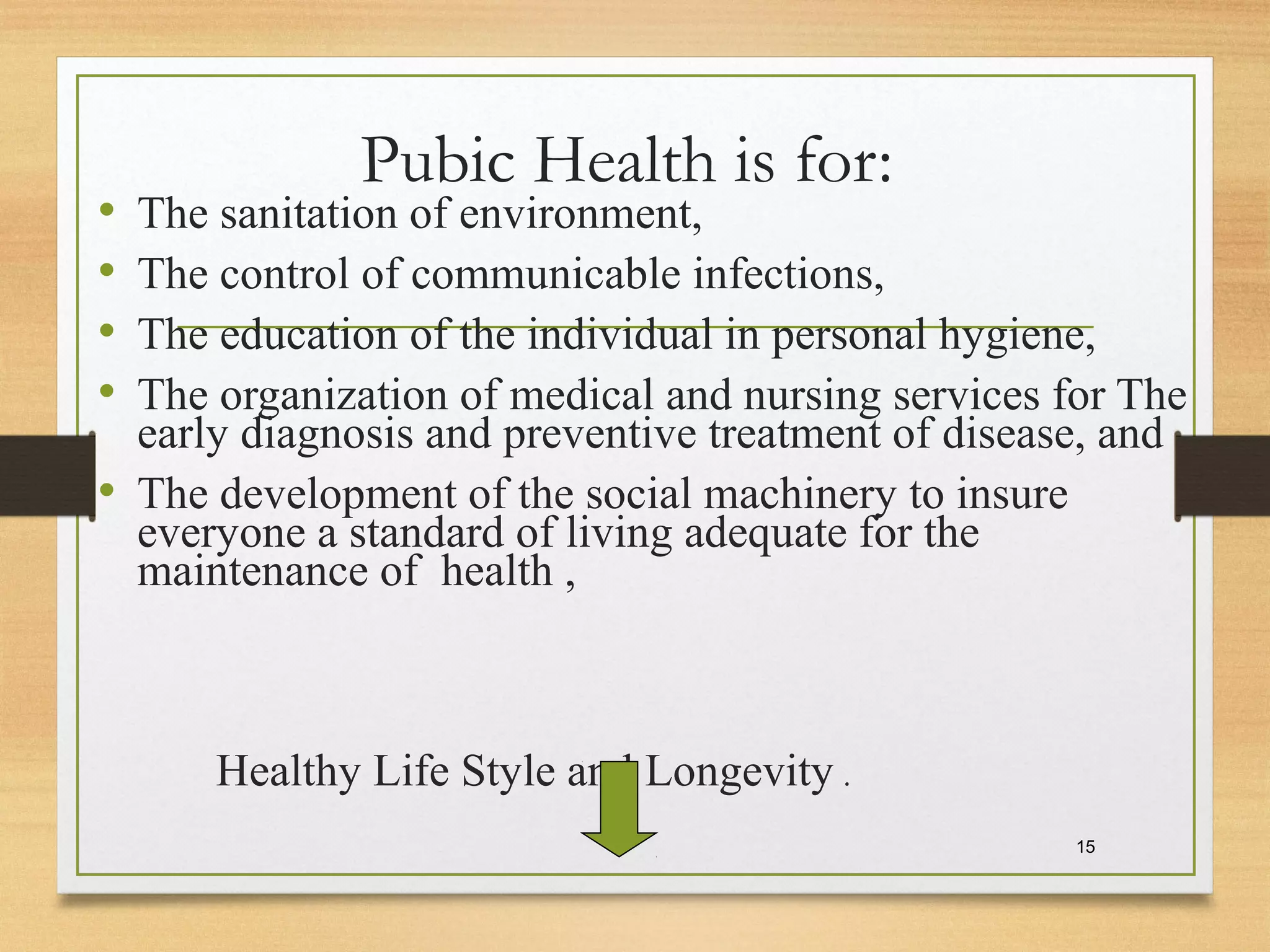
Pubic Health isfor:
• The sanitation of environment,
• The control of communicable infections,
• The education of the individual in personal hygiene,
• The organization of medical and nursing services for The
early diagnosis and preventive treatment of disease, and
• The development of the social machinery to insure
everyone a standard of living adequate for the
maintenance of health ,
Healthy Life Style and Longevity .
15
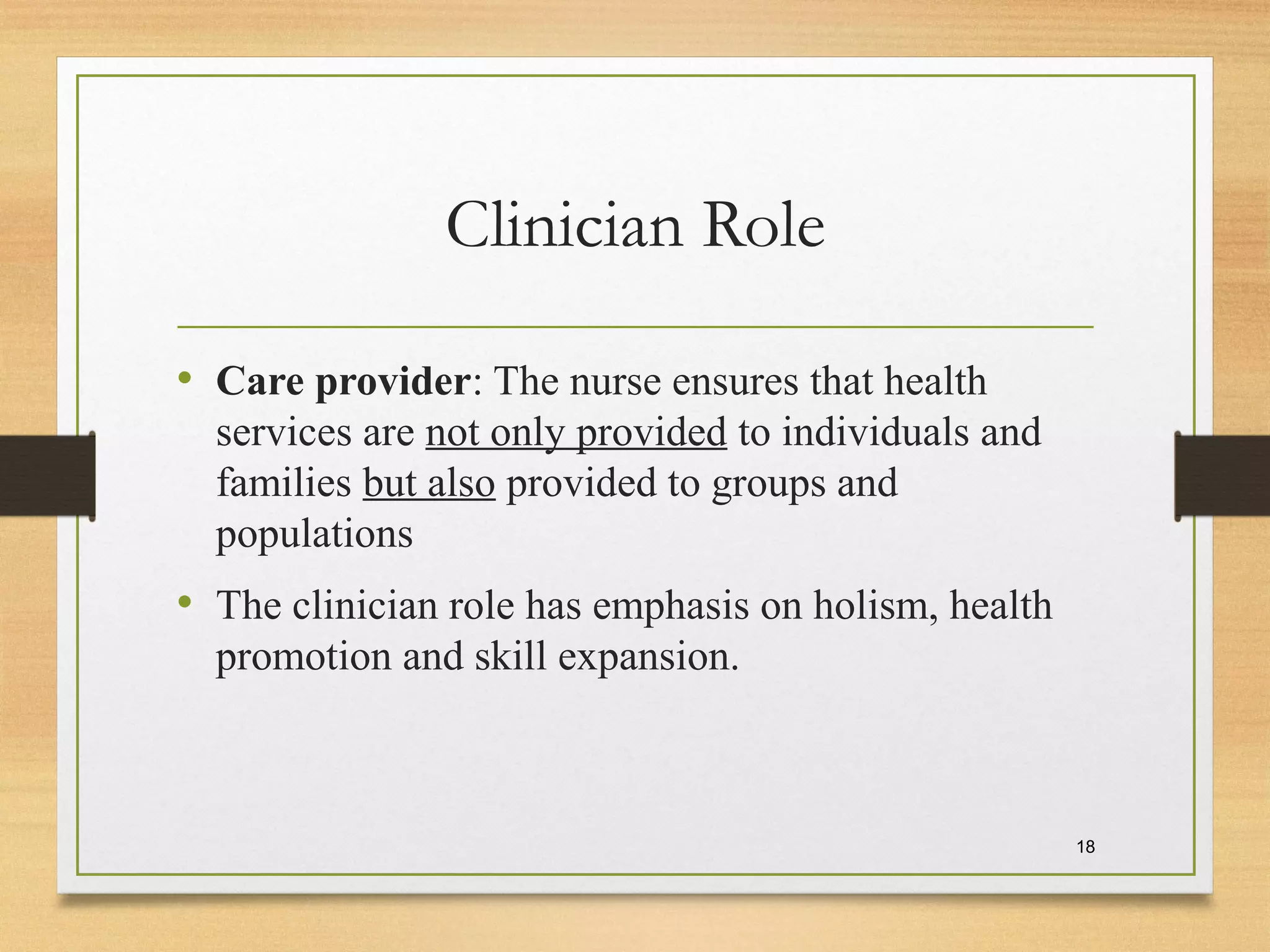
Clinician Role
• Careprovider: The nurse ensures that health
services are not only provided to individuals and
families but also provided to groups and
populations
• The clinician role has emphasis on holism, health
promotion and skill expansion.
18
19.
Examples at theclinics & Schools
• Immunization of infants and pre-schoolers
• Family planning programs
• Cholesterol screening
• Prevention of behavioural problems in adolescents
Expanded skills in observation, listening,
communication and counseling are integral to
your role as a CHN with emphasis on
psychological and socio-cultural factors
19
20.
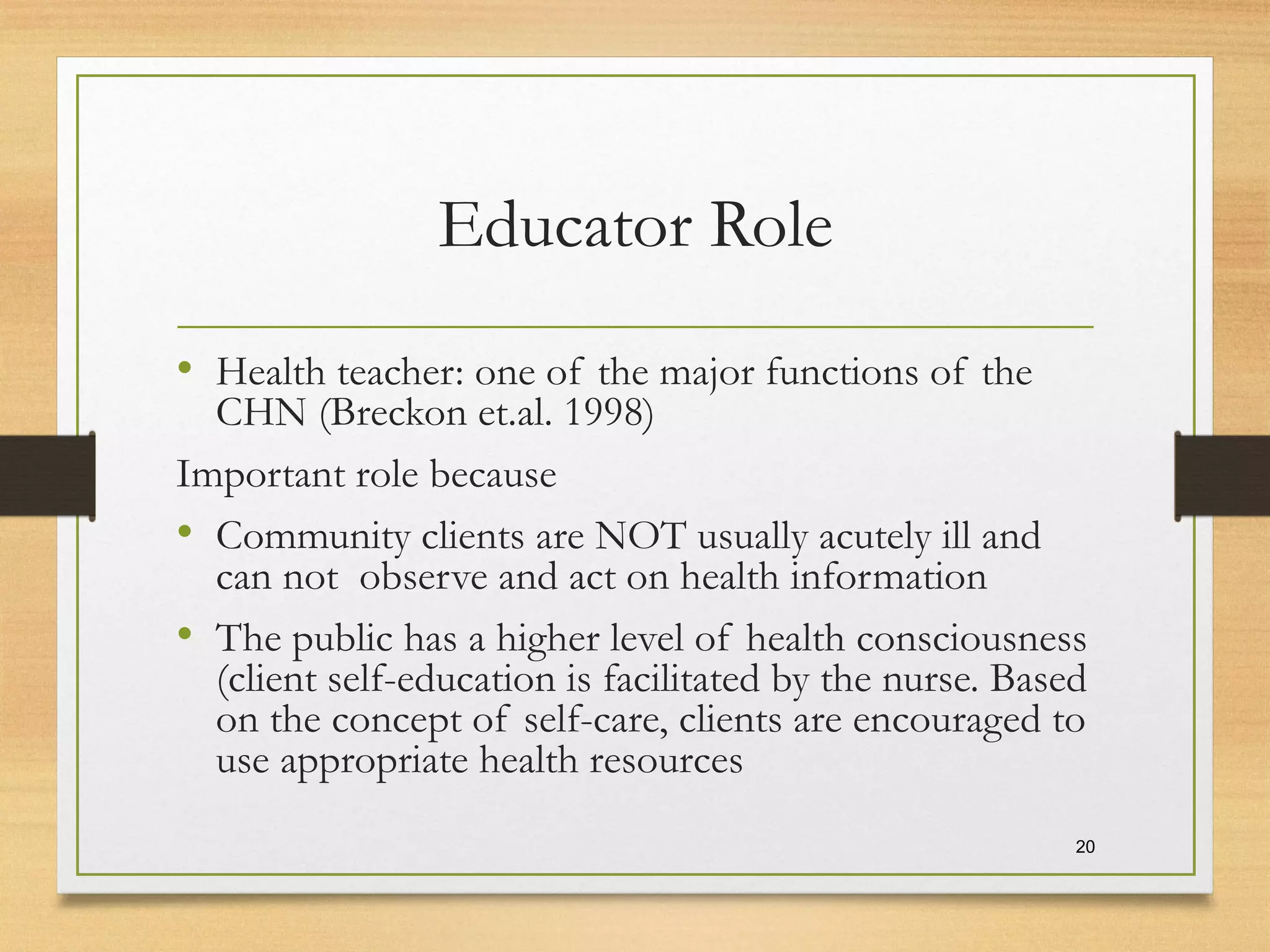
Educator Role
• Healthteacher: one of the major functions of the
CHN (Breckon et.al. 1998)
Important role because
• Community clients are NOT usually acutely ill and
can not observe and act on health information
• The public has a higher level of health consciousness
(client self-education is facilitated by the nurse. Based
on the concept of self-care, clients are encouraged to
use appropriate health resources
20
21.
Advocate Role
• Basedon clients’ rights: Every patient or client has the
right to receive just, equal, and humane treatment.
Goals of advocacy:
1.Help clients gain more independence and self-
determination
2.Make the system more responsive and relevant
21
22.
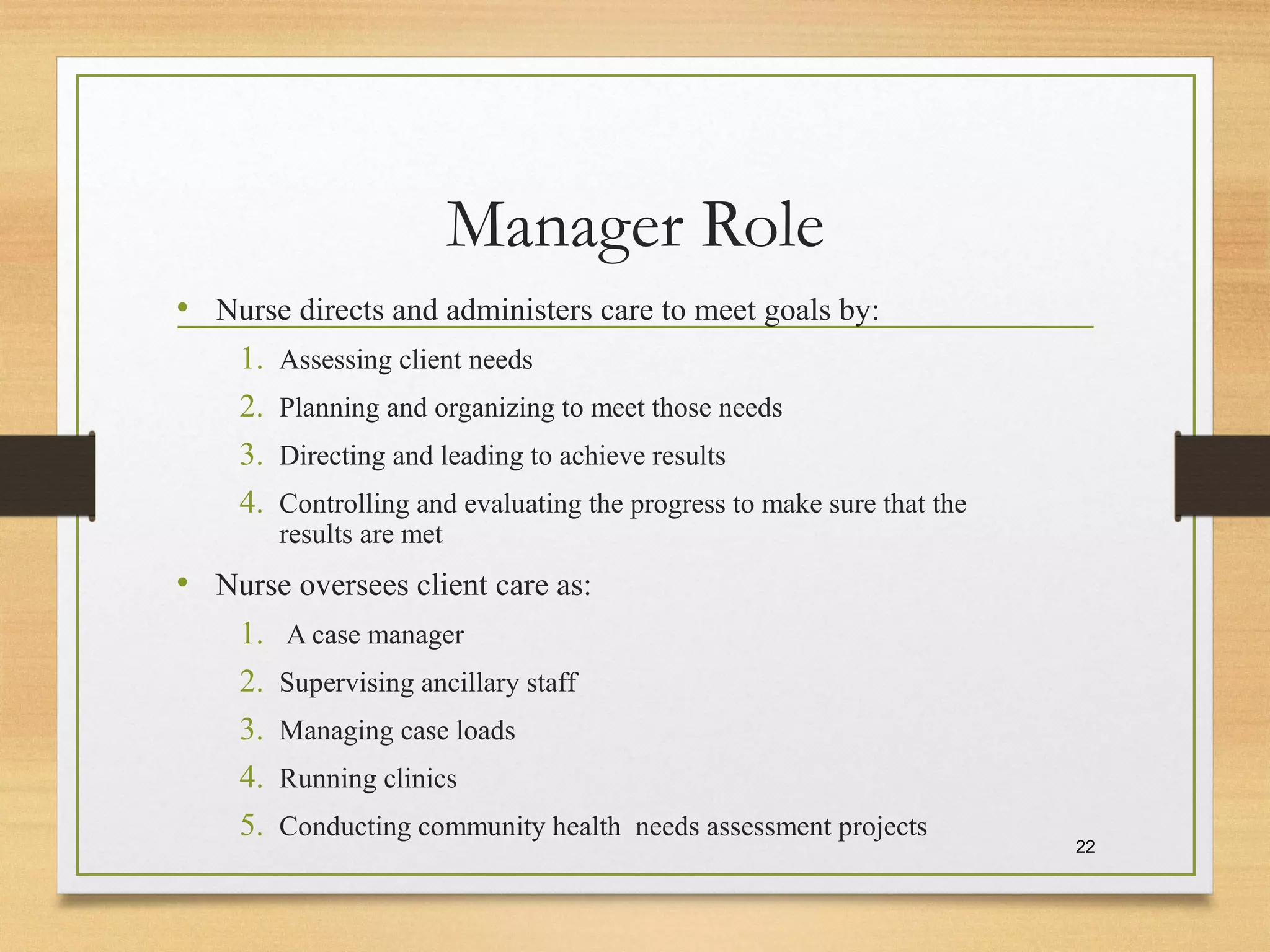
Manager Role
• Nursedirects and administers care to meet goals by:
1. Assessing client needs
2. Planning and organizing to meet those needs
3. Directing and leading to achieve results
4. Controlling and evaluating the progress to make sure that the
results are met
• Nurse oversees client care as:
1. A case manager
2. Supervising ancillary staff
3. Managing case loads
4. Running clinics
5. Conducting community health needs assessment projects
22
23.
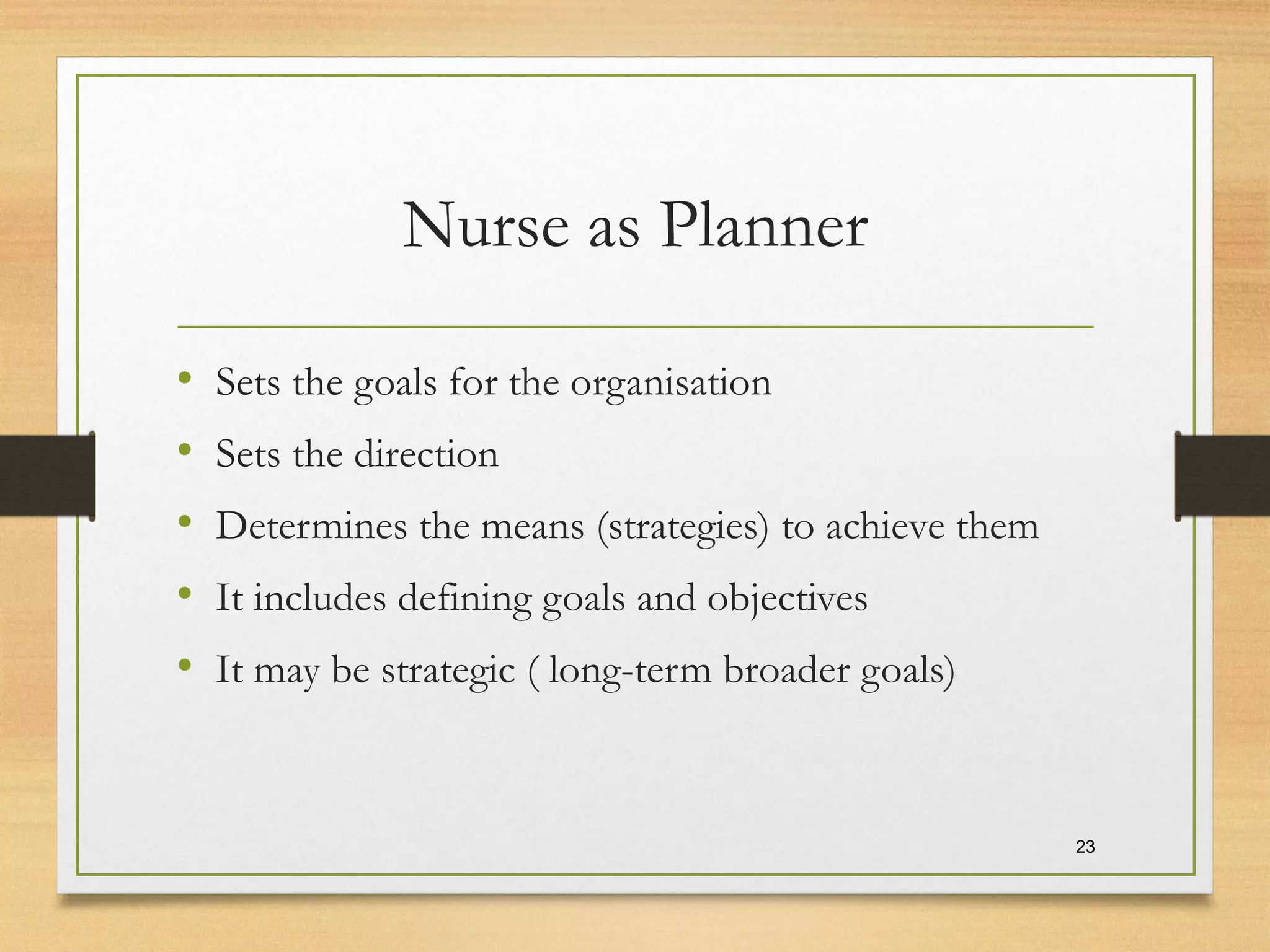
Nurse as Planner
•Sets the goals for the organisation
• Sets the direction
• Determines the means (strategies) to achieve them
• It includes defining goals and objectives
• It may be strategic ( long-term broader goals)
23
24.
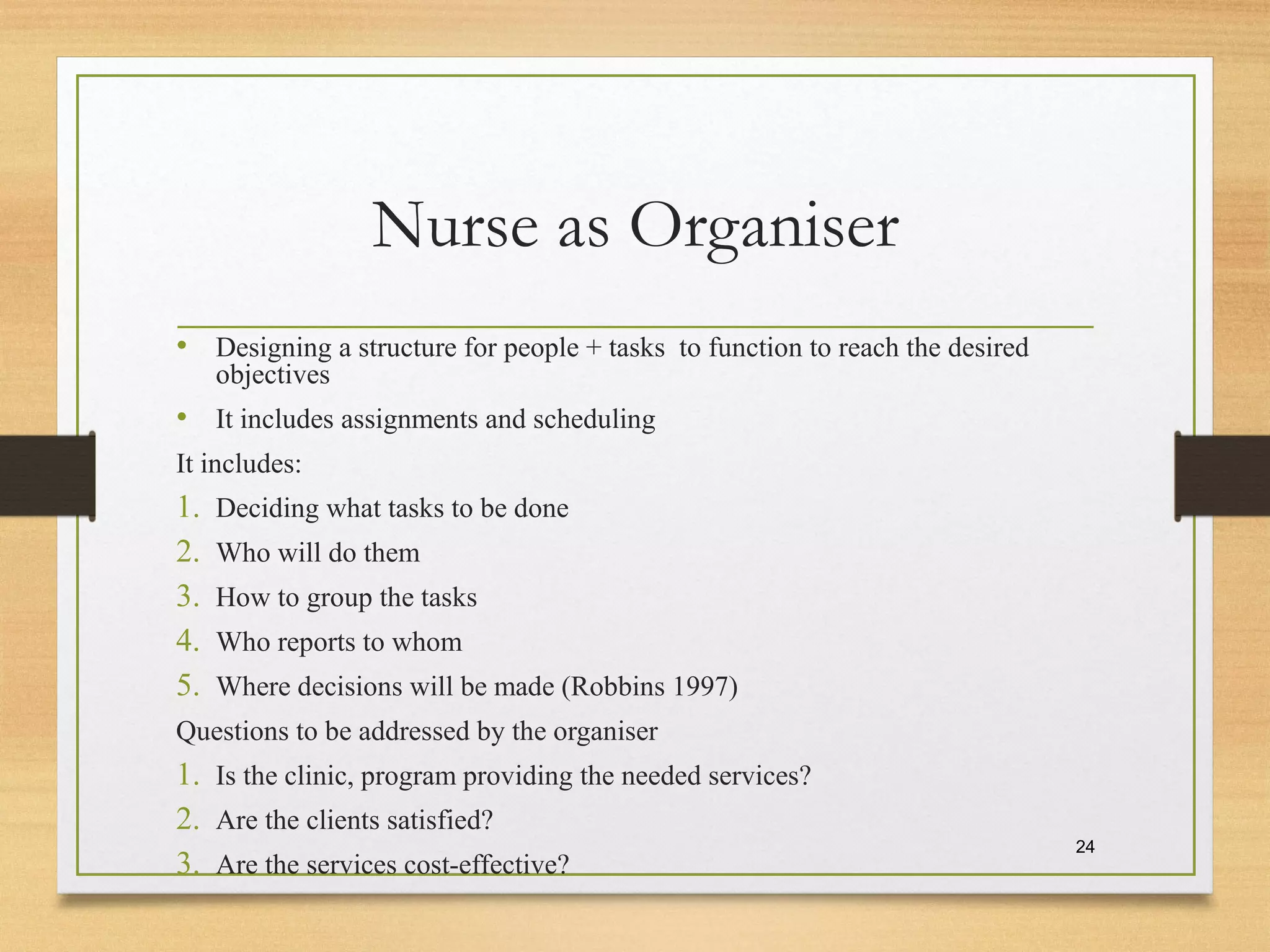
Nurse as Organiser
•Designing a structure for people + tasks to function to reach the desired
objectives
• It includes assignments and scheduling
It includes:
1. Deciding what tasks to be done
2. Who will do them
3. How to group the tasks
4. Who reports to whom
5. Where decisions will be made (Robbins 1997)
Questions to be addressed by the organiser
1. Is the clinic, program providing the needed services?
2. Are the clients satisfied?
3. Are the services cost-effective?
24
25.
Nurse as Leader
•The nurse directs, influences, or persuades others to
make change to positively influence people’s health.
• Includes persuading and motivating people, directing
activities, effective two-way communication, resolving
conflicts and coordinating the plan
• Coordination: Bringing people and activities
together to function in harmony to achieve desired
objectives
25
26.
Nurse as Controllerand Evaluator
• Controller: Monitors the plan and ensures that it
stays on course.
• Sometimes plans do not proceed as intended and need to
be adjusted
• Monitoring, comparing and adjusting are activities of
controlling
• Comparing performance and outcomes against set goals
and standards = Evaluator role
26
27.
Collaborator Role
• Meansworking jointly with others on a common project to cooperate as partners
Who?
• Clients
• Other nurses and physicians
• Teachers and health educators
• Social workers
• Physical therapists
• Nutritionists
• Psychologists
• Epidemiologists and Biostatisticians
• Secretaries
• City Planners and legislators
27
28.
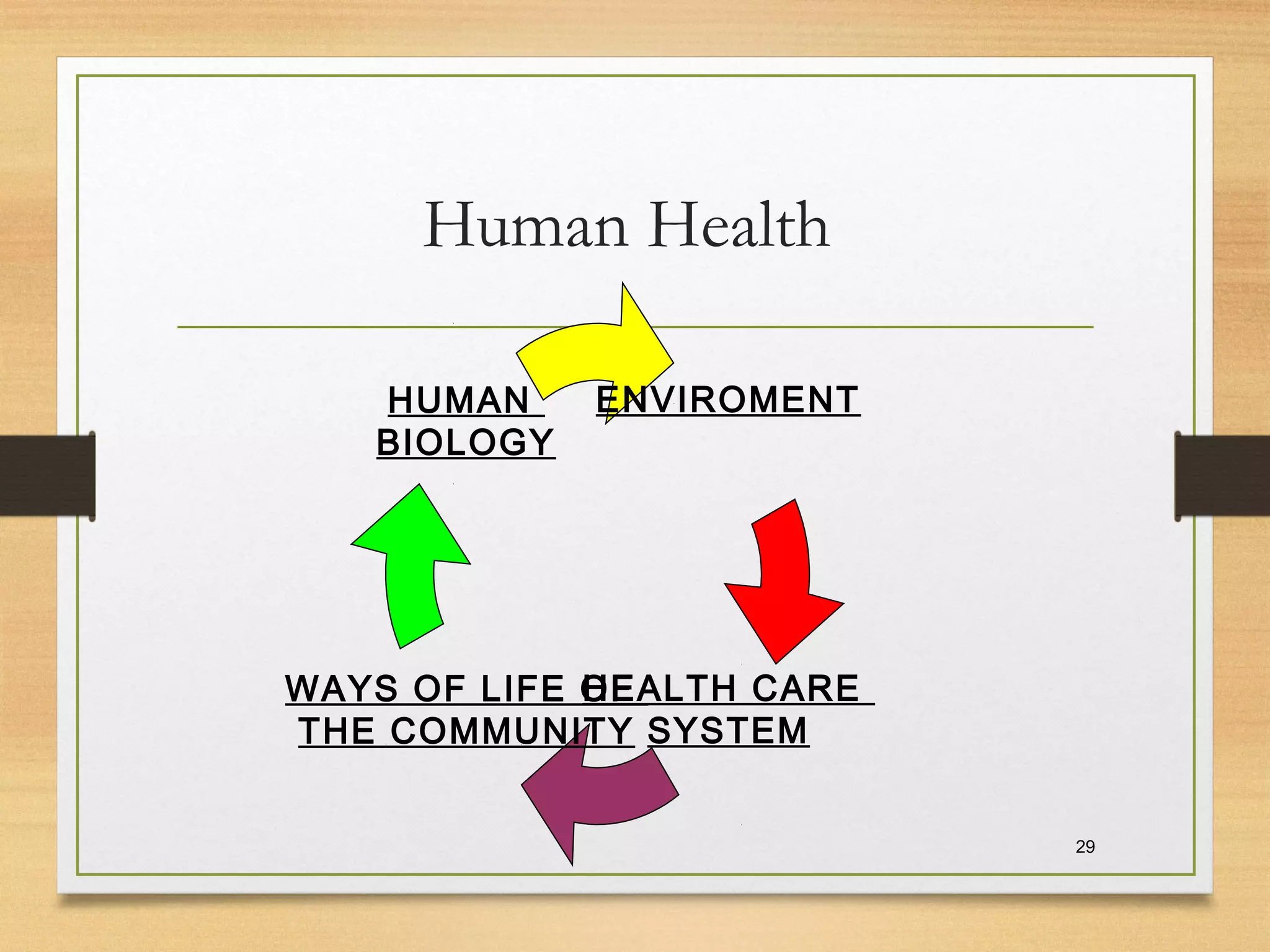
Health :
Health isa state of complete physical
,mental, social and spiritual well being and
ability to function ,not merely an absence of
disease or infirmity.
28
• Disease :A condition in which body health is impaired
(Webster).
• A state in which the individuals is no longer in a state of
equilibrium with forces in his external and internal
environment (Belend).
• Illness :Is failure or disturbance in the growth, development,
function and adjustment of the organism as a whole or any of
its system (Engel)
1. Acute
2. Chronic
30
31.
Purposes of communityhealth
• A certain the nature and extent of disease and
disability in the community.
Take suitable measure to
• Promote healthful living,
• Prevent disabilities, correct remedial defects, treat
illness.
• Evaluate the progress and success of current
programs.
31
32.
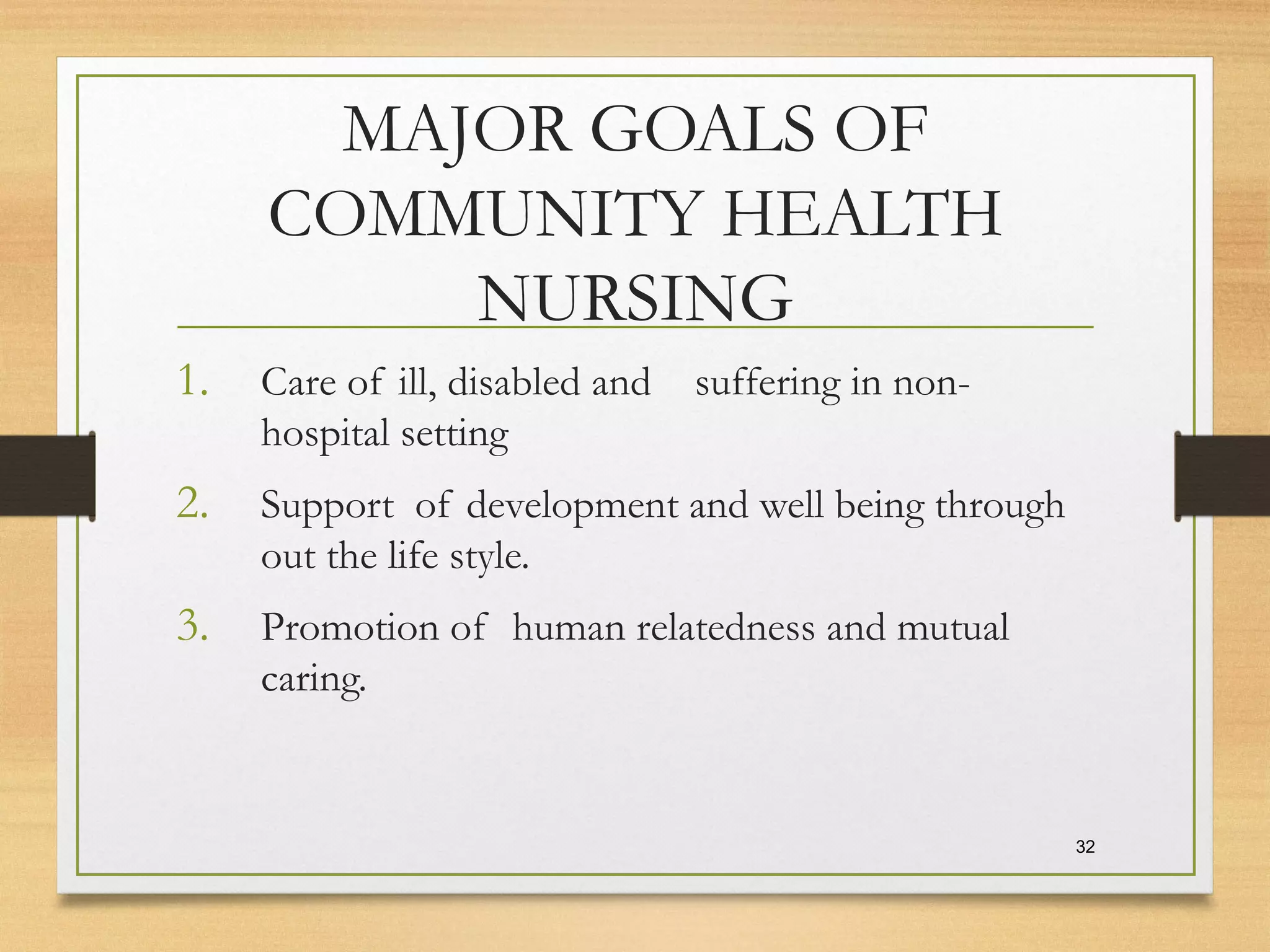
MAJOR GOALS OF
COMMUNITYHEALTH
NURSING
1. Care of ill, disabled and suffering in non-
hospital setting
2. Support of development and well being through
out the life style.
3. Promotion of human relatedness and mutual
caring.
32
33.
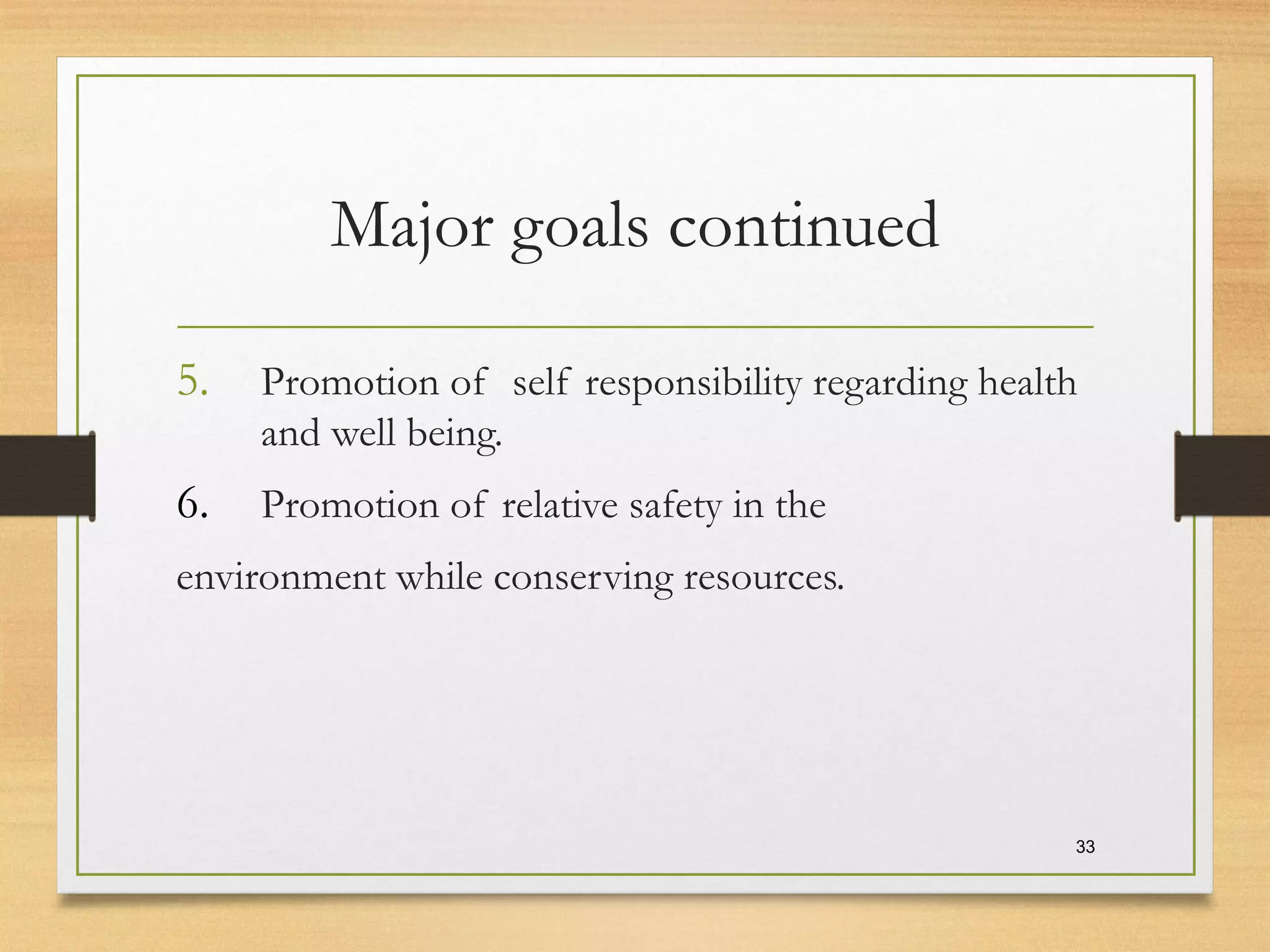
Major goals continued
5.Promotion of self responsibility regarding health
and well being.
6. Promotion of relative safety in the
environment while conserving resources.
33
34.
Settings for CHNPractice
1. Homes
2. Community health centers
3. Schools
4. Occupational health settings (business and
industry)
5. Residential institutions: Older age residences
6. charitable mosques related organizations
7. Community at large
34
Primary Prevention forHealth
Promotion
• Health Education
• Adequate Nutrition
• Individual Development
• Adequate working environment and recreation,
resting
• Pre-marriage counseling and education
• Genetic Counseling
• Regular Physical Examination
36
37.
Primary Prevention forHealth
Protection
• Comply with immunization
• Individual hygiene
• Improve environment sanitary
• Occupational Safety
• Prevent Accident in all ages
• Adequate nutrition
• Avoid cancer cause agents
• Avoid allergic
37
38.
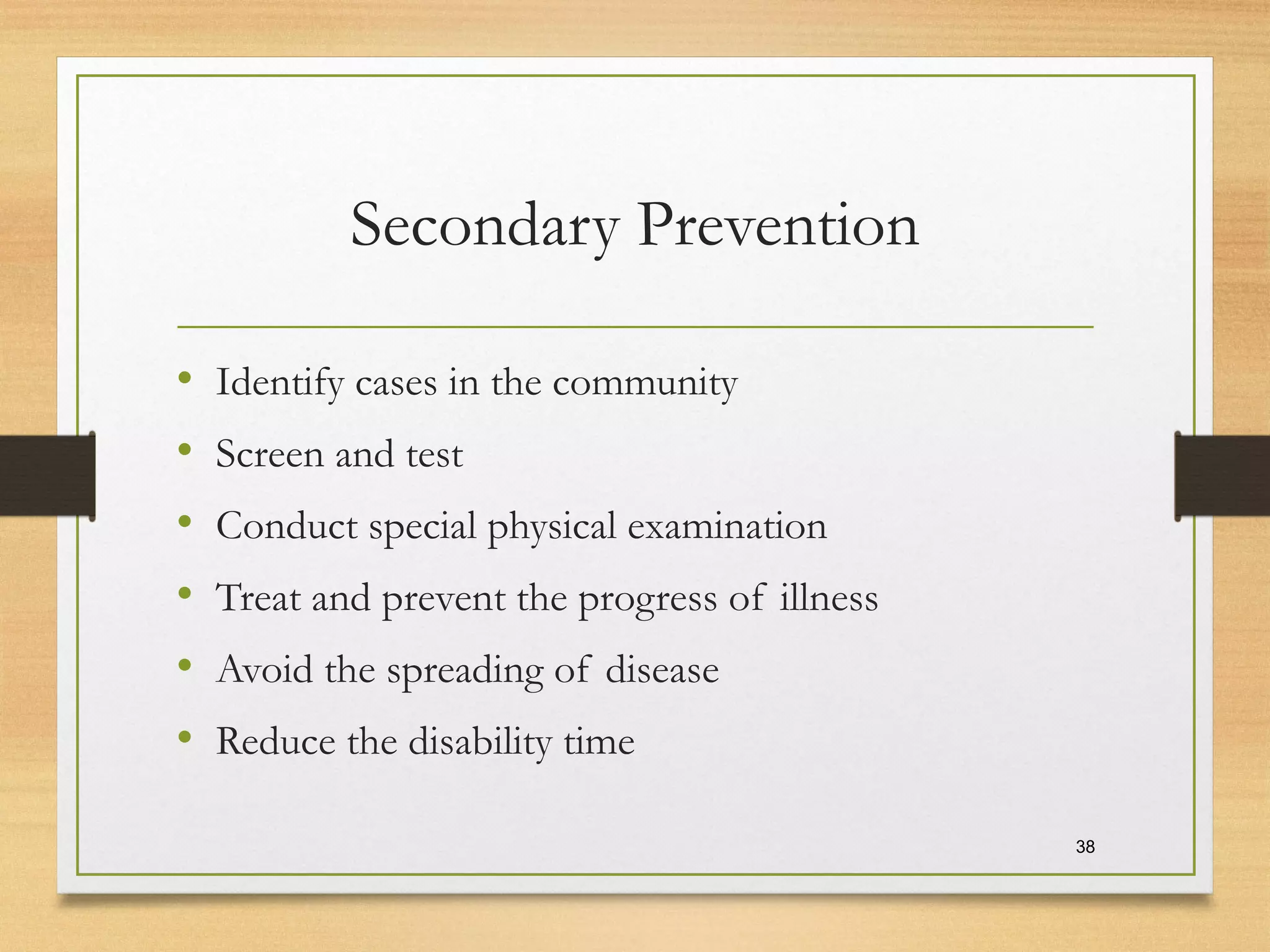
Secondary Prevention
• Identifycases in the community
• Screen and test
• Conduct special physical examination
• Treat and prevent the progress of illness
• Avoid the spreading of disease
• Reduce the disability time
38
39.
Tertiary Prevention
• Treatand stop the disease progress and avoid complication and
side effect
• Limit the chance for disability
• Provide rehabilitation for physical and psychological well-being,
occupational therapy, availability of long-term care
39
40.
Characteristics of community
healthnursing
• it is a field of nursing
• it combines public health with nursing
• it is population-focused
• it emphasizes wellness
• it involves interdisciplinary collaboration
• it promotes clients’ responsibility and self care
40
41.
Setting for communityhealth
nursing practice
• homes
• ambulatory service settings
• schools
• occupational health setting
• residential institutions
• the community at large
41
42.
Philosophy of CHN
•THE Philosophy of CHN is based on the worth and
dignity on the worth and dignity of man.
42
43.
Opportunity for FutureCommunity
Health Nursing
• Chronic Disease management
• Home Care
• Extended care from Acute care setting
• Elderly care
• Rehabilitation care in different population
• Health promotion in every level
• Health system referral, emphasize individual role and
function of community health sector
43
44.
References
• Ansari.I.M.,(2003) communitymedicine and public
health.(6th
ed)
• Clarke.j.,(1999) revising the concepts of community
care and community health nursing standards .10 34-
35
44