TAX AVOIDANCE AND CORPORATES
SOCIAL RESPONSIBILITY
PEOPLE AND JUSTICE
MN5001
INTRODUCTION
• Focusing on the effects of tax avoidance
• Corporate Social Responsibility (“CSR”)
as a tool to encourage social justice and
morality
• The problems of tax avoidance
• The implication of tax avoidance on economic growth
• Effects of tax avoidance on society within developing
countries
“More than four out of five
adults believe tax dodging
by corporates is morally
wrong” (Molina, 2015)
CSR OVERVIEW
• Corporate Social Responsibility
• Companies take stakeholder interests into account
• Stockholders, employees, neighbors, the environment, etc.
• Can be seen as a tool for moral/social justice
• Corporations seen as “citizens”
• Adherence to same moral codes as normal citizens
• Takes place on multiple levels
• Institutional
• Organizational
• Individual
MORAL BEHAVIOR
• Moral standards are often higher than legal requirements
• Moral behavior comes in steps from amoral behavior to
ethical behavior
• CSR takes place in this model and is closely tied to
morality
• CSR is conducted voluntarily
• Social pressure
TAX AVOIDANCE
• “Tax avoidance [...] is mostly associated with companies, rather than
individuals. It usually falls just within the limits of the law, but goes against
the spirit of the law. Using aggressive tax planning techniques, certain
companies exploit legal loopholes in tax systems and mismatches between
national rules to minimise their tax bills and avoid paying their fair share of
taxes” (European Commission, 2015)
• Especially practiced by MNCs
• Leads to distortion of
competition
(McTague , 2013)
INTERNATIONAL TAX COMPETITION
Average global tax rate 2000-2011
(KPMG , 2011)
• Pressure to attract foreign
direct investment leads to
continuous decrease of
tax rates
• Accumulates to an
average revenue loss
of 13 percent in
non-OECD countries
TAX AVOIDANCE BY ASSOCIATED
BRITISH FOOD GROUP IN ZAMBIA
• Associated British Food group
• International food, ingredients and retail
group with annual profit of £12,9bn
• Subsidiary ‘Zambia Sugar‘
• Shifts a third of pre-tax profits, £13m
a year, to tax havens
• Enough money to put 48,000 children
in school
(Country Reports, 2015)
(Specialised Training Solutions, 2013) (Mfula, 2010)
ECONOMIC IMPACT ON
DEVELOPING COUNTRIES
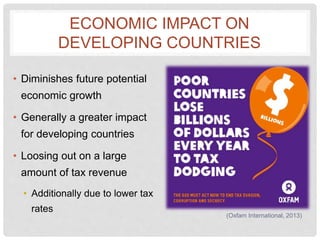
• Diminishes future potential
economic growth
• Generally a greater impact
for developing countries
• Loosing out on a large
amount of tax revenue
• Additionally due to lower tax
rates
(Oxfam International, 2013)
ECONOMIC IMPACT ON
DEVELOPING COUNTRIES
• Taxes help improve social services and infrastructure
• Assists in reducing poverty levels
• Helps improve living standards
• Sustainable growth is important
• BRIC countries
• Requires fiscal independence
• Tax avoidance is social irresponsibility
• Stumps economic growth and human development
“Tax avoidance is a
crime against the
nation”
(Landolf, 2006, p.7)
JUSTICE IN SOCIETIES
• “Society at large” as a corporation’s stakeholder
• World bank figures
• Access to clean water
• Life expectancy
• School enrolment
Sayer (2008) articulates
that people flourish or
suffer depending on
how their needs are met.
JUSTICE IN SOCIETIES
• Tax avoidance
• social and health problems
• Nigeria’s case
• The importance of the Procedural Justice
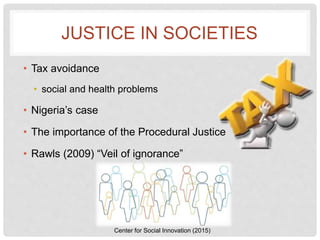
• Rawls (2009) “Veil of ignorance”
Center for Social Innovation (2015)
CONCLUSION
• Tax avoidance negatively impacts developing countries
harder.
• Tax avoidance is unjust and immoral
• G20 are implementing regulations to try reduce tax
avoidance
• Does not incorporate developing and non-OECD
countries
• Should be standard worldwide regulations
REFERENCES
• Baker, B., 2013. World Development Book Case Studies: Tax avoidance and its Impacts in the Developing World. New
Internationalist. [Online] Newint.org. Available at: http://newint.org/books/reference/world-development/case-
studies/avoidance-and-its-impacts/ [Last Accessed 23 November 2015].
• Carroll, A. B., 1987. In Search of the Moral Manager. Business Horizons, 30 (2), pp.7-15.
• Carroll, A. B., 1999. Corporate Social Responsibility: Evolution of a Definitional Construct. Business & Society, 38(3),
pp.268–295.
• Christensen, J. & Murphy, R., 2004. The Social Irresponsibility of Corporate Tax Avoidance: Taking CSR to the Bottom
Line. Journal of Development, 47, pp.37-44.
• Christian Aid, 2005. The Shirts Off Their Backs: How Tax Policies Fleece The Poor. London: Christian Aid.
• Cobham, A., 2005. Tax Evasion, Tax Avoidance and Development Finance. Oxford: University of Oxford.
• Country Reports, 2015. Zambia Facts and Culture. [Online] Available at:
http://www.countryreports.org/country/Zambia.htm [Last Accessed 20 November 2015].
• European Commission, 2012. Commission Recommendation of 6.12.2012 on aggressive tax planning. [Online] Available
at: http://ec.europa.eu/taxation_customs/resources/documents/taxation/tax_fraud_evasion/c_2012_8806_en.pdf [Last
Accessed 23 November 2015].
• Farny, O. Franz, M., Gerhartinger, P., Lunzer, G., Neuwirth, M., Saringer M., 2015. Tax avoidance, tax evasion and tax
havens. [Online] Available at: http://media.arbeiterkammer.at/wien/PDF/studien/Studie_tax_avoidance.pdf [Last
Accessed 23 November 2015].
• Garriga, E. & Melé, D., 2004. Corporate social responsibility theories: Mapping the territory. Journal of Business Ethics,
53(1-2), pp.51–71.
• Houlder, V., 2013. ‘Dutch sandwich’ grows as Google shifts €8.8bn to Bermuda. [Online] Financial Times. Available at:
http://www.ft.com/cms/s/0/89acc832-31cc-11e3-a16d-00144feab7de.html#axzz3sEDK43aK [Last Accessed 23
November 2015].
• International Monetary Fund., 2014. IMF Policy Paper: Spillovers in International Corporate Taxation. [Online] Available at:
https://www.imf.org/external/np/pp/eng/2014/050914.pdf [Last Accessed 23 November 2015].
• International Monetary Fund., 2011. Revenue Mobilisation in Developing Countries. Washington: IMF.
• Landolf, U., 2006. Tax and Corporate Responsibility. International Tax Reveiew, 29, pp.6-9.
• Lind, E. A., & Tyler, T. R., 1988. The Social Psychology of Procedural Justice. New York: Plenum Press.
• Lin-Hi, N. & Müller, K., 2013. The CSR bottom line: Preventing corporate social irresponsibility. Journal of Business
Research, 66(10), pp.1928–1936.
• Logsdon, J.M. et al., 2012. Corporate Stakeholder Organizational Social Performance , and Moral Development, 16(12),
pp.1213–1226.
• Lord Holme & Richard Watts, 1999. Corporate social responsibility. Geneva: World Business Council for Sustainable
Development.
• May, P.H., 2008. Overcoming Contradictions Between Growth and Sustainability: Institutional Innovation in the BRICS.
Chinese Journal of Population Resources and Environment, 6(3), pp.3-13.
• Mfula, C., 2010. Farmers Plan to Invest in Zambia - Govt. [Online] Available at:
http://in.reuters.com/article/2010/08/05/idINIndia-50657020100805 [Last Accessed 18 November 2015].
• Molina, N., 2015. A UK Tax Avoidance Bill Could Save Developing Countries Billions. [Online] Available at:
http://www.theguardian.com/global-development/2015/feb/13/uk-tax-avoidance-bill-save-developing-countries-billions [Last
Accessed 14 November 2015].
• Nylen, U., 1998. Ethical Views on Tax Evasion among Swedish CEOs. Journal of Accounting, Ethics & Public Policy, 1 (3),
pp.435-459.
• Otusanya, O. J., 2011. The Role of Multinational Companies in Tax Evasion and Tax Avoidance: The Case of Nigeria. Critical
Perspectives on Accounting, 22 (3), pp.316-332.
• Oxfam International., 2013. Tax Evasion Damaging Poor Country Economies. [Online] Available at:
https://www.oxfam.org/en/pressroom/pressreleases/2013-09-01/tax-evasion-damaging-poor-country-economies [Last
Accessed 14 November 2015].
• Pease, M., 2014. You pay taxes, and rich corporations don't. [Online] CNN. Available at:
http://edition.cnn.com/2014/07/16/opinion/pease-tax-avoidance/ [Last Accessed 23 November 2015].
• Tax Justice Network-Africa., 2012. Tax competition in East Africa: A race to the bottom. [Online] Available at:
http://www.actionaid.org/sites/files/actionaid/eac_report.pdf [Last Accessed 23 November 2015].
• Pomerleau, K., 2015. Sources of Government Revenue across the OECD, 2015. [Online] Available at:
http://taxfoundation.org/article/sources-government-revenue-across-oecd-2015 [Last Accessed 17 November 2015].
• Rawls, J., 1999. A theory of Justice. Cambridge, MA: Harvard University Press
• Reidenbach, R.E. & Robin, D.P., 1991. A conceptual model of corporate moral development. Journal of Business Ethics,
10(4), pp.273–284.
• Sayer, A., 2008. Moral Economic Regulation in Organizations: A University Example. Organization, 15 (2), pp.147-164.
• Searcy, C. & Buslovich, R., 2014. Corporate Perspectives on the Development and Use of Sustainability Reports. Journal of
Business Ethics, 121(2), pp.149–169.
• Sikka P., 2008. Enterprise Culture and Accountancy Firms: New Masters of the Universe. Accounting, Auditing and
Accountability Journal, 21 (2), pp.268-295.
• Specialised Training Solutions, 2013. Health and hygiene in the Workplace. [Online] Available at: http://sts.co.zm/about.php
[Last Accessed 19 November 2015].
• Spicer, M. W., 1975. New Approaches to the Problem of Tax Evasion. British Tax Review, 3, pp.152-154.
• Tax Justice Network Limited, 2015. UNCTAD: Multinational Tax Avoidance Costs Developing Countries $100 Billion Plus.
[Online] Available at: http://www.taxjustice.net/2015/03/26/unctad-multinational-tax-avoidance-costs-developing-countries-
100-billion/ [Last Accessed 14 November 2015].
• Tax Justice Network, 2015. Press Release: OECD’s BEPS Proposals Will not be the End of Tax Avoidance by
Multinationals. [Online] Available at: http://www.taxjustice.net/2015/10/05/press-release-oecds-beps-proposals-will-not-be-
the-end-of-tax-avoidance-by-multinationals/ [Last Accessed 20 November 2015].
•
• Tax Justice Network-Africa., 2012. Tax competition in East Africa: A race to the bottom. [Online] Available at:
http://www.actionaid.org/sites/files/actionaid/eac_report.pdf [Last Accessed 23 November 2015].
THANK YOU
ANY QUESTIONS?

MN5001 - Presentation on Tax Avoidance

  • 1.
    TAX AVOIDANCE ANDCORPORATES SOCIAL RESPONSIBILITY PEOPLE AND JUSTICE MN5001
  • 2.
    INTRODUCTION • Focusing onthe effects of tax avoidance • Corporate Social Responsibility (“CSR”) as a tool to encourage social justice and morality • The problems of tax avoidance • The implication of tax avoidance on economic growth • Effects of tax avoidance on society within developing countries “More than four out of five adults believe tax dodging by corporates is morally wrong” (Molina, 2015)
  • 3.
    CSR OVERVIEW • CorporateSocial Responsibility • Companies take stakeholder interests into account • Stockholders, employees, neighbors, the environment, etc. • Can be seen as a tool for moral/social justice • Corporations seen as “citizens” • Adherence to same moral codes as normal citizens • Takes place on multiple levels • Institutional • Organizational • Individual
  • 4.
    MORAL BEHAVIOR • Moralstandards are often higher than legal requirements • Moral behavior comes in steps from amoral behavior to ethical behavior • CSR takes place in this model and is closely tied to morality • CSR is conducted voluntarily • Social pressure
  • 5.
    TAX AVOIDANCE • “Taxavoidance [...] is mostly associated with companies, rather than individuals. It usually falls just within the limits of the law, but goes against the spirit of the law. Using aggressive tax planning techniques, certain companies exploit legal loopholes in tax systems and mismatches between national rules to minimise their tax bills and avoid paying their fair share of taxes” (European Commission, 2015) • Especially practiced by MNCs • Leads to distortion of competition (McTague , 2013)
  • 6.
    INTERNATIONAL TAX COMPETITION Averageglobal tax rate 2000-2011 (KPMG , 2011) • Pressure to attract foreign direct investment leads to continuous decrease of tax rates • Accumulates to an average revenue loss of 13 percent in non-OECD countries
  • 7.
    TAX AVOIDANCE BYASSOCIATED BRITISH FOOD GROUP IN ZAMBIA • Associated British Food group • International food, ingredients and retail group with annual profit of £12,9bn • Subsidiary ‘Zambia Sugar‘ • Shifts a third of pre-tax profits, £13m a year, to tax havens • Enough money to put 48,000 children in school (Country Reports, 2015) (Specialised Training Solutions, 2013) (Mfula, 2010)
  • 8.
    ECONOMIC IMPACT ON DEVELOPINGCOUNTRIES • Diminishes future potential economic growth • Generally a greater impact for developing countries • Loosing out on a large amount of tax revenue • Additionally due to lower tax rates (Oxfam International, 2013)
  • 9.
    ECONOMIC IMPACT ON DEVELOPINGCOUNTRIES • Taxes help improve social services and infrastructure • Assists in reducing poverty levels • Helps improve living standards • Sustainable growth is important • BRIC countries • Requires fiscal independence • Tax avoidance is social irresponsibility • Stumps economic growth and human development “Tax avoidance is a crime against the nation” (Landolf, 2006, p.7)
  • 10.
    JUSTICE IN SOCIETIES •“Society at large” as a corporation’s stakeholder • World bank figures • Access to clean water • Life expectancy • School enrolment Sayer (2008) articulates that people flourish or suffer depending on how their needs are met.
  • 11.
    JUSTICE IN SOCIETIES •Tax avoidance • social and health problems • Nigeria’s case • The importance of the Procedural Justice • Rawls (2009) “Veil of ignorance” Center for Social Innovation (2015)
  • 12.
    CONCLUSION • Tax avoidancenegatively impacts developing countries harder. • Tax avoidance is unjust and immoral • G20 are implementing regulations to try reduce tax avoidance • Does not incorporate developing and non-OECD countries • Should be standard worldwide regulations
  • 13.
    REFERENCES • Baker, B.,2013. World Development Book Case Studies: Tax avoidance and its Impacts in the Developing World. New Internationalist. [Online] Newint.org. Available at: http://newint.org/books/reference/world-development/case- studies/avoidance-and-its-impacts/ [Last Accessed 23 November 2015]. • Carroll, A. B., 1987. In Search of the Moral Manager. Business Horizons, 30 (2), pp.7-15. • Carroll, A. B., 1999. Corporate Social Responsibility: Evolution of a Definitional Construct. Business & Society, 38(3), pp.268–295. • Christensen, J. & Murphy, R., 2004. The Social Irresponsibility of Corporate Tax Avoidance: Taking CSR to the Bottom Line. Journal of Development, 47, pp.37-44. • Christian Aid, 2005. The Shirts Off Their Backs: How Tax Policies Fleece The Poor. London: Christian Aid. • Cobham, A., 2005. Tax Evasion, Tax Avoidance and Development Finance. Oxford: University of Oxford. • Country Reports, 2015. Zambia Facts and Culture. [Online] Available at: http://www.countryreports.org/country/Zambia.htm [Last Accessed 20 November 2015]. • European Commission, 2012. Commission Recommendation of 6.12.2012 on aggressive tax planning. [Online] Available at: http://ec.europa.eu/taxation_customs/resources/documents/taxation/tax_fraud_evasion/c_2012_8806_en.pdf [Last Accessed 23 November 2015]. • Farny, O. Franz, M., Gerhartinger, P., Lunzer, G., Neuwirth, M., Saringer M., 2015. Tax avoidance, tax evasion and tax havens. [Online] Available at: http://media.arbeiterkammer.at/wien/PDF/studien/Studie_tax_avoidance.pdf [Last Accessed 23 November 2015]. • Garriga, E. & Melé, D., 2004. Corporate social responsibility theories: Mapping the territory. Journal of Business Ethics, 53(1-2), pp.51–71. • Houlder, V., 2013. ‘Dutch sandwich’ grows as Google shifts €8.8bn to Bermuda. [Online] Financial Times. Available at: http://www.ft.com/cms/s/0/89acc832-31cc-11e3-a16d-00144feab7de.html#axzz3sEDK43aK [Last Accessed 23 November 2015].
  • 14.
    • International MonetaryFund., 2014. IMF Policy Paper: Spillovers in International Corporate Taxation. [Online] Available at: https://www.imf.org/external/np/pp/eng/2014/050914.pdf [Last Accessed 23 November 2015]. • International Monetary Fund., 2011. Revenue Mobilisation in Developing Countries. Washington: IMF. • Landolf, U., 2006. Tax and Corporate Responsibility. International Tax Reveiew, 29, pp.6-9. • Lind, E. A., & Tyler, T. R., 1988. The Social Psychology of Procedural Justice. New York: Plenum Press. • Lin-Hi, N. & Müller, K., 2013. The CSR bottom line: Preventing corporate social irresponsibility. Journal of Business Research, 66(10), pp.1928–1936. • Logsdon, J.M. et al., 2012. Corporate Stakeholder Organizational Social Performance , and Moral Development, 16(12), pp.1213–1226. • Lord Holme & Richard Watts, 1999. Corporate social responsibility. Geneva: World Business Council for Sustainable Development. • May, P.H., 2008. Overcoming Contradictions Between Growth and Sustainability: Institutional Innovation in the BRICS. Chinese Journal of Population Resources and Environment, 6(3), pp.3-13. • Mfula, C., 2010. Farmers Plan to Invest in Zambia - Govt. [Online] Available at: http://in.reuters.com/article/2010/08/05/idINIndia-50657020100805 [Last Accessed 18 November 2015]. • Molina, N., 2015. A UK Tax Avoidance Bill Could Save Developing Countries Billions. [Online] Available at: http://www.theguardian.com/global-development/2015/feb/13/uk-tax-avoidance-bill-save-developing-countries-billions [Last Accessed 14 November 2015]. • Nylen, U., 1998. Ethical Views on Tax Evasion among Swedish CEOs. Journal of Accounting, Ethics & Public Policy, 1 (3), pp.435-459. • Otusanya, O. J., 2011. The Role of Multinational Companies in Tax Evasion and Tax Avoidance: The Case of Nigeria. Critical Perspectives on Accounting, 22 (3), pp.316-332. • Oxfam International., 2013. Tax Evasion Damaging Poor Country Economies. [Online] Available at: https://www.oxfam.org/en/pressroom/pressreleases/2013-09-01/tax-evasion-damaging-poor-country-economies [Last Accessed 14 November 2015]. • Pease, M., 2014. You pay taxes, and rich corporations don't. [Online] CNN. Available at: http://edition.cnn.com/2014/07/16/opinion/pease-tax-avoidance/ [Last Accessed 23 November 2015]. • Tax Justice Network-Africa., 2012. Tax competition in East Africa: A race to the bottom. [Online] Available at: http://www.actionaid.org/sites/files/actionaid/eac_report.pdf [Last Accessed 23 November 2015].
  • 15.
    • Pomerleau, K.,2015. Sources of Government Revenue across the OECD, 2015. [Online] Available at: http://taxfoundation.org/article/sources-government-revenue-across-oecd-2015 [Last Accessed 17 November 2015]. • Rawls, J., 1999. A theory of Justice. Cambridge, MA: Harvard University Press • Reidenbach, R.E. & Robin, D.P., 1991. A conceptual model of corporate moral development. Journal of Business Ethics, 10(4), pp.273–284. • Sayer, A., 2008. Moral Economic Regulation in Organizations: A University Example. Organization, 15 (2), pp.147-164. • Searcy, C. & Buslovich, R., 2014. Corporate Perspectives on the Development and Use of Sustainability Reports. Journal of Business Ethics, 121(2), pp.149–169. • Sikka P., 2008. Enterprise Culture and Accountancy Firms: New Masters of the Universe. Accounting, Auditing and Accountability Journal, 21 (2), pp.268-295. • Specialised Training Solutions, 2013. Health and hygiene in the Workplace. [Online] Available at: http://sts.co.zm/about.php [Last Accessed 19 November 2015]. • Spicer, M. W., 1975. New Approaches to the Problem of Tax Evasion. British Tax Review, 3, pp.152-154. • Tax Justice Network Limited, 2015. UNCTAD: Multinational Tax Avoidance Costs Developing Countries $100 Billion Plus. [Online] Available at: http://www.taxjustice.net/2015/03/26/unctad-multinational-tax-avoidance-costs-developing-countries- 100-billion/ [Last Accessed 14 November 2015]. • Tax Justice Network, 2015. Press Release: OECD’s BEPS Proposals Will not be the End of Tax Avoidance by Multinationals. [Online] Available at: http://www.taxjustice.net/2015/10/05/press-release-oecds-beps-proposals-will-not-be- the-end-of-tax-avoidance-by-multinationals/ [Last Accessed 20 November 2015]. • • Tax Justice Network-Africa., 2012. Tax competition in East Africa: A race to the bottom. [Online] Available at: http://www.actionaid.org/sites/files/actionaid/eac_report.pdf [Last Accessed 23 November 2015].
  • 16.