The Role of the Government in
Creating Prosperity
13th TCI Annual Global Conference
New Delhi, India
November 29 to December 3, 2010
Outline
• Propositions
• What is Prosperity?
• Traditional Government Roles in creating prosperity
• Approaches to creating Prosperity
• New Approach to Creating Prosperity Using Inclusive
Growth
• What is Inclusive Growth and why it is Important?
• Conclusions
3
Propositions
• Governments around the world aspire to encourage economic
growth and prosperity for their citizens
• All levels of government have a proactive and strategic role to play
in this effort, over and above their traditional regulatory mandate
• Globalization, rapidly changing technology, intense
competition, and rising expectations for a higher standard of livingcompetition, and rising expectations for a higher standard of living
pose challenges to the established top-down approaches to
economic development
• And our principal indicator, GDP growth, may be questionable as a
reliable indicator of inclusiveness
• Growth and profits may be unquestionable attributes of the post-
modern economy, but unless broadly beneficial, recognizable
prosperity may not be the natural outcome
4
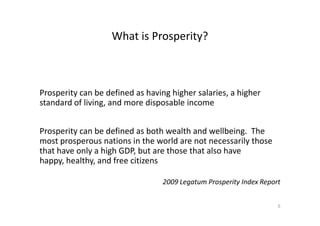
What is Prosperity?
Prosperity can be defined as having higher salaries, a higher
standard of living, and more disposable income
Prosperity can be defined as both wealth and wellbeing. The
most prosperous nations in the world are not necessarily those
that have only a high GDP, but are those that also have
happy, healthy, and free citizens
2009 Legatum Prosperity Index Report
5
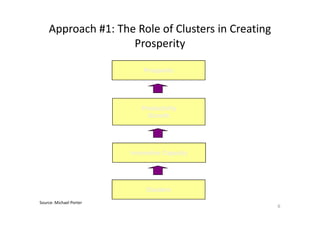
Approach #1: The Role of Clusters in Creating
Prosperity
ProsperityProsperity
ProductivityProductivity
GrowthGrowth
Source: Michael Porter
6
GrowthGrowth
InnovativeInnovative CapacityCapacity
ClustersClusters
Approach #1: The Role of Clusters in Creating
Prosperity (Cont’d)
“Clusters…a form of dialogue between firms and the institutions that
support innovation”
Michael Porter, 2000
Clusters are groups of interrelated industries and institutions that drive
wealth creation primarily through innovation and the export of goodswealth creation primarily through innovation and the export of goods
and services.
Clusters create prosperity by:
• Stimulating innovation
• Facilitating Commercialization
• Promoting synergies and collaboration
7
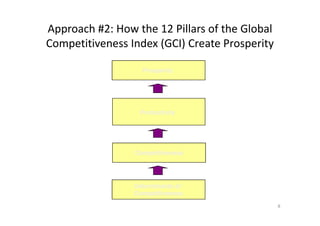
Approach #2: How the 12 Pillars of the Global
Competitiveness Index (GCI) Create Prosperity
ProsperityProsperity
ProductivityProductivity
8
ProductivityProductivity
CompetitivenessCompetitiveness
Determinants ofDeterminants of
CompetitivenessCompetitiveness
Approach #2: How the 12 Pillars of the GCI
Create Prosperity (Cont’d)
Global Competitive IndexGlobal Competitive Index
InnovationInnovation
9
Note how the 12 pillars cover more than just innovative capacityNote how the 12 pillars cover more than just innovative capacity
Source: Global Competitiveness Report 2010Source: Global Competitiveness Report 2010--20112011
Basic RequirementsBasic Requirements Efficiency EnhancersEfficiency Enhancers
InnovationInnovation
and Sophisticationand Sophistication
FactorsFactors
• InstitutionsInstitutions
•• InfrastructureInfrastructure
•• Macroeconomic StabilityMacroeconomic Stability
•• Health and Primary EducationHealth and Primary Education
• Higher Education and TrainingHigher Education and Training
•• Goods Market EfficiencyGoods Market Efficiency
•• Labour Market EfficiencyLabour Market Efficiency
•• Financial Market SophisticationFinancial Market Sophistication
•• Technological ReadinessTechnological Readiness
•• Market SizeMarket Size
• Business SophisticationBusiness Sophistication
•• InnovationInnovation
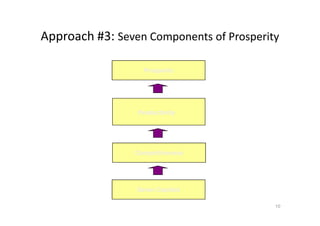
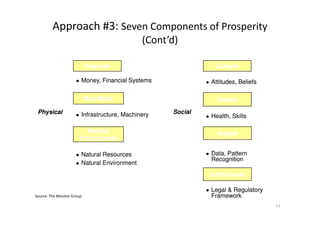
Approach #3: Seven Components of Prosperity
ProsperityProsperity
ProductivityProductivity
10
ProductivityProductivity
CompetitivenessCompetitiveness
Seven CapitalsSeven Capitals
Approach #3: Seven Components of Prosperity
(Cont’d)
CulturalCultural
HumanHuman
FinancialFinancial
ManMan--MadeMade
SocialPhysicalPhysical
 Money, Financial SystemsMoney, Financial Systems
Infrastructure, MachineryInfrastructure, Machinery Health, SkillsHealth, Skills
 Attitudes, BeliefsAttitudes, Beliefs
Source: The Monitor Group
11
InsightInsight
InstitutionalInstitutional
NaturalNatural
EndowmentsEndowments
SocialPhysicalPhysical  Infrastructure, MachineryInfrastructure, Machinery
 Natural ResourcesNatural Resources
 Natural EnvironmentNatural Environment
 Legal & RegulatoryLegal & Regulatory
FrameworkFramework
 Data, PatternData, Pattern
RecognitionRecognition
 Health, SkillsHealth, Skills
Similarities Between the Three Approaches
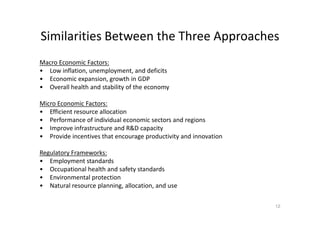
Macro Economic Factors:
• Low inflation, unemployment, and deficits
• Economic expansion, growth in GDP
• Overall health and stability of the economy
Micro Economic Factors:
• Efficient resource allocation• Efficient resource allocation
• Performance of individual economic sectors and regions
• Improve infrastructure and R&D capacity
• Provide incentives that encourage productivity and innovation
Regulatory Frameworks:
• Employment standards
• Occupational health and safety standards
• Environmental protection
• Natural resource planning, allocation, and use
12
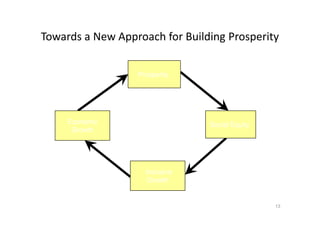
Towards a New Approach for Building Prosperity
ProsperityProsperity
13
Social EquitySocial EquityEconomicEconomic
GrowthGrowth
InclusiveInclusive
GrowthGrowth
What is Inclusive Growth?
• Inclusive growth means economic growth that is
shared fairly among citizens
• It includes measurable criteria such as the literacy
rate and the general provision and distribution of
public goods (i.e. electricity, water, transportation)public goods (i.e. electricity, water, transportation)
• A call for active ‘moral leadership’ by both
government and business
• A call for a shift from conflict to cooperation and
collaboration
14
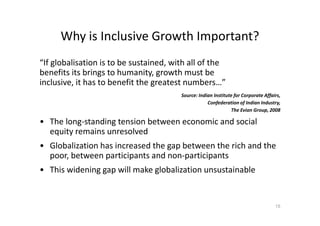
Why is Inclusive Growth Important?
“If globalisation is to be sustained, with all of the
benefits its brings to humanity, growth must be
inclusive, it has to benefit the greatest numbers…”
Source: Indian Institute for Corporate Affairs,
Confederation of Indian Industry,
The Evian Group, 2008
• The long-standing tension between economic and social
equity remains unresolved
• Globalization has increased the gap between the rich and the
poor, between participants and non-participants
• This widening gap will make globalization unsustainable
15
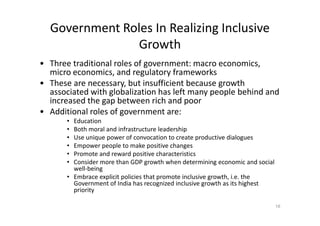
Government Roles In Realizing Inclusive
Growth
• Three traditional roles of government: macro economics,
micro economics, and regulatory frameworks
• These are necessary, but insufficient because growth
associated with globalization has left many people behind and
increased the gap between rich and poor
• Additional roles of government are:• Additional roles of government are:
• Education
• Both moral and infrastructure leadership
• Use unique power of convocation to create productive dialogues
• Empower people to make positive changes
• Promote and reward positive characteristics
• Consider more than GDP growth when determining economic and social
well-being
• Embrace explicit policies that promote inclusive growth, i.e. the
Government of India has recognized inclusive growth as its highest
priority
16
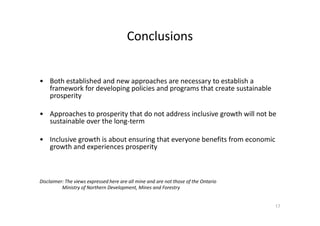
Conclusions
• Both established and new approaches are necessary to establish a
framework for developing policies and programs that create sustainable
prosperity
• Approaches to prosperity that do not address inclusive growth will not be• Approaches to prosperity that do not address inclusive growth will not be
sustainable over the long-term
• Inclusive growth is about ensuring that everyone benefits from economic
growth and experiences prosperity
Disclaimer: The views expressed here are all mine and are not those of the Ontario
Ministry of Northern Development, Mines and Forestry
17
Thank You
Indira Singh
Director, Executive Projects Office
Executive Director
Ontario Mineral Industry Cluster Council
Ministry of Northern Development,
Mines and ForestryMines and Forestry
Ontario, Canada
Indira.Singh1@ontario.ca
18

Presentation done by Indira singh

  • 2.
    The Role ofthe Government in Creating Prosperity 13th TCI Annual Global Conference New Delhi, India November 29 to December 3, 2010
  • 3.
    Outline • Propositions • Whatis Prosperity? • Traditional Government Roles in creating prosperity • Approaches to creating Prosperity • New Approach to Creating Prosperity Using Inclusive Growth • What is Inclusive Growth and why it is Important? • Conclusions 3
  • 4.
    Propositions • Governments aroundthe world aspire to encourage economic growth and prosperity for their citizens • All levels of government have a proactive and strategic role to play in this effort, over and above their traditional regulatory mandate • Globalization, rapidly changing technology, intense competition, and rising expectations for a higher standard of livingcompetition, and rising expectations for a higher standard of living pose challenges to the established top-down approaches to economic development • And our principal indicator, GDP growth, may be questionable as a reliable indicator of inclusiveness • Growth and profits may be unquestionable attributes of the post- modern economy, but unless broadly beneficial, recognizable prosperity may not be the natural outcome 4
  • 5.
    What is Prosperity? Prosperitycan be defined as having higher salaries, a higher standard of living, and more disposable income Prosperity can be defined as both wealth and wellbeing. The most prosperous nations in the world are not necessarily those that have only a high GDP, but are those that also have happy, healthy, and free citizens 2009 Legatum Prosperity Index Report 5
  • 6.
    Approach #1: TheRole of Clusters in Creating Prosperity ProsperityProsperity ProductivityProductivity GrowthGrowth Source: Michael Porter 6 GrowthGrowth InnovativeInnovative CapacityCapacity ClustersClusters
  • 7.
    Approach #1: TheRole of Clusters in Creating Prosperity (Cont’d) “Clusters…a form of dialogue between firms and the institutions that support innovation” Michael Porter, 2000 Clusters are groups of interrelated industries and institutions that drive wealth creation primarily through innovation and the export of goodswealth creation primarily through innovation and the export of goods and services. Clusters create prosperity by: • Stimulating innovation • Facilitating Commercialization • Promoting synergies and collaboration 7
  • 8.
    Approach #2: Howthe 12 Pillars of the Global Competitiveness Index (GCI) Create Prosperity ProsperityProsperity ProductivityProductivity 8 ProductivityProductivity CompetitivenessCompetitiveness Determinants ofDeterminants of CompetitivenessCompetitiveness
  • 9.
    Approach #2: Howthe 12 Pillars of the GCI Create Prosperity (Cont’d) Global Competitive IndexGlobal Competitive Index InnovationInnovation 9 Note how the 12 pillars cover more than just innovative capacityNote how the 12 pillars cover more than just innovative capacity Source: Global Competitiveness Report 2010Source: Global Competitiveness Report 2010--20112011 Basic RequirementsBasic Requirements Efficiency EnhancersEfficiency Enhancers InnovationInnovation and Sophisticationand Sophistication FactorsFactors • InstitutionsInstitutions •• InfrastructureInfrastructure •• Macroeconomic StabilityMacroeconomic Stability •• Health and Primary EducationHealth and Primary Education • Higher Education and TrainingHigher Education and Training •• Goods Market EfficiencyGoods Market Efficiency •• Labour Market EfficiencyLabour Market Efficiency •• Financial Market SophisticationFinancial Market Sophistication •• Technological ReadinessTechnological Readiness •• Market SizeMarket Size • Business SophisticationBusiness Sophistication •• InnovationInnovation
  • 10.
    Approach #3: SevenComponents of Prosperity ProsperityProsperity ProductivityProductivity 10 ProductivityProductivity CompetitivenessCompetitiveness Seven CapitalsSeven Capitals
  • 11.
    Approach #3: SevenComponents of Prosperity (Cont’d) CulturalCultural HumanHuman FinancialFinancial ManMan--MadeMade SocialPhysicalPhysical  Money, Financial SystemsMoney, Financial Systems Infrastructure, MachineryInfrastructure, Machinery Health, SkillsHealth, Skills  Attitudes, BeliefsAttitudes, Beliefs Source: The Monitor Group 11 InsightInsight InstitutionalInstitutional NaturalNatural EndowmentsEndowments SocialPhysicalPhysical  Infrastructure, MachineryInfrastructure, Machinery  Natural ResourcesNatural Resources  Natural EnvironmentNatural Environment  Legal & RegulatoryLegal & Regulatory FrameworkFramework  Data, PatternData, Pattern RecognitionRecognition  Health, SkillsHealth, Skills
  • 12.
    Similarities Between theThree Approaches Macro Economic Factors: • Low inflation, unemployment, and deficits • Economic expansion, growth in GDP • Overall health and stability of the economy Micro Economic Factors: • Efficient resource allocation• Efficient resource allocation • Performance of individual economic sectors and regions • Improve infrastructure and R&D capacity • Provide incentives that encourage productivity and innovation Regulatory Frameworks: • Employment standards • Occupational health and safety standards • Environmental protection • Natural resource planning, allocation, and use 12
  • 13.
    Towards a NewApproach for Building Prosperity ProsperityProsperity 13 Social EquitySocial EquityEconomicEconomic GrowthGrowth InclusiveInclusive GrowthGrowth
  • 14.
    What is InclusiveGrowth? • Inclusive growth means economic growth that is shared fairly among citizens • It includes measurable criteria such as the literacy rate and the general provision and distribution of public goods (i.e. electricity, water, transportation)public goods (i.e. electricity, water, transportation) • A call for active ‘moral leadership’ by both government and business • A call for a shift from conflict to cooperation and collaboration 14
  • 15.
    Why is InclusiveGrowth Important? “If globalisation is to be sustained, with all of the benefits its brings to humanity, growth must be inclusive, it has to benefit the greatest numbers…” Source: Indian Institute for Corporate Affairs, Confederation of Indian Industry, The Evian Group, 2008 • The long-standing tension between economic and social equity remains unresolved • Globalization has increased the gap between the rich and the poor, between participants and non-participants • This widening gap will make globalization unsustainable 15
  • 16.
    Government Roles InRealizing Inclusive Growth • Three traditional roles of government: macro economics, micro economics, and regulatory frameworks • These are necessary, but insufficient because growth associated with globalization has left many people behind and increased the gap between rich and poor • Additional roles of government are:• Additional roles of government are: • Education • Both moral and infrastructure leadership • Use unique power of convocation to create productive dialogues • Empower people to make positive changes • Promote and reward positive characteristics • Consider more than GDP growth when determining economic and social well-being • Embrace explicit policies that promote inclusive growth, i.e. the Government of India has recognized inclusive growth as its highest priority 16
  • 17.
    Conclusions • Both establishedand new approaches are necessary to establish a framework for developing policies and programs that create sustainable prosperity • Approaches to prosperity that do not address inclusive growth will not be• Approaches to prosperity that do not address inclusive growth will not be sustainable over the long-term • Inclusive growth is about ensuring that everyone benefits from economic growth and experiences prosperity Disclaimer: The views expressed here are all mine and are not those of the Ontario Ministry of Northern Development, Mines and Forestry 17
  • 18.
    Thank You Indira Singh Director,Executive Projects Office Executive Director Ontario Mineral Industry Cluster Council Ministry of Northern Development, Mines and ForestryMines and Forestry Ontario, Canada Indira.Singh1@ontario.ca 18