The Triple Bottom
Line: What Is It and
How Does It Work?
Presented by: Ayesha Khan
Introduction
 Sustainability has been an often mentioned goal of businesses, nonprofits and
governments in the past decade, yet measuring the degree to which an
organization is being sustainable or pursuing sustainable growth can be
difficult.
 Interest in triple bottom line accounting has been growing across for-profit,
nonprofit and government sectors.
Aim of the Article
 This article reviews the TBL concept, explains how it can be useful for
businesses, policy-makers and economic development practitioners and
highlights some current examples of putting the TBL into practice.
The Triple Bottom Line
The TBL is an accounting framework that incorporates three dimensions of
performance:
 Social performance
 Environmental performance
 Financial performance
The TBL dimensions are also commonly called the three Ps:
 People
 Planet
 Profits
Calculating the TBL
The 3Ps do not have a common unit of measure.
 Profits are measured in dollars.
 What is social capital measured in?
 What about environmental or ecological health?
Finding a common unit of measurement is one challenge.
In this way, one eliminates the incompatible units issue and, as long as
there is a universally accepted accounting method, allows for
comparisons between entities, e.g., comparing performance between
companies, cities, development projects or some other benchmark.
Calculating the TBL
An example of an index that compares a county versus the nation’s performance
for a variety of components is the Indiana Business Research Center’s Innovation
Index.
There remains some subjectivity even when using an index however.
For example:
 How are the index components weighted?
 Would each “P” get equal weighting?
 What about the sub-components within each “P”?
 Do they each get equal weighting?
 Is the people category more important than the planet?
 Who decides?
What Measures Go into the Index?
There is no universal standard method for calculating the TBL. Neither is there a
universally accepted standard for the measures that comprise each of the three
TBL categories.
 Needs of different entities (businesses or nonprofits)
 Different projects or policies (infrastructure investment or educational programs)
 Different geographic boundaries (a city, region or country)
Economic Measures
Economic variables ought to be variables that deal with the bottom line and the flow
of money.
It could look at income or expenditures, taxes, business climate factors, employment,
and business diversity factors. Specific examples include:
 Personal income
 Cost of underemployment
 Establishment churn
 Establishment sizes
 Job growth
 Employment distribution by sector
 Percentage of firms in each sector
 Revenue by sector contributing to gross state product
Environmental Measures
Environmental variables should represent measurements of natural resources and
reflect potential influences to its viability. Specific examples include:
 Sulfur dioxide concentration
 Concentration of nitrogen oxides
 Selected priority pollutants
 Excessive nutrients
 Electricity consumption
 Fossil fuel consumption
 Solid waste management
 Hazardous waste management
 Change in land use/land cover
Social Measures
 Social variables refer to social dimensions of a community or region and could
include measurements of education, equity and access to social resources, health
and well-being, quality of life, and social capital. The examples listed below are a
small snippet of potential variables:
 Unemployment rate
 Female labor force participation rate
 Median household income
 Relative poverty
 Percentage of population with a post-secondary degree or certificate
 Average commute time
 Violent crimes per capita
 Health-adjusted life expectancy
Variations of the Triple Bottom Line
Measurement
 The application of the TBL by businesses, nonprofits and governments are motivated by the
principles of economic, environmental and social sustainability, but differ with regard to the
way they measure the three categories of outcomes.
 The Genuine Progress Indicator (GPI), for example, consists of 25 variables that encompass
economic, social and environmental factors. Those variables are converted into monetary
units and summed into a single, dollar-denominated measure.
 Minnesota developed its own progress indicator comprised of 42 variables that focused on the
goals of a healthy economy and gauged progress in achieving these goals.
 Researchers in environmental policy argue that the three categories—economic, social and
environmental—need to be integrated in order to see the complete picture of the
consequences that a regulation, policy or economic development project may have and to
assess policy options and tradeoffs.
Who Uses the Triple Bottom Line?
Businesses
The TBL and its core value of sustainability have become compelling in the business world due to accumulating anecdotal evidence of
greater long-term profitability.
Cascade Engineering, for example, a private firm that does not need to file the detailed financial paperwork of public companies, has
identified the following variables for their TBL scorecard:
Economic
 Amount of taxes paid
Social
 Average hours of training/ employee
 From welfare to career retention
 Charitable contributions
Environmental/Safety
 Safety incident rate
 Lost/restricted workday rate
 Sales dollars per kilowatt hours
 Greenhouse gas emissions
 Use of post-consumer and industrial recycled material
Nonprofits
 Many nonprofit organizations have adopted the TBL and some have partnered with private firms to
address broad sustainability issues that affect mutual stakeholders. Their approach includes the
following:
 Food and Agriculture (economic)
 Ecological Stewardship (environmental)
 Education and the Arts (social)
Government
 State, regional and local governments are increasingly adopting the TBL and analogous
sustainability assessment frameworks as decision making and performance-monitoring tools.
 Policy-makers use these sustainability assessment frameworks to decide which actions they
should or should not take to make society more sustainable.
 Policy-makers want to know the cause and effect relationship between actions— projects or
policies—and whether the results move society toward or away from sustainability.
 Internationally, the European Union uses integrated assessment to identify the “likely positive
and negative impacts of proposed policy actions, enabling informed political judgments to be
made about the proposal and identify trade-offs in achieving competing objectives.”
 The EU guidelines have themselves been the subject of critique and have undergone several
rounds of improvement.16 The process of refining the guidelines shows both the transparency
of the process and the EU commitment to integrated assessment.
Regional Economic Development
Initiatives
 The concept of the triple bottom line can be used regionally by communities
to encourage economic development growth in a sustainable manner.
 This requires an increased level of cooperation among businesses, nonprofit
organizations, governments and citizens of the region.
 The following examples throughout the United States show various ways the
TBL concept can be used to grow a region’s economic base in a sustainable
manner.
Regional Economic Development
Initiatives
 Cleveland, Ohio
 In 2009, the mayor of Cleveland convened the Sustainable Cleveland 2019 (SC2019)
Summit to bring together hundreds of people interested in applying the principles
of sustainability to the design of the local economy.
 The SC2019 is a 10-year initiative to create a sustainable economy in Cleveland by
focusing on a TBL-like concept.
 The city uses four key areas for measuring sustainability: the personal and social
environment, the natural environment, the built environment (e.g., infrastructure
and urban growth patterns) and the business environment.
Regional Economic Development
Initiatives
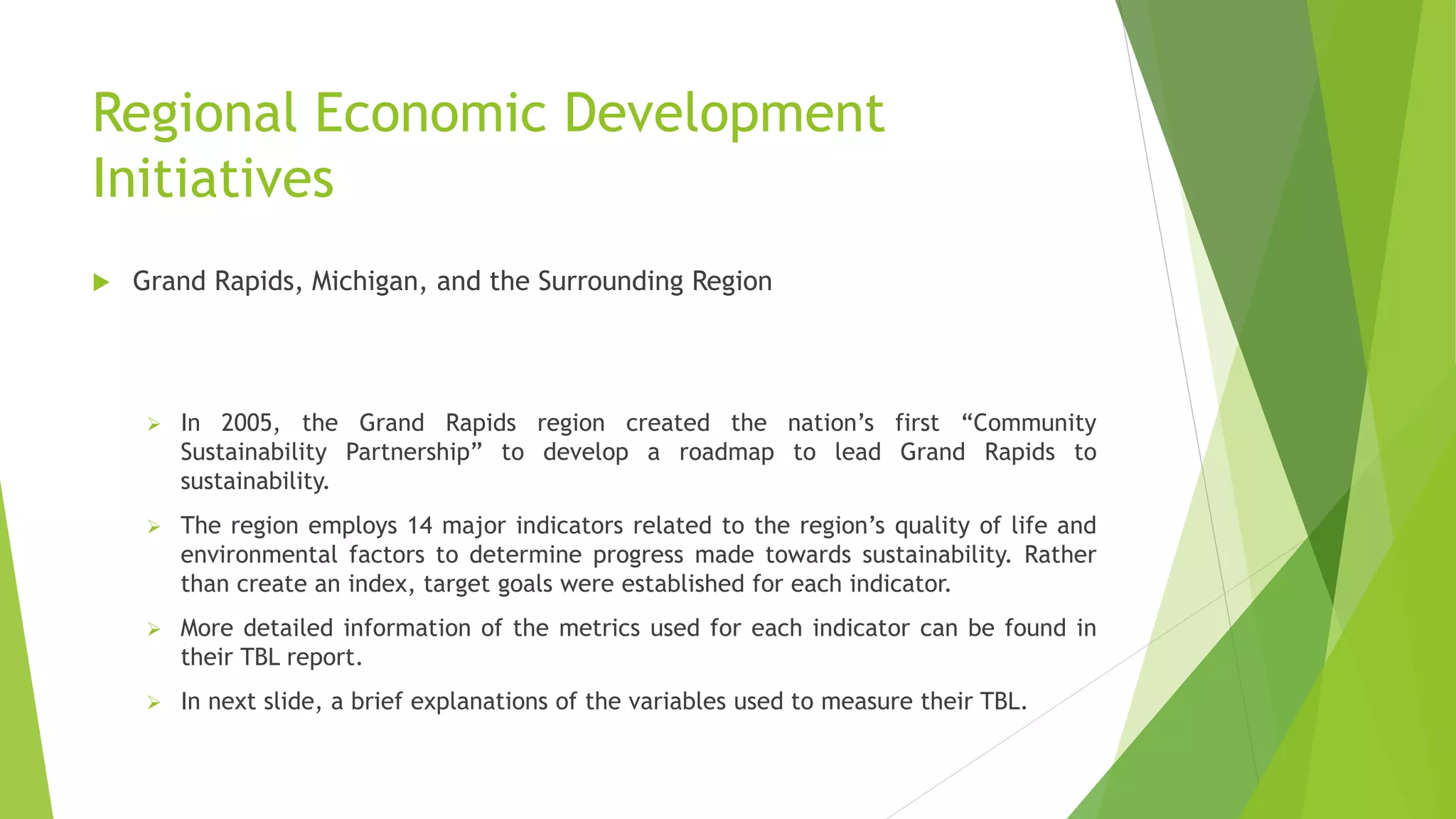
 Grand Rapids, Michigan, and the Surrounding Region
 In 2005, the Grand Rapids region created the nation’s first “Community
Sustainability Partnership” to develop a roadmap to lead Grand Rapids to
sustainability.
 The region employs 14 major indicators related to the region’s quality of life and
environmental factors to determine progress made towards sustainability. Rather
than create an index, target goals were established for each indicator.
 More detailed information of the metrics used for each indicator can be found in
their TBL report.
 In next slide, a brief explanations of the variables used to measure their TBL.
Regional Economic Development
Initiatives
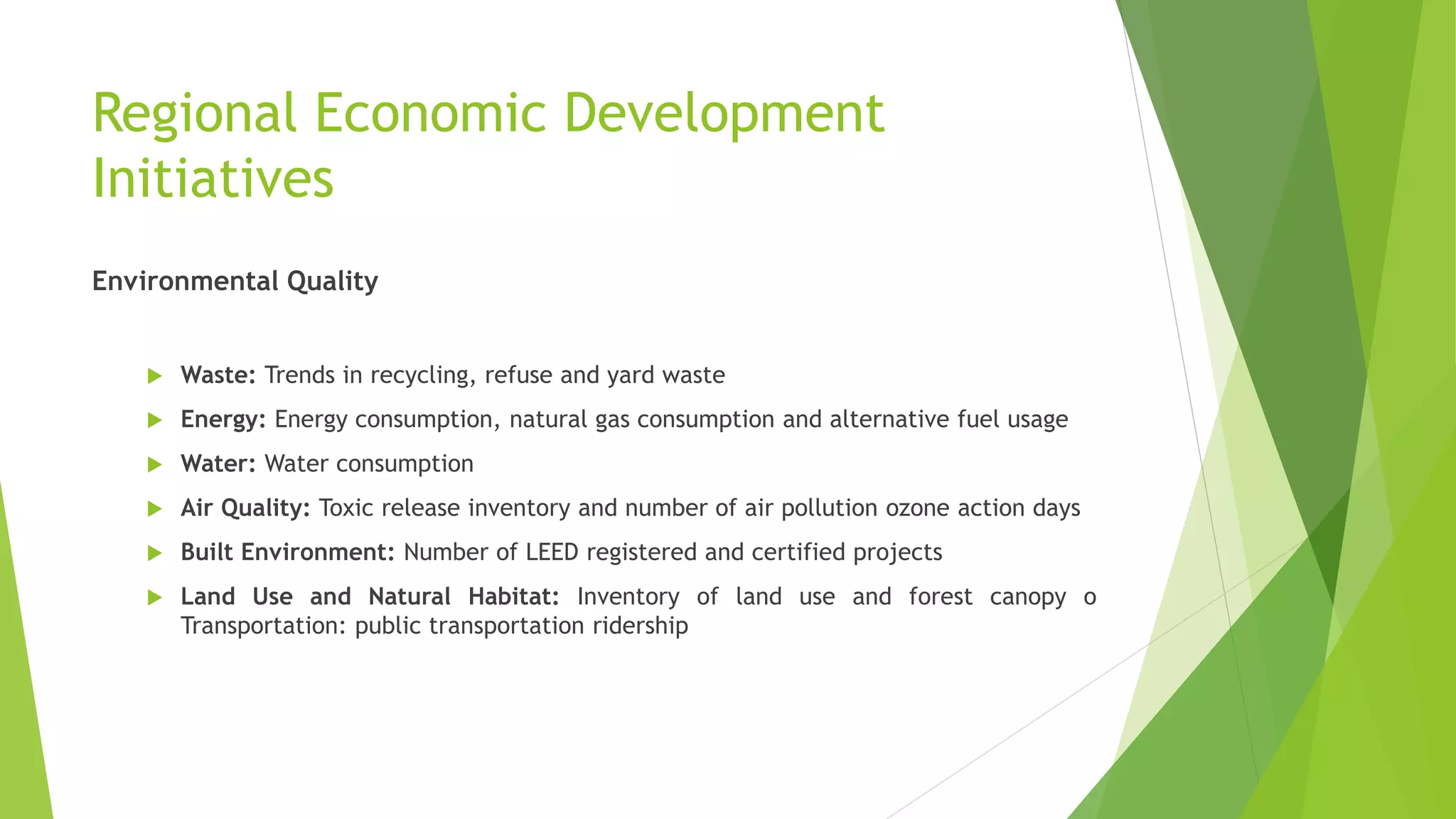
Environmental Quality
 Waste: Trends in recycling, refuse and yard waste
 Energy: Energy consumption, natural gas consumption and alternative fuel usage
 Water: Water consumption
 Air Quality: Toxic release inventory and number of air pollution ozone action days
 Built Environment: Number of LEED registered and certified projects
 Land Use and Natural Habitat: Inventory of land use and forest canopy o
Transportation: public transportation ridership
Regional Economic Development
Initiatives
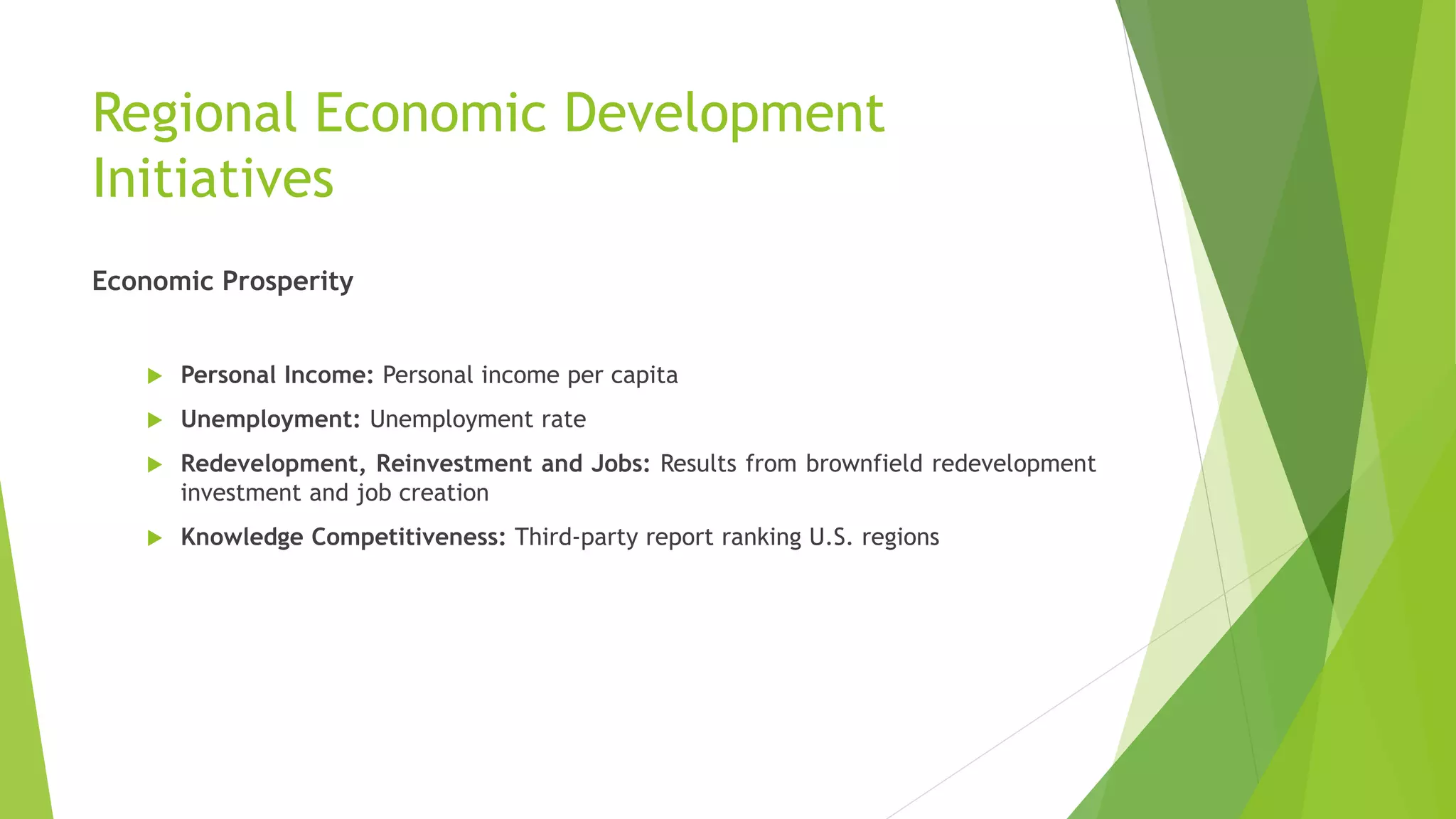
Economic Prosperity
 Personal Income: Personal income per capita
 Unemployment: Unemployment rate
 Redevelopment, Reinvestment and Jobs: Results from brownfield redevelopment
investment and job creation
 Knowledge Competitiveness: Third-party report ranking U.S. regions
Regional Economic Development
Initiatives
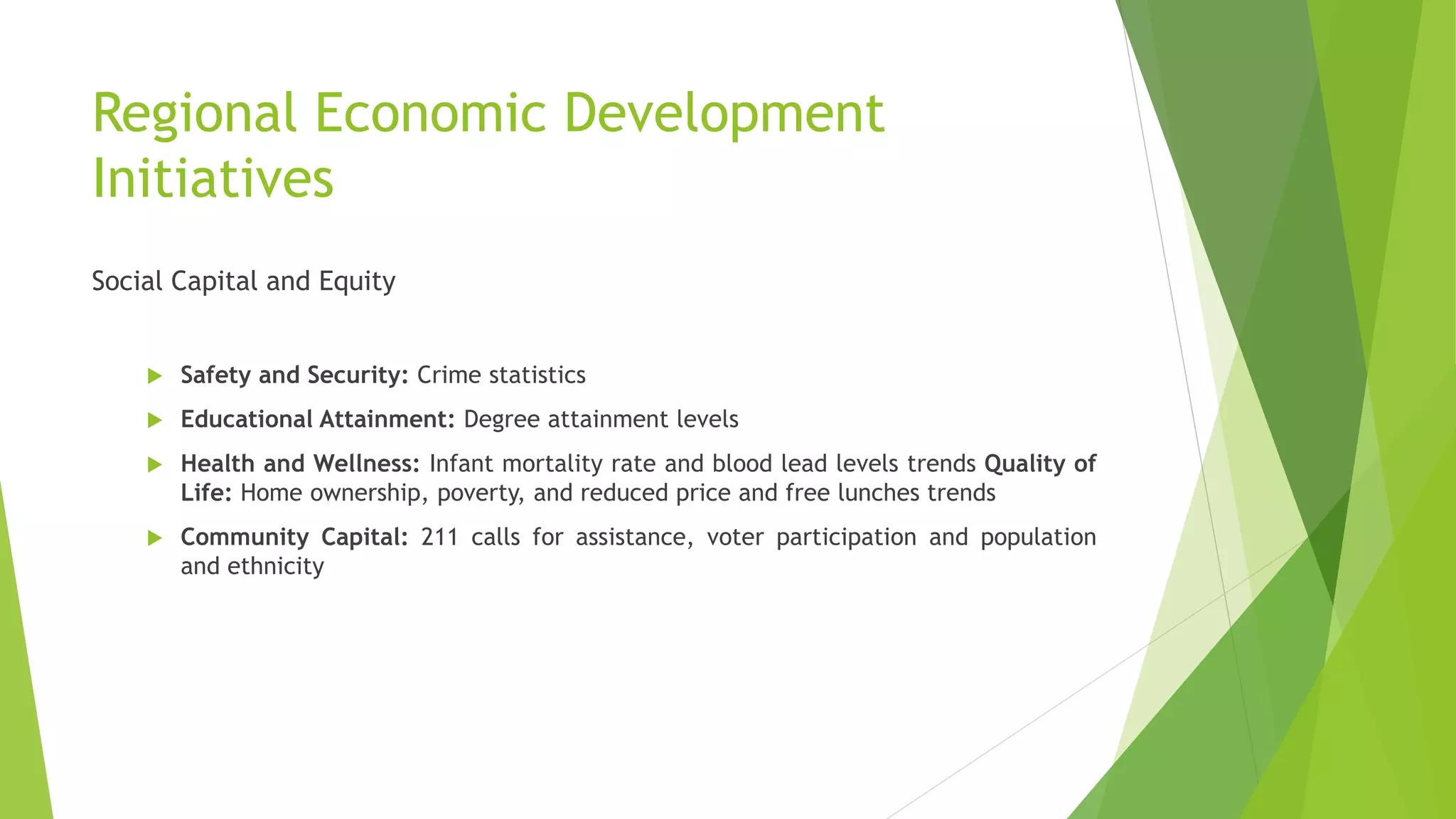
Social Capital and Equity
 Safety and Security: Crime statistics
 Educational Attainment: Degree attainment levels
 Health and Wellness: Infant mortality rate and blood lead levels trends Quality of
Life: Home ownership, poverty, and reduced price and free lunches trends
 Community Capital: 211 calls for assistance, voter participation and population
and ethnicity

Ayesha.pptx

  • 1.
    The Triple Bottom Line:What Is It and How Does It Work? Presented by: Ayesha Khan
  • 2.
    Introduction  Sustainability hasbeen an often mentioned goal of businesses, nonprofits and governments in the past decade, yet measuring the degree to which an organization is being sustainable or pursuing sustainable growth can be difficult.  Interest in triple bottom line accounting has been growing across for-profit, nonprofit and government sectors.
  • 3.
    Aim of theArticle  This article reviews the TBL concept, explains how it can be useful for businesses, policy-makers and economic development practitioners and highlights some current examples of putting the TBL into practice.
  • 4.
    The Triple BottomLine The TBL is an accounting framework that incorporates three dimensions of performance:  Social performance  Environmental performance  Financial performance The TBL dimensions are also commonly called the three Ps:  People  Planet  Profits
  • 5.
    Calculating the TBL The3Ps do not have a common unit of measure.  Profits are measured in dollars.  What is social capital measured in?  What about environmental or ecological health? Finding a common unit of measurement is one challenge. In this way, one eliminates the incompatible units issue and, as long as there is a universally accepted accounting method, allows for comparisons between entities, e.g., comparing performance between companies, cities, development projects or some other benchmark.
  • 6.
    Calculating the TBL Anexample of an index that compares a county versus the nation’s performance for a variety of components is the Indiana Business Research Center’s Innovation Index. There remains some subjectivity even when using an index however. For example:  How are the index components weighted?  Would each “P” get equal weighting?  What about the sub-components within each “P”?  Do they each get equal weighting?  Is the people category more important than the planet?  Who decides?
  • 7.
    What Measures Gointo the Index? There is no universal standard method for calculating the TBL. Neither is there a universally accepted standard for the measures that comprise each of the three TBL categories.  Needs of different entities (businesses or nonprofits)  Different projects or policies (infrastructure investment or educational programs)  Different geographic boundaries (a city, region or country)
  • 8.
    Economic Measures Economic variablesought to be variables that deal with the bottom line and the flow of money. It could look at income or expenditures, taxes, business climate factors, employment, and business diversity factors. Specific examples include:  Personal income  Cost of underemployment  Establishment churn  Establishment sizes  Job growth  Employment distribution by sector  Percentage of firms in each sector  Revenue by sector contributing to gross state product
  • 9.
    Environmental Measures Environmental variablesshould represent measurements of natural resources and reflect potential influences to its viability. Specific examples include:  Sulfur dioxide concentration  Concentration of nitrogen oxides  Selected priority pollutants  Excessive nutrients  Electricity consumption  Fossil fuel consumption  Solid waste management  Hazardous waste management  Change in land use/land cover
  • 10.
    Social Measures  Socialvariables refer to social dimensions of a community or region and could include measurements of education, equity and access to social resources, health and well-being, quality of life, and social capital. The examples listed below are a small snippet of potential variables:  Unemployment rate  Female labor force participation rate  Median household income  Relative poverty  Percentage of population with a post-secondary degree or certificate  Average commute time  Violent crimes per capita  Health-adjusted life expectancy
  • 11.
    Variations of theTriple Bottom Line Measurement  The application of the TBL by businesses, nonprofits and governments are motivated by the principles of economic, environmental and social sustainability, but differ with regard to the way they measure the three categories of outcomes.  The Genuine Progress Indicator (GPI), for example, consists of 25 variables that encompass economic, social and environmental factors. Those variables are converted into monetary units and summed into a single, dollar-denominated measure.  Minnesota developed its own progress indicator comprised of 42 variables that focused on the goals of a healthy economy and gauged progress in achieving these goals.  Researchers in environmental policy argue that the three categories—economic, social and environmental—need to be integrated in order to see the complete picture of the consequences that a regulation, policy or economic development project may have and to assess policy options and tradeoffs.
  • 12.
    Who Uses theTriple Bottom Line? Businesses The TBL and its core value of sustainability have become compelling in the business world due to accumulating anecdotal evidence of greater long-term profitability. Cascade Engineering, for example, a private firm that does not need to file the detailed financial paperwork of public companies, has identified the following variables for their TBL scorecard: Economic  Amount of taxes paid Social  Average hours of training/ employee  From welfare to career retention  Charitable contributions Environmental/Safety  Safety incident rate  Lost/restricted workday rate  Sales dollars per kilowatt hours  Greenhouse gas emissions  Use of post-consumer and industrial recycled material
  • 13.
    Nonprofits  Many nonprofitorganizations have adopted the TBL and some have partnered with private firms to address broad sustainability issues that affect mutual stakeholders. Their approach includes the following:  Food and Agriculture (economic)  Ecological Stewardship (environmental)  Education and the Arts (social)
  • 14.
    Government  State, regionaland local governments are increasingly adopting the TBL and analogous sustainability assessment frameworks as decision making and performance-monitoring tools.  Policy-makers use these sustainability assessment frameworks to decide which actions they should or should not take to make society more sustainable.  Policy-makers want to know the cause and effect relationship between actions— projects or policies—and whether the results move society toward or away from sustainability.  Internationally, the European Union uses integrated assessment to identify the “likely positive and negative impacts of proposed policy actions, enabling informed political judgments to be made about the proposal and identify trade-offs in achieving competing objectives.”  The EU guidelines have themselves been the subject of critique and have undergone several rounds of improvement.16 The process of refining the guidelines shows both the transparency of the process and the EU commitment to integrated assessment.
  • 15.
    Regional Economic Development Initiatives The concept of the triple bottom line can be used regionally by communities to encourage economic development growth in a sustainable manner.  This requires an increased level of cooperation among businesses, nonprofit organizations, governments and citizens of the region.  The following examples throughout the United States show various ways the TBL concept can be used to grow a region’s economic base in a sustainable manner.
  • 16.
    Regional Economic Development Initiatives Cleveland, Ohio  In 2009, the mayor of Cleveland convened the Sustainable Cleveland 2019 (SC2019) Summit to bring together hundreds of people interested in applying the principles of sustainability to the design of the local economy.  The SC2019 is a 10-year initiative to create a sustainable economy in Cleveland by focusing on a TBL-like concept.  The city uses four key areas for measuring sustainability: the personal and social environment, the natural environment, the built environment (e.g., infrastructure and urban growth patterns) and the business environment.
  • 17.
    Regional Economic Development Initiatives Grand Rapids, Michigan, and the Surrounding Region  In 2005, the Grand Rapids region created the nation’s first “Community Sustainability Partnership” to develop a roadmap to lead Grand Rapids to sustainability.  The region employs 14 major indicators related to the region’s quality of life and environmental factors to determine progress made towards sustainability. Rather than create an index, target goals were established for each indicator.  More detailed information of the metrics used for each indicator can be found in their TBL report.  In next slide, a brief explanations of the variables used to measure their TBL.
  • 18.
    Regional Economic Development Initiatives EnvironmentalQuality  Waste: Trends in recycling, refuse and yard waste  Energy: Energy consumption, natural gas consumption and alternative fuel usage  Water: Water consumption  Air Quality: Toxic release inventory and number of air pollution ozone action days  Built Environment: Number of LEED registered and certified projects  Land Use and Natural Habitat: Inventory of land use and forest canopy o Transportation: public transportation ridership
  • 19.
    Regional Economic Development Initiatives EconomicProsperity  Personal Income: Personal income per capita  Unemployment: Unemployment rate  Redevelopment, Reinvestment and Jobs: Results from brownfield redevelopment investment and job creation  Knowledge Competitiveness: Third-party report ranking U.S. regions
  • 20.
    Regional Economic Development Initiatives SocialCapital and Equity  Safety and Security: Crime statistics  Educational Attainment: Degree attainment levels  Health and Wellness: Infant mortality rate and blood lead levels trends Quality of Life: Home ownership, poverty, and reduced price and free lunches trends  Community Capital: 211 calls for assistance, voter participation and population and ethnicity