ET 8403
INFORMATION THEORY AND CODING
Introduction
• What is Information Theory?
• IT is a branch of math (a strictly deductive system). (C.
Shannon)
• General statistical concept of communication. (N. Wiener,
What is IT?)
• It was build upon the work of Shannon (1948)
• It answers to two fundamental questions in
Communications Theory:
• What is the fundamental limit for information
compression?
• What is the fundamental limit on information transmission
rate over a communications channel?
Digital Communications Systems
• The fundamental problem of communication
is that of reproducing at one point either
exactly or approximately a message selected
at another point. (Claude Shannon: A
Mathematical Theory of Communications,
1948)
• Source
• Source Coder: Convert an analog or digital source
into bits.
• Channel Coder: Protection against
errors/erasures in the channel.
• Modulator: Each binary sequence is assigned to a
waveform
• Channel: Physical Medium to send information
from transmitter to receiver. Source of
randomness.
• Demodulator, Channel Decoder, Source Decoder,
Sink.
• Modulator + Channel = Discrete Channel.
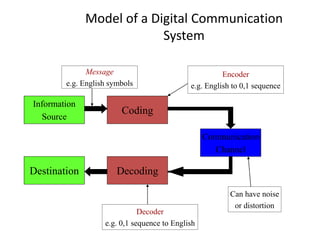
Model of a Digital Communication
System
Destination Decoding
Communication
Channel
Coding
Information
Source
Message
e.g. English symbols
Encoder
e.g. English to 0,1 sequence
Can have noise
or distortion
Decoder
e.g. 0,1 sequence to English
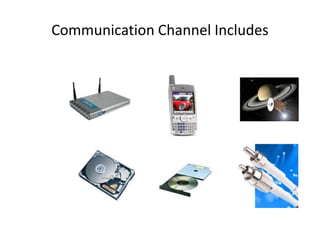
Communication Channel Includes
Shannon’s Definition
of Communication
“The fundamental problem of communication
is that of reproducing at one point either
exactly or approximately a message selected at
another point.”
“Frequently the messages have meaning”
“... [which is] irrelevant to the engineering problem.”
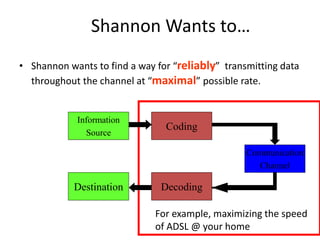
Shannon Wants to…
• Shannon wants to find a way for “reliably” transmitting data
throughout the channel at “maximal” possible rate.
For example, maximizing the speed
of ADSL @ your home
Destination Decoding
Communication
Channel
Coding
Information
Source
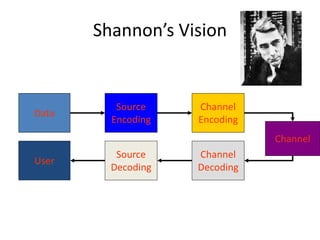
Shannon’s Vision
Data
Source
Encoding
Channel
Source
Decoding
User
Channel
Encoding
Channel
Decoding
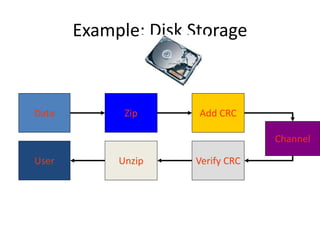
Example: Disk Storage
Data Zip
Channel
Unzip
User
Add CRC
Verify CRC
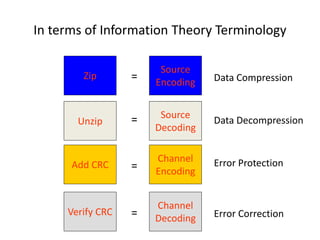
In terms of Information Theory Terminology
Zip
Source
Encoding
= Data Compression
Add CRC
Channel
Encoding
=
Unzip
Source
Decoding
=
Verify CRC
Channel
Decoding
=
Data Decompression
Error Protection
Error Correction
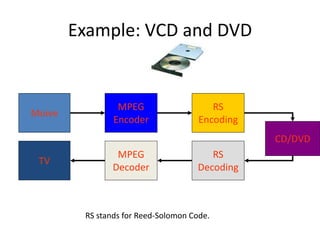
Example: VCD and DVD
Moive
MPEG
Encoder
CD/DVD
MPEG
Decoder
TV
RS
Encoding
RS
Decoding
RS stands for Reed-Solomon Code.
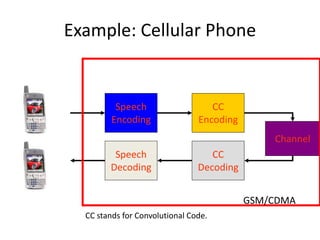
Example: Cellular Phone
Speech
Encoding
Channel
Speech
Decoding
CC
Encoding
CC
Decoding
CC stands for Convolutional Code.
GSM/CDMA
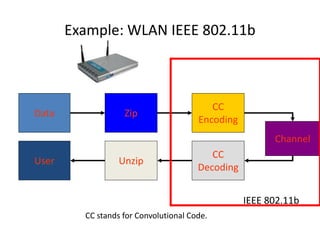
Example: WLAN IEEE 802.11b
Data Zip
Channel
Unzip
User
CC
Encoding
CC
Decoding
CC stands for Convolutional Code.
IEEE 802.11b
Shannon Theory
• The original 1948 Shannon Theory contains:
1. Measurement of Information
2. Source Coding Theory
3. Channel Coding Theory
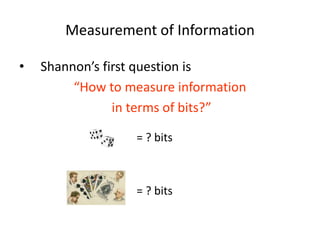
Measurement of Information
• Shannon’s first question is
“How to measure information
in terms of bits?”
= ? bits
= ? bits
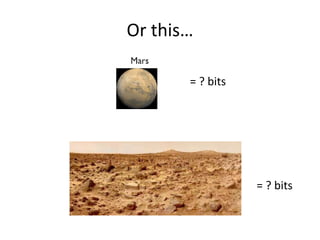
Or this…
= ? bits
= ? bits
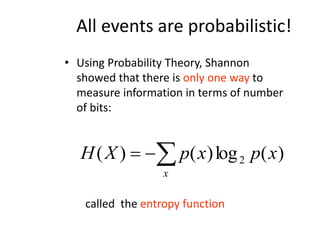
All events are probabilistic!
• Using Probability Theory, Shannon
showed that there is only one way to
measure information in terms of number
of bits:
)
(
log
)
(
)
( 2 x
p
x
p
X
H
x



called the entropy function
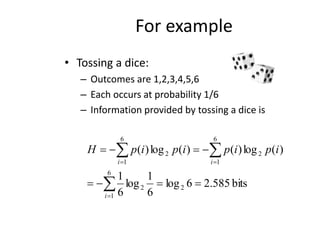
For example
• Tossing a dice:
– Outcomes are 1,2,3,4,5,6
– Each occurs at probability 1/6
– Information provided by tossing a dice is
bits
585
.
2
6
log
6
1
log
6
1
)
(
log
)
(
)
(
log
)
(
2
6
1
2
2
6
1
2
6
1














i
i
i
i
p
i
p
i
p
i
p
H
Wait!
It is nonsense!
The number 2.585-bits is not an integer!!
What does you mean?
Shannon’s First Source
Coding Theorem
• Shannon showed:
“To reliably store the information
generated by some random source
X, you need no more/less than, on
the average, H(X) bits for each
outcome.”
Meaning:
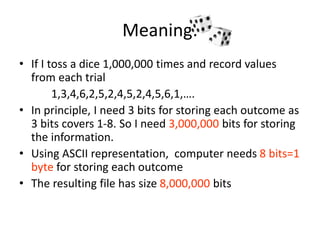
• If I toss a dice 1,000,000 times and record values
from each trial
1,3,4,6,2,5,2,4,5,2,4,5,6,1,….
• In principle, I need 3 bits for storing each outcome as
3 bits covers 1-8. So I need 3,000,000 bits for storing
the information.
• Using ASCII representation, computer needs 8 bits=1
byte for storing each outcome
• The resulting file has size 8,000,000 bits
But Shannon said:
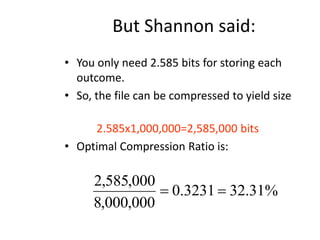
• You only need 2.585 bits for storing each
outcome.
• So, the file can be compressed to yield size
2.585x1,000,000=2,585,000 bits
• Optimal Compression Ratio is:
%
31
.
32
3231
.
0
000
,
000
,
8
000
,
585
,
2


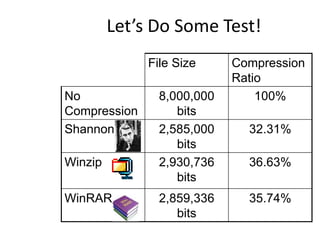
Let’s Do Some Test!
File Size Compression
Ratio
No
Compression
8,000,000
bits
100%
Shannon 2,585,000
bits
32.31%
Winzip 2,930,736
bits
36.63%
WinRAR 2,859,336
bits
35.74%
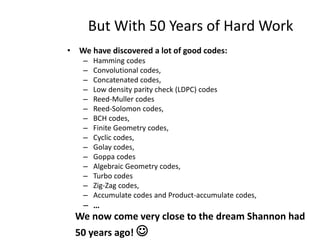
But With 50 Years of Hard Work
• We have discovered a lot of good codes:
– Hamming codes
– Convolutional codes,
– Concatenated codes,
– Low density parity check (LDPC) codes
– Reed-Muller codes
– Reed-Solomon codes,
– BCH codes,
– Finite Geometry codes,
– Cyclic codes,
– Golay codes,
– Goppa codes
– Algebraic Geometry codes,
– Turbo codes
– Zig-Zag codes,
– Accumulate codes and Product-accumulate codes,
– …
We now come very close to the dream Shannon had
50 years ago! 
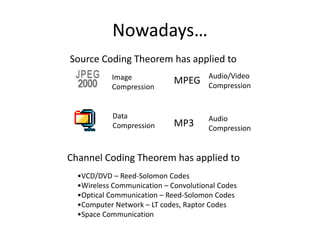
Nowadays…
Source Coding Theorem has applied to
Channel Coding Theorem has applied to
Image
Compression
Data
Compression
Audio/Video
Compression
Audio
Compression
MPEG
MP3
•VCD/DVD – Reed-Solomon Codes
•Wireless Communication – Convolutional Codes
•Optical Communication – Reed-Solomon Codes
•Computer Network – LT codes, Raptor Codes
•Space Communication
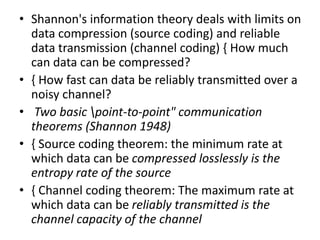
• Shannon's information theory deals with limits on
data compression (source coding) and reliable
data transmission (channel coding) { How much
can data can be compressed?
• { How fast can data be reliably transmitted over a
noisy channel?
• Two basic point-to-point" communication
theorems (Shannon 1948)
• { Source coding theorem: the minimum rate at
which data can be compressed losslessly is the
entropy rate of the source
• { Channel coding theorem: The maximum rate at
which data can be reliably transmitted is the
channel capacity of the channel
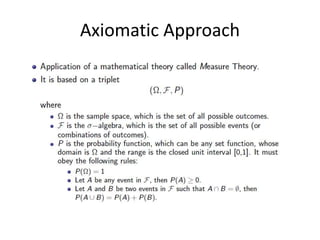
Axiomatic Approach
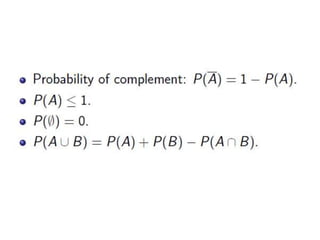
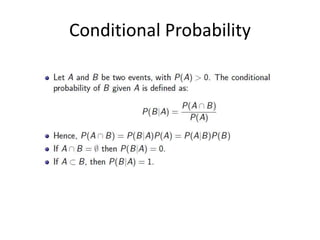
Conditional Probability
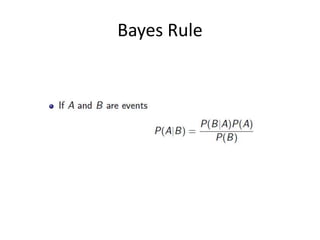
Bayes Rule
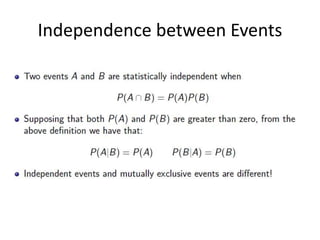
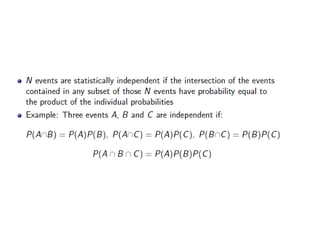
Independence between Events
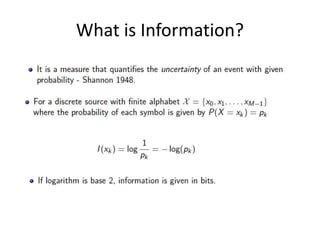
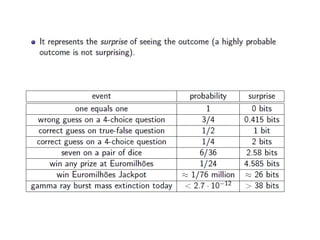
What is Information?
• Entropy ??
• NEXT LECTURE
• Thank you

Lecture 1.pptx

  • 1.
  • 2.
    Introduction • What isInformation Theory? • IT is a branch of math (a strictly deductive system). (C. Shannon) • General statistical concept of communication. (N. Wiener, What is IT?) • It was build upon the work of Shannon (1948) • It answers to two fundamental questions in Communications Theory: • What is the fundamental limit for information compression? • What is the fundamental limit on information transmission rate over a communications channel?
  • 3.
    Digital Communications Systems •The fundamental problem of communication is that of reproducing at one point either exactly or approximately a message selected at another point. (Claude Shannon: A Mathematical Theory of Communications, 1948)
  • 4.
    • Source • SourceCoder: Convert an analog or digital source into bits. • Channel Coder: Protection against errors/erasures in the channel. • Modulator: Each binary sequence is assigned to a waveform • Channel: Physical Medium to send information from transmitter to receiver. Source of randomness. • Demodulator, Channel Decoder, Source Decoder, Sink. • Modulator + Channel = Discrete Channel.
  • 5.
    Model of aDigital Communication System Destination Decoding Communication Channel Coding Information Source Message e.g. English symbols Encoder e.g. English to 0,1 sequence Can have noise or distortion Decoder e.g. 0,1 sequence to English
  • 6.
  • 7.
    Shannon’s Definition of Communication “Thefundamental problem of communication is that of reproducing at one point either exactly or approximately a message selected at another point.” “Frequently the messages have meaning” “... [which is] irrelevant to the engineering problem.”
  • 8.
    Shannon Wants to… •Shannon wants to find a way for “reliably” transmitting data throughout the channel at “maximal” possible rate. For example, maximizing the speed of ADSL @ your home Destination Decoding Communication Channel Coding Information Source
  • 9.
  • 10.
    Example: Disk Storage DataZip Channel Unzip User Add CRC Verify CRC
  • 11.
    In terms ofInformation Theory Terminology Zip Source Encoding = Data Compression Add CRC Channel Encoding = Unzip Source Decoding = Verify CRC Channel Decoding = Data Decompression Error Protection Error Correction
  • 12.
    Example: VCD andDVD Moive MPEG Encoder CD/DVD MPEG Decoder TV RS Encoding RS Decoding RS stands for Reed-Solomon Code.
  • 13.
  • 14.
    Example: WLAN IEEE802.11b Data Zip Channel Unzip User CC Encoding CC Decoding CC stands for Convolutional Code. IEEE 802.11b
  • 15.
    Shannon Theory • Theoriginal 1948 Shannon Theory contains: 1. Measurement of Information 2. Source Coding Theory 3. Channel Coding Theory
  • 16.
    Measurement of Information •Shannon’s first question is “How to measure information in terms of bits?” = ? bits = ? bits
  • 17.
    Or this… = ?bits = ? bits
  • 18.
    All events areprobabilistic! • Using Probability Theory, Shannon showed that there is only one way to measure information in terms of number of bits: ) ( log ) ( ) ( 2 x p x p X H x    called the entropy function
  • 19.
    For example • Tossinga dice: – Outcomes are 1,2,3,4,5,6 – Each occurs at probability 1/6 – Information provided by tossing a dice is bits 585 . 2 6 log 6 1 log 6 1 ) ( log ) ( ) ( log ) ( 2 6 1 2 2 6 1 2 6 1               i i i i p i p i p i p H
  • 20.
    Wait! It is nonsense! Thenumber 2.585-bits is not an integer!! What does you mean?
  • 21.
    Shannon’s First Source CodingTheorem • Shannon showed: “To reliably store the information generated by some random source X, you need no more/less than, on the average, H(X) bits for each outcome.”
  • 22.
    Meaning: • If Itoss a dice 1,000,000 times and record values from each trial 1,3,4,6,2,5,2,4,5,2,4,5,6,1,…. • In principle, I need 3 bits for storing each outcome as 3 bits covers 1-8. So I need 3,000,000 bits for storing the information. • Using ASCII representation, computer needs 8 bits=1 byte for storing each outcome • The resulting file has size 8,000,000 bits
  • 23.
    But Shannon said: •You only need 2.585 bits for storing each outcome. • So, the file can be compressed to yield size 2.585x1,000,000=2,585,000 bits • Optimal Compression Ratio is: % 31 . 32 3231 . 0 000 , 000 , 8 000 , 585 , 2  
  • 24.
    Let’s Do SomeTest! File Size Compression Ratio No Compression 8,000,000 bits 100% Shannon 2,585,000 bits 32.31% Winzip 2,930,736 bits 36.63% WinRAR 2,859,336 bits 35.74%
  • 25.
    But With 50Years of Hard Work • We have discovered a lot of good codes: – Hamming codes – Convolutional codes, – Concatenated codes, – Low density parity check (LDPC) codes – Reed-Muller codes – Reed-Solomon codes, – BCH codes, – Finite Geometry codes, – Cyclic codes, – Golay codes, – Goppa codes – Algebraic Geometry codes, – Turbo codes – Zig-Zag codes, – Accumulate codes and Product-accumulate codes, – … We now come very close to the dream Shannon had 50 years ago! 
  • 26.
    Nowadays… Source Coding Theoremhas applied to Channel Coding Theorem has applied to Image Compression Data Compression Audio/Video Compression Audio Compression MPEG MP3 •VCD/DVD – Reed-Solomon Codes •Wireless Communication – Convolutional Codes •Optical Communication – Reed-Solomon Codes •Computer Network – LT codes, Raptor Codes •Space Communication
  • 27.
    • Shannon's informationtheory deals with limits on data compression (source coding) and reliable data transmission (channel coding) { How much can data can be compressed? • { How fast can data be reliably transmitted over a noisy channel? • Two basic point-to-point" communication theorems (Shannon 1948) • { Source coding theorem: the minimum rate at which data can be compressed losslessly is the entropy rate of the source • { Channel coding theorem: The maximum rate at which data can be reliably transmitted is the channel capacity of the channel
  • 28.
  • 30.
  • 31.
  • 32.
  • 34.
  • 36.
    • Entropy ?? •NEXT LECTURE • Thank you