A CIRCULAR ECONOMY FOR
DENMARK IN A GLOBAL
CONTEXT
WASTE-TO-ENERGY IN THE CIRCULAR ECONOMY
21ST OCTOBER 2015
Dr Mervyn Jones
Sustainable Global Resources
United Kingdom
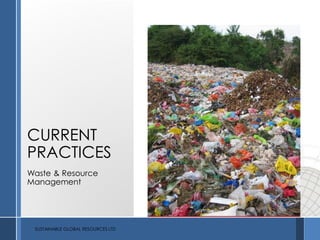
CURRENT
PRACTICES
Waste & Resource
Management
SUSTAINABLE GLOBAL RESOURCES LTD
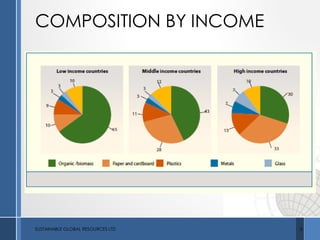
COMPOSITION BY INCOME
SUSTAINABLE GLOBAL RESOURCES LTD 3
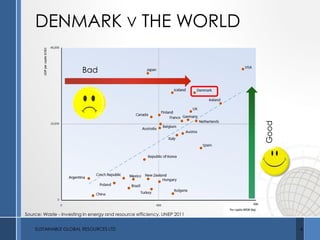
DENMARK V THE WORLD
SUSTAINABLE GLOBAL RESOURCES LTD 4
Good
Bad
Source: Waste - Investing in energy and resource efficiency. UNEP 2011
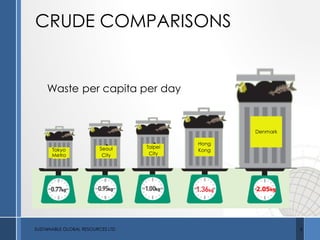
CRUDE COMPARISONS
SUSTAINABLE GLOBAL RESOURCES LTD 5
2.05kg
Waste per capita per day
Tokyo
Metro
Taipei
City
Seoul
City
Hong
Kong
Denmark
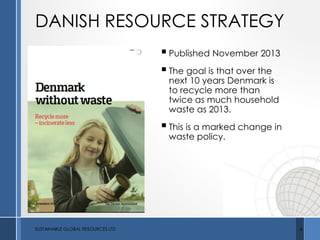
DANISH RESOURCE STRATEGY
SUSTAINABLE GLOBAL RESOURCES LTD 6
Published November 2013
The goal is that over the
next 10 years Denmark is
to recycle more than
twice as much household
waste as 2013.
This is a marked change in
waste policy.
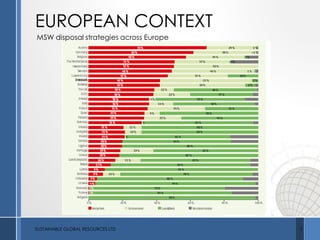
EUROPEAN CONTEXT
SUSTAINABLE GLOBAL RESOURCES LTD 7
MSW disposal strategies across Europe
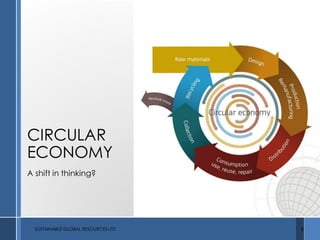
CIRCULAR
ECONOMY
A shift in thinking?
SUSTAINABLE GLOBAL RESOURCES LTD 8
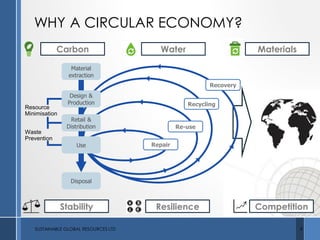
WHY A CIRCULAR ECONOMY?
Carbon
Recovery
Recycling
Repair
Re-use
Material
extraction
Disposal
Design &
Production
Use
Retail &
Distribution
Resource
Minimisation
Waste
Prevention
Water Materials
Stability Resilience Competition
SUSTAINABLE GLOBAL RESOURCES LTD 9
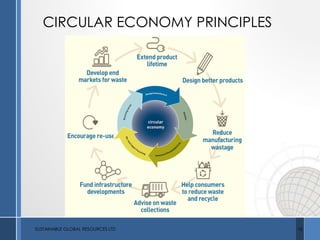
CIRCULAR ECONOMY PRINCIPLES
SUSTAINABLE GLOBAL RESOURCES LTD 10
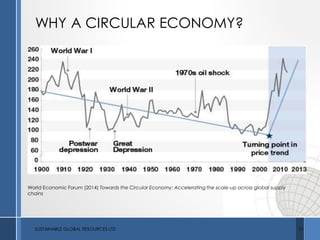
WHY A CIRCULAR ECONOMY?
World Economic Forum (2014) Towards the Circular Economy: Accelerating the scale-up across global supply
chains
SUSTAINABLE GLOBAL RESOURCES LTD 11
80
100
120
140
160
180
200
1996 1998 2000 2002 2004 2006 2008 2010 2012
Input prices Output prices
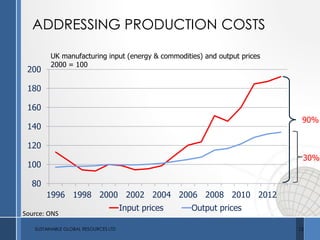
UK manufacturing input (energy & commodities) and output prices
2000 = 100
Source: ONS
90%
ADDRESSING PRODUCTION COSTS
30%
SUSTAINABLE GLOBAL RESOURCES LTD 12
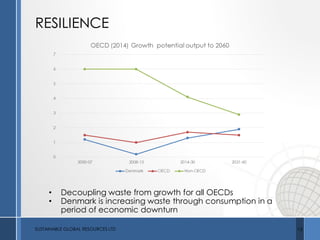
RESILIENCE
SUSTAINABLE GLOBAL RESOURCES LTD 13
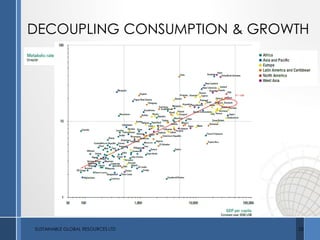
• Decoupling waste from growth for all OECDs
• Denmark is increasing waste through consumption in a
period of economic downturn
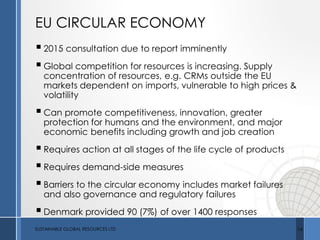
EU CIRCULAR ECONOMY
2015 consultation due to report imminently
Global competition for resources is increasing. Supply
concentration of resources, e.g. CRMs outside the EU
markets dependent on imports, vulnerable to high prices &
volatility
Can promote competitiveness, innovation, greater
protection for humans and the environment, and major
economic benefits including growth and job creation
Requires action at all stages of the life cycle of products
Requires demand-side measures
Barriers to the circular economy includes market failures
and also governance and regulatory failures
Denmark provided 90 (7%) of over 1400 responses
SUSTAINABLE GLOBAL RESOURCES LTD 14
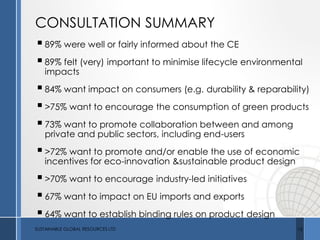
CONSULTATION SUMMARY
89% were well or fairly informed about the CE
89% felt (very) important to minimise lifecycle environmental
impacts
84% want impact on consumers (e.g. durability & reparability)
>75% want to encourage the consumption of green products
73% want to promote collaboration between and among
private and public sectors, including end-users
>72% want to promote and/or enable the use of economic
incentives for eco-innovation &sustainable product design
>70% want to encourage industry-led initiatives
67% want to impact on EU imports and exports
64% want to establish binding rules on product design
SUSTAINABLE GLOBAL RESOURCES LTD 15
VIEWS ON PRODUCT FEATURES
 Recyclability – 86% felt (very) important
 Durability - 83%
 Resource use in the use phase (e.g. water efficiency) – 83%
 Reusability -78%
 Increase in reused parts or RC – 76%
 Reparability: Product design & parts availability facilitating
maintenance and repair activities – 74%
 Reparability: Availability of information on product repair -
73%
 Upgradability and modularity – 71%
 Biodegradability and compostability – 60%
 Packaging & Small EE were the clear priorities identified
(followed by construction, textiles & large white goods)
SUSTAINABLE GLOBAL RESOURCES LTD 16
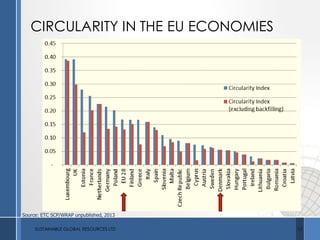
CIRCULARITY IN THE EU ECONOMIES
Source: ETC SCP/WRAP unpublished, 2013
SUSTAINABLE GLOBAL RESOURCES LTD 17
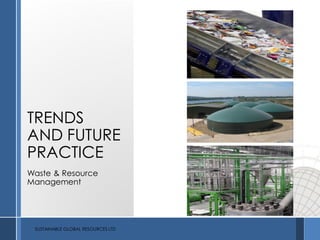
TRENDS
AND FUTURE
PRACTICE
Waste & Resource
Management
SUSTAINABLE GLOBAL RESOURCES LTD
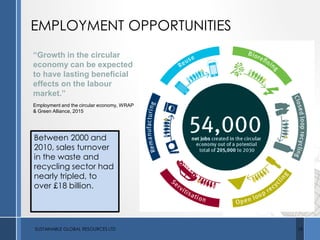
EMPLOYMENT OPPORTUNITIES
“Growth in the circular
economy can be expected
to have lasting beneficial
effects on the labour
market.”
Employment and the circular economy, WRAP
& Green Alliance, 2015
Between 2000 and
2010, sales turnover
in the waste and
recycling sector had
nearly tripled, to
over £18 billion.
SUSTAINABLE GLOBAL RESOURCES LTD 19
CLOTHING CLOSED LOOP
SUSTAINABLE GLOBAL RESOURCES LTD 20
ELECTRICALS LOOP
SUSTAINABLE GLOBAL RESOURCES LTD 21
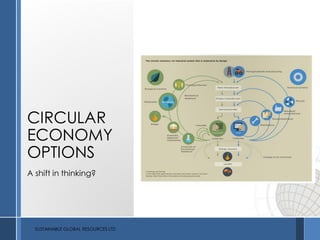
CIRCULAR
ECONOMY
OPTIONS
A shift in thinking?
SUSTAINABLE GLOBAL RESOURCES LTD
DECOUPLING CONSUMPTION & GROWTH
SUSTAINABLE GLOBAL RESOURCES LTD 23
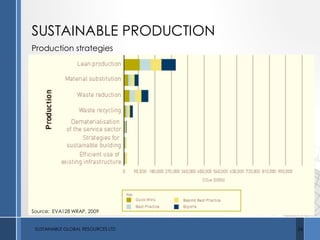
SUSTAINABLE PRODUCTION
Source: EVA128 WRAP, 2009
Production strategies
SUSTAINABLE GLOBAL RESOURCES LTD 24
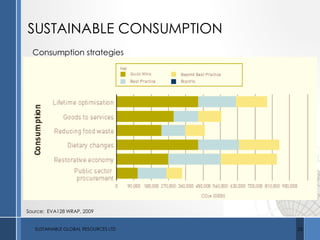
SUSTAINABLE CONSUMPTION
Consumption strategies
Source: EVA128 WRAP, 2009
SUSTAINABLE GLOBAL RESOURCES LTD 25
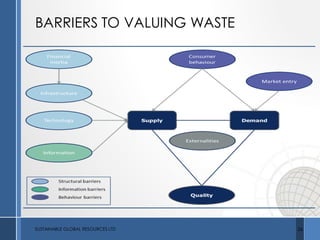
BARRIERS TO VALUING WASTE
SUSTAINABLE GLOBAL RESOURCES LTD 26
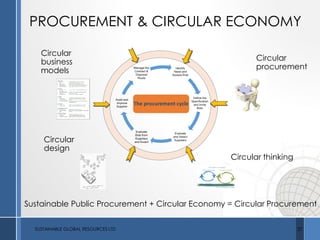
PROCUREMENT & CIRCULAR ECONOMY
Sustainable Public Procurement + Circular Economy = Circular Procurement
Circular
business
models
Circular
design
Circular
procurement
Circular thinking
SUSTAINABLE GLOBAL RESOURCES LTD 27
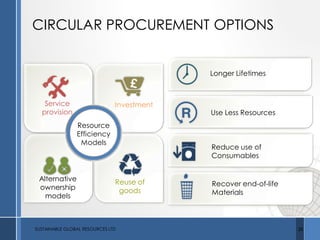
Resource
Efficiency
Models
Investment
Alternative
ownership
models
Service
provision
Reuse of
goods
Service
provision
CIRCULAR PROCUREMENT OPTIONS
Reduce use of
Consumables
Use Less Resources
Longer Lifetimes
Recover end-of-life
Materials
SUSTAINABLE GLOBAL RESOURCES LTD 28
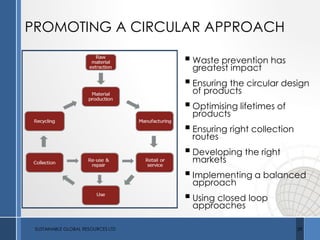
PROMOTING A CIRCULAR APPROACH
Waste prevention has
greatest impact
Ensuring the circular design
of products
Optimising lifetimes of
products
Ensuring right collection
routes
Developing the right
markets
Implementing a balanced
approach
Using closed loop
approaches
SUSTAINABLE GLOBAL RESOURCES LTD 29
THANK YOU
Dr Mervyn Jones
mervyn@sustainableglobalresources.co.uk
?any questions?
SUSTAINABLE GLOBAL RESOURCES LTD

MJ Keynote FINAL 211015

  • 1.
    A CIRCULAR ECONOMYFOR DENMARK IN A GLOBAL CONTEXT WASTE-TO-ENERGY IN THE CIRCULAR ECONOMY 21ST OCTOBER 2015 Dr Mervyn Jones Sustainable Global Resources United Kingdom
  • 2.
  • 3.
    COMPOSITION BY INCOME SUSTAINABLEGLOBAL RESOURCES LTD 3
  • 4.
    DENMARK V THEWORLD SUSTAINABLE GLOBAL RESOURCES LTD 4 Good Bad Source: Waste - Investing in energy and resource efficiency. UNEP 2011
  • 5.
    CRUDE COMPARISONS SUSTAINABLE GLOBALRESOURCES LTD 5 2.05kg Waste per capita per day Tokyo Metro Taipei City Seoul City Hong Kong Denmark
  • 6.
    DANISH RESOURCE STRATEGY SUSTAINABLEGLOBAL RESOURCES LTD 6 Published November 2013 The goal is that over the next 10 years Denmark is to recycle more than twice as much household waste as 2013. This is a marked change in waste policy.
  • 7.
    EUROPEAN CONTEXT SUSTAINABLE GLOBALRESOURCES LTD 7 MSW disposal strategies across Europe
  • 8.
    CIRCULAR ECONOMY A shift inthinking? SUSTAINABLE GLOBAL RESOURCES LTD 8
  • 9.
    WHY A CIRCULARECONOMY? Carbon Recovery Recycling Repair Re-use Material extraction Disposal Design & Production Use Retail & Distribution Resource Minimisation Waste Prevention Water Materials Stability Resilience Competition SUSTAINABLE GLOBAL RESOURCES LTD 9
  • 10.
  • 11.
    WHY A CIRCULARECONOMY? World Economic Forum (2014) Towards the Circular Economy: Accelerating the scale-up across global supply chains SUSTAINABLE GLOBAL RESOURCES LTD 11
  • 12.
    80 100 120 140 160 180 200 1996 1998 20002002 2004 2006 2008 2010 2012 Input prices Output prices UK manufacturing input (energy & commodities) and output prices 2000 = 100 Source: ONS 90% ADDRESSING PRODUCTION COSTS 30% SUSTAINABLE GLOBAL RESOURCES LTD 12
  • 13.
    RESILIENCE SUSTAINABLE GLOBAL RESOURCESLTD 13 • Decoupling waste from growth for all OECDs • Denmark is increasing waste through consumption in a period of economic downturn
  • 14.
    EU CIRCULAR ECONOMY 2015consultation due to report imminently Global competition for resources is increasing. Supply concentration of resources, e.g. CRMs outside the EU markets dependent on imports, vulnerable to high prices & volatility Can promote competitiveness, innovation, greater protection for humans and the environment, and major economic benefits including growth and job creation Requires action at all stages of the life cycle of products Requires demand-side measures Barriers to the circular economy includes market failures and also governance and regulatory failures Denmark provided 90 (7%) of over 1400 responses SUSTAINABLE GLOBAL RESOURCES LTD 14
  • 15.
    CONSULTATION SUMMARY 89% werewell or fairly informed about the CE 89% felt (very) important to minimise lifecycle environmental impacts 84% want impact on consumers (e.g. durability & reparability) >75% want to encourage the consumption of green products 73% want to promote collaboration between and among private and public sectors, including end-users >72% want to promote and/or enable the use of economic incentives for eco-innovation &sustainable product design >70% want to encourage industry-led initiatives 67% want to impact on EU imports and exports 64% want to establish binding rules on product design SUSTAINABLE GLOBAL RESOURCES LTD 15
  • 16.
    VIEWS ON PRODUCTFEATURES  Recyclability – 86% felt (very) important  Durability - 83%  Resource use in the use phase (e.g. water efficiency) – 83%  Reusability -78%  Increase in reused parts or RC – 76%  Reparability: Product design & parts availability facilitating maintenance and repair activities – 74%  Reparability: Availability of information on product repair - 73%  Upgradability and modularity – 71%  Biodegradability and compostability – 60%  Packaging & Small EE were the clear priorities identified (followed by construction, textiles & large white goods) SUSTAINABLE GLOBAL RESOURCES LTD 16
  • 17.
    CIRCULARITY IN THEEU ECONOMIES Source: ETC SCP/WRAP unpublished, 2013 SUSTAINABLE GLOBAL RESOURCES LTD 17
  • 18.
    TRENDS AND FUTURE PRACTICE Waste &Resource Management SUSTAINABLE GLOBAL RESOURCES LTD
  • 19.
    EMPLOYMENT OPPORTUNITIES “Growth inthe circular economy can be expected to have lasting beneficial effects on the labour market.” Employment and the circular economy, WRAP & Green Alliance, 2015 Between 2000 and 2010, sales turnover in the waste and recycling sector had nearly tripled, to over £18 billion. SUSTAINABLE GLOBAL RESOURCES LTD 19
  • 20.
    CLOTHING CLOSED LOOP SUSTAINABLEGLOBAL RESOURCES LTD 20
  • 21.
  • 22.
    CIRCULAR ECONOMY OPTIONS A shift inthinking? SUSTAINABLE GLOBAL RESOURCES LTD
  • 23.
    DECOUPLING CONSUMPTION &GROWTH SUSTAINABLE GLOBAL RESOURCES LTD 23
  • 24.
    SUSTAINABLE PRODUCTION Source: EVA128WRAP, 2009 Production strategies SUSTAINABLE GLOBAL RESOURCES LTD 24
  • 25.
    SUSTAINABLE CONSUMPTION Consumption strategies Source:EVA128 WRAP, 2009 SUSTAINABLE GLOBAL RESOURCES LTD 25
  • 26.
    BARRIERS TO VALUINGWASTE SUSTAINABLE GLOBAL RESOURCES LTD 26
  • 27.
    PROCUREMENT & CIRCULARECONOMY Sustainable Public Procurement + Circular Economy = Circular Procurement Circular business models Circular design Circular procurement Circular thinking SUSTAINABLE GLOBAL RESOURCES LTD 27
  • 28.
    Resource Efficiency Models Investment Alternative ownership models Service provision Reuse of goods Service provision CIRCULAR PROCUREMENTOPTIONS Reduce use of Consumables Use Less Resources Longer Lifetimes Recover end-of-life Materials SUSTAINABLE GLOBAL RESOURCES LTD 28
  • 29.
    PROMOTING A CIRCULARAPPROACH Waste prevention has greatest impact Ensuring the circular design of products Optimising lifetimes of products Ensuring right collection routes Developing the right markets Implementing a balanced approach Using closed loop approaches SUSTAINABLE GLOBAL RESOURCES LTD 29
  • 30.
    THANK YOU Dr MervynJones mervyn@sustainableglobalresources.co.uk ?any questions? SUSTAINABLE GLOBAL RESOURCES LTD