Sustainable Public
Procurement:
engaging the market and
the supply chain
Dr Mervyn Jones
Head of Collaborative
Programmes
28th August 2014
2º International Seminar of Sustainable Public Procurement, Brasilia, Brazil
Our vision
WRAP is working towards a world where resources
are used sustainably.
We focus on the most important challenges,
domestically and internationally, where we can
make the most difference.
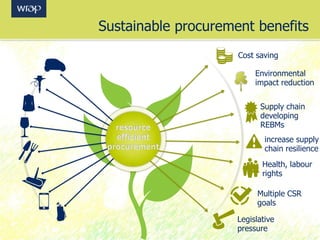
Sustainable procurement benefits
Cost saving
increase supply
chain resilience
Supply chain
developing
REBMs
Health, labour
rights
Multiple CSR
goals
Legislative
pressure
Environmental
impact reduction
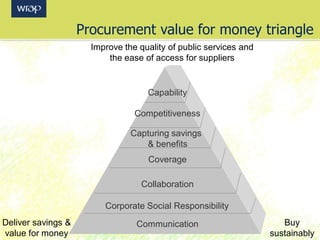
Procurement value for money triangle
Improve the quality of public services and
the ease of access for suppliers
Deliver savings &
value for money
Buy
sustainably
Communication
Coverage
Collaboration
Corporate Social Responsibility
Capturing savings
& benefits
Competitiveness
Capability
Impact
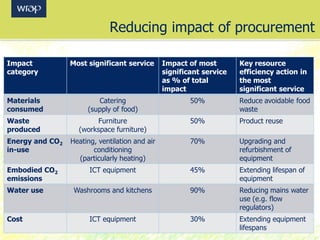
category
Most significant service Impact of most
significant service
as % of total
impact
Key resource
efficiency action in
the most
significant service
Materials
consumed
Catering
(supply of food)
50% Reduce avoidable food
waste
Waste
produced
Furniture
(workspace furniture)
50% Product reuse
Energy and CO2
in-use
Heating, ventilation and air
conditioning
(particularly heating)
70% Upgrading and
refurbishment of
equipment
Embodied CO2
emissions
ICT equipment 45% Extending lifespan of
equipment
Water use Washrooms and kitchens 90% Reducing mains water
use (e.g. flow
regulators)
Cost ICT equipment 30% Extending equipment
lifespans
Reducing impact of procurement
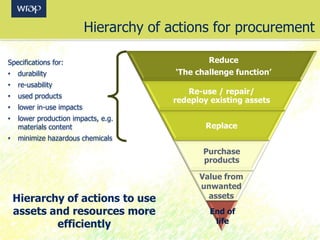
Re-use / repair/
redeploy existing assets
Replace
Purchase
products
Value from
unwanted
assetsHierarchy of actions to use
assets and resources more
efficiently
Hierarchy of actions for procurement
Specifications for:
• durability
• re-usability
• used products
• lower in-use impacts
• lower production impacts, e.g.
materials content
• minimize hazardous chemicals
Reduce
‘The challenge function’
End of
life
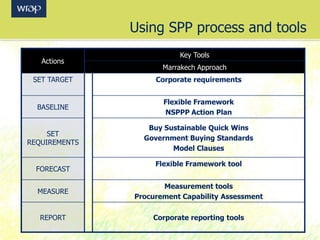
Using SPP process and tools
Actions
Key Tools
Marrakech Approach
SET TARGET Corporate requirements
BASELINE
Flexible Framework
NSPPP Action Plan
SET
REQUIREMENTS
Buy Sustainable Quick Wins
Government Buying Standards
Model Clauses
FORECAST
Flexible Framework tool
MEASURE
Measurement tools
Procurement Capability Assessment
REPORT Corporate reporting tools
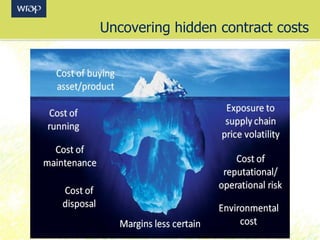
Uncovering hidden contract costs
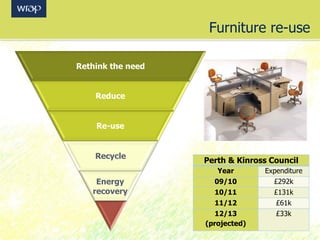
Furniture re-use
Perth & Kinross Council
Year Expenditure
09/10 £292k
10/11 £131k
11/12 £61k
12/13
(projected)
£33k
Rethink the need
Reduce
Re-use
Recycle
Energy
recovery
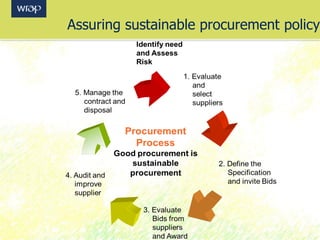
Assuring sustainable procurement policy
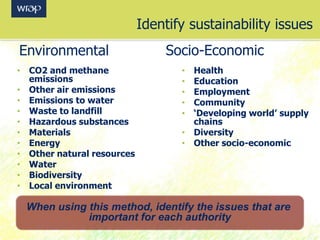
Identify sustainability issues
• Health
• Education
• Employment
• Community
• ‘Developing world’ supply
chains
• Diversity
• Other socio-economic
• CO2 and methane
emissions
• Other air emissions
• Emissions to water
• Waste to landfill
• Hazardous substances
• Materials
• Energy
• Other natural resources
• Water
• Biodiversity
• Local environment
Socio-EconomicEnvironmental
When using this method, identify the issues that are
important for each authority
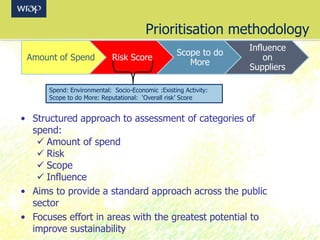
• Structured approach to assessment of categories of
spend:
 Amount of spend
 Risk
 Scope
 Influence
• Aims to provide a standard approach across the public
sector
• Focuses effort in areas with the greatest potential to
improve sustainability
Amount of Spend Risk Score
Scope to do
More
Influence
on
Suppliers
Prioritisation methodology
Spend: Environmental: Socio-Economic :Existing Activity:
Scope to do More: Reputational: ‘Overall risk’ Score
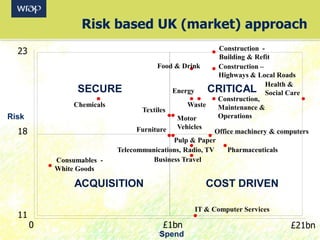
13
£21bn
Health &
Social CareSECURE
ACQUISITION
CRITICAL
COST DRIVEN
Risk
23
18
11
0 £1bn
Construction -
Building & Refit
Construction –
Highways & Local Roads
Food & Drink
–Consumables -
White Goods
IT & Computer Services
Chemicals
Pharmaceuticals
Business Travel
Telecommunications, Radio, TV
Office machinery & computers
Construction,
Maintenance &
Operations
Waste
Energy
Textiles
Motor
VehiclesFurniture
Pulp & Paper
Spend
Risk based UK (market) approach
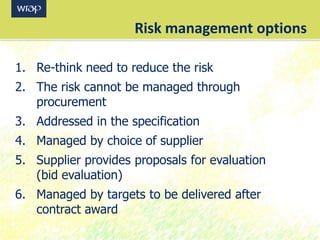
Risk management options
1. Re-think need to reduce the risk
2. The risk cannot be managed through
procurement
3. Addressed in the specification
4. Managed by choice of supplier
5. Supplier provides proposals for evaluation
(bid evaluation)
6. Managed by targets to be delivered after
contract award
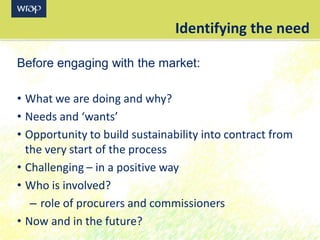
Identifying the need
Before engaging with the market:
• What we are doing and why?
• Needs and ‘wants’
• Opportunity to build sustainability into contract from
the very start of the process
• Challenging – in a positive way
• Who is involved?
– role of procurers and commissioners
• Now and in the future?
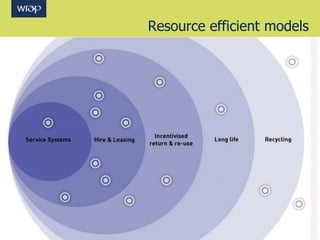
Resource efficient models
With the contribution of the LIFE financial instrument of the European Community www.rebus.eu.com
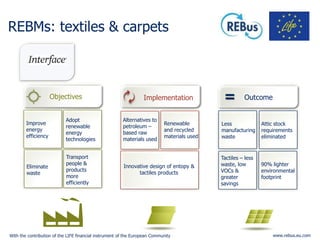
REBMs: textiles & carpets
Alternatives to
petroleum –
based raw
materials used
Renewable
and recycled
materials used
Innovative design of entopy &
tactiles products
Less
manufacturing
waste
Tactiles – less
waste, low
VOCs &
greater
savings
90% lighter
environmental
footprint
Attic stock
requirements
eliminated
Improve
energy
efficiency
Adopt
renewable
energy
technologies
Eliminate
waste
Transport
people &
products
more
efficiently
Outcome=Objectives Implementation
Assess Need Specification Evaluation Contract
Management
Influence
Time
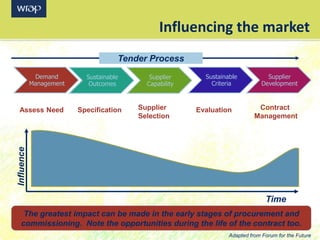
The greatest impact can be made in the early stages of procurement and
commissioning. Note the opportunities during the life of the contract too.
Supplier
Selection
Influencing the market
Tender Process
Demand
Management
Supplier
Capability
Sustainable
Outcomes
Sustainable
Criteria
Supplier
Development
Adapted from Forum for the Future
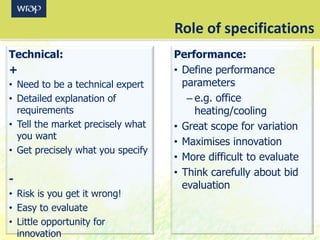
Role of specifications
Technical:
+
• Need to be a technical expert
• Detailed explanation of
requirements
• Tell the market precisely what
you want
• Get precisely what you specify
-
• Risk is you get it wrong!
• Easy to evaluate
• Little opportunity for
innovation
Performance:
• Define performance
parameters
– e.g. office
heating/cooling
• Great scope for variation
• Maximises innovation
• More difficult to evaluate
• Think carefully about bid
evaluation
With the contribution of the LIFE financial instrument of the European Community www.rebus.eu.com
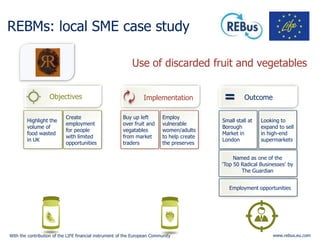
REBMs: local SME case study
Highlight the
volume of
food wasted
in UK
Create
employment
for people
with limited
opportunities
Buy up left
over fruit and
vegatables
from market
traders
Employ
vulnerable
women/adults
to help create
the preserves
Outcome=Objectives Implementation
Small stall at
Borough
Market in
London
Looking to
expand to sell
in high-end
supermarkets
Named as one of the
’Top 50 Radical Businesses’ by
The Guardian
Employment opportunities
Use of discarded fruit and vegetables
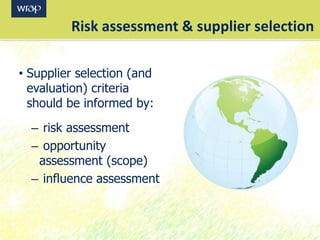
Risk assessment & supplier selection
• Supplier selection (and
evaluation) criteria
should be informed by:
– risk assessment
– opportunity
assessment (scope)
– influence assessment
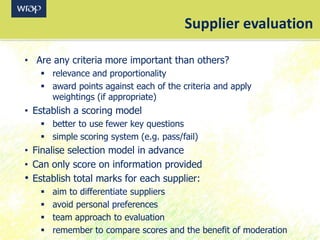
• Are any criteria more important than others?
 relevance and proportionality
 award points against each of the criteria and apply
weightings (if appropriate)
• Establish a scoring model
 better to use fewer key questions
 simple scoring system (e.g. pass/fail)
• Finalise selection model in advance
• Can only score on information provided
• Establish total marks for each supplier:
 aim to differentiate suppliers
 avoid personal preferences
 team approach to evaluation
 remember to compare scores and the benefit of moderation
Supplier evaluation
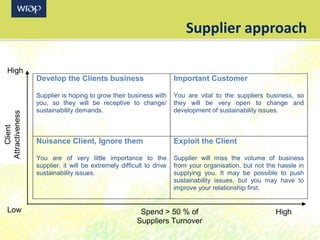
Supplier approach
Develop the Clients business
Supplier is hoping to grow their business with
you, so they will be receptive to change/
sustainability demands.
Important Customer
You are vital to the suppliers business, so
they will be very open to change and
development of sustainability issues.
Nuisance Client, Ignore them
You are of very little importance to the
supplier, it will be extremely difficult to drive
sustainability issues.
Exploit the Client
Supplier will miss the volume of business
from your organisation, but not the hassle in
supplying you. It may be possible to push
sustainability issues, but you may have to
improve your relationship first.
Client
Attractiveness
Spend > 50 % of
Suppliers Turnover
HighLow
High
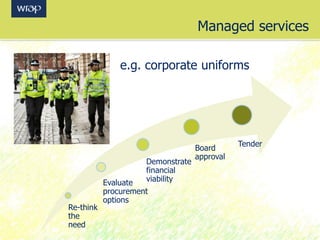
Managed services
Re-think
the
need
Evaluate
procurement
options
Demonstrate
financial
viability
Board
approval
Tender
e.g. corporate uniforms
Client benefit example
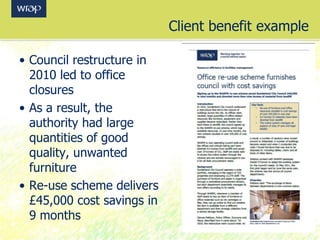
• Council restructure in
2010 led to office
closures
• As a result, the
authority had large
quantities of good
quality, unwanted
furniture
• Re-use scheme delivers
£45,000 cost savings in
9 months
Stakeholder engagement
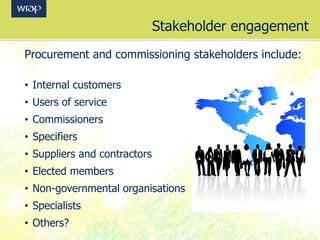
Procurement and commissioning stakeholders include:
• Internal customers
• Users of service
• Commissioners
• Specifiers
• Suppliers and contractors
• Elected members
• Non-governmental organisations
• Specialists
• Others?
Some further links
 Guidance on how to develop a sustainable procurement policy and
related documentshttp://www.wrap.org.uk/content/sustainable-
procurement
 E-learning - http://www.wrap.org.uk/content/sustainable-procurement-
e-learning-modules
 Procurement wording for key categories – these are embedded in the e-
learning, the last modules in each category
 Facilities Management tools & guidance (e.g. toolkit):
http://www.wrap.org.uk/category/sector/facilities-management
 Zero Waste Scotland e-booklet and related documents:
http://www.zerowastescotland.org.uk/scotlandprocurement
Thank you
Dr Mervyn Jones
mervyn.jones@wrap.org.uk
www.wrap.org.uk

Brazil Procurement

  • 1.
    Sustainable Public Procurement: engaging themarket and the supply chain Dr Mervyn Jones Head of Collaborative Programmes 28th August 2014 2º International Seminar of Sustainable Public Procurement, Brasilia, Brazil
  • 2.
    Our vision WRAP isworking towards a world where resources are used sustainably. We focus on the most important challenges, domestically and internationally, where we can make the most difference.
  • 3.
    Sustainable procurement benefits Costsaving increase supply chain resilience Supply chain developing REBMs Health, labour rights Multiple CSR goals Legislative pressure Environmental impact reduction
  • 4.
    Procurement value formoney triangle Improve the quality of public services and the ease of access for suppliers Deliver savings & value for money Buy sustainably Communication Coverage Collaboration Corporate Social Responsibility Capturing savings & benefits Competitiveness Capability
  • 5.
    Impact category Most significant serviceImpact of most significant service as % of total impact Key resource efficiency action in the most significant service Materials consumed Catering (supply of food) 50% Reduce avoidable food waste Waste produced Furniture (workspace furniture) 50% Product reuse Energy and CO2 in-use Heating, ventilation and air conditioning (particularly heating) 70% Upgrading and refurbishment of equipment Embodied CO2 emissions ICT equipment 45% Extending lifespan of equipment Water use Washrooms and kitchens 90% Reducing mains water use (e.g. flow regulators) Cost ICT equipment 30% Extending equipment lifespans Reducing impact of procurement
  • 6.
    Re-use / repair/ redeployexisting assets Replace Purchase products Value from unwanted assetsHierarchy of actions to use assets and resources more efficiently Hierarchy of actions for procurement Specifications for: • durability • re-usability • used products • lower in-use impacts • lower production impacts, e.g. materials content • minimize hazardous chemicals Reduce ‘The challenge function’ End of life
  • 7.
    Using SPP processand tools Actions Key Tools Marrakech Approach SET TARGET Corporate requirements BASELINE Flexible Framework NSPPP Action Plan SET REQUIREMENTS Buy Sustainable Quick Wins Government Buying Standards Model Clauses FORECAST Flexible Framework tool MEASURE Measurement tools Procurement Capability Assessment REPORT Corporate reporting tools
  • 8.
  • 9.
    Furniture re-use Perth &Kinross Council Year Expenditure 09/10 £292k 10/11 £131k 11/12 £61k 12/13 (projected) £33k Rethink the need Reduce Re-use Recycle Energy recovery
  • 10.
  • 11.
    Identify sustainability issues •Health • Education • Employment • Community • ‘Developing world’ supply chains • Diversity • Other socio-economic • CO2 and methane emissions • Other air emissions • Emissions to water • Waste to landfill • Hazardous substances • Materials • Energy • Other natural resources • Water • Biodiversity • Local environment Socio-EconomicEnvironmental When using this method, identify the issues that are important for each authority
  • 12.
    • Structured approachto assessment of categories of spend:  Amount of spend  Risk  Scope  Influence • Aims to provide a standard approach across the public sector • Focuses effort in areas with the greatest potential to improve sustainability Amount of Spend Risk Score Scope to do More Influence on Suppliers Prioritisation methodology Spend: Environmental: Socio-Economic :Existing Activity: Scope to do More: Reputational: ‘Overall risk’ Score
  • 13.
    13 £21bn Health & Social CareSECURE ACQUISITION CRITICAL COSTDRIVEN Risk 23 18 11 0 £1bn Construction - Building & Refit Construction – Highways & Local Roads Food & Drink –Consumables - White Goods IT & Computer Services Chemicals Pharmaceuticals Business Travel Telecommunications, Radio, TV Office machinery & computers Construction, Maintenance & Operations Waste Energy Textiles Motor VehiclesFurniture Pulp & Paper Spend Risk based UK (market) approach
  • 14.
    Risk management options 1.Re-think need to reduce the risk 2. The risk cannot be managed through procurement 3. Addressed in the specification 4. Managed by choice of supplier 5. Supplier provides proposals for evaluation (bid evaluation) 6. Managed by targets to be delivered after contract award
  • 15.
    Identifying the need Beforeengaging with the market: • What we are doing and why? • Needs and ‘wants’ • Opportunity to build sustainability into contract from the very start of the process • Challenging – in a positive way • Who is involved? – role of procurers and commissioners • Now and in the future?
  • 16.
  • 17.
    With the contributionof the LIFE financial instrument of the European Community www.rebus.eu.com REBMs: textiles & carpets Alternatives to petroleum – based raw materials used Renewable and recycled materials used Innovative design of entopy & tactiles products Less manufacturing waste Tactiles – less waste, low VOCs & greater savings 90% lighter environmental footprint Attic stock requirements eliminated Improve energy efficiency Adopt renewable energy technologies Eliminate waste Transport people & products more efficiently Outcome=Objectives Implementation
  • 18.
    Assess Need SpecificationEvaluation Contract Management Influence Time The greatest impact can be made in the early stages of procurement and commissioning. Note the opportunities during the life of the contract too. Supplier Selection Influencing the market Tender Process Demand Management Supplier Capability Sustainable Outcomes Sustainable Criteria Supplier Development Adapted from Forum for the Future
  • 19.
    Role of specifications Technical: + •Need to be a technical expert • Detailed explanation of requirements • Tell the market precisely what you want • Get precisely what you specify - • Risk is you get it wrong! • Easy to evaluate • Little opportunity for innovation Performance: • Define performance parameters – e.g. office heating/cooling • Great scope for variation • Maximises innovation • More difficult to evaluate • Think carefully about bid evaluation
  • 20.
    With the contributionof the LIFE financial instrument of the European Community www.rebus.eu.com REBMs: local SME case study Highlight the volume of food wasted in UK Create employment for people with limited opportunities Buy up left over fruit and vegatables from market traders Employ vulnerable women/adults to help create the preserves Outcome=Objectives Implementation Small stall at Borough Market in London Looking to expand to sell in high-end supermarkets Named as one of the ’Top 50 Radical Businesses’ by The Guardian Employment opportunities Use of discarded fruit and vegetables
  • 21.
    Risk assessment &supplier selection • Supplier selection (and evaluation) criteria should be informed by: – risk assessment – opportunity assessment (scope) – influence assessment
  • 22.
    • Are anycriteria more important than others?  relevance and proportionality  award points against each of the criteria and apply weightings (if appropriate) • Establish a scoring model  better to use fewer key questions  simple scoring system (e.g. pass/fail) • Finalise selection model in advance • Can only score on information provided • Establish total marks for each supplier:  aim to differentiate suppliers  avoid personal preferences  team approach to evaluation  remember to compare scores and the benefit of moderation Supplier evaluation
  • 23.
    Supplier approach Develop theClients business Supplier is hoping to grow their business with you, so they will be receptive to change/ sustainability demands. Important Customer You are vital to the suppliers business, so they will be very open to change and development of sustainability issues. Nuisance Client, Ignore them You are of very little importance to the supplier, it will be extremely difficult to drive sustainability issues. Exploit the Client Supplier will miss the volume of business from your organisation, but not the hassle in supplying you. It may be possible to push sustainability issues, but you may have to improve your relationship first. Client Attractiveness Spend > 50 % of Suppliers Turnover HighLow High
  • 24.
  • 25.
    Client benefit example •Council restructure in 2010 led to office closures • As a result, the authority had large quantities of good quality, unwanted furniture • Re-use scheme delivers £45,000 cost savings in 9 months
  • 26.
    Stakeholder engagement Procurement andcommissioning stakeholders include: • Internal customers • Users of service • Commissioners • Specifiers • Suppliers and contractors • Elected members • Non-governmental organisations • Specialists • Others?
  • 27.
    Some further links Guidance on how to develop a sustainable procurement policy and related documentshttp://www.wrap.org.uk/content/sustainable- procurement  E-learning - http://www.wrap.org.uk/content/sustainable-procurement- e-learning-modules  Procurement wording for key categories – these are embedded in the e- learning, the last modules in each category  Facilities Management tools & guidance (e.g. toolkit): http://www.wrap.org.uk/category/sector/facilities-management  Zero Waste Scotland e-booklet and related documents: http://www.zerowastescotland.org.uk/scotlandprocurement
  • 28.
    Thank you Dr MervynJones mervyn.jones@wrap.org.uk www.wrap.org.uk