Navigating the Automotive Specifications for Aluminum Anodizing AACOA, Inc.
The Standard Makers General Motors Ford Motor Company DaimlerChrysler Corporation Japanese Standards Association German Standards European Union Standards
General Motors - GM4472M Coating requirements dependent upon application “Type”: “ Type” depends upon the following: Finish: Clear or Color Use: Functional or Decorative Location: Exterior or Interior Coating for each application type must pass some combination of the following tests: ADT, Weatherometer, Florida exposure, CASS, Coating Thickness, Coating Mass (Weight)
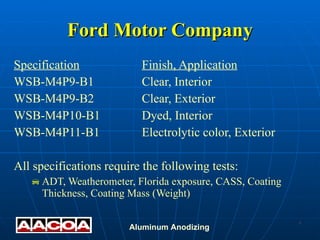
Ford Motor Company Specification Finish, Application WSB-M4P9-B1 Clear, Interior WSB-M4P9-B2 Clear, Exterior WSB-M4P10-B1 Dyed, Interior WSB-M4P11-B1 Electrolytic color, Exterior All specifications require the following tests: ADT, Weatherometer, Florida exposure, CASS, Coating Thickness, Coating Mass (Weight)
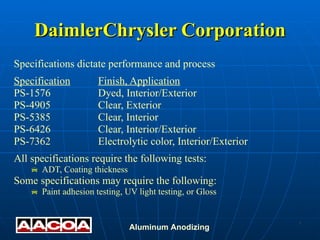
DaimlerChrysler Corporation Specifications dictate performance and process Specification Finish, Application PS-1576 Dyed, Interior/Exterior PS-4905 Clear, Exterior PS-5385 Clear, Interior PS-6426 Clear, Interior/Exterior PS-7362 Electrolytic color, Interior/Exterior All specifications require the following tests: ADT, Coating thickness Some specifications may require the following: Paint adhesion testing, UV light testing, or Gloss
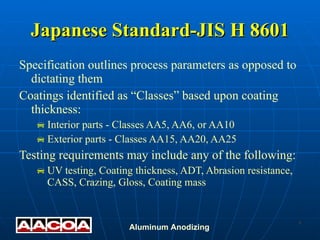
Japanese Standard-JIS H 8601 Specification outlines process parameters as opposed to dictating them Coatings identified as “Classes” based upon coating thickness: Interior parts - Classes AA5, AA6, or AA10 Exterior parts - Classes AA15, AA20, AA25 Testing requirements may include any of the following: UV testing, Coating thickness, ADT, Abrasion resistance, CASS, Crazing, Gloss, Coating mass
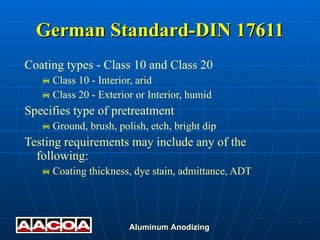
German Standard-DIN 17611 Coating types - Class 10 and Class 20 Class 10 - Interior, arid Class 20 - Exterior or Interior, humid Specifies type of pretreatment Ground, brush, polish, etch, bright dip Testing requirements may include any of the following: Coating thickness, dye stain, admittance, ADT
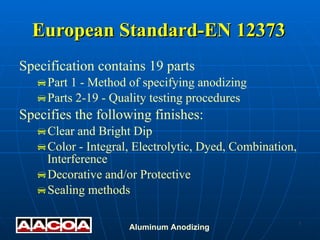
European Standard-EN 12373 Specification contains 19 parts Part 1 - Method of specifying anodizing Parts 2-19 - Quality testing procedures Specifies the following finishes: Clear and Bright Dip Color - Integral, Electrolytic, Dyed, Combination, Interference Decorative and/or Protective Sealing methods
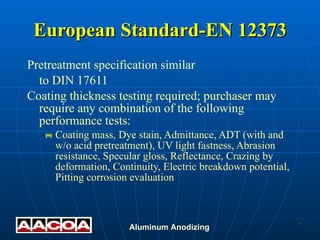
Pretreatment specification similar to DIN 17611 Coating thickness testing required; purchaser may require any combination of the following performance tests: Coating mass, Dye stain, Admittance, ADT (with and w/o acid pretreatment), UV light fastness, Abrasion resistance, Specular gloss, Reflectance, Crazing by deformation, Continuity, Electric breakdown potential, Pitting corrosion evaluation European Standard-EN 12373
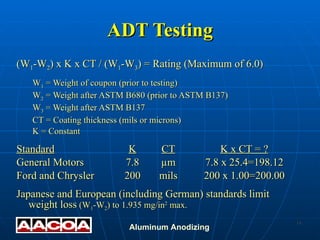
ADT Testing (W 1 -W 2 ) x K x CT / (W 1 -W 3 ) = Rating (Maximum of 6.0) W 1  = Weight of coupon (prior to testing) W 2  = Weight after ASTM B680 (prior to ASTM B137) W 3  = Weight after ASTM B137 CT = Coating thickness (mils or microns) K = Constant Standard K CT K x CT = ? General Motors 7.8 µm 7.8 x 25.4=198.12 Ford and Chrysler 200 mils 200 x 1.00=200.00 Japanese and European (including German) standards limit weight loss  (W 1 -W 2 ) to 1.935 mg/in 2  max.
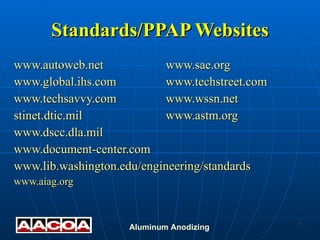
Standards/PPAP Websites www.autoweb.net www.global.ihs.com www.techsavvy.com stinet.dtic.mil www.dscc.dla.mil www.document-center.com www.lib.washington.edu/engineering/standards www.aiag.org www.sae.org www.techstreet.com www.wssn.net www.astm.org
Documentation for a PPAP The Production Part Approval Process
Required Documents Initial Process Study Qualified Laboratory Documentation Process Flow Diagram Process Control Plan Process FMEA Dimensional Results Material, Performance Test Results Measurement Systems Analysis Study  Part Submission Warrant Appearance Approval Report
Initial Process Study SPC charting and statistics for the following: Coating thickness Coating weight ADT rating Charts include the following: X-Bar Range Control Moving average (subgroups with minimum of 4) C pk
Qualified Lab Documentation QS/TS/ISO Documentation Registration certification Process control plan Laboratory Scope Tests for which lab is qualified to perform Certification Statements Results from testing performed on products/samples (in-house or outsourced)  Calibration records Any equipment used in quality assurance testing
Refer to the Handouts Process Flow Diagram Process Control Plan Process FMEA Dimensional Results Material, Performance Test Results Measurement Systems Analysis Study  Part Submission Warrant Appearance Approval Report
Thank you to the Following Aluminum Anodizers Council AACOA, Inc.

Automotive Anodizing

  • 1.
    Navigating the AutomotiveSpecifications for Aluminum Anodizing AACOA, Inc.
  • 2.
    The Standard MakersGeneral Motors Ford Motor Company DaimlerChrysler Corporation Japanese Standards Association German Standards European Union Standards
  • 3.
    General Motors -GM4472M Coating requirements dependent upon application “Type”: “ Type” depends upon the following: Finish: Clear or Color Use: Functional or Decorative Location: Exterior or Interior Coating for each application type must pass some combination of the following tests: ADT, Weatherometer, Florida exposure, CASS, Coating Thickness, Coating Mass (Weight)
  • 4.
    Ford Motor CompanySpecification Finish, Application WSB-M4P9-B1 Clear, Interior WSB-M4P9-B2 Clear, Exterior WSB-M4P10-B1 Dyed, Interior WSB-M4P11-B1 Electrolytic color, Exterior All specifications require the following tests: ADT, Weatherometer, Florida exposure, CASS, Coating Thickness, Coating Mass (Weight)
  • 5.
    DaimlerChrysler Corporation Specificationsdictate performance and process Specification Finish, Application PS-1576 Dyed, Interior/Exterior PS-4905 Clear, Exterior PS-5385 Clear, Interior PS-6426 Clear, Interior/Exterior PS-7362 Electrolytic color, Interior/Exterior All specifications require the following tests: ADT, Coating thickness Some specifications may require the following: Paint adhesion testing, UV light testing, or Gloss
  • 6.
    Japanese Standard-JIS H8601 Specification outlines process parameters as opposed to dictating them Coatings identified as “Classes” based upon coating thickness: Interior parts - Classes AA5, AA6, or AA10 Exterior parts - Classes AA15, AA20, AA25 Testing requirements may include any of the following: UV testing, Coating thickness, ADT, Abrasion resistance, CASS, Crazing, Gloss, Coating mass
  • 7.
    German Standard-DIN 17611Coating types - Class 10 and Class 20 Class 10 - Interior, arid Class 20 - Exterior or Interior, humid Specifies type of pretreatment Ground, brush, polish, etch, bright dip Testing requirements may include any of the following: Coating thickness, dye stain, admittance, ADT
  • 8.
    European Standard-EN 12373Specification contains 19 parts Part 1 - Method of specifying anodizing Parts 2-19 - Quality testing procedures Specifies the following finishes: Clear and Bright Dip Color - Integral, Electrolytic, Dyed, Combination, Interference Decorative and/or Protective Sealing methods
  • 9.
    Pretreatment specification similarto DIN 17611 Coating thickness testing required; purchaser may require any combination of the following performance tests: Coating mass, Dye stain, Admittance, ADT (with and w/o acid pretreatment), UV light fastness, Abrasion resistance, Specular gloss, Reflectance, Crazing by deformation, Continuity, Electric breakdown potential, Pitting corrosion evaluation European Standard-EN 12373
  • 10.
    ADT Testing (W1 -W 2 ) x K x CT / (W 1 -W 3 ) = Rating (Maximum of 6.0) W 1 = Weight of coupon (prior to testing) W 2 = Weight after ASTM B680 (prior to ASTM B137) W 3 = Weight after ASTM B137 CT = Coating thickness (mils or microns) K = Constant Standard K CT K x CT = ? General Motors 7.8 µm 7.8 x 25.4=198.12 Ford and Chrysler 200 mils 200 x 1.00=200.00 Japanese and European (including German) standards limit weight loss (W 1 -W 2 ) to 1.935 mg/in 2 max.
  • 11.
    Standards/PPAP Websites www.autoweb.netwww.global.ihs.com www.techsavvy.com stinet.dtic.mil www.dscc.dla.mil www.document-center.com www.lib.washington.edu/engineering/standards www.aiag.org www.sae.org www.techstreet.com www.wssn.net www.astm.org
  • 12.
    Documentation for aPPAP The Production Part Approval Process
  • 13.
    Required Documents InitialProcess Study Qualified Laboratory Documentation Process Flow Diagram Process Control Plan Process FMEA Dimensional Results Material, Performance Test Results Measurement Systems Analysis Study Part Submission Warrant Appearance Approval Report
  • 14.
    Initial Process StudySPC charting and statistics for the following: Coating thickness Coating weight ADT rating Charts include the following: X-Bar Range Control Moving average (subgroups with minimum of 4) C pk
  • 15.
    Qualified Lab DocumentationQS/TS/ISO Documentation Registration certification Process control plan Laboratory Scope Tests for which lab is qualified to perform Certification Statements Results from testing performed on products/samples (in-house or outsourced) Calibration records Any equipment used in quality assurance testing
  • 16.
    Refer to theHandouts Process Flow Diagram Process Control Plan Process FMEA Dimensional Results Material, Performance Test Results Measurement Systems Analysis Study Part Submission Warrant Appearance Approval Report
  • 17.
    Thank you tothe Following Aluminum Anodizers Council AACOA, Inc.