Assessment for Learning
Mark Barratt
• Why bother with Assessment for
Learning (AfL)?
• Review and recap the elements of AfL
Why bother with AfL?
• “The act of teaching requires deliberate interventions to
ensure that there is cognitive change in the student; thus the
key ingredients are being aware of the learning intentions,
knowing when a student is, having sufficient understanding
of the student’s prior knowledge, and knowing enough
content…” Hattie (2012)
• Sadler (1989) identified three indispensible conditions for
improving the quality of the student’s learning. The teacher
and learner have to: know the goals of learning and what
successful achievement ‘looks like; compare actual
performance to the desired performance (goal); engage in
appropriate action/ strategies to bridge the gap between
expected and desired performance
Assessment for Learning
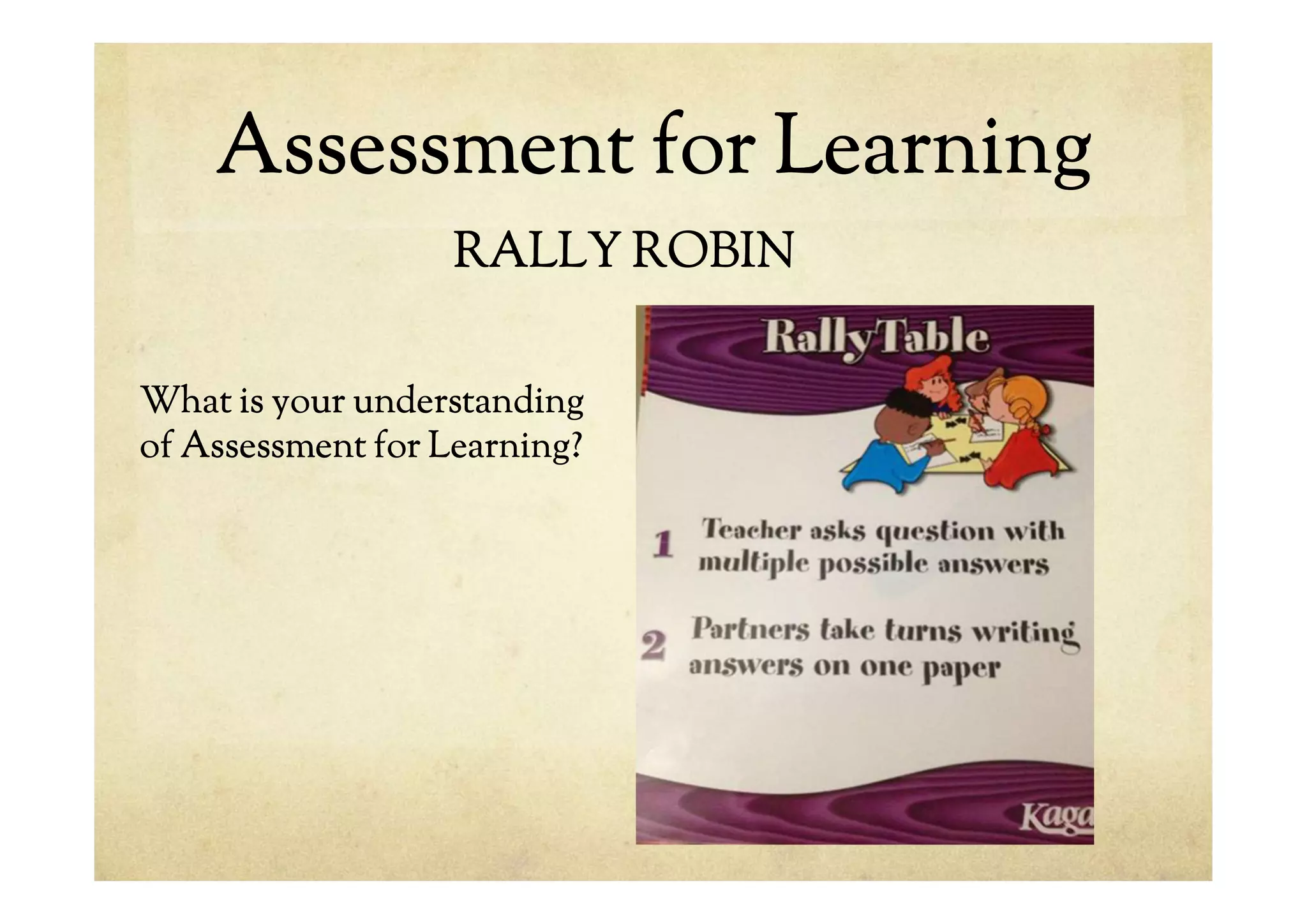
What is your understanding
of Assessment for Learning?
RALLY ROBIN
Definition
• Klenowski (2009) defines Assessment for
Learning (AFL) as being “part of everyday
practice by students, teachers and peers
that seeks, reflects upon and responds to
information from dialogue, demonstration
and observation in ways that enhance
ongoing learning” (p.264).
Definition
• Assessment for Learning places students at
the fore, recognizes that learning is an
activity that happens with others, and
emphasizes assessment happening in the
moment.
Activity
• Work with you shoulder partner and
highlight the key points in your reading –
Assessment for Learning, Self-Regulated
Learners
• Face to face partners swap key ideas
Quiz-Quiz-Trade
• AfL
• SRL
The Learner’s Role
If the learner is to take an active role in the learning process
he/she needs to know /understand:
• Where the learning is going(goal/s);
• What is expected in terms of performance and/or
standards (criteria, exemplars …);
• The nature of current achievement, what needs
improvement and how this might be effected
(evaluative knowledge);
• How to bring current performance closer to what is
expected (productive knowledge).
The Teacher’s Role is to:
• Get ‘alongside’ the learner(s), noticing, recognising and
responding to learning, during learning [importance of
knowledge bases];
• Promote dialogue between learners, and between the teacher
and learner(s) so they can co-construct understandings, ask
questions …
• Establish an environment and program that encourages
learners to take responsibility for and ownership of their learning
(to become self-regulating learners )
eg: provide authentic opportunities to set goals, generate
feedback, review peers’ work, self-monitor, reflect on learning
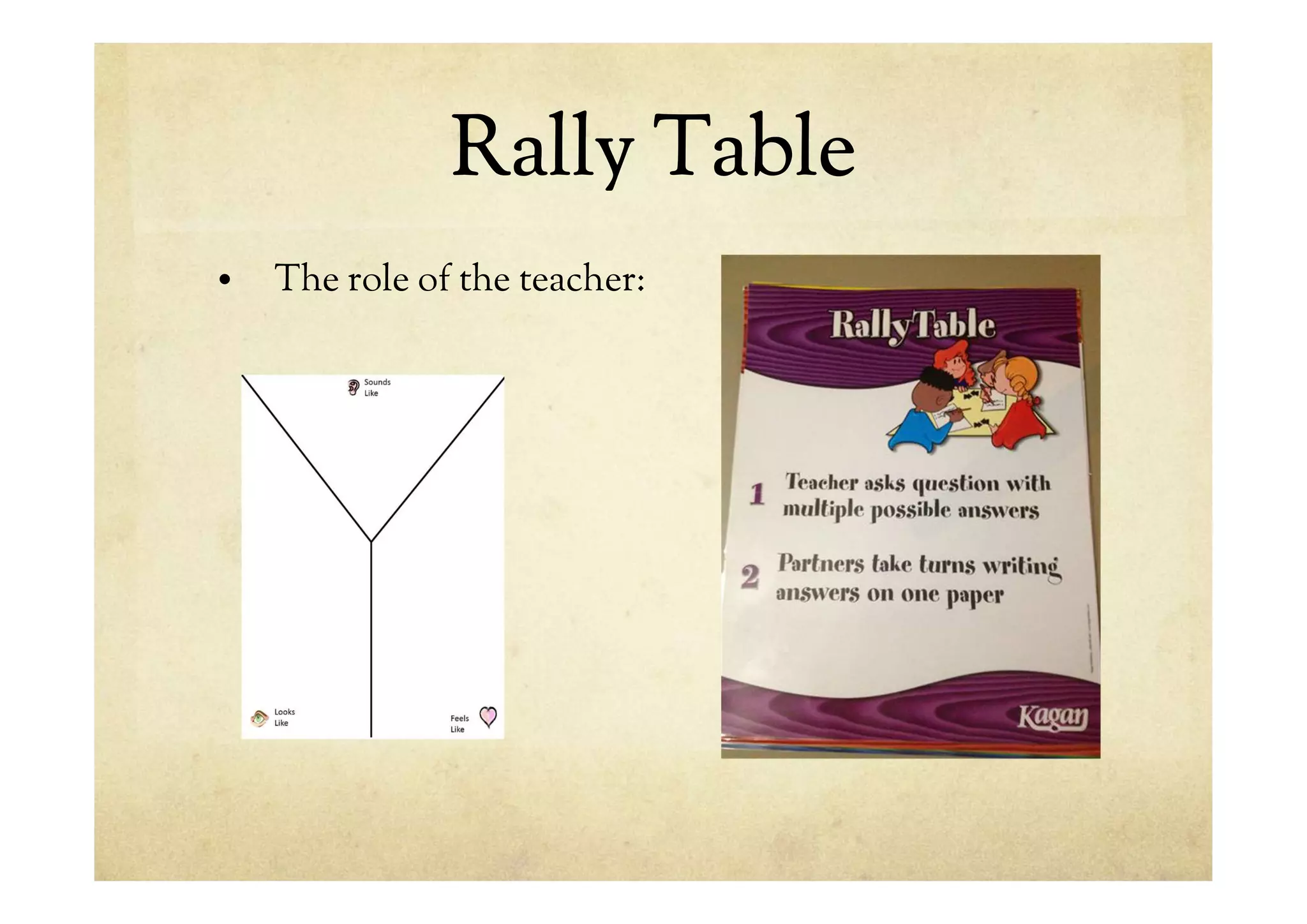
Rally Table
• The role of the teacher:
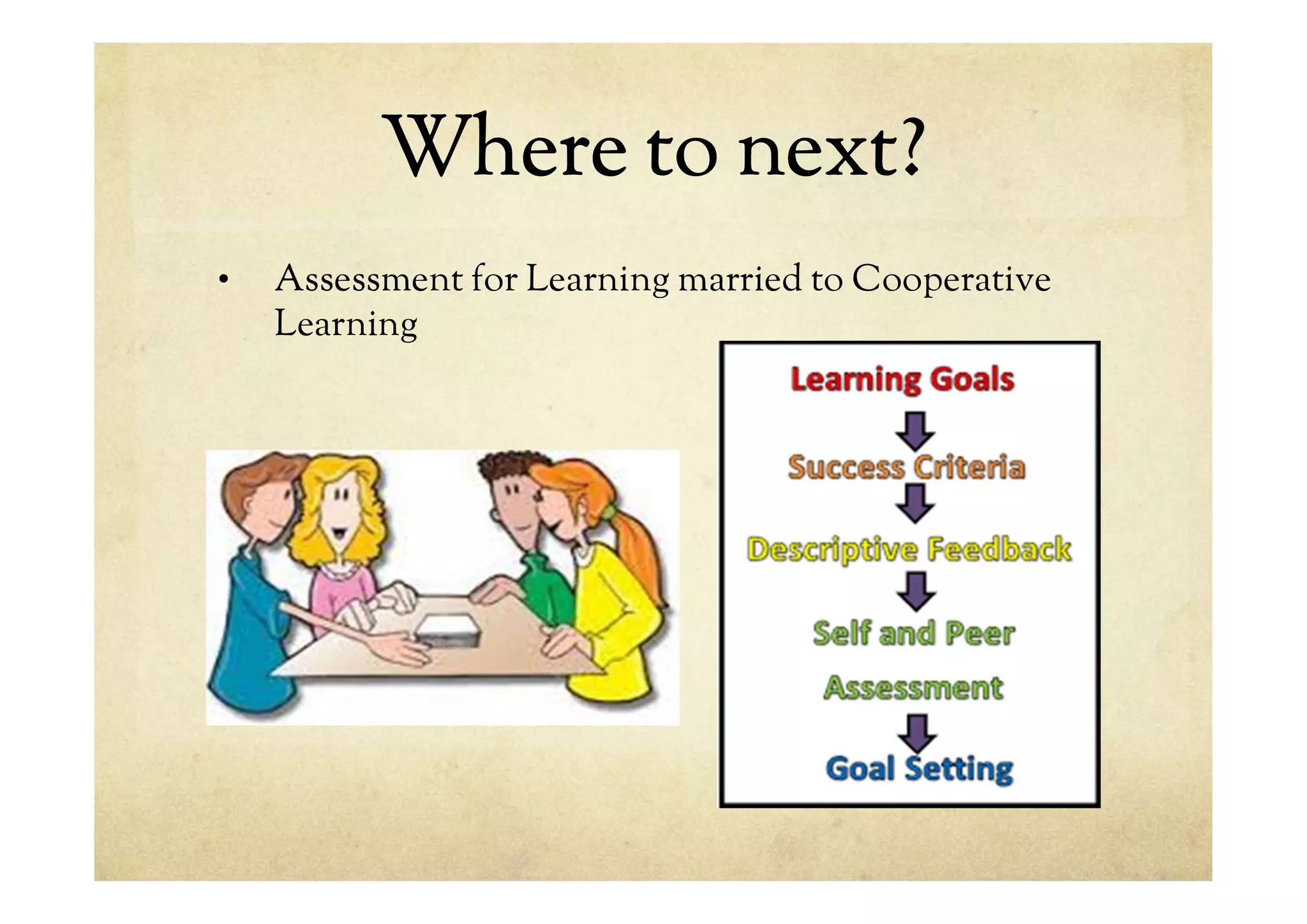
Where to next?
• Assessment for Learning married to Cooperative
Learning

Assessment for learning

  • 1.
  • 2.
    • Why botherwith Assessment for Learning (AfL)? • Review and recap the elements of AfL
  • 4.
    Why bother withAfL? • “The act of teaching requires deliberate interventions to ensure that there is cognitive change in the student; thus the key ingredients are being aware of the learning intentions, knowing when a student is, having sufficient understanding of the student’s prior knowledge, and knowing enough content…” Hattie (2012) • Sadler (1989) identified three indispensible conditions for improving the quality of the student’s learning. The teacher and learner have to: know the goals of learning and what successful achievement ‘looks like; compare actual performance to the desired performance (goal); engage in appropriate action/ strategies to bridge the gap between expected and desired performance
  • 5.
    Assessment for Learning Whatis your understanding of Assessment for Learning? RALLY ROBIN
  • 6.
    Definition • Klenowski (2009)defines Assessment for Learning (AFL) as being “part of everyday practice by students, teachers and peers that seeks, reflects upon and responds to information from dialogue, demonstration and observation in ways that enhance ongoing learning” (p.264).
  • 7.
    Definition • Assessment forLearning places students at the fore, recognizes that learning is an activity that happens with others, and emphasizes assessment happening in the moment.
  • 8.
    Activity • Work withyou shoulder partner and highlight the key points in your reading – Assessment for Learning, Self-Regulated Learners • Face to face partners swap key ideas
  • 9.
  • 10.
    The Learner’s Role Ifthe learner is to take an active role in the learning process he/she needs to know /understand: • Where the learning is going(goal/s); • What is expected in terms of performance and/or standards (criteria, exemplars …); • The nature of current achievement, what needs improvement and how this might be effected (evaluative knowledge); • How to bring current performance closer to what is expected (productive knowledge).
  • 11.
    The Teacher’s Roleis to: • Get ‘alongside’ the learner(s), noticing, recognising and responding to learning, during learning [importance of knowledge bases]; • Promote dialogue between learners, and between the teacher and learner(s) so they can co-construct understandings, ask questions … • Establish an environment and program that encourages learners to take responsibility for and ownership of their learning (to become self-regulating learners ) eg: provide authentic opportunities to set goals, generate feedback, review peers’ work, self-monitor, reflect on learning
  • 12.
    Rally Table • Therole of the teacher:
  • 13.
    Where to next? •Assessment for Learning married to Cooperative Learning