Types of information systems:
Transaction Processing System, Definition,
Purpose, Objectives and Role of MIS in
Business Organization with particular
reference to Management Levels.
[MIS Growth and Development, Location of
MIS in the Organization – Concept and
Design.]
Decision Support System, Executive
Information System, Expert System, and the
recent developments in the Field of MIS.
UNIT III
GROWTH AND DEVELOPMENT OF MIS
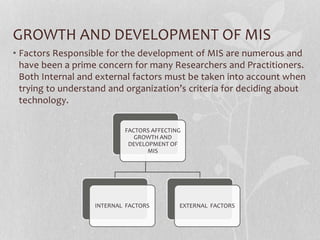
• Factors Responsible for the development of MIS are numerous and
have been a prime concern for many Researchers and Practitioners.
Both Internal and external factors must be taken into account when
trying to understand and organization’s criteria for deciding about
technology.
FACTORS AFFECTING
GROWTH AND
DEVELOPMENT OF
MIS
INTERNAL FACTORS EXTERNAL FACTORS
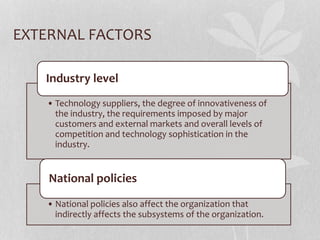
EXTERNAL FACTORS
• Technology suppliers, the degree of innovativeness of
the industry, the requirements imposed by major
customers and external markets and overall levels of
competition and technology sophistication in the
industry.
Industry level
• National policies also affect the organization that
indirectly affects the subsystems of the organization.
National policies
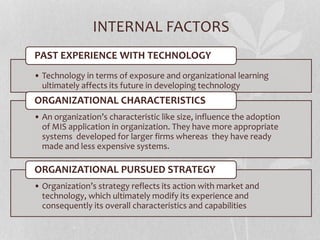
INTERNAL FACTORS
• Technology in terms of exposure and organizational learning
ultimately affects its future in developing technology
PAST EXPERIENCE WITH TECHNOLOGY
• An organization’s characteristic like size, influence the adoption
of MIS application in organization. They have more appropriate
systems developed for larger firms whereas they have ready
made and less expensive systems.
ORGANIZATIONAL CHARACTERISTICS
• Organization’s strategy reflects its action with market and
technology, which ultimately modify its experience and
consequently its overall characteristics and capabilities
ORGANIZATIONAL PURSUED STRATEGY
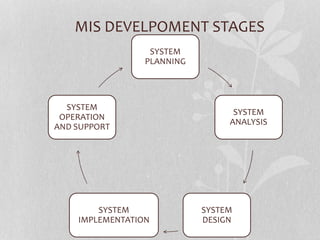
MIS DEVELPOMENT STAGES
SYSTEM
PLANNING
SYSTEM
ANALYSIS
SYSTEM
DESIGN
SYSTEM
IMPLEMENTATION
SYSTEM
OPERATION
AND SUPPORT
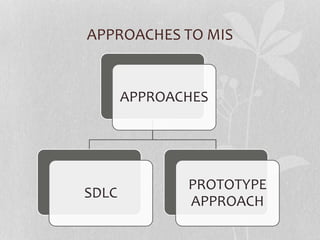
APPROACHES TO MIS
APPROACHES
SDLC
PROTOTYPE
APPROACH
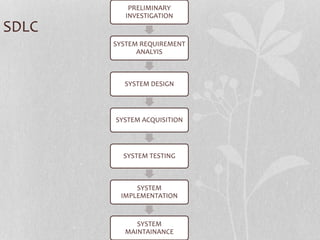
SDLC
PRELIMINARY
INVESTIGATION
SYSTEM REQUIREMENT
ANALYIS
SYSTEM DESIGN
SYSTEM ACQUISITION
SYSTEM TESTING
SYSTEM
IMPLEMENTATION
SYSTEM
MAINTAINANCE
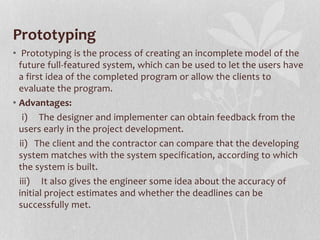
Prototyping
• Prototyping is the process of creating an incomplete model of the
future full-featured system, which can be used to let the users have
a first idea of the completed program or allow the clients to
evaluate the program.
• Advantages:
i) The designer and implementer can obtain feedback from the
users early in the project development.
ii) The client and the contractor can compare that the developing
system matches with the system specification, according to which
the system is built.
iii) It also gives the engineer some idea about the accuracy of
initial project estimates and whether the deadlines can be
successfully met.
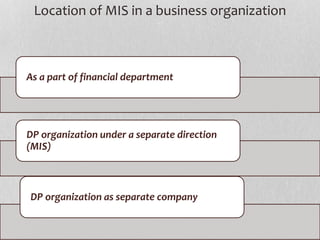
As a part of financial department
DP organization under a separate direction
(MIS)
DP organization as separate company
Location of MIS in a business organization
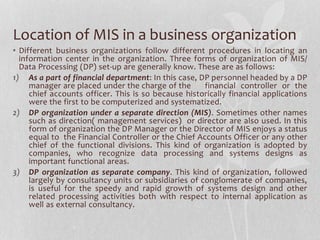
• Different business organizations follow different procedures in locating an
information center in the organization. Three forms of organization of MIS/
Data Processing (DP) set-up are generally know. These are as follows:
1) As a part of financial department: In this case, DP personnel headed by a DP
manager are placed under the charge of the financial controller or the
chief accounts officer. This is so because historically financial applications
were the first to be computerized and systematized.
2) DP organization under a separate direction (MIS). Sometimes other names
such as direction( management services) or director are also used. In this
form of organization the DP Manager or the Director of MIS enjoys a status
equal to the Financial Controller or the Chief Accounts Officer or any other
chief of the functional divisions. This kind of organization is adopted by
companies, who recognize data processing and systems designs as
important functional areas.
3) DP organization as separate company. This kind of organization, followed
largely by consultancy units or subsidiaries of conglomerate of companies,
is useful for the speedy and rapid growth of systems design and other
related processing activities both with respect to internal application as
well as external consultancy.
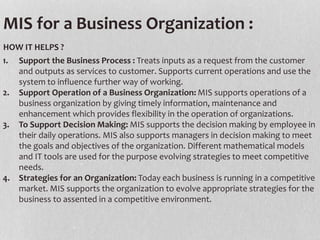
1. Support the Business Process : Treats inputs as a request from the customer
and outputs as services to customer. Supports current operations and use the
system to influence further way of working.
2. Support Operation of a Business Organization: MIS supports operations of a
business organization by giving timely information, maintenance and
enhancement which provides flexibility in the operation of organizations.
3. To Support Decision Making: MIS supports the decision making by employee in
their daily operations. MIS also supports managers in decision making to meet
the goals and objectives of the organization. Different mathematical models
and IT tools are used for the purpose evolving strategies to meet competitive
needs.
4. Strategies for an Organization: Today each business is running in a competitive
market. MIS supports the organization to evolve appropriate strategies for the
business to assented in a competitive environment.
HOW IT HELPS ?
MIS for a Business Organization :
ESSENTIAL
REQUIREMNETS FOR
AN EFFECTIVE MIS
QUALIFIED SYSTEM
AND MANAGEMENT
STAFF
SYSTEM AND
COMPUTER EXPERTS
MANAGEMENT
EXPERTS
FUTURISTIC
PERSPECTIVE
SUPPORT OF TOP
MANAGEMENT
COMMON
DATABASE
CONTROL AND
MAINTAINANCE OF
MIS
Essential Requirement of an Effective MIS:
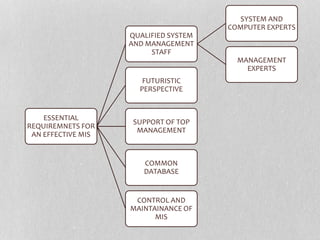
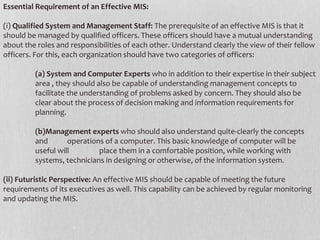
(i) Qualified System and Management Staff: The prerequisite of an effective MIS is that it
should be managed by qualified officers. These officers should have a mutual understanding
about the roles and responsibilities of each other. Understand clearly the view of their fellow
officers. For this, each organization should have two categories of officers:
(a) System and Computer Experts who in addition to their expertise in their subject
area , they should also be capable of understanding management concepts to
facilitate the understanding of problems asked by concern. They should also be
clear about the process of decision making and information requirements for
planning.
(b)Management experts who should also understand quite-clearly the concepts
and operations of a computer. This basic knowledge of computer will be
useful will place them in a comfortable position, while working with
systems, technicians in designing or otherwise, of the information system.
(ii) Futuristic Perspective: An effective MIS should be capable of meeting the future
requirements of its executives as well. This capability can be achieved by regular monitoring
and updating the MIS.
(iii) Support of Top Management: For a management information system to be effective, it
must receive the full support of top management. The Reasons for this are :
(a) Subordinate managers are usually lethargic about activities which do not
receive the support of their superiors.
(b) The resources involved in computer based information system are larger and
are growing larger and larger in view of importance gained by management
information system.
(iv) Common Database: It is an integrated collection of data and information which is utilized
by several information subsystems of an organization. A common database may be defined
as a super file which consolidates and integrates data records formerly stored in a separate
data file. Such a database can be organized as an integrated collection of data records into a
single super file or it can be organized as an integrated collection of several data file.
(v) Control and maintenance of MIS: Control of the MIS means the operation of the system
as it was designed to operate. Sometimes, users develop their own procedures or short cut
methods to use the system which reduces its effectiveness.

Unit iii mis

  • 1.
    Types of informationsystems: Transaction Processing System, Definition, Purpose, Objectives and Role of MIS in Business Organization with particular reference to Management Levels. [MIS Growth and Development, Location of MIS in the Organization – Concept and Design.] Decision Support System, Executive Information System, Expert System, and the recent developments in the Field of MIS. UNIT III
  • 2.
    GROWTH AND DEVELOPMENTOF MIS • Factors Responsible for the development of MIS are numerous and have been a prime concern for many Researchers and Practitioners. Both Internal and external factors must be taken into account when trying to understand and organization’s criteria for deciding about technology. FACTORS AFFECTING GROWTH AND DEVELOPMENT OF MIS INTERNAL FACTORS EXTERNAL FACTORS
  • 3.
    EXTERNAL FACTORS • Technologysuppliers, the degree of innovativeness of the industry, the requirements imposed by major customers and external markets and overall levels of competition and technology sophistication in the industry. Industry level • National policies also affect the organization that indirectly affects the subsystems of the organization. National policies
  • 4.
    INTERNAL FACTORS • Technologyin terms of exposure and organizational learning ultimately affects its future in developing technology PAST EXPERIENCE WITH TECHNOLOGY • An organization’s characteristic like size, influence the adoption of MIS application in organization. They have more appropriate systems developed for larger firms whereas they have ready made and less expensive systems. ORGANIZATIONAL CHARACTERISTICS • Organization’s strategy reflects its action with market and technology, which ultimately modify its experience and consequently its overall characteristics and capabilities ORGANIZATIONAL PURSUED STRATEGY
  • 5.
  • 6.
  • 7.
    SDLC PRELIMINARY INVESTIGATION SYSTEM REQUIREMENT ANALYIS SYSTEM DESIGN SYSTEMACQUISITION SYSTEM TESTING SYSTEM IMPLEMENTATION SYSTEM MAINTAINANCE
  • 8.
    Prototyping • Prototyping isthe process of creating an incomplete model of the future full-featured system, which can be used to let the users have a first idea of the completed program or allow the clients to evaluate the program. • Advantages: i) The designer and implementer can obtain feedback from the users early in the project development. ii) The client and the contractor can compare that the developing system matches with the system specification, according to which the system is built. iii) It also gives the engineer some idea about the accuracy of initial project estimates and whether the deadlines can be successfully met.
  • 9.
    As a partof financial department DP organization under a separate direction (MIS) DP organization as separate company Location of MIS in a business organization
  • 10.
    Location of MISin a business organization • Different business organizations follow different procedures in locating an information center in the organization. Three forms of organization of MIS/ Data Processing (DP) set-up are generally know. These are as follows: 1) As a part of financial department: In this case, DP personnel headed by a DP manager are placed under the charge of the financial controller or the chief accounts officer. This is so because historically financial applications were the first to be computerized and systematized. 2) DP organization under a separate direction (MIS). Sometimes other names such as direction( management services) or director are also used. In this form of organization the DP Manager or the Director of MIS enjoys a status equal to the Financial Controller or the Chief Accounts Officer or any other chief of the functional divisions. This kind of organization is adopted by companies, who recognize data processing and systems designs as important functional areas. 3) DP organization as separate company. This kind of organization, followed largely by consultancy units or subsidiaries of conglomerate of companies, is useful for the speedy and rapid growth of systems design and other related processing activities both with respect to internal application as well as external consultancy.
  • 11.
    1. Support theBusiness Process : Treats inputs as a request from the customer and outputs as services to customer. Supports current operations and use the system to influence further way of working. 2. Support Operation of a Business Organization: MIS supports operations of a business organization by giving timely information, maintenance and enhancement which provides flexibility in the operation of organizations. 3. To Support Decision Making: MIS supports the decision making by employee in their daily operations. MIS also supports managers in decision making to meet the goals and objectives of the organization. Different mathematical models and IT tools are used for the purpose evolving strategies to meet competitive needs. 4. Strategies for an Organization: Today each business is running in a competitive market. MIS supports the organization to evolve appropriate strategies for the business to assented in a competitive environment. HOW IT HELPS ? MIS for a Business Organization :
  • 12.
    ESSENTIAL REQUIREMNETS FOR AN EFFECTIVEMIS QUALIFIED SYSTEM AND MANAGEMENT STAFF SYSTEM AND COMPUTER EXPERTS MANAGEMENT EXPERTS FUTURISTIC PERSPECTIVE SUPPORT OF TOP MANAGEMENT COMMON DATABASE CONTROL AND MAINTAINANCE OF MIS
  • 13.
    Essential Requirement ofan Effective MIS: (i) Qualified System and Management Staff: The prerequisite of an effective MIS is that it should be managed by qualified officers. These officers should have a mutual understanding about the roles and responsibilities of each other. Understand clearly the view of their fellow officers. For this, each organization should have two categories of officers: (a) System and Computer Experts who in addition to their expertise in their subject area , they should also be capable of understanding management concepts to facilitate the understanding of problems asked by concern. They should also be clear about the process of decision making and information requirements for planning. (b)Management experts who should also understand quite-clearly the concepts and operations of a computer. This basic knowledge of computer will be useful will place them in a comfortable position, while working with systems, technicians in designing or otherwise, of the information system. (ii) Futuristic Perspective: An effective MIS should be capable of meeting the future requirements of its executives as well. This capability can be achieved by regular monitoring and updating the MIS.
  • 14.
    (iii) Support ofTop Management: For a management information system to be effective, it must receive the full support of top management. The Reasons for this are : (a) Subordinate managers are usually lethargic about activities which do not receive the support of their superiors. (b) The resources involved in computer based information system are larger and are growing larger and larger in view of importance gained by management information system. (iv) Common Database: It is an integrated collection of data and information which is utilized by several information subsystems of an organization. A common database may be defined as a super file which consolidates and integrates data records formerly stored in a separate data file. Such a database can be organized as an integrated collection of data records into a single super file or it can be organized as an integrated collection of several data file. (v) Control and maintenance of MIS: Control of the MIS means the operation of the system as it was designed to operate. Sometimes, users develop their own procedures or short cut methods to use the system which reduces its effectiveness.