In this video we are going to discuss
• Protocol Layers
• Advantages of Layering
• Protocols
• Open System Protocols
• Network Protocols
• Internet Protocol Stack
• Postal Network
• Protocol Layering & Data
Protocol Layers
• The idea: a series of steps
• A way for organizing structure of network
Advantages of Layering
explicit structure allows identification & relationship of complex
system’s pieces
layered reference model for discussion
modularization eases maintenance & updating of system
change of implementation of layer’s service transparent to rest of system
Protocols
 A protocol is a set of rules and formats that govern the communication
between communicating peers
 set of valid messages
 meaning of each message
 Necessary for any function that requires cooperation between peers
Protocols
A protocol provides a service
For example: the post office protocol for reliable parcel transfer service
Peer entities use a protocol to provide a service to a higher-level
peer entity
for example, truck drivers use a protocol to present post offices with the
abstraction of an unreliable parcel transfer service
Protocol Layers
A network that provides many services needs many protocols
Some services are independent, But others depend on each other
A Protocol may use another protocol as a step in its execution
for example, ground transfer is one step in the execution of the example
reliable parcel transfer protocol
This form of dependency is called layering
Post office handling is layered above parcel ground transfer protocol.
Open Systems
Proprietary system A system that uses technologies kept private by a
particular commercial vendor
 One system couldn’t communicate with another, leading to the need for
Interoperability The ability of software and hardware on multiple
machines and from multiple commercial vendors to communicate
 Leading to
Open systems System based on a common model of network
architecture and a suite of protocols used in its implementation
Open Systems
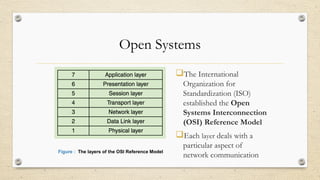
The International
Organization for
Standardization (ISO)
established the Open
Systems Interconnection
(OSI) Reference Model
Each layer deals with a
particular aspect of
network communication
Figure : The layers of the OSI Reference Model
Network Protocols
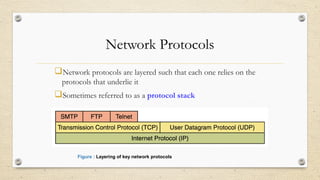
Network protocols are layered such that each one relies on the
protocols that underlie it
Sometimes referred to as a protocol stack
Figure : Layering of key network protocols
Open protocols and systems
A set of protocols is open if
protocol details are publicly available
changes are managed by an organization whose membership and
transactions are open to the public
A system that implements open protocols is called an open system
International Organization for Standards (ISO) prescribes a
standard to connect open systems
open system interconnect (OSI)
Has greatly influenced thinking on protocol stacks
Postal network
Application: people using the postal system
Session and presentation: chief clerk sends some priority mail, and some by
regular mail ; translator translates letters going abroad.
mail clerk sends a message, retransmits if not acked
postal system computes a route and forwards the letters
datalink layer: letters carried by planes, trains, automobiles
physical layer: the letter itself
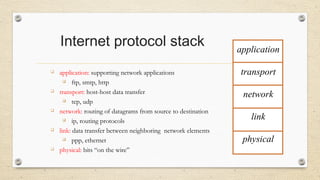
Internet protocol stack
 application: supporting network applications
 ftp, smtp, http
 transport: host-host data transfer
 tcp, udp
 network: routing of datagrams from source to destination
 ip, routing protocols
 link: data transfer between neighboring network elements
 ppp, ethernet
 physical: bits “on the wire”
application
transport
network
link
physical
application
transport
network
Link
physical
application
transport
network
Link
physical
source destination
M
M
M
M
Ht
HtHn
HtHnHl
M
M
M
M
Ht
HtHn
HtHnHl
message
segment
datagram
frame
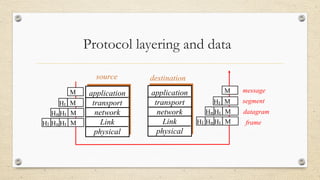
Protocol layering and data

Computer networks-2

  • 1.
    In this videowe are going to discuss • Protocol Layers • Advantages of Layering • Protocols • Open System Protocols • Network Protocols • Internet Protocol Stack • Postal Network • Protocol Layering & Data
  • 2.
    Protocol Layers • Theidea: a series of steps • A way for organizing structure of network
  • 3.
    Advantages of Layering explicitstructure allows identification & relationship of complex system’s pieces layered reference model for discussion modularization eases maintenance & updating of system change of implementation of layer’s service transparent to rest of system
  • 4.
    Protocols  A protocolis a set of rules and formats that govern the communication between communicating peers  set of valid messages  meaning of each message  Necessary for any function that requires cooperation between peers
  • 5.
    Protocols A protocol providesa service For example: the post office protocol for reliable parcel transfer service Peer entities use a protocol to provide a service to a higher-level peer entity for example, truck drivers use a protocol to present post offices with the abstraction of an unreliable parcel transfer service
  • 6.
    Protocol Layers A networkthat provides many services needs many protocols Some services are independent, But others depend on each other A Protocol may use another protocol as a step in its execution for example, ground transfer is one step in the execution of the example reliable parcel transfer protocol This form of dependency is called layering Post office handling is layered above parcel ground transfer protocol.
  • 7.
    Open Systems Proprietary systemA system that uses technologies kept private by a particular commercial vendor  One system couldn’t communicate with another, leading to the need for Interoperability The ability of software and hardware on multiple machines and from multiple commercial vendors to communicate  Leading to Open systems System based on a common model of network architecture and a suite of protocols used in its implementation
  • 8.
    Open Systems The International Organizationfor Standardization (ISO) established the Open Systems Interconnection (OSI) Reference Model Each layer deals with a particular aspect of network communication Figure : The layers of the OSI Reference Model
  • 9.
    Network Protocols Network protocolsare layered such that each one relies on the protocols that underlie it Sometimes referred to as a protocol stack Figure : Layering of key network protocols
  • 10.
    Open protocols andsystems A set of protocols is open if protocol details are publicly available changes are managed by an organization whose membership and transactions are open to the public A system that implements open protocols is called an open system International Organization for Standards (ISO) prescribes a standard to connect open systems open system interconnect (OSI) Has greatly influenced thinking on protocol stacks
  • 11.
    Postal network Application: peopleusing the postal system Session and presentation: chief clerk sends some priority mail, and some by regular mail ; translator translates letters going abroad. mail clerk sends a message, retransmits if not acked postal system computes a route and forwards the letters datalink layer: letters carried by planes, trains, automobiles physical layer: the letter itself
  • 12.
    Internet protocol stack application: supporting network applications  ftp, smtp, http  transport: host-host data transfer  tcp, udp  network: routing of datagrams from source to destination  ip, routing protocols  link: data transfer between neighboring network elements  ppp, ethernet  physical: bits “on the wire” application transport network link physical
  • 13.

Editor's Notes