Minorities In Pakistan
PAKISTAN STUDIES PRESENTATION
Minorities in Pakistan
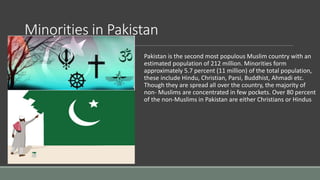
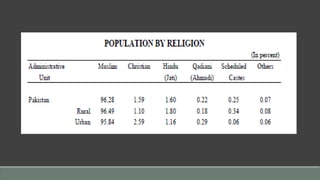
Pakistan is the second most populous Muslim country with an
estimated population of 212 million. Minorities form
approximately 5.7 percent (11 million) of the total population,
these include Hindu, Christian, Parsi, Buddhist, Ahmadi etc.
Though they are spread all over the country, the majority of
non- Muslims are concentrated in few pockets. Over 80 percent
of the non-Muslims in Pakistan are either Christians or Hindus
• Literature Reviews
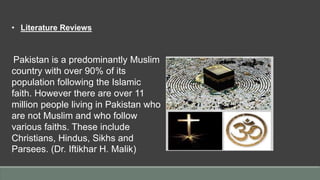
Pakistan is a predominantly Muslim
country with over 90% of its
population following the Islamic
faith. However there are over 11
million people living in Pakistan who
are not Muslim and who follow
various faiths. These include
Christians, Hindus, Sikhs and
Parsees. (Dr. Iftikhar H. Malik)
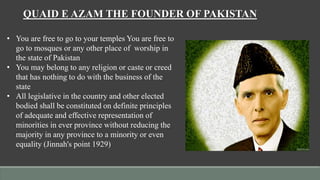
QUAID E AZAM THE FOUNDER OF PAKISTAN
• You are free to go to your temples You are free to
go to mosques or any other place of worship in
the state of Pakistan
• You may belong to any religion or caste or creed
that has nothing to do with the business of the
state
• All legislative in the country and other elected
bodied shall be constituted on definite principles
of adequate and effective representation of
minorities in ever province without reducing the
majority in any province to a minority or even
equality (Jinnah's point 1929)
Islam and Minorities
Principle of Law:
“in sufferings (i.e., affairs) of this world, Muslims and non-Muslims are
equal and alike”
Treaty of Hudaibia
Funeral of a Jew
People of Najran
Minorities Freedom in Ottoman Empire
Context of Qur’an
Qur’an (9:6):
"And if anyone of the pagans seeketh asylum (O Muhammad), then give him asylum ... and
afterwards convey him to his place of safety ...“
Qur’an (2:256)
“There shall be no compulsion in [acceptance of] the religion. The right course has become clear
from the wrong. So whoever disbelieves in Taghut and believes in Allah has grasped the most
trustworthy handhold with no break in it. And Allah is Hearing and Knowing.”
LAWS OF
MINORITIES
Article 25-1
“All citizens are equal before law
and are entitled to equal protection of law.”
Article 2-A of the Constitution of 1973
“Wherein adequate provision shall
be made for the minorities to freely profess and
practice their religions and develop their cultures”
Article 36 Protection of Minorities
“The State shall safeguard the
legitimate rights and interests of minorities,
including their due representation in the Federal
and Provincial services"
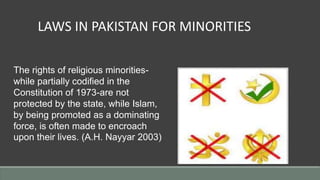
The rights of religious minorities-
while partially codified in the
Constitution of 1973-are not
protected by the state, while Islam,
by being promoted as a dominating
force, is often made to encroach
upon their lives. (A.H. Nayyar 2003)
LAWS IN PAKISTAN FOR MINORITIES
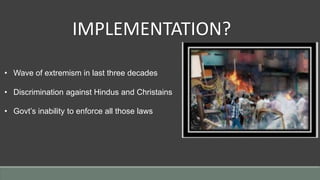
• Wave of extremism in last three decades
• Discrimination against Hindus and Christains
• Govt’s inability to enforce all those laws
IMPLEMENTATION?
International laws regarding minorities
1. Minority rights protect human identities.
2. Tenuous relationship between minorities and universal value.
3. Yet possess capacity to divide people.
International Laws(Cont.)
1. The Universal Declaration makes no explicit mention of minority rights.
2. Preliminary draft contained general statements.
3. Omitted from final version adopted by UN General Assembly in 1948.
4. ICCPR(1976) refers to minorities explicitly but frames in individualistic terms.
5. The convenant monitoring body is empowered to hear only individual claims that is
incontrast to its 1st article that guarantees right of self determination to all people.
International Laws (Cont.)
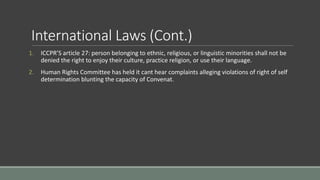
1. ICCPR’S article 27: person belonging to ethnic, religious, or linguistic minorities shall not be
denied the right to enjoy their culture, practice religion, or use their language.
2. Human Rights Committee has held it cant hear complaints alleging violations of right of self
determination blunting the capacity of Convenat.
Problems
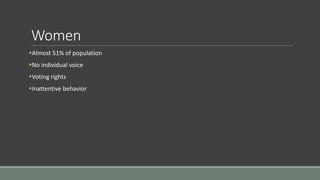
Women
Almost 51% of population
No individual voice
Voting rights
Inattentive behavior
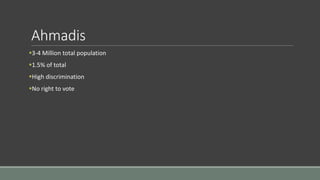
Ahmadis
3-4 Million total population
1.5% of total
High discrimination
No right to vote
Christians and Hindus
Similar challenges
Largest population in minorities
Freedom to become an unencumbered part of the Pakistani electoral system
Persecution under blasphemy laws
Internally Displaced Persons (IDPs)
Political minority
Lack of proper documents
Voting problems
Representation
National Assembly
10 seats reserved for minorities
60 seats reserved for women
342 total seats
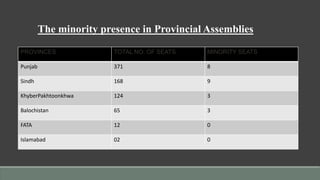
PROVINCES TOTAL NO: OF SEATS MINORITY SEATS
Punjab 371 8
Sindh 168 9
KhyberPakhtoonkhwa 124 3
Balochistan 65 3
FATA 12 0
Islamabad 02 0
The minority presence in Provincial Assemblies
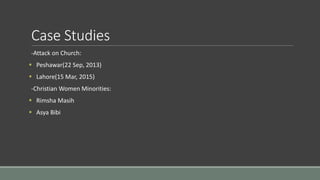
Case Studies
-Attack on Church:
 Peshawar(22 Sep, 2013)
 Lahore(15 Mar, 2015)
-Christian Women Minorities:
 Rimsha Masih
 Asya Bibi
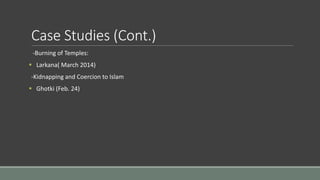
Case Studies (Cont.)
-Burning of Temples:
 Larkana( March 2014)
-Kidnapping and Coercion to Islam
 Ghotki (Feb. 24)
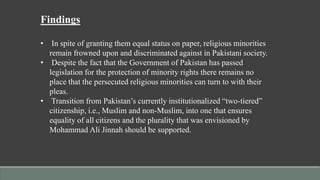
Findings
• In spite of granting them equal status on paper, religious minorities
remain frowned upon and discriminated against in Pakistani society.
• Despite the fact that the Government of Pakistan has passed
legislation for the protection of minority rights there remains no
place that the persecuted religious minorities can turn to with their
pleas.
• Transition from Pakistan’s currently institutionalized “two-tiered”
citizenship, i.e., Muslim and non-Muslim, into one that ensures
equality of all citizens and the plurality that was envisioned by
Mohammad Ali Jinnah should be supported.
Conclusion
• Minorities identify strongly with a Pakistani national identity, even as they
are persecuted on the basis of their religious identity. Minorities who have a
historical connection to this land and have been contributing members of
society are now being targeted for their beliefs.
• We recognize all minority communities in Pakistan as sovereign citizens of
the state who deserve equality, justice and dignity.
Thank You

Minorities in Pakistan

  • 1.
    Minorities In Pakistan PAKISTANSTUDIES PRESENTATION
  • 3.
    Minorities in Pakistan Pakistanis the second most populous Muslim country with an estimated population of 212 million. Minorities form approximately 5.7 percent (11 million) of the total population, these include Hindu, Christian, Parsi, Buddhist, Ahmadi etc. Though they are spread all over the country, the majority of non- Muslims are concentrated in few pockets. Over 80 percent of the non-Muslims in Pakistan are either Christians or Hindus
  • 5.
    • Literature Reviews Pakistanis a predominantly Muslim country with over 90% of its population following the Islamic faith. However there are over 11 million people living in Pakistan who are not Muslim and who follow various faiths. These include Christians, Hindus, Sikhs and Parsees. (Dr. Iftikhar H. Malik)
  • 6.
    QUAID E AZAMTHE FOUNDER OF PAKISTAN • You are free to go to your temples You are free to go to mosques or any other place of worship in the state of Pakistan • You may belong to any religion or caste or creed that has nothing to do with the business of the state • All legislative in the country and other elected bodied shall be constituted on definite principles of adequate and effective representation of minorities in ever province without reducing the majority in any province to a minority or even equality (Jinnah's point 1929)
  • 7.
    Islam and Minorities Principleof Law: “in sufferings (i.e., affairs) of this world, Muslims and non-Muslims are equal and alike” Treaty of Hudaibia Funeral of a Jew People of Najran Minorities Freedom in Ottoman Empire
  • 8.
    Context of Qur’an Qur’an(9:6): "And if anyone of the pagans seeketh asylum (O Muhammad), then give him asylum ... and afterwards convey him to his place of safety ...“ Qur’an (2:256) “There shall be no compulsion in [acceptance of] the religion. The right course has become clear from the wrong. So whoever disbelieves in Taghut and believes in Allah has grasped the most trustworthy handhold with no break in it. And Allah is Hearing and Knowing.”
  • 9.
    LAWS OF MINORITIES Article 25-1 “Allcitizens are equal before law and are entitled to equal protection of law.” Article 2-A of the Constitution of 1973 “Wherein adequate provision shall be made for the minorities to freely profess and practice their religions and develop their cultures” Article 36 Protection of Minorities “The State shall safeguard the legitimate rights and interests of minorities, including their due representation in the Federal and Provincial services"
  • 10.
    The rights ofreligious minorities- while partially codified in the Constitution of 1973-are not protected by the state, while Islam, by being promoted as a dominating force, is often made to encroach upon their lives. (A.H. Nayyar 2003) LAWS IN PAKISTAN FOR MINORITIES
  • 11.
    • Wave ofextremism in last three decades • Discrimination against Hindus and Christains • Govt’s inability to enforce all those laws IMPLEMENTATION?
  • 12.
    International laws regardingminorities 1. Minority rights protect human identities. 2. Tenuous relationship between minorities and universal value. 3. Yet possess capacity to divide people.
  • 13.
    International Laws(Cont.) 1. TheUniversal Declaration makes no explicit mention of minority rights. 2. Preliminary draft contained general statements. 3. Omitted from final version adopted by UN General Assembly in 1948. 4. ICCPR(1976) refers to minorities explicitly but frames in individualistic terms. 5. The convenant monitoring body is empowered to hear only individual claims that is incontrast to its 1st article that guarantees right of self determination to all people.
  • 14.
    International Laws (Cont.) 1.ICCPR’S article 27: person belonging to ethnic, religious, or linguistic minorities shall not be denied the right to enjoy their culture, practice religion, or use their language. 2. Human Rights Committee has held it cant hear complaints alleging violations of right of self determination blunting the capacity of Convenat.
  • 15.
  • 16.
    Women Almost 51% ofpopulation No individual voice Voting rights Inattentive behavior
  • 17.
    Ahmadis 3-4 Million totalpopulation 1.5% of total High discrimination No right to vote
  • 18.
    Christians and Hindus Similarchallenges Largest population in minorities Freedom to become an unencumbered part of the Pakistani electoral system Persecution under blasphemy laws
  • 19.
    Internally Displaced Persons(IDPs) Political minority Lack of proper documents Voting problems
  • 20.
  • 21.
    National Assembly 10 seatsreserved for minorities 60 seats reserved for women 342 total seats
  • 22.
    PROVINCES TOTAL NO:OF SEATS MINORITY SEATS Punjab 371 8 Sindh 168 9 KhyberPakhtoonkhwa 124 3 Balochistan 65 3 FATA 12 0 Islamabad 02 0 The minority presence in Provincial Assemblies
  • 23.
    Case Studies -Attack onChurch:  Peshawar(22 Sep, 2013)  Lahore(15 Mar, 2015) -Christian Women Minorities:  Rimsha Masih  Asya Bibi
  • 24.
    Case Studies (Cont.) -Burningof Temples:  Larkana( March 2014) -Kidnapping and Coercion to Islam  Ghotki (Feb. 24)
  • 25.
    Findings • In spiteof granting them equal status on paper, religious minorities remain frowned upon and discriminated against in Pakistani society. • Despite the fact that the Government of Pakistan has passed legislation for the protection of minority rights there remains no place that the persecuted religious minorities can turn to with their pleas. • Transition from Pakistan’s currently institutionalized “two-tiered” citizenship, i.e., Muslim and non-Muslim, into one that ensures equality of all citizens and the plurality that was envisioned by Mohammad Ali Jinnah should be supported.
  • 26.
    Conclusion • Minorities identifystrongly with a Pakistani national identity, even as they are persecuted on the basis of their religious identity. Minorities who have a historical connection to this land and have been contributing members of society are now being targeted for their beliefs. • We recognize all minority communities in Pakistan as sovereign citizens of the state who deserve equality, justice and dignity.
  • 27.