Human Rights & Pakistan
Basic Definition
 Human rights are rights inherent to all human
beings, whatever our nationality, place of
residence, sex, national or ethnic origin, color,
religion, language, or any other status. We are all
equally entitled to our human rights without
discrimination. These rights are all interrelated,
interdependent and indivisible.
Substantive rights
1. Right to life
2. Right to a fair trial
3. Freedom from torture
4. Freedom from slavery
5. Freedom of speech
6. Freedom of thought, conscience and religion
7. Freedom of movement
Introduction:
 The present age is described as the "age of
rights" and human rights as the "only political-
moral idea that has received universal
acceptance.“
 The codification of international law relating to
human rights ranks as some of the most
noteworthy achievements of man in the twentieth
century. Founded on the Universal Declaration of
Human Rights (UDHR),
 human rights law is now an indispensable part of
the international landscape.
Continued…
 Human rights do not, of course, negate the
sovereignty of states, although they constrain it in
important ways. International law does not
replace national law; rather, international law
instructs sovereign states on internationally
accepted human rights and, for the most part,
leaves it to states to implement those norms
domestically.
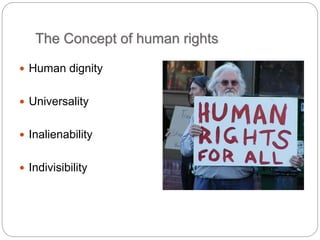
The Concept of human rights
 Human dignity
 Universality
 Inalienability
 Indivisibility
EVOLUTION
 The International Labour Organization (1919)
aim: oversee treaties protecting workers
 The League of Nations (1919)
aim: international peace and cooperation
 The United Nations (1945)
aim: cooperation in international law, international
security, economic development, human rights
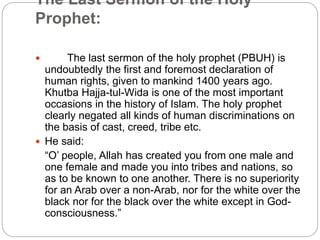
The Last Sermon of the Holy
Prophet:
 The last sermon of the holy prophet (PBUH) is
undoubtedly the first and foremost declaration of
human rights, given to mankind 1400 years ago.
Khutba Hajja-tul-Wida is one of the most important
occasions in the history of Islam. The holy prophet
clearly negated all kinds of human discriminations on
the basis of cast, creed, tribe etc.
 He said:
“O’ people, Allah has created you from one male and
one female and made you into tribes and nations, so
as to be known to one another. There is no superiority
for an Arab over a non-Arab, nor for the white over the
black nor for the black over the white except in God-
consciousness.”
CLASSIFICATION
 Civil Rights
 Political Rights
 Economic Rights
 Social Rights
 Cultural Rights
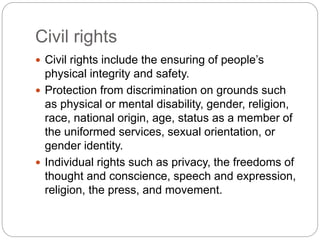
 Civil rights include the ensuring of people’s
physical integrity and safety.
 Protection from discrimination on grounds such
as physical or mental disability, gender, religion,
race, national origin, age, status as a member of
the uniformed services, sexual orientation, or
gender identity.
 Individual rights such as privacy, the freedoms of
thought and conscience, speech and expression,
religion, the press, and movement.
Civil rights
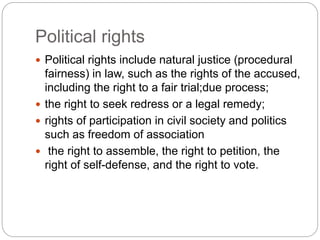
 Political rights include natural justice (procedural
fairness) in law, such as the rights of the accused,
including the right to a fair trial;due process;
 the right to seek redress or a legal remedy;
 rights of participation in civil society and politics
such as freedom of association
 the right to assemble, the right to petition, the
right of self-defense, and the right to vote.
Political rights
 Economic, social and cultural rights are socio-
economic human rights, such as the right to
education, right to housing, right to adequate
standard of living and the right to health.
 Economic, social and cultural rights are
recognized and protected in international and
regional human rights instruments.
 Member states have a legal obligation to respect,
protect and fullfil economic, social and cultural
rights and are expected to take "progressive
action" towards their fullfilment.
Socio-Economic human rights
The Human Rights Situation in
Pakistan:
 Over the years the general rule of basic civilized law and human
rights has broke down and alarmingly diminished in Pakistan.
Humanitarian crime is on the increase especially against the
vulnerable, the poor, the women and children. All these crimes
have reached epidemic proportions.
 Sectarian violence, Religious crime.
 Domestic violence.
 Child Abuse, Rape & Gang Rape.
 Acid & chemical Attacks.
 Illegal village Courts and trials,
 Honor killings.
 Bonded Slave labor and the sale of women and children.
 Illegal detentions and abuse of police powers.
 Extra Judicial Killings.
 Disappearances of persons taken into custody by law
enforcement agencies.
 There are over 1 million bonded slaves in Pakistan.
 There were… More than 10,000 honor killings in 2009 alone known
as “kahroh kari”
 In 2009 more than 2000 brides were burned to death (reported
figures only)
 On average 12 women were murdered everyday by their husbands.
 More than 1000 acid attacks on women. (reported figures only)
 Somewhere in Pakistan a woman, man or child was raped every 10
minutes.
 100’s of children were sold off as sex slaves every day
 1000’s of girls sold off to criminals,
 Over 20,000 people killed in sectarian crime

Human rights

  • 1.
  • 2.
    Basic Definition  Humanrights are rights inherent to all human beings, whatever our nationality, place of residence, sex, national or ethnic origin, color, religion, language, or any other status. We are all equally entitled to our human rights without discrimination. These rights are all interrelated, interdependent and indivisible.
  • 3.
    Substantive rights 1. Rightto life 2. Right to a fair trial 3. Freedom from torture 4. Freedom from slavery 5. Freedom of speech 6. Freedom of thought, conscience and religion 7. Freedom of movement
  • 4.
    Introduction:  The presentage is described as the "age of rights" and human rights as the "only political- moral idea that has received universal acceptance.“  The codification of international law relating to human rights ranks as some of the most noteworthy achievements of man in the twentieth century. Founded on the Universal Declaration of Human Rights (UDHR),  human rights law is now an indispensable part of the international landscape.
  • 5.
    Continued…  Human rightsdo not, of course, negate the sovereignty of states, although they constrain it in important ways. International law does not replace national law; rather, international law instructs sovereign states on internationally accepted human rights and, for the most part, leaves it to states to implement those norms domestically.
  • 6.
    The Concept ofhuman rights  Human dignity  Universality  Inalienability  Indivisibility
  • 7.
    EVOLUTION  The InternationalLabour Organization (1919) aim: oversee treaties protecting workers  The League of Nations (1919) aim: international peace and cooperation  The United Nations (1945) aim: cooperation in international law, international security, economic development, human rights
  • 8.
    The Last Sermonof the Holy Prophet:  The last sermon of the holy prophet (PBUH) is undoubtedly the first and foremost declaration of human rights, given to mankind 1400 years ago. Khutba Hajja-tul-Wida is one of the most important occasions in the history of Islam. The holy prophet clearly negated all kinds of human discriminations on the basis of cast, creed, tribe etc.  He said: “O’ people, Allah has created you from one male and one female and made you into tribes and nations, so as to be known to one another. There is no superiority for an Arab over a non-Arab, nor for the white over the black nor for the black over the white except in God- consciousness.”
  • 9.
    CLASSIFICATION  Civil Rights Political Rights  Economic Rights  Social Rights  Cultural Rights
  • 10.
     Civil rightsinclude the ensuring of people’s physical integrity and safety.  Protection from discrimination on grounds such as physical or mental disability, gender, religion, race, national origin, age, status as a member of the uniformed services, sexual orientation, or gender identity.  Individual rights such as privacy, the freedoms of thought and conscience, speech and expression, religion, the press, and movement. Civil rights
  • 11.
     Political rightsinclude natural justice (procedural fairness) in law, such as the rights of the accused, including the right to a fair trial;due process;  the right to seek redress or a legal remedy;  rights of participation in civil society and politics such as freedom of association  the right to assemble, the right to petition, the right of self-defense, and the right to vote. Political rights
  • 12.
     Economic, socialand cultural rights are socio- economic human rights, such as the right to education, right to housing, right to adequate standard of living and the right to health.  Economic, social and cultural rights are recognized and protected in international and regional human rights instruments.  Member states have a legal obligation to respect, protect and fullfil economic, social and cultural rights and are expected to take "progressive action" towards their fullfilment. Socio-Economic human rights
  • 13.
    The Human RightsSituation in Pakistan:  Over the years the general rule of basic civilized law and human rights has broke down and alarmingly diminished in Pakistan. Humanitarian crime is on the increase especially against the vulnerable, the poor, the women and children. All these crimes have reached epidemic proportions.  Sectarian violence, Religious crime.  Domestic violence.  Child Abuse, Rape & Gang Rape.  Acid & chemical Attacks.  Illegal village Courts and trials,  Honor killings.  Bonded Slave labor and the sale of women and children.  Illegal detentions and abuse of police powers.  Extra Judicial Killings.  Disappearances of persons taken into custody by law enforcement agencies.
  • 14.
     There areover 1 million bonded slaves in Pakistan.  There were… More than 10,000 honor killings in 2009 alone known as “kahroh kari”  In 2009 more than 2000 brides were burned to death (reported figures only)  On average 12 women were murdered everyday by their husbands.  More than 1000 acid attacks on women. (reported figures only)  Somewhere in Pakistan a woman, man or child was raped every 10 minutes.  100’s of children were sold off as sex slaves every day  1000’s of girls sold off to criminals,  Over 20,000 people killed in sectarian crime