International Research Journal of Engineering and Technology (IRJET) e-ISSN: 2395 -0056
Volume: 04 Issue: 01 | Jan -2017 www.irjet.net p-ISSN: 2395-0072
© 2017, IRJET | Impact Factor value: 5.181 | ISO 9001:2008 Certified Journal | Page 1613
Mining of Medical Data to Identify Risk Factors of Heart Disease Using
Frequent Itemset
H K Shifali, Dr. B. Srinivasu, Rajashekar Shastry, B N Ranga Swamy
H K Shifali M.Tech
Dept. of Computer Science and Engineering, Stanley College of Engineering and Technology for Women
Telangana - Hyderabad, India.
Dr. B. Srinivasu Associate Professor, Rajashekar Shastry Assistant Professor
Dept. of Computer Science and Engineering, Stanley College of Engineering and Technology for Women
Telangana - Hyderabad, India.
B N Ranga Swamy Scientist ‘F’
Defence Electronics Research Laboratory (D.L.R.L)
Telangana - Hyderabad, India.
---------------------------------------------------------------------***---------------------------------------------------------------------
Abstract – - Data mining techniques are used in the field
of medicine for various purposes. The function of data
mining in biomedical information is remarkable one. Mining
association rule is one of the interesting topics. It was first
proposed for market basket analysis. In this project a
method has been implemented to identify risk factors having
heart disease through frequent Itemset. Frequent itemsets
are generated based on the attributes and minimum
support value. The extracted frequent itemsets help the
medical practitioner to make diagnostic decisions and
determine the risk level of patients at an early stage. The
proposed method can be applied to any medical dataset to
predict the risk factors with risk level of the patients based
on chosen factors.
Key Words: Data Mining, Heart Disease, Frequent
Itemset, prediction, missing values,
1. INTRODUCTION
Heart disease or cardiovascular disease is the class of
diseases that involve the heart or blood vessels (arteries
and veins). Heart disease was considered to be a man’s
problem, but now it is recognized as number one killer of
women, just as it is of men.
As described by National Heart Lung and Blood Institute
echo can detect possible blood clots inside the heart, fluid
buildup in the pericardium (the sac around the heart), and
problems with the aorta But, the interpretation of echo
recordings remains a challenge as it is time consuming. In
order to solve this and many other problems in the health
sector related to disease diagnosis. Data mining can be a
solution by generating rules from those enormous
datasets which can be used in echo readings. mining
include diverse techniques to extract the information from
a large database [1].
1.2 Problem Description
Clinical decisions are often made based on doctors’
intuition and experience rather than on the knowledge
rich data hidden in the database. This practice leads to
unwanted biases, errors and excessive medical costs
which affects the quality of service provided to patients.
The integration of clinical decision support with
computer‐based patient records could reduce medical
errors, enhance patient safety, decrease unwanted
practice variation, and improve patient outcome. Data
mining have shown a promising result in prediction of
heart disease. It is widely applied for prediction or
classification of different types of heart disease. The key
objective of the work is,
 To identify key patterns or features from the
dataset.
 To Identify and select attributes that are more
relevant in relation to heart disease diagnosis.
 To analyze the results of the selected model with
the help of domain expert.
1.3 Basics and Background Knowledge
Data Mining is the core of the KDD process, involving the
inferring of algorithms that explore the data, develop the
model and discover previously unknown patterns. The
model is used for understanding phenomena from the
data, analysis and prediction [2].
Healthcare data analysis: healthcare data is diversified
due to the high dimensionality of the data comprising of
medical history records of patients having different
symptoms. Textual data analysis: Textual data is
commonly available in electronic documents or on social
networks.
1.3.1 Association Rule Discovery
The association task for data mining is the job of finding
which attributes “go together.” Association rules are of the
International Research Journal of Engineering and Technology (IRJET) e-ISSN: 2395 -0056
Volume: 04 Issue: 01 | Jan -2017 www.irjet.net p-ISSN: 2395-0072
© 2017, IRJET | Impact Factor value: 5.181 | ISO 9001:2008 Certified Journal | Page 1614
form “If antecedent, then consequent,” together with a
measure of the support and confidence associated with the
rule.
(Eq 1.1)
(Eq 1.2)
Association differs from classification in two ways: they
can “predict” any attribute, not just the class, and they can
predict more than one attribute’s value at a time [3].
1.3.2 Frequent Itemset
Frequent patterns are itemsets, subsequences, or
substructures that appear in a data set with frequency no
less than a user-specified threshold. Frequent pattern
mining was first proposed by Agrawal et al.[4] for market
basket analysis in the form of association rule mining.
1.3.3 Heart Disease
Heart disease or cardiovascular disease is the greatest
scourge afflicting the world. As with previous scourge-
bubonic plague, yellow fever, and smallpox;
cardiovascular disease not only strikes down a significant
fraction of the population without warning but causes
prolonged suffering and disability in an even larger
number. Simultaneously, remarkable progress has been
made in preventing and treating cardiovascular diseases
by medical and surgical means Braunwald et al., [5].
1.3.4 Major Types of Heart Disease
There are many types of heart disease, but in this study
the researcher chooses to discuss five types that are
common to happen. As described by Cindy [6], five
common types of heart disease are discussed below.
Congenital heart disease-heart doesn’t pump adequate
blood to the other organs in the body. Congestive heart
failure -heart disease which is passed down through the
family.Coronary heart disease (ischemic heart
disease)- -damage to the heart that happens because its
blood supply is decreased.Pulmonary heart disease-
disease that comes from lung, pulmonary, disorder.
Rheumatic heart disease derives from strep throat
infections.
2. LITERATURE SURVEY
Numerous works related to heart disease diagnosis using
data mining techniques have motivated this study.
K S Kavitha et al [7] performed a work on “Modeling and
design of evolutionary neural network for heart disease
detection” an alternative solution for complex medical
diagnosis in detection of heart disease where human
knowledge is apprehended in a general fashion.
AH Chen et al [8] developed a new system to predict heart
disease that can assist medical professionals in predicting
heart disease status based on the clinical data of patients.
An artificial neural network algorithm was developed for
classifying heart disease based on 13 important clinical
features.
Resul Das et al [9] introduced a methodology using SAS
Base Software9.1.3 for diagnosing of the valvular heart
disease. A neural networks ensemble method creates new
models by combining the posterior probabilities or the
predicted values from multiple predecessor models.
Carlos Ordonez [10] introduced an algorithm to searches
for association rules on a training set reduces the number
of rules using search constraints, and finally validates
them an independent test set. The discovered rules are
evaluated with support value, confidence value and lift.
Dubey et al. [11] performed a work on suggest the early
detection may help in providing better treatment and can
cure. They also suggest that the framework based on data
mining and optimization may predict diseases properly.
U.Chandrasekhar et al. [12] surveys various latest
frequent pattern mining algorithms on data streams to
understand various advantages and disadvantages, so they
provides a way of using new insights in the direction of
frequent pattern. The combination of optimization and
data mining is also suggested has gotten much
consideration and has been joined in numerous
enhancement issues, to be specific the system directing,
voyaging salesperson, quadratic task, and asset
assignment issues.
3. ARCHITECTURE
This section deals with the proposed method, system
architecture and short description of design process.
3.1 Proposed Method
We are proposing a method to predict the risk of heart
disease based on patience history. In this approach we do
not require training module, directly we can extract the
frequent patterns by which we can generate the attributes
that cause heart disease and rise early warnings to
patience. In this method attributes which are in columns
and patient records which are in rows are eliminated if
they do not satisfy support value and which leads to
dimension reduction from further analysis, if they do not
satisfy the chosen rules.
International Research Journal of Engineering and Technology (IRJET) e-ISSN: 2395 -0056
Volume: 04 Issue: 01 | Jan -2017 www.irjet.net p-ISSN: 2395-0072
© 2017, IRJET | Impact Factor value: 5.181 | ISO 9001:2008 Certified Journal | Page 1615
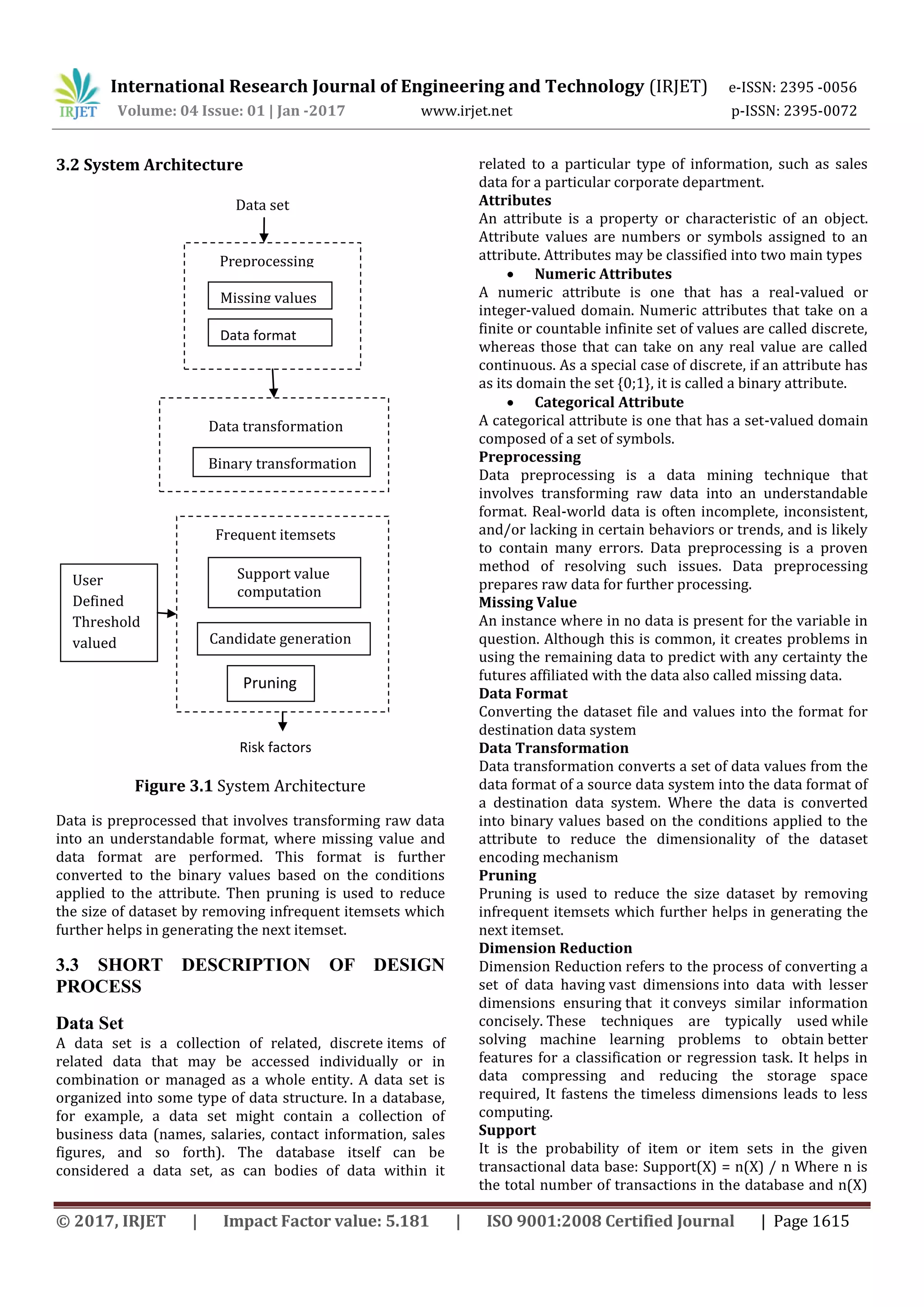
3.2 System Architecture
Figure 3.1 System Architecture
Data is preprocessed that involves transforming raw data
into an understandable format, where missing value and
data format are performed. This format is further
converted to the binary values based on the conditions
applied to the attribute. Then pruning is used to reduce
the size of dataset by removing infrequent itemsets which
further helps in generating the next itemset.
3.3 SHORT DESCRIPTION OF DESIGN
PROCESS
Data Set
A data set is a collection of related, discrete items of
related data that may be accessed individually or in
combination or managed as a whole entity. A data set is
organized into some type of data structure. In a database,
for example, a data set might contain a collection of
business data (names, salaries, contact information, sales
figures, and so forth). The database itself can be
considered a data set, as can bodies of data within it
related to a particular type of information, such as sales
data for a particular corporate department.
Attributes
An attribute is a property or characteristic of an object.
Attribute values are numbers or symbols assigned to an
attribute. Attributes may be classified into two main types
 Numeric Attributes
A numeric attribute is one that has a real-valued or
integer-valued domain. Numeric attributes that take on a
finite or countable infinite set of values are called discrete,
whereas those that can take on any real value are called
continuous. As a special case of discrete, if an attribute has
as its domain the set {0;1}, it is called a binary attribute.
 Categorical Attribute
A categorical attribute is one that has a set-valued domain
composed of a set of symbols.
Preprocessing
Data preprocessing is a data mining technique that
involves transforming raw data into an understandable
format. Real-world data is often incomplete, inconsistent,
and/or lacking in certain behaviors or trends, and is likely
to contain many errors. Data preprocessing is a proven
method of resolving such issues. Data preprocessing
prepares raw data for further processing.
Missing Value
An instance where in no data is present for the variable in
question. Although this is common, it creates problems in
using the remaining data to predict with any certainty the
futures affiliated with the data also called missing data.
Data Format
Converting the dataset file and values into the format for
destination data system
Data Transformation
Data transformation converts a set of data values from the
data format of a source data system into the data format of
a destination data system. Where the data is converted
into binary values based on the conditions applied to the
attribute to reduce the dimensionality of the dataset
encoding mechanism
Pruning
Pruning is used to reduce the size dataset by removing
infrequent itemsets which further helps in generating the
next itemset.
Dimension Reduction
Dimension Reduction refers to the process of converting a
set of data having vast dimensions into data with lesser
dimensions ensuring that it conveys similar information
concisely. These techniques are typically used while
solving machine learning problems to obtain better
features for a classification or regression task. It helps in
data compressing and reducing the storage space
required, It fastens the timeless dimensions leads to less
computing.
Support
It is the probability of item or item sets in the given
transactional data base: Support(X) = n(X) / n Where n is
the total number of transactions in the database and n(X)
Preprocessing
Data format
Data transformation
Frequent itemsets
Support value
computation
Candidate generation
Missing values
Binary transformation
Pruning
User
Defined
Threshold
valued
Data set
Risk factors
International Research Journal of Engineering and Technology (IRJET) e-ISSN: 2395 -0056
Volume: 04 Issue: 01 | Jan -2017 www.irjet.net p-ISSN: 2395-0072
© 2017, IRJET | Impact Factor value: 5.181 | ISO 9001:2008 Certified Journal | Page 1616
is the number of transactions that contains the item set X.
Therefore, Support (X=>Y) = Support (XUY).
Risk Factors
A condition or habit that makes a person more likely to
develop a disease can also increase the chances that an
existing disease will get worse.
4. IMPLEMENTATION
Based on the proposed system architecture in figure
3.1, the methodology is constructed into four
modules (1) data set collection (2) preprocessing (3)
data transformation (4) frequent Item set generation.
4.1 Dataset Description
The dataset used in this project is obtained from UCI
Repository of Cleveland database [36] containing 303
patience’s record. Below are the list of attributes and there
values.
Table 4.1 Attributes of Heart Disease Dataset
S.no Attribute
name
Type Values
1 Age Continuous In years
2 Sex Discrete 1=male 2=female
3 CP Discrete Value1=typical angina
Value2=atypical
angina
Value3=non-anginal
pain
Value4=asymptomatic
4 Trestbps Continuous In mm Hg on
Admission to the
Hospital
5 Chol Continous In mg/dl
6 Fbs Discrete Fasting blood sugar>
120mg/dl
True=1
False=0
7 RestECG Discrete Value0=normal
Value1=having ST-T
Wave abnormality
Value2=showing
probable
8 Thalach Continous Maximum heart rate
achieved
9 Exang Discrete Value1=yes
Value0=no
10 Old peak Continuous In number values
11 Slope Discrete Value1=up sloping
Value2=flat
Value3=down sloping
12 CA Discrete 0-3 value
13 Thal Discrete Value3=normal
Value6=fixed
Value7=reversible
Defect
14 Concept
Class
Discrete 5 types of values 0-4
The dataset is used by authors for different purpose; they
have used it to find the prediction of heart disease with
different algorithms and technique. Our aim is to find the
risk factor that causes heart disease. The Cleveland
database contains 75 attributes in which 14 attributes are
considered.
Table 4.2 Sample Dataset Structure
age sex cp trestbps chol fbs restECG thalach exang Oldpeak slope ca thal Concept
class
63 1 1 145 233 1 2 150 0 2.3 3 0 6 0
67 1 4 160 286 0 2 108 1 1.5 2 3 3 2
67 1 4 120 229 0 2 129 1 2.6 2 2 7 1
37 1 3 130 250 0 0 187 0 3.5 3 0 3 0
41 0 2 130 204 0 2 172 0 1.4 1 0 3 0
56 1 2 120 236 0 0 178 0 0.8 1 0 3 0
4.2 Preprocessing
Analyzing data that has not been carefully screened can
produce misleading results. If there is much irrelevant and
redundant information or noisy and unreliable data
reduces the performance. Removing such noisy data is
International Research Journal of Engineering and Technology (IRJET) e-ISSN: 2395 -0056
Volume: 04 Issue: 01 | Jan -2017 www.irjet.net p-ISSN: 2395-0072
© 2017, IRJET | Impact Factor value: 5.181 | ISO 9001:2008 Certified Journal | Page 1617
preprocessing. This module consists of two sub modules
as mentioned below.
1. Missing Value
2. Data Format
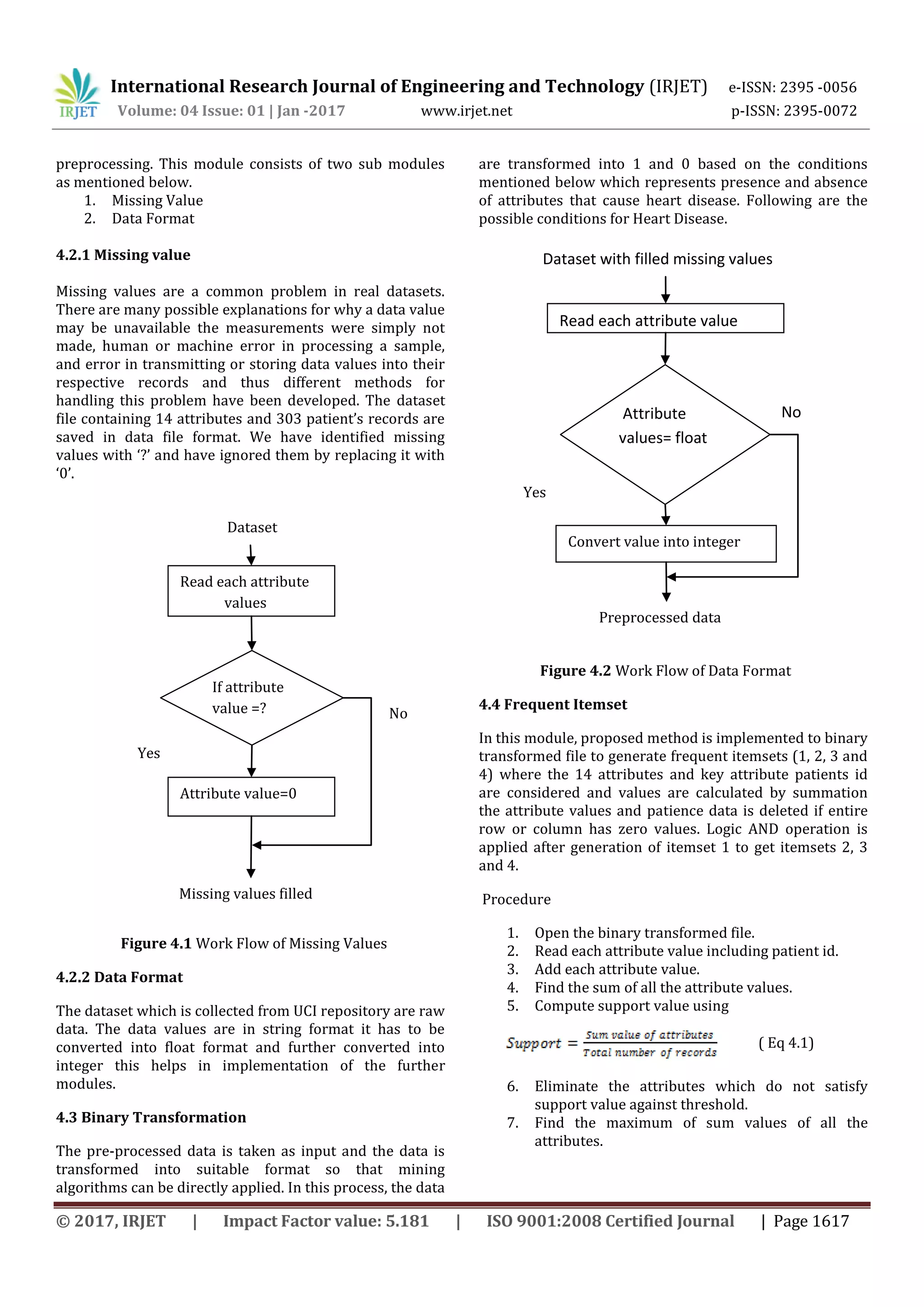
4.2.1 Missing value
Missing values are a common problem in real datasets.
There are many possible explanations for why a data value
may be unavailable the measurements were simply not
made, human or machine error in processing a sample,
and error in transmitting or storing data values into their
respective records and thus different methods for
handling this problem have been developed. The dataset
file containing 14 attributes and 303 patient’s records are
saved in data file format. We have identified missing
values with ‘?’ and have ignored them by replacing it with
‘0’.
Figure 4.1 Work Flow of Missing Values
4.2.2 Data Format
The dataset which is collected from UCI repository are raw
data. The data values are in string format it has to be
converted into float format and further converted into
integer this helps in implementation of the further
modules.
4.3 Binary Transformation
The pre-processed data is taken as input and the data is
transformed into suitable format so that mining
algorithms can be directly applied. In this process, the data
are transformed into 1 and 0 based on the conditions
mentioned below which represents presence and absence
of attributes that cause heart disease. Following are the
possible conditions for Heart Disease.
Figure 4.2 Work Flow of Data Format
4.4 Frequent Itemset
In this module, proposed method is implemented to binary
transformed file to generate frequent itemsets (1, 2, 3 and
4) where the 14 attributes and key attribute patients id
are considered and values are calculated by summation
the attribute values and patience data is deleted if entire
row or column has zero values. Logic AND operation is
applied after generation of itemset 1 to get itemsets 2, 3
and 4.
Procedure
1. Open the binary transformed file.
2. Read each attribute value including patient id.
3. Add each attribute value.
4. Find the sum of all the attribute values.
5. Compute support value using
( Eq 4.1)
6. Eliminate the attributes which do not satisfy
support value against threshold.
7. Find the maximum of sum values of all the
attributes.
Dataset
Read each attribute
values
If attribute
value =?
Attribute value=0
Missing values filled
Yes
No
Dataset with filled missing values
Read each attribute value
Attribute
values= float
Convert value into integer
Preprocessed data
Yes
No
International Research Journal of Engineering and Technology (IRJET) e-ISSN: 2395 -0056
Volume: 04 Issue: 01 | Jan -2017 www.irjet.net p-ISSN: 2395-0072
© 2017, IRJET | Impact Factor value: 5.181 | ISO 9001:2008 Certified Journal | Page 1618
8. Apply logic AND operation between maximum
sum value of attribute with all the other
attributes.
9. Delete the row containing zero i.e. by deleting the
rows, patients who are not affected by the
attributes are eliminated for further analysis.
10. Repeat step 4 to 9.
11. Finally, frequent itemsets (1, 2, 3, and 4) are
generated.
12. All four frequent itemset show the pairs of risk
factors causing heart disease.
5. EXPERIMENT RESULTS
5.1 Result Analysis
The dataset used in this project is Cleveland Clinic
Foundation. Heart disease dataset is available at UCI
repository. The data set has 76 raw attributes. However,
all of the published experiments only refer to 13 of them
and one more attribute which specify the concept class.
The data set contains 303 patients’ records.
During implementation we found 6 missing values which
represents as ‘?’ in attributes slope and ca. In slope and ca
the missing values are 4 and 2 as mentioned in the below
table 5.1.
Table 5.1 Missing Values
Attributes name Missing values
Slope 4
CA 2
Total=6
The overall performance of the proposed approach for the
generation of frequent itemsets based on the support
calculation against support threshold.
We set the threshold to see the variations of frequent
itemsets from the above table we estimate that as the
threshold increases frequent itemsets decreases. The table
5.2 it depicts for 40% support threshold frequent itemset-
1 generates 11 risk factors whereas, for 50% support
threshold frequent itemset-1 generates 7 risk factors we
obtained four frequent itemsets. Similarly in frequent
itemsets – 2, 3 and 4 for threshold 40% 10, 13 and 6
respectively and for threshold 50% 7, 6, 3 respectively.
Table 5.2: Generation of Frequent Itemsets
Support
threshold
Iteration
Number
Selected Attribute
40% 1 [1,2,3,4,5,7,8,10,11,13]
2 [1,8,2,8,3,8,4,8,5,8,7,8,10,8,11,8,
13,8]
3 [1,2,8,1,3,8,1,4,8,1,5,8,1,7,8,1,11
8,2,4,8,2,13,8]
4 [1,2,4,8]
50% 1 [1,2,4,5,8,11]
2 [1,8,2,8,4,8,5,8,11,8]
3 [1,2,8,1,4,8]
4 [1,2,4,8]
Table 5.3 Number of Lexical chains generated.
Iteration
numbers
No of frequent itemsets
at threshold 40%
No of frequent
itemsets at
threshold 50%
1 11 7
2 10 6
3 13 3
4 6 0
Figure 5.1 Pattern Comparison
6. CONCLUSIONS
A new method has been developed to generate the
frequent itemsets based on the heart disease dataset
which is collected from UCI repository Cleveland Clinical
International Research Journal of Engineering and Technology (IRJET) e-ISSN: 2395 -0056
Volume: 04 Issue: 01 | Jan -2017 www.irjet.net p-ISSN: 2395-0072
© 2017, IRJET | Impact Factor value: 5.181 | ISO 9001:2008 Certified Journal | Page 1619
Foundation. It helps to identify the risk factors from the
extracted itemsets that cause heart disease. This helps
medical practitioners to alert the patients with the risk
factors that are obtained. This proposed method is
implemented with Java programming language. We have
generated four frequent itemsets. In first frequent itemset
attribute 8 i.e. Thalach was found common in maximum
patients, hence it was important attribute and was
compared with all the other attributes using logic AND
operation to generate second frequent itemsets. In second
frequent itemset attribute (1, 8) i.e. Age and Thalach found
common in maximum number of patients. Third frequent
itemsets includes the attribute which occurs among
maximum number of patients in itemset-2.This is repeated
until dataset is exhausted. Finally frequent itemset will
contain the attributes which causes heart attack.
As a future work, the researcher can plan to perform
additional experiments with more dataset or real time
dataset using different data mining techniques; algorithms
to build a model that can specific heart disease types and a
predictive model.
ACKNOWLEDGEMENT
To Mom
Thanks for the support and strength
Without you I am nothing.
To Dad
Thanks for the encouragement and moral support.
I thank my back bone Support my friends.
REFERENCES
1. M. Ilayaraja Medical Data Mining Method to
Predict Risk Factors of Heart Attack and Raise
Early Warning to Patients, 2015.
2. Oded, M. and Lior, R., "Data Mining and
Knowledge Discovery Handbook", Springer
Science and Business Media Inc., New York, 2005.
3. Witten H. Ian and Frank, E., "Data Mining:
Practical Machine Learning Tools and
Techniques", Second Edition. Morgan Kaufmann
Publishers, San Francisco, 2005.
4. Agrawal R, Imielinski T, Swami A (1993) Mining
association rules between sets of items in large
databases. In: Proceedings of the 1993 ACM-
SIGMOD international conference on management
of data (SIGMOD’93), Washington, DC, pp 207–
216
5. Braunwald, E., Douglas, P. Zipes, Peter, L., Robert,
B., "Braunwald's Heart Disease: A Textbook of
Cardiovascular Medicine", Third Edition, Harcourt
Brace Jovanovich Inc., New York, 1988.
6. Cindy H., "5 Common Types of Heart Disease",
EzineArticles.com. Available at
http://ezinearticles.com/?5--Common--Types-
-of--Heart--Disease& id= 1073496, 2008.
7. K.S. Kavitha, K.V. Ramakrishnan and Manoj Kumar
Singh. “Modelling and design of evolutionary
neural network for heart disease detection”
International Journal of Computer Science Issues,
ISSN (Online): 1694-0814,Vol. 7, Issue.5, 2010.
8. AH Chen, SY Huang, PS Hong, CH Cheng and EJ Lin.
“HDPS: Heart Disease Prediction System”
Computing in Cardiology, Vol.38, pp.557-560,
2011.
9. Resul Dasa, Ibrahim Turkoglub and Abdulkadir
Sengur. Diagnosis of valvular heart disease
through neural networks ensembles” Computer
Methods and Programs in Biomedicine, pp.185–
191, 2009.
10. Carlos Ordonez.“Association Rule Discovery with
the Train and Test Approach for Heart Disease
Prediction” Transactions on Information
Technology in Biomedicine, 2006.
11. Dubey A, Patel R, Choure K, "An efficient data
mining and ant colony optimization technique
(DMACO) for heart disease prediction",
International Journal of Advanced Technology and
Engineering Exploration.; 1(1):1-6, 2014.
12. U.Chandrasekhar, Sandeep Kumar. K, Yakkala
Uma Mahesh,” A Survey of latest Algorithms for
Frequent Item set Mining in Data Stream”,
International Journal of Advanced Computer
Research (IJACR),Volume-3 Number-1 Issue-9
March-2013.
BIOGRAPHIES
H K Shifali Received Her M.Tech
Degree in Software Engineering
from Osmania University. Her
Research Interest is in Data
Mining.

Mining of medical data to identify risk factors of heart disease using frequent itemset

  • 1.
    International Research Journalof Engineering and Technology (IRJET) e-ISSN: 2395 -0056 Volume: 04 Issue: 01 | Jan -2017 www.irjet.net p-ISSN: 2395-0072 © 2017, IRJET | Impact Factor value: 5.181 | ISO 9001:2008 Certified Journal | Page 1613 Mining of Medical Data to Identify Risk Factors of Heart Disease Using Frequent Itemset H K Shifali, Dr. B. Srinivasu, Rajashekar Shastry, B N Ranga Swamy H K Shifali M.Tech Dept. of Computer Science and Engineering, Stanley College of Engineering and Technology for Women Telangana - Hyderabad, India. Dr. B. Srinivasu Associate Professor, Rajashekar Shastry Assistant Professor Dept. of Computer Science and Engineering, Stanley College of Engineering and Technology for Women Telangana - Hyderabad, India. B N Ranga Swamy Scientist ‘F’ Defence Electronics Research Laboratory (D.L.R.L) Telangana - Hyderabad, India. ---------------------------------------------------------------------***--------------------------------------------------------------------- Abstract – - Data mining techniques are used in the field of medicine for various purposes. The function of data mining in biomedical information is remarkable one. Mining association rule is one of the interesting topics. It was first proposed for market basket analysis. In this project a method has been implemented to identify risk factors having heart disease through frequent Itemset. Frequent itemsets are generated based on the attributes and minimum support value. The extracted frequent itemsets help the medical practitioner to make diagnostic decisions and determine the risk level of patients at an early stage. The proposed method can be applied to any medical dataset to predict the risk factors with risk level of the patients based on chosen factors. Key Words: Data Mining, Heart Disease, Frequent Itemset, prediction, missing values, 1. INTRODUCTION Heart disease or cardiovascular disease is the class of diseases that involve the heart or blood vessels (arteries and veins). Heart disease was considered to be a man’s problem, but now it is recognized as number one killer of women, just as it is of men. As described by National Heart Lung and Blood Institute echo can detect possible blood clots inside the heart, fluid buildup in the pericardium (the sac around the heart), and problems with the aorta But, the interpretation of echo recordings remains a challenge as it is time consuming. In order to solve this and many other problems in the health sector related to disease diagnosis. Data mining can be a solution by generating rules from those enormous datasets which can be used in echo readings. mining include diverse techniques to extract the information from a large database [1]. 1.2 Problem Description Clinical decisions are often made based on doctors’ intuition and experience rather than on the knowledge rich data hidden in the database. This practice leads to unwanted biases, errors and excessive medical costs which affects the quality of service provided to patients. The integration of clinical decision support with computer‐based patient records could reduce medical errors, enhance patient safety, decrease unwanted practice variation, and improve patient outcome. Data mining have shown a promising result in prediction of heart disease. It is widely applied for prediction or classification of different types of heart disease. The key objective of the work is,  To identify key patterns or features from the dataset.  To Identify and select attributes that are more relevant in relation to heart disease diagnosis.  To analyze the results of the selected model with the help of domain expert. 1.3 Basics and Background Knowledge Data Mining is the core of the KDD process, involving the inferring of algorithms that explore the data, develop the model and discover previously unknown patterns. The model is used for understanding phenomena from the data, analysis and prediction [2]. Healthcare data analysis: healthcare data is diversified due to the high dimensionality of the data comprising of medical history records of patients having different symptoms. Textual data analysis: Textual data is commonly available in electronic documents or on social networks. 1.3.1 Association Rule Discovery The association task for data mining is the job of finding which attributes “go together.” Association rules are of the
  • 2.
    International Research Journalof Engineering and Technology (IRJET) e-ISSN: 2395 -0056 Volume: 04 Issue: 01 | Jan -2017 www.irjet.net p-ISSN: 2395-0072 © 2017, IRJET | Impact Factor value: 5.181 | ISO 9001:2008 Certified Journal | Page 1614 form “If antecedent, then consequent,” together with a measure of the support and confidence associated with the rule. (Eq 1.1) (Eq 1.2) Association differs from classification in two ways: they can “predict” any attribute, not just the class, and they can predict more than one attribute’s value at a time [3]. 1.3.2 Frequent Itemset Frequent patterns are itemsets, subsequences, or substructures that appear in a data set with frequency no less than a user-specified threshold. Frequent pattern mining was first proposed by Agrawal et al.[4] for market basket analysis in the form of association rule mining. 1.3.3 Heart Disease Heart disease or cardiovascular disease is the greatest scourge afflicting the world. As with previous scourge- bubonic plague, yellow fever, and smallpox; cardiovascular disease not only strikes down a significant fraction of the population without warning but causes prolonged suffering and disability in an even larger number. Simultaneously, remarkable progress has been made in preventing and treating cardiovascular diseases by medical and surgical means Braunwald et al., [5]. 1.3.4 Major Types of Heart Disease There are many types of heart disease, but in this study the researcher chooses to discuss five types that are common to happen. As described by Cindy [6], five common types of heart disease are discussed below. Congenital heart disease-heart doesn’t pump adequate blood to the other organs in the body. Congestive heart failure -heart disease which is passed down through the family.Coronary heart disease (ischemic heart disease)- -damage to the heart that happens because its blood supply is decreased.Pulmonary heart disease- disease that comes from lung, pulmonary, disorder. Rheumatic heart disease derives from strep throat infections. 2. LITERATURE SURVEY Numerous works related to heart disease diagnosis using data mining techniques have motivated this study. K S Kavitha et al [7] performed a work on “Modeling and design of evolutionary neural network for heart disease detection” an alternative solution for complex medical diagnosis in detection of heart disease where human knowledge is apprehended in a general fashion. AH Chen et al [8] developed a new system to predict heart disease that can assist medical professionals in predicting heart disease status based on the clinical data of patients. An artificial neural network algorithm was developed for classifying heart disease based on 13 important clinical features. Resul Das et al [9] introduced a methodology using SAS Base Software9.1.3 for diagnosing of the valvular heart disease. A neural networks ensemble method creates new models by combining the posterior probabilities or the predicted values from multiple predecessor models. Carlos Ordonez [10] introduced an algorithm to searches for association rules on a training set reduces the number of rules using search constraints, and finally validates them an independent test set. The discovered rules are evaluated with support value, confidence value and lift. Dubey et al. [11] performed a work on suggest the early detection may help in providing better treatment and can cure. They also suggest that the framework based on data mining and optimization may predict diseases properly. U.Chandrasekhar et al. [12] surveys various latest frequent pattern mining algorithms on data streams to understand various advantages and disadvantages, so they provides a way of using new insights in the direction of frequent pattern. The combination of optimization and data mining is also suggested has gotten much consideration and has been joined in numerous enhancement issues, to be specific the system directing, voyaging salesperson, quadratic task, and asset assignment issues. 3. ARCHITECTURE This section deals with the proposed method, system architecture and short description of design process. 3.1 Proposed Method We are proposing a method to predict the risk of heart disease based on patience history. In this approach we do not require training module, directly we can extract the frequent patterns by which we can generate the attributes that cause heart disease and rise early warnings to patience. In this method attributes which are in columns and patient records which are in rows are eliminated if they do not satisfy support value and which leads to dimension reduction from further analysis, if they do not satisfy the chosen rules.
  • 3.
    International Research Journalof Engineering and Technology (IRJET) e-ISSN: 2395 -0056 Volume: 04 Issue: 01 | Jan -2017 www.irjet.net p-ISSN: 2395-0072 © 2017, IRJET | Impact Factor value: 5.181 | ISO 9001:2008 Certified Journal | Page 1615 3.2 System Architecture Figure 3.1 System Architecture Data is preprocessed that involves transforming raw data into an understandable format, where missing value and data format are performed. This format is further converted to the binary values based on the conditions applied to the attribute. Then pruning is used to reduce the size of dataset by removing infrequent itemsets which further helps in generating the next itemset. 3.3 SHORT DESCRIPTION OF DESIGN PROCESS Data Set A data set is a collection of related, discrete items of related data that may be accessed individually or in combination or managed as a whole entity. A data set is organized into some type of data structure. In a database, for example, a data set might contain a collection of business data (names, salaries, contact information, sales figures, and so forth). The database itself can be considered a data set, as can bodies of data within it related to a particular type of information, such as sales data for a particular corporate department. Attributes An attribute is a property or characteristic of an object. Attribute values are numbers or symbols assigned to an attribute. Attributes may be classified into two main types  Numeric Attributes A numeric attribute is one that has a real-valued or integer-valued domain. Numeric attributes that take on a finite or countable infinite set of values are called discrete, whereas those that can take on any real value are called continuous. As a special case of discrete, if an attribute has as its domain the set {0;1}, it is called a binary attribute.  Categorical Attribute A categorical attribute is one that has a set-valued domain composed of a set of symbols. Preprocessing Data preprocessing is a data mining technique that involves transforming raw data into an understandable format. Real-world data is often incomplete, inconsistent, and/or lacking in certain behaviors or trends, and is likely to contain many errors. Data preprocessing is a proven method of resolving such issues. Data preprocessing prepares raw data for further processing. Missing Value An instance where in no data is present for the variable in question. Although this is common, it creates problems in using the remaining data to predict with any certainty the futures affiliated with the data also called missing data. Data Format Converting the dataset file and values into the format for destination data system Data Transformation Data transformation converts a set of data values from the data format of a source data system into the data format of a destination data system. Where the data is converted into binary values based on the conditions applied to the attribute to reduce the dimensionality of the dataset encoding mechanism Pruning Pruning is used to reduce the size dataset by removing infrequent itemsets which further helps in generating the next itemset. Dimension Reduction Dimension Reduction refers to the process of converting a set of data having vast dimensions into data with lesser dimensions ensuring that it conveys similar information concisely. These techniques are typically used while solving machine learning problems to obtain better features for a classification or regression task. It helps in data compressing and reducing the storage space required, It fastens the timeless dimensions leads to less computing. Support It is the probability of item or item sets in the given transactional data base: Support(X) = n(X) / n Where n is the total number of transactions in the database and n(X) Preprocessing Data format Data transformation Frequent itemsets Support value computation Candidate generation Missing values Binary transformation Pruning User Defined Threshold valued Data set Risk factors
  • 4.
    International Research Journalof Engineering and Technology (IRJET) e-ISSN: 2395 -0056 Volume: 04 Issue: 01 | Jan -2017 www.irjet.net p-ISSN: 2395-0072 © 2017, IRJET | Impact Factor value: 5.181 | ISO 9001:2008 Certified Journal | Page 1616 is the number of transactions that contains the item set X. Therefore, Support (X=>Y) = Support (XUY). Risk Factors A condition or habit that makes a person more likely to develop a disease can also increase the chances that an existing disease will get worse. 4. IMPLEMENTATION Based on the proposed system architecture in figure 3.1, the methodology is constructed into four modules (1) data set collection (2) preprocessing (3) data transformation (4) frequent Item set generation. 4.1 Dataset Description The dataset used in this project is obtained from UCI Repository of Cleveland database [36] containing 303 patience’s record. Below are the list of attributes and there values. Table 4.1 Attributes of Heart Disease Dataset S.no Attribute name Type Values 1 Age Continuous In years 2 Sex Discrete 1=male 2=female 3 CP Discrete Value1=typical angina Value2=atypical angina Value3=non-anginal pain Value4=asymptomatic 4 Trestbps Continuous In mm Hg on Admission to the Hospital 5 Chol Continous In mg/dl 6 Fbs Discrete Fasting blood sugar> 120mg/dl True=1 False=0 7 RestECG Discrete Value0=normal Value1=having ST-T Wave abnormality Value2=showing probable 8 Thalach Continous Maximum heart rate achieved 9 Exang Discrete Value1=yes Value0=no 10 Old peak Continuous In number values 11 Slope Discrete Value1=up sloping Value2=flat Value3=down sloping 12 CA Discrete 0-3 value 13 Thal Discrete Value3=normal Value6=fixed Value7=reversible Defect 14 Concept Class Discrete 5 types of values 0-4 The dataset is used by authors for different purpose; they have used it to find the prediction of heart disease with different algorithms and technique. Our aim is to find the risk factor that causes heart disease. The Cleveland database contains 75 attributes in which 14 attributes are considered. Table 4.2 Sample Dataset Structure age sex cp trestbps chol fbs restECG thalach exang Oldpeak slope ca thal Concept class 63 1 1 145 233 1 2 150 0 2.3 3 0 6 0 67 1 4 160 286 0 2 108 1 1.5 2 3 3 2 67 1 4 120 229 0 2 129 1 2.6 2 2 7 1 37 1 3 130 250 0 0 187 0 3.5 3 0 3 0 41 0 2 130 204 0 2 172 0 1.4 1 0 3 0 56 1 2 120 236 0 0 178 0 0.8 1 0 3 0 4.2 Preprocessing Analyzing data that has not been carefully screened can produce misleading results. If there is much irrelevant and redundant information or noisy and unreliable data reduces the performance. Removing such noisy data is
  • 5.
    International Research Journalof Engineering and Technology (IRJET) e-ISSN: 2395 -0056 Volume: 04 Issue: 01 | Jan -2017 www.irjet.net p-ISSN: 2395-0072 © 2017, IRJET | Impact Factor value: 5.181 | ISO 9001:2008 Certified Journal | Page 1617 preprocessing. This module consists of two sub modules as mentioned below. 1. Missing Value 2. Data Format 4.2.1 Missing value Missing values are a common problem in real datasets. There are many possible explanations for why a data value may be unavailable the measurements were simply not made, human or machine error in processing a sample, and error in transmitting or storing data values into their respective records and thus different methods for handling this problem have been developed. The dataset file containing 14 attributes and 303 patient’s records are saved in data file format. We have identified missing values with ‘?’ and have ignored them by replacing it with ‘0’. Figure 4.1 Work Flow of Missing Values 4.2.2 Data Format The dataset which is collected from UCI repository are raw data. The data values are in string format it has to be converted into float format and further converted into integer this helps in implementation of the further modules. 4.3 Binary Transformation The pre-processed data is taken as input and the data is transformed into suitable format so that mining algorithms can be directly applied. In this process, the data are transformed into 1 and 0 based on the conditions mentioned below which represents presence and absence of attributes that cause heart disease. Following are the possible conditions for Heart Disease. Figure 4.2 Work Flow of Data Format 4.4 Frequent Itemset In this module, proposed method is implemented to binary transformed file to generate frequent itemsets (1, 2, 3 and 4) where the 14 attributes and key attribute patients id are considered and values are calculated by summation the attribute values and patience data is deleted if entire row or column has zero values. Logic AND operation is applied after generation of itemset 1 to get itemsets 2, 3 and 4. Procedure 1. Open the binary transformed file. 2. Read each attribute value including patient id. 3. Add each attribute value. 4. Find the sum of all the attribute values. 5. Compute support value using ( Eq 4.1) 6. Eliminate the attributes which do not satisfy support value against threshold. 7. Find the maximum of sum values of all the attributes. Dataset Read each attribute values If attribute value =? Attribute value=0 Missing values filled Yes No Dataset with filled missing values Read each attribute value Attribute values= float Convert value into integer Preprocessed data Yes No
  • 6.
    International Research Journalof Engineering and Technology (IRJET) e-ISSN: 2395 -0056 Volume: 04 Issue: 01 | Jan -2017 www.irjet.net p-ISSN: 2395-0072 © 2017, IRJET | Impact Factor value: 5.181 | ISO 9001:2008 Certified Journal | Page 1618 8. Apply logic AND operation between maximum sum value of attribute with all the other attributes. 9. Delete the row containing zero i.e. by deleting the rows, patients who are not affected by the attributes are eliminated for further analysis. 10. Repeat step 4 to 9. 11. Finally, frequent itemsets (1, 2, 3, and 4) are generated. 12. All four frequent itemset show the pairs of risk factors causing heart disease. 5. EXPERIMENT RESULTS 5.1 Result Analysis The dataset used in this project is Cleveland Clinic Foundation. Heart disease dataset is available at UCI repository. The data set has 76 raw attributes. However, all of the published experiments only refer to 13 of them and one more attribute which specify the concept class. The data set contains 303 patients’ records. During implementation we found 6 missing values which represents as ‘?’ in attributes slope and ca. In slope and ca the missing values are 4 and 2 as mentioned in the below table 5.1. Table 5.1 Missing Values Attributes name Missing values Slope 4 CA 2 Total=6 The overall performance of the proposed approach for the generation of frequent itemsets based on the support calculation against support threshold. We set the threshold to see the variations of frequent itemsets from the above table we estimate that as the threshold increases frequent itemsets decreases. The table 5.2 it depicts for 40% support threshold frequent itemset- 1 generates 11 risk factors whereas, for 50% support threshold frequent itemset-1 generates 7 risk factors we obtained four frequent itemsets. Similarly in frequent itemsets – 2, 3 and 4 for threshold 40% 10, 13 and 6 respectively and for threshold 50% 7, 6, 3 respectively. Table 5.2: Generation of Frequent Itemsets Support threshold Iteration Number Selected Attribute 40% 1 [1,2,3,4,5,7,8,10,11,13] 2 [1,8,2,8,3,8,4,8,5,8,7,8,10,8,11,8, 13,8] 3 [1,2,8,1,3,8,1,4,8,1,5,8,1,7,8,1,11 8,2,4,8,2,13,8] 4 [1,2,4,8] 50% 1 [1,2,4,5,8,11] 2 [1,8,2,8,4,8,5,8,11,8] 3 [1,2,8,1,4,8] 4 [1,2,4,8] Table 5.3 Number of Lexical chains generated. Iteration numbers No of frequent itemsets at threshold 40% No of frequent itemsets at threshold 50% 1 11 7 2 10 6 3 13 3 4 6 0 Figure 5.1 Pattern Comparison 6. CONCLUSIONS A new method has been developed to generate the frequent itemsets based on the heart disease dataset which is collected from UCI repository Cleveland Clinical
  • 7.
    International Research Journalof Engineering and Technology (IRJET) e-ISSN: 2395 -0056 Volume: 04 Issue: 01 | Jan -2017 www.irjet.net p-ISSN: 2395-0072 © 2017, IRJET | Impact Factor value: 5.181 | ISO 9001:2008 Certified Journal | Page 1619 Foundation. It helps to identify the risk factors from the extracted itemsets that cause heart disease. This helps medical practitioners to alert the patients with the risk factors that are obtained. This proposed method is implemented with Java programming language. We have generated four frequent itemsets. In first frequent itemset attribute 8 i.e. Thalach was found common in maximum patients, hence it was important attribute and was compared with all the other attributes using logic AND operation to generate second frequent itemsets. In second frequent itemset attribute (1, 8) i.e. Age and Thalach found common in maximum number of patients. Third frequent itemsets includes the attribute which occurs among maximum number of patients in itemset-2.This is repeated until dataset is exhausted. Finally frequent itemset will contain the attributes which causes heart attack. As a future work, the researcher can plan to perform additional experiments with more dataset or real time dataset using different data mining techniques; algorithms to build a model that can specific heart disease types and a predictive model. ACKNOWLEDGEMENT To Mom Thanks for the support and strength Without you I am nothing. To Dad Thanks for the encouragement and moral support. I thank my back bone Support my friends. REFERENCES 1. M. Ilayaraja Medical Data Mining Method to Predict Risk Factors of Heart Attack and Raise Early Warning to Patients, 2015. 2. Oded, M. and Lior, R., "Data Mining and Knowledge Discovery Handbook", Springer Science and Business Media Inc., New York, 2005. 3. Witten H. Ian and Frank, E., "Data Mining: Practical Machine Learning Tools and Techniques", Second Edition. Morgan Kaufmann Publishers, San Francisco, 2005. 4. Agrawal R, Imielinski T, Swami A (1993) Mining association rules between sets of items in large databases. In: Proceedings of the 1993 ACM- SIGMOD international conference on management of data (SIGMOD’93), Washington, DC, pp 207– 216 5. Braunwald, E., Douglas, P. Zipes, Peter, L., Robert, B., "Braunwald's Heart Disease: A Textbook of Cardiovascular Medicine", Third Edition, Harcourt Brace Jovanovich Inc., New York, 1988. 6. Cindy H., "5 Common Types of Heart Disease", EzineArticles.com. Available at http://ezinearticles.com/?5--Common--Types- -of--Heart--Disease& id= 1073496, 2008. 7. K.S. Kavitha, K.V. Ramakrishnan and Manoj Kumar Singh. “Modelling and design of evolutionary neural network for heart disease detection” International Journal of Computer Science Issues, ISSN (Online): 1694-0814,Vol. 7, Issue.5, 2010. 8. AH Chen, SY Huang, PS Hong, CH Cheng and EJ Lin. “HDPS: Heart Disease Prediction System” Computing in Cardiology, Vol.38, pp.557-560, 2011. 9. Resul Dasa, Ibrahim Turkoglub and Abdulkadir Sengur. Diagnosis of valvular heart disease through neural networks ensembles” Computer Methods and Programs in Biomedicine, pp.185– 191, 2009. 10. Carlos Ordonez.“Association Rule Discovery with the Train and Test Approach for Heart Disease Prediction” Transactions on Information Technology in Biomedicine, 2006. 11. Dubey A, Patel R, Choure K, "An efficient data mining and ant colony optimization technique (DMACO) for heart disease prediction", International Journal of Advanced Technology and Engineering Exploration.; 1(1):1-6, 2014. 12. U.Chandrasekhar, Sandeep Kumar. K, Yakkala Uma Mahesh,” A Survey of latest Algorithms for Frequent Item set Mining in Data Stream”, International Journal of Advanced Computer Research (IJACR),Volume-3 Number-1 Issue-9 March-2013. BIOGRAPHIES H K Shifali Received Her M.Tech Degree in Software Engineering from Osmania University. Her Research Interest is in Data Mining.