Blend Your Learning
for All Students
Tim Holt
Executive Director Blended Learning EPISD
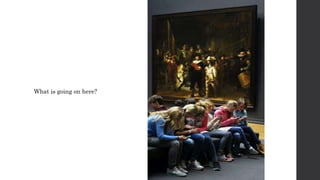
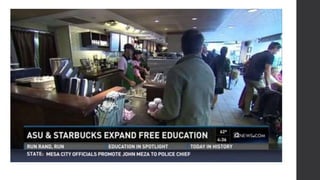
What is going on here?
What is "Blended Learning?"
“Blended learning is any time a student learns at least
in part at a supervised brick and mortar location away
from home and at least in part through online delivery
with some element of student control over time, place,
and/or pace.”
The Rise of K-12 Blended Learning by Michael B. Horn and Heather Staker
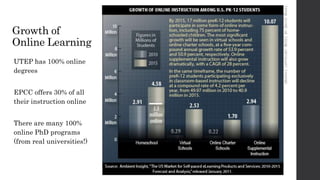
Growth of
Online Learning
UTEP has 100% online
degrees
EPCC offers 30% of all
their instruction online
There are many 100%
online PhD programs
(from real universities!)
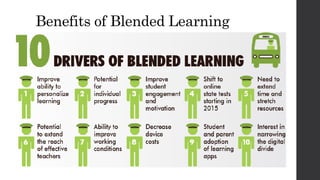
Benefits of Blended Learning
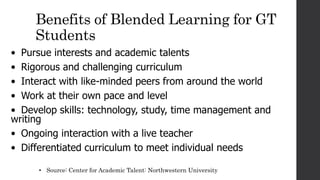
Benefits of Blended Learning for GT
Students
• Pursue interests and academic talents
• Rigorous and challenging curriculum
• Interact with like-minded peers from around the world
• Work at their own pace and level
• Develop skills: technology, study, time management and
writing
• Ongoing interaction with a live teacher
• Differentiated curriculum to meet individual needs
• Source: Center for Academic Talent: Northwestern University
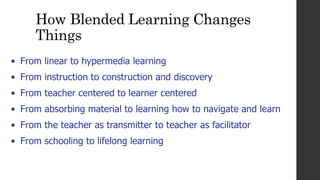
How Blended Learning Changes
Things
• From linear to hypermedia learning
• From instruction to construction and discovery
• From teacher centered to learner centered
• From absorbing material to learning how to navigate and learn
• From the teacher as transmitter to teacher as facilitator
• From schooling to lifelong learning
Six Models of Blended Learning
Face to Face
Rotation
Flex
Online Lab
Self Blend
Online Driver
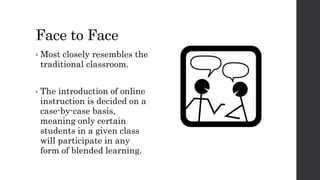
Face to Face
• Most closely resembles the
traditional classroom.
• The introduction of online
instruction is decided on a
case-by-case basis,
meaning only certain
students in a given class
will participate in any
form of blended learning.
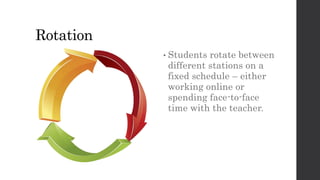
Rotation
• Students rotate between
different stations on a
fixed schedule – either
working online or
spending face-to-face
time with the teacher.
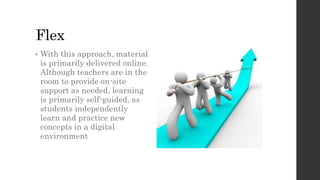
Flex
• With this approach, material
is primarily delivered online.
Although teachers are in the
room to provide on-site
support as needed, learning
is primarily self-guided, as
students independently
learn and practice new
concepts in a digital
environment
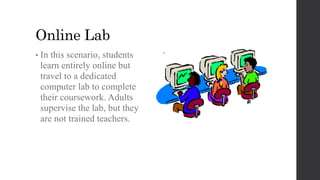
Online Lab
•
• In this scenario, students
learn entirely online but
travel to a dedicated
computer lab to complete
their coursework. Adults
supervise the lab, but they
are not trained teachers.
Self Blend
•• Self-blend model of
blended learning gives
students the
opportunity to take
classes beyond what is
already offered at their
school
Online Driver
• Form of blended
learning in which
students work remotely
and material is
primarily delivered via
an online platform
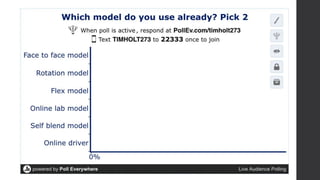
Lets take a vote with your feet
Pick the Blended Learning Model that you
think best serves Gifted Students
• Face to Face
• Rotation
• Flex
• Online Lab
• Self Blend
• Online Driver
Explain Why
• Student centered
• Increasing numbers
• Higher order thinking skills
• Helps teachers and students
• Framework for data driven decision
making
• Personalized learning
• Productive gamification
• Mobile world is where learning is now
• Students personal access to knowledge
• Increasing broadband
MiniCast presentation

MiniCast presentation

  • 1.
    Blend Your Learning forAll Students Tim Holt Executive Director Blended Learning EPISD
  • 2.
    What is goingon here?
  • 3.
    What is "BlendedLearning?" “Blended learning is any time a student learns at least in part at a supervised brick and mortar location away from home and at least in part through online delivery with some element of student control over time, place, and/or pace.” The Rise of K-12 Blended Learning by Michael B. Horn and Heather Staker
  • 4.
    Growth of Online Learning UTEPhas 100% online degrees EPCC offers 30% of all their instruction online There are many 100% online PhD programs (from real universities!)
  • 7.
  • 8.
    Benefits of BlendedLearning for GT Students • Pursue interests and academic talents • Rigorous and challenging curriculum • Interact with like-minded peers from around the world • Work at their own pace and level • Develop skills: technology, study, time management and writing • Ongoing interaction with a live teacher • Differentiated curriculum to meet individual needs • Source: Center for Academic Talent: Northwestern University
  • 9.
    How Blended LearningChanges Things • From linear to hypermedia learning • From instruction to construction and discovery • From teacher centered to learner centered • From absorbing material to learning how to navigate and learn • From the teacher as transmitter to teacher as facilitator • From schooling to lifelong learning
  • 10.
    Six Models ofBlended Learning Face to Face Rotation Flex Online Lab Self Blend Online Driver
  • 11.
    Face to Face •Most closely resembles the traditional classroom. • The introduction of online instruction is decided on a case-by-case basis, meaning only certain students in a given class will participate in any form of blended learning.
  • 12.
    Rotation • Students rotatebetween different stations on a fixed schedule – either working online or spending face-to-face time with the teacher.
  • 13.
    Flex • With thisapproach, material is primarily delivered online. Although teachers are in the room to provide on-site support as needed, learning is primarily self-guided, as students independently learn and practice new concepts in a digital environment
  • 14.
    Online Lab • • Inthis scenario, students learn entirely online but travel to a dedicated computer lab to complete their coursework. Adults supervise the lab, but they are not trained teachers.
  • 15.
    Self Blend •• Self-blendmodel of blended learning gives students the opportunity to take classes beyond what is already offered at their school
  • 16.
    Online Driver • Formof blended learning in which students work remotely and material is primarily delivered via an online platform
  • 17.
    Lets take avote with your feet Pick the Blended Learning Model that you think best serves Gifted Students • Face to Face • Rotation • Flex • Online Lab • Self Blend • Online Driver Explain Why
  • 18.
    • Student centered •Increasing numbers • Higher order thinking skills • Helps teachers and students • Framework for data driven decision making • Personalized learning • Productive gamification • Mobile world is where learning is now • Students personal access to knowledge • Increasing broadband

Editor's Notes

  • #12 Of all the blended learning models, face-to-face driver is the closest to a typical school structure. With this approach, the introduction of online instruction is decided on a case-by-case basis, meaning only certain students in a given class will participate in any form of blended learning. The face-to-face driver approach allows students who are struggling or working above their grade level to progress at their own pace using technology in the classroom. Some schools have also found this model to be a helpful way to engage English language learners (ELL), who sometimes fall behind not because they are incapable of understanding a concept, but because they’re not native speakers. A 2009 study of the Round Rock Independent School District in Texas found that the math and reading test scores of third and fifth grade ELLs increased following the implementation of blended learning and the use of interactive whiteboards.
  • #13 In this form of blended learning, students rotate between different stations on a fixed schedule – either working online or spending face-to-face time with the teacher. The rotational model is more widely used in elementary schools – 80 percent of elementary schools in California that use blended learning follow the rotational model – because many are already set up to have students rotate between stations. In a case study of IDEA Public Schools in Texas published by DreamBox Learning, the rotational model of blended learning was determined to be an effective means of increasing the achievement of students in this Title 1 School. IDEA students rotated between learning labs, where they used intelligent adaptive learning software to learn math concepts, and a traditional classroom. The result? Students became more active learners and often challenged themselves to work harder and learn material that had not yet been introduced in their math classroom.
  • #14 Schools who are supporting a large number of non-traditional or at-risk students often choose the flex model of blended learning. With this approach, material is primarily delivered online. Although teachers are in the room to provide on-site support as needed, learning is primarily self-guided , as students independently learn and practice new concepts in a digital environment. The flex model is an approach used by the AdvancePath Academy, a blended learning school, which works with school district partners to address the needs of students with behavioral, academic and/or socio-economic challenges. Students at AdvancePath spend most of their time in a computer lab learning online. However, certified teachers are also on-site to work with students on reading and writing, lead small-group work, and provide help as needed. More than 90 percent of students enrolled at AdvancePath either graduate from high school, transfer to other schools to complete their studies, or are on track for graduation. These are promising results, considering that only three out of 10 students who drop out of high school manage to earn a degree by age 25.
  • #15 As schools face increasingly tighter resource constraints, the online lab model of blended learning is a viable option for helping students complete courses, including those not offered at the specific school site . In this scenario, students learn entirely online but travel to a dedicated computer lab to complete their coursework . Adults supervise the lab, but they are not trained teachers. This not only allows schools to offer courses for which they have no teacher or not enough teachers, but also allows students to work at a pace and in a subject area that suits them without affecting the learning environment of other students . In a case study published by DreamBox Learning, the Inner City Education Foundation demonstrated how vital online lab programs can be for school districts facing budgetary and resource shortfalls. The ICEF Vista Elementary Academy in Los Angeles faced significant state funding cuts in 2010 , so school leaders instituted learning labs in an attempt to give students quality digital learning experiences because they had fewer teachers. The result? Students in need of intervention had more face time with teachers and the school’s second and third graders demonstrated improved math skills. As schools face increasingly tighter resource constraints, the online lab model of blended learning is a viable option for helping students complete courses, including those not offered at the specific school site. In this scenario , students learn entirely online but travel to a dedicated computer lab to complete their coursework. Adults supervise the lab, but they are not trained teachers. This not only allows schools to offer courses for which they have no teacher or not enough teachers, but also allows students to work at a pace and in a subject area that suits them without affecting the learning environment of other students. In a case study published by DreamBox Learning, the Inner City Education Foundation demonstrated how vital online lab programs can be for school districts facing budgetary and resource shortfalls. The ICEF Vista Elementary Academy in Los Angeles faced significant state funding cuts in 2010, so school leaders instituted learning labs in an attempt to give students quality digital learning experiences because they had fewer teachers. The result? Students in need of intervention had more face time with teachers and the school’s second and third graders demonstrated improved math skills.
  • #16 Popular in high schools, the self-blend model of blended learning gives students the opportunity to take classes beyond what is already offered at their school. While these individuals will attend a traditional school environment, they also opt to supplement their learning through online courses offered remotely. In order for this method of blended learning to be successful, students must be highly self-motivated. Self-blend is ideal for the student who wants to take additional Advanced Placement courses, or who has interest in a subject area that is not covered in the traditional course catalog.
  • #17 At the opposite end of the spectrum from face-to-face driver we have online driver, which is a form of blended learning in which students work remotely and material is primarily delivered via an online platform. Although face-to-face check-ins are optional, students can usually chat with teachers online if they have questions. This model of blended learning is ideal for students who need more flexibility and independence in their daily schedules. This approach is becoming increasingly popular – each year, the number of students participating in online driver programs increases by about 15 percent.
  • #18 Pick the one that you think works best with your students Discuss with others in your group Why is this e best choice for your students?