ISSN 2349-7815
International Journal of Recent Research in Electrical and Electronics Engineering (IJRREEE)
Vol. 4, Issue 1, pp: (25-29), Month: January - March 2017, Available at: www.paperpublications.org
Page | 25
Paper Publications
A Simple and Reliable Touch Sensitive Security
System
1
Mohammed Sameer Hussain, 2
Mirza Mohammed Abed Ullah Baig, 3
Adnan Adil,
4
Syed Samdani, 5
S V Altaf
1,2,3,4
Student Vll- Semester, Electronics and Communication Engineering, Lords Institute of Engineering & Technology
5
Associate Professor, Department of Electronics and Communication Engineering, Lords Institute of Engineering &
Technology, Hyderabad
Abstract: Insecurity and crime constitute some of the major problems facing our society today. People live with fear
of being attacked by thieves. Despite all the effort, resources and time this lead to the development of tools that will
reduce crime rates and make the world a safer place to live, these problems are still on the increase. These gave rise
to the need for an increasing development in the technology of alarm systems.
Keywords: Touch Sensing, Alarm, Security System, Indicator.
I. INTRODUCTION
Insecurity and crime constitute some of the major problems facing our immediate society today. People live with fear of
being attacked by burglars, vandals and thieves. Despite all the effort, resources and time that has been devoted to the
development of tools that will reduce crime rates and make the world a safer place to live, these problems are still on the
increase. These gave rise to the need for an increasing development in the technology of alarm systems which utilizes
various principles such as infrared motion detection, light (photo) sensitive electronic devices and so on. Even with the
introduction of these alarm systems which have reduced greatly the level of insecurity, there is still a problem of false
alarm which needs to be minimized. In order to effectively reduce the level of insecurity and avoid false alarms which can
create unnecessary unrest, a touch activated security system is required. This system if properly designed will provide
security and ensure alarms are activated only when an unauthorized person try to gain access to the protected area or
device by touching the entrance or any other part of the device. An alarm is a loud noise or signal for alerting or informing
people of danger or a problem. An alarm system is thus a security system that produces a form of sound to warn people of
a particular danger. The development of alarm systems started with the creation of man.
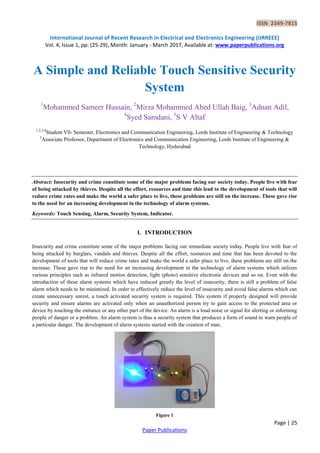
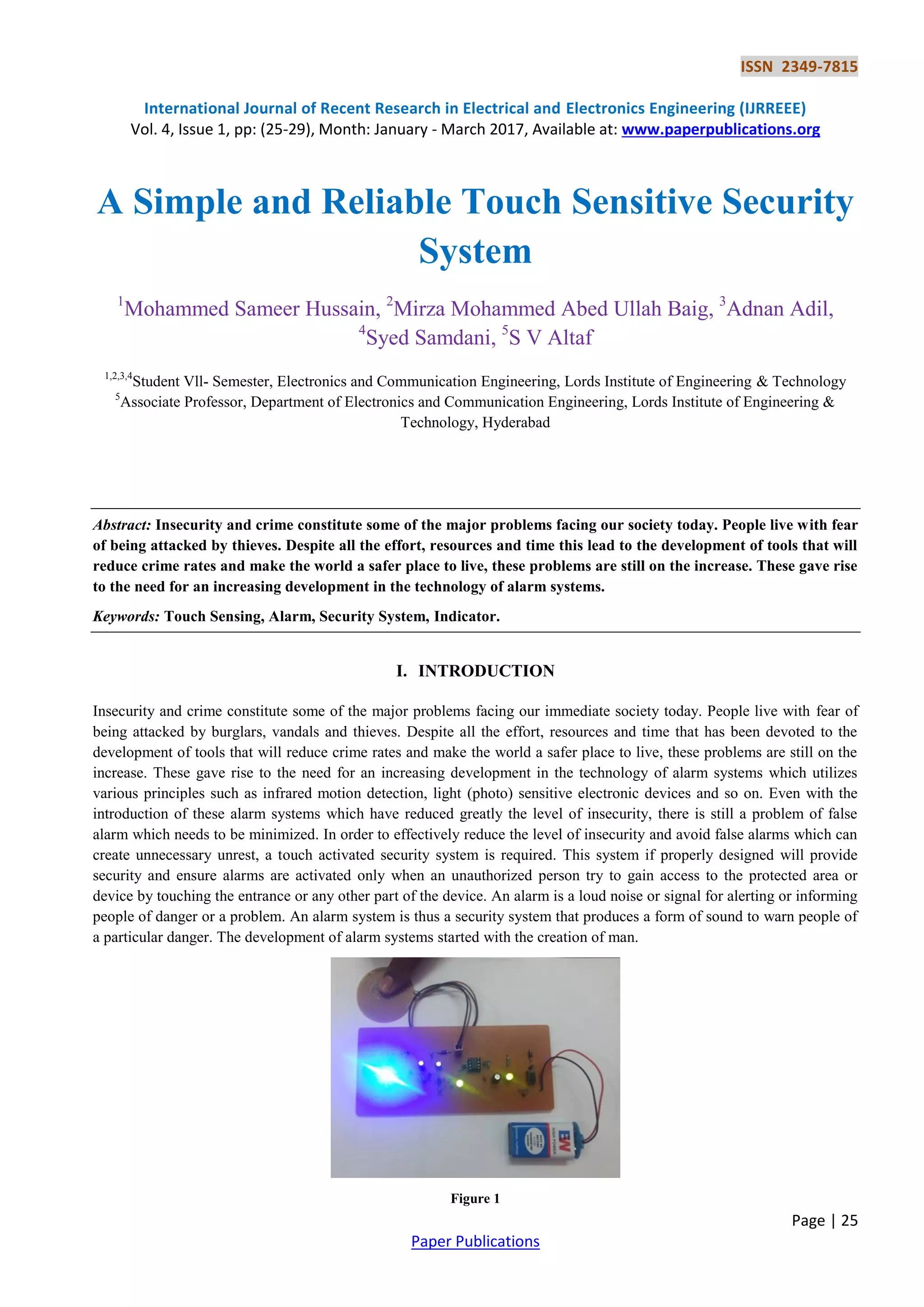
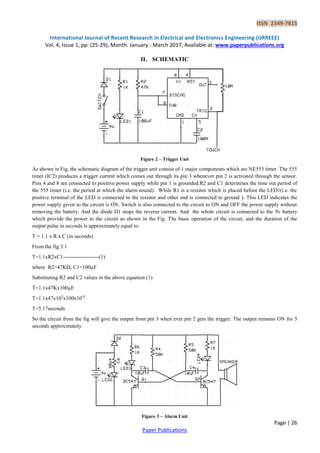
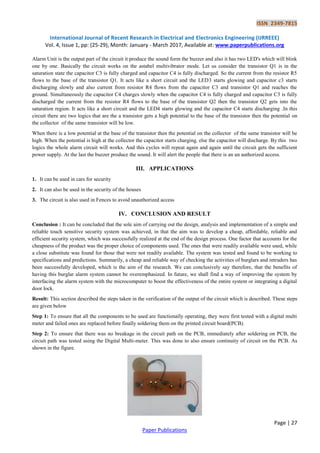
Figure 1
ISSN 2349-7815
International Journal of Recent Research in Electrical and Electronics Engineering (IJRREEE)
Vol. 4, Issue 1, pp: (25-29), Month: January - March 2017, Available at: www.paperpublications.org
Page | 26
Paper Publications
II. SCHEMATIC
Figure 2 – Trigger Unit
As shown in Fig, the schematic diagram of the trigger unit consist of 1 major components which are NE555 timer. The 555
timer (IC2) produces a trigger current which comes out through its pin 3 whenever pin 2 is activated through the sensor.
Pins 4 and 8 are connected to positive power supply while pin 1 is grounded.R2 and C1 determines the time out period of
the 555 timer (i.e. the period at which the alarm sound). While R1 is a resistor which is placed before the LED1(i.e. the
positive terminal of the LED is connected to the resistor and other end is connected to ground ). This LED indicates the
power supply given to the circuit is ON. Switch is also connected to the circuit to ON and OFF the power supply without
removing the battery. And the diode D1 stops the reverse current. And the whole circuit is connected to the 9v battery
which provide the power to the circuit as shown in the Fig. The basic operation of the circuit, and the duration of the
output pulse in seconds is approximately equal to:
T = 1.1 x R x C (in seconds)
From the fig 3.1
T=1.1xR2xC1--------------------(1)
where R2=47KΩ, C1=100µF
Substituting R2 and C2 values in the above equation (1)
T=1.1x47Kx100µF
T=1.1x47x103
x100x10-6
T=5.17seconds
So the circuit from the fig will give the output from pin 3 when ever pin 2 gets the trigger. The output remains ON for 5
seconds approximately.
Figure 3 – Alarm Unit
ISSN 2349-7815
International Journal of Recent Research in Electrical and Electronics Engineering (IJRREEE)
Vol. 4, Issue 1, pp: (25-29), Month: January - March 2017, Available at: www.paperpublications.org
Page | 27
Paper Publications
Alarm Unit is the output part of the circuit it produce the sound form the buzzer and also it has two LED's which will blink
one by one. Basically the circuit works on the astabel multivibrator mode. Let us consider the transistor Q1 is in the
saturation state the capacitor C3 is fully charged and capacitor C4 is fully discharged. So the current from the resistor R5
flows to the base of the transistor Q1. It acts like a short circuit and the LED3 starts glowing and capacitor c3 starts
discharging slowly and also current from resistor R4 flows from the capacitor C3 and transistor Q1 and reaches the
ground. Simultaneously the capacitor C4 charges slowly when the capacitor C4 is fully charged and capacitor C3 is fully
discharged the current from the resistor R4 flows to the base of the transistor Q2 then the transistor Q2 gets into the
saturation region. It acts like a short circuit and the LED4 starts glowing and the capacitor C4 starts discharging .In this
circuit there are two logics that are the a transistor gets a high potential to the base of the transistor then the potential on
the collector of the same transistor will be low.
When there is a low potential at the base of the transistor then the potential on the collector of the same transistor will be
high. When the potential is high at the collector the capacitor starts charging. else the capacitor will discharge. By this two
logics the whole alarm circuit will works. And this cycles will repeat again and again until the circuit gets the sufficient
power supply. At the last the buzzer produce the sound. It will alert the people that there is an un authorized access.
III. APPLICATIONS
1. It can be used in cars for security
2. It can also be used in the security of the houses
3. The circuit is also used in Fences to avoid unauthorized access
IV. CONCLUSION AND RESULT
Conclusion : It can be concluded that the sole aim of carrying out the design, analysis and implementation of a simple and
reliable touch sensitive security system was achieved, in that the aim was to develop a cheap, affordable, reliable and
efficient security system, which was successfully realized at the end of the design process. One factor that accounts for the
cheapness of the product was the proper choice of components used. The ones that were readily available were used, while
a close substitute was found for those that were not readily available. The system was tested and found to be working to
specifications and predictions. Summarily, a cheap and reliable way of checking the activities of burglars and intruders has
been successfully developed, which is the aim of the research. We can conclusively say therefore, that the benefits of
having this burglar alarm system cannot be overemphasized. In future, we shall find a way of improving the system by
interfacing the alarm system with the microcomputer to boost the effectiveness of the entire system or integrating a digital
door lock.
Result: This section described the steps taken in the verification of the output of the circuit which is described. These steps
are given below
Step 1: To ensure that all the components to be used are functionally operating, they were first tested with a digital multi
meter and failed ones are replaced before finally soldering them on the printed circuit board(PCB).
Step 2: To ensure that there was no breakage in the circuit path on the PCB, immediately after soldering on PCB, the
circuit path was tested using the Digital Multi-meter. This was done to also ensure continuity of circuit on the PCB. As
shown in the figure.
ISSN 2349-7815
International Journal of Recent Research in Electrical and Electronics Engineering (IJRREEE)
Vol. 4, Issue 1, pp: (25-29), Month: January - March 2017, Available at: www.paperpublications.org
Page | 28
Paper Publications
Step 3: Now connect the battery to the battery connector which is provided on the PCB. Then switch on the switch to give
the power supply to the circuit. the green LED starts glowing which indicates that the power supply to the circuit is
properly working. As shown in the figure
At this stage only green LED will glow to ensure the power supply.
Step 4: As the power supply is given to the circuit with 9v battery initially green led will glow to ensure the power
supply. Now touch the given touch plate to activate alarm. The Touch plate act as a trigger to the pin 2 of the 555 timer
which is in monostabel mode. By touching the touch plate alarm will activate indicating unauthorized access. As shown in
the figure 4.3
There are two LEDs at the output side which is in astabel mode using the transistors. The LED will glow one by one. This
will give a visual effect to the alarm circuit. So this is how the circuit look like after making on PCB board. And we get the
output.
ACKNOWLEDGEMENT
We thank the capable faculty of LORDS INSTITUTE OF ENGINEERING AND TECHNOLOGY for providing us with
an opportunity to conduct project work in college.
We are also thankful to Mr.S.V.ALTAF, ASSOCIATE PROF internal guide for his valuable academic guidance and
support.
We whole heartedly thank all staff members of Department of Electronics and Communication Engineering of LORDS
INSTITUTE OF ENGINEERING AND TECHNOLOGY for their support and encouragement related to our project work.
Lastly, we thank all those who helped us directly and indirectly with this project work which turned out to be very
successful, and we finally thank our beloved parents and family for their extreme support throughout the project.
REFERENCES
[1] Linear Integrated Circuits--D. Roy Chowdhury, New Age International (p) Ltd, 3rd
Ed., 2008.
[2] Linear Integrated Circuits-- k. Lal Kishore- Pearson, 2008.
[3] Electrical Engineering and Electronic--V.K Mehta, Rohit Mehta
ISSN 2349-7815
International Journal of Recent Research in Electrical and Electronics Engineering (IJRREEE)
Vol. 4, Issue 1, pp: (25-29), Month: January - March 2017, Available at: www.paperpublications.org
Page | 29
Paper Publications
[4] www.electroniccircuitsforu.com
[5] www.extremecircuits.com
[6] www.mycircuits.com
[7] www.buildcircuits.com
[8] www.electronicshub.org
AUTHORS PROFILE:
Mr. Mohammed Sameer Hussain Pursuing B-Tech in Electronics and Communication Engineering from
Lords Institute of Engineering and Technology, Hyderabad.
Mr. Mirza Mohammed Abed Ullah Baig Pursuing B-Tech in Electronics and Communication Engineering
from Lords Institute of Engineering and Technology, Hyderabad.
Mr.Adnan Adil Pursuing B-Tech in Electronics and Communication Engineering from Lords Institute of
Engineering and Technology, Hyderabad.
Syed Samdani Pursuing B-Tech in Electronics and Communication Engineering from Lords Institute of
Engineering and Technology,Hyderabad.
Mr. S V Altaf Assoc professor in ECE department at Lords Institute of Engineering and Technology has 27
years of Industrial experience in the field of Embedded Systems along with 10 years of teaching experience in
Micro-Processors, Micro-Controllers and its applications. Also published Micro-Processors and Micro
Controllers (MP-MC), Micro-Processor and Interfacing (MPI) books.

A Simple and Reliable Touch Sensitive Security System

  • 1.
    ISSN 2349-7815 International Journalof Recent Research in Electrical and Electronics Engineering (IJRREEE) Vol. 4, Issue 1, pp: (25-29), Month: January - March 2017, Available at: www.paperpublications.org Page | 25 Paper Publications A Simple and Reliable Touch Sensitive Security System 1 Mohammed Sameer Hussain, 2 Mirza Mohammed Abed Ullah Baig, 3 Adnan Adil, 4 Syed Samdani, 5 S V Altaf 1,2,3,4 Student Vll- Semester, Electronics and Communication Engineering, Lords Institute of Engineering & Technology 5 Associate Professor, Department of Electronics and Communication Engineering, Lords Institute of Engineering & Technology, Hyderabad Abstract: Insecurity and crime constitute some of the major problems facing our society today. People live with fear of being attacked by thieves. Despite all the effort, resources and time this lead to the development of tools that will reduce crime rates and make the world a safer place to live, these problems are still on the increase. These gave rise to the need for an increasing development in the technology of alarm systems. Keywords: Touch Sensing, Alarm, Security System, Indicator. I. INTRODUCTION Insecurity and crime constitute some of the major problems facing our immediate society today. People live with fear of being attacked by burglars, vandals and thieves. Despite all the effort, resources and time that has been devoted to the development of tools that will reduce crime rates and make the world a safer place to live, these problems are still on the increase. These gave rise to the need for an increasing development in the technology of alarm systems which utilizes various principles such as infrared motion detection, light (photo) sensitive electronic devices and so on. Even with the introduction of these alarm systems which have reduced greatly the level of insecurity, there is still a problem of false alarm which needs to be minimized. In order to effectively reduce the level of insecurity and avoid false alarms which can create unnecessary unrest, a touch activated security system is required. This system if properly designed will provide security and ensure alarms are activated only when an unauthorized person try to gain access to the protected area or device by touching the entrance or any other part of the device. An alarm is a loud noise or signal for alerting or informing people of danger or a problem. An alarm system is thus a security system that produces a form of sound to warn people of a particular danger. The development of alarm systems started with the creation of man. Figure 1
  • 2.
    ISSN 2349-7815 International Journalof Recent Research in Electrical and Electronics Engineering (IJRREEE) Vol. 4, Issue 1, pp: (25-29), Month: January - March 2017, Available at: www.paperpublications.org Page | 26 Paper Publications II. SCHEMATIC Figure 2 – Trigger Unit As shown in Fig, the schematic diagram of the trigger unit consist of 1 major components which are NE555 timer. The 555 timer (IC2) produces a trigger current which comes out through its pin 3 whenever pin 2 is activated through the sensor. Pins 4 and 8 are connected to positive power supply while pin 1 is grounded.R2 and C1 determines the time out period of the 555 timer (i.e. the period at which the alarm sound). While R1 is a resistor which is placed before the LED1(i.e. the positive terminal of the LED is connected to the resistor and other end is connected to ground ). This LED indicates the power supply given to the circuit is ON. Switch is also connected to the circuit to ON and OFF the power supply without removing the battery. And the diode D1 stops the reverse current. And the whole circuit is connected to the 9v battery which provide the power to the circuit as shown in the Fig. The basic operation of the circuit, and the duration of the output pulse in seconds is approximately equal to: T = 1.1 x R x C (in seconds) From the fig 3.1 T=1.1xR2xC1--------------------(1) where R2=47KΩ, C1=100µF Substituting R2 and C2 values in the above equation (1) T=1.1x47Kx100µF T=1.1x47x103 x100x10-6 T=5.17seconds So the circuit from the fig will give the output from pin 3 when ever pin 2 gets the trigger. The output remains ON for 5 seconds approximately. Figure 3 – Alarm Unit
  • 3.
    ISSN 2349-7815 International Journalof Recent Research in Electrical and Electronics Engineering (IJRREEE) Vol. 4, Issue 1, pp: (25-29), Month: January - March 2017, Available at: www.paperpublications.org Page | 27 Paper Publications Alarm Unit is the output part of the circuit it produce the sound form the buzzer and also it has two LED's which will blink one by one. Basically the circuit works on the astabel multivibrator mode. Let us consider the transistor Q1 is in the saturation state the capacitor C3 is fully charged and capacitor C4 is fully discharged. So the current from the resistor R5 flows to the base of the transistor Q1. It acts like a short circuit and the LED3 starts glowing and capacitor c3 starts discharging slowly and also current from resistor R4 flows from the capacitor C3 and transistor Q1 and reaches the ground. Simultaneously the capacitor C4 charges slowly when the capacitor C4 is fully charged and capacitor C3 is fully discharged the current from the resistor R4 flows to the base of the transistor Q2 then the transistor Q2 gets into the saturation region. It acts like a short circuit and the LED4 starts glowing and the capacitor C4 starts discharging .In this circuit there are two logics that are the a transistor gets a high potential to the base of the transistor then the potential on the collector of the same transistor will be low. When there is a low potential at the base of the transistor then the potential on the collector of the same transistor will be high. When the potential is high at the collector the capacitor starts charging. else the capacitor will discharge. By this two logics the whole alarm circuit will works. And this cycles will repeat again and again until the circuit gets the sufficient power supply. At the last the buzzer produce the sound. It will alert the people that there is an un authorized access. III. APPLICATIONS 1. It can be used in cars for security 2. It can also be used in the security of the houses 3. The circuit is also used in Fences to avoid unauthorized access IV. CONCLUSION AND RESULT Conclusion : It can be concluded that the sole aim of carrying out the design, analysis and implementation of a simple and reliable touch sensitive security system was achieved, in that the aim was to develop a cheap, affordable, reliable and efficient security system, which was successfully realized at the end of the design process. One factor that accounts for the cheapness of the product was the proper choice of components used. The ones that were readily available were used, while a close substitute was found for those that were not readily available. The system was tested and found to be working to specifications and predictions. Summarily, a cheap and reliable way of checking the activities of burglars and intruders has been successfully developed, which is the aim of the research. We can conclusively say therefore, that the benefits of having this burglar alarm system cannot be overemphasized. In future, we shall find a way of improving the system by interfacing the alarm system with the microcomputer to boost the effectiveness of the entire system or integrating a digital door lock. Result: This section described the steps taken in the verification of the output of the circuit which is described. These steps are given below Step 1: To ensure that all the components to be used are functionally operating, they were first tested with a digital multi meter and failed ones are replaced before finally soldering them on the printed circuit board(PCB). Step 2: To ensure that there was no breakage in the circuit path on the PCB, immediately after soldering on PCB, the circuit path was tested using the Digital Multi-meter. This was done to also ensure continuity of circuit on the PCB. As shown in the figure.
  • 4.
    ISSN 2349-7815 International Journalof Recent Research in Electrical and Electronics Engineering (IJRREEE) Vol. 4, Issue 1, pp: (25-29), Month: January - March 2017, Available at: www.paperpublications.org Page | 28 Paper Publications Step 3: Now connect the battery to the battery connector which is provided on the PCB. Then switch on the switch to give the power supply to the circuit. the green LED starts glowing which indicates that the power supply to the circuit is properly working. As shown in the figure At this stage only green LED will glow to ensure the power supply. Step 4: As the power supply is given to the circuit with 9v battery initially green led will glow to ensure the power supply. Now touch the given touch plate to activate alarm. The Touch plate act as a trigger to the pin 2 of the 555 timer which is in monostabel mode. By touching the touch plate alarm will activate indicating unauthorized access. As shown in the figure 4.3 There are two LEDs at the output side which is in astabel mode using the transistors. The LED will glow one by one. This will give a visual effect to the alarm circuit. So this is how the circuit look like after making on PCB board. And we get the output. ACKNOWLEDGEMENT We thank the capable faculty of LORDS INSTITUTE OF ENGINEERING AND TECHNOLOGY for providing us with an opportunity to conduct project work in college. We are also thankful to Mr.S.V.ALTAF, ASSOCIATE PROF internal guide for his valuable academic guidance and support. We whole heartedly thank all staff members of Department of Electronics and Communication Engineering of LORDS INSTITUTE OF ENGINEERING AND TECHNOLOGY for their support and encouragement related to our project work. Lastly, we thank all those who helped us directly and indirectly with this project work which turned out to be very successful, and we finally thank our beloved parents and family for their extreme support throughout the project. REFERENCES [1] Linear Integrated Circuits--D. Roy Chowdhury, New Age International (p) Ltd, 3rd Ed., 2008. [2] Linear Integrated Circuits-- k. Lal Kishore- Pearson, 2008. [3] Electrical Engineering and Electronic--V.K Mehta, Rohit Mehta
  • 5.
    ISSN 2349-7815 International Journalof Recent Research in Electrical and Electronics Engineering (IJRREEE) Vol. 4, Issue 1, pp: (25-29), Month: January - March 2017, Available at: www.paperpublications.org Page | 29 Paper Publications [4] www.electroniccircuitsforu.com [5] www.extremecircuits.com [6] www.mycircuits.com [7] www.buildcircuits.com [8] www.electronicshub.org AUTHORS PROFILE: Mr. Mohammed Sameer Hussain Pursuing B-Tech in Electronics and Communication Engineering from Lords Institute of Engineering and Technology, Hyderabad. Mr. Mirza Mohammed Abed Ullah Baig Pursuing B-Tech in Electronics and Communication Engineering from Lords Institute of Engineering and Technology, Hyderabad. Mr.Adnan Adil Pursuing B-Tech in Electronics and Communication Engineering from Lords Institute of Engineering and Technology, Hyderabad. Syed Samdani Pursuing B-Tech in Electronics and Communication Engineering from Lords Institute of Engineering and Technology,Hyderabad. Mr. S V Altaf Assoc professor in ECE department at Lords Institute of Engineering and Technology has 27 years of Industrial experience in the field of Embedded Systems along with 10 years of teaching experience in Micro-Processors, Micro-Controllers and its applications. Also published Micro-Processors and Micro Controllers (MP-MC), Micro-Processor and Interfacing (MPI) books.