UNIVERSITY OF ZAGREB
   FACULTY OF ORGANIZATION AND INFORMATICS
                  VARAŽDIN


MANAGING AGILE SOFTWARE DEVELOPMENT
 PROJECTS: BEST PRACTICES AND PROJECT
         MANAGEMENT TOOLS

              MASTER THESIS

                                                          Mentor:
                             Ph.D. Ruben Picek, assistant professor

                                                       Student:
                                                  Martina Šimičić
                                          ID Number: 38805/09-R
                             Information and Software Engineering
                                                  Graduate Study


              Varaždin, Rujan 2011.
Contents
1.    Introduction
2.    Project management
3.    Software development methodologies
     1. Traditional
     2. Agile
      1.   Extreme programming
      2.   Scrum
4.    Tools for Agile Software Development
5.    Analysis of Agile software development projects
     1. POS project
     2. Invoicing project
     3. Educational software project
6.    Conclusion
7.    Literature
Introduction
 The fastest and the most efficient way of
  developing software?
 Deliver software on budget, on time,
  satisfy customer, allocate resources?
 Traditional or Agile Methodology?
 Project management tool?
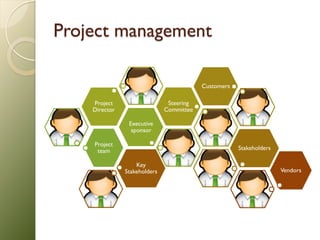
Project management

                                          Customers

    Project                    Steering
    Director                  Committee

                Executive
                 sponsor

    Project
     team                                             Stakeholders

                   Key
               Stakeholders                                          Vendors
Software development
     methodologies
      According to Sommerville [ (5), page 13]
       there are three key challenges facing
       software engineering nowadays:

       The heterogeneity challenge
       The delivery challenge
       The trust challenge


(5) Sommerville, Ian. Software engineering - 8th edition. s.l. : Addison Wesley, June 4, 2006.
Software development
     methodologies - Traditional
     According to Awad [ (7), page 6] there are
       four main characteristics of heavyweight
       methodologies:
      Predictive approach
      Comprehensive documentation
      Process oriented
      Tool oriented

(7) Awad, Mohamed. Comparison between Agile and Traditional Software Development
Methodologies. [Online] [Cited: 25 February 2011.]
http://pds10.egloos.com/pds/200808/13/85/A_comparision_between_Agile_and_Traditional_SW
_development_methodologies.pdf.
Software development
     methodologies - Agile
Agile methodologies are introduced by four
 basic values [ (10)]:

 Individuals and interactions over processes and tools
 Working software over comprehensive
  documentation
 Customer collaboration over contract negotiation
 Responding to change over following a plan


(10) Agile values. Agile manifesto official web page. [Online] [Cited: 2 March 2011.]
http://agilemanifesto.org/.
Software development
    methodologies - Agile
     Agile process                              Modularity

                             Collaborative                         Iterative


                      People-
                                                                          Time-Bound
                      Oriented


                        Convergent                                      Parsimony


                                      Incremental         Adaptive


Granville, Miller G. The Characteristics of Agile Software Processes. [Online] [Cited: 2 March 2011.]
http://faculty.salisbury.edu/~xswang/Research/Papers/SERelated/Agile/12510385.pdf.
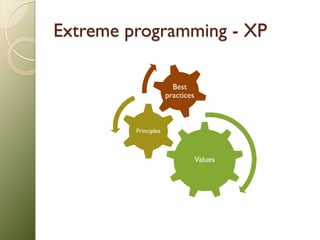
Extreme programming - XP

                        Best
                      practices


         Principles


                                  Values
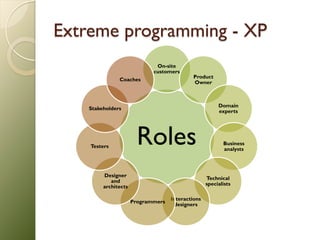
Extreme programming - XP
                             On-site
                            customers
                                            Product
              Coaches
                                            Owner


                                                       Domain
   Stakeholders
                                                       experts


    Testers
                       Roles                             Business
                                                         analysts


        Designer
                                                  Technical
           and
                                                  specialists
        architects

                                   Interactions
                     Programmers
                                    designers
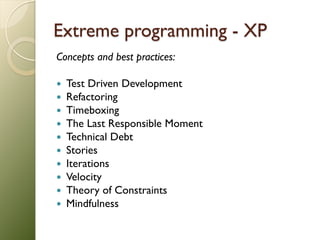
Extreme programming - XP
Concepts and best practices:

   Test Driven Development
   Refactoring
   Timeboxing
   The Last Responsible Moment
   Technical Debt
   Stories
   Iterations
   Velocity
   Theory of Constraints
   Mindfulness
Scrum
Values and principles
 Empiricism
 Emergence
 Timeboxing
 Prioritization
 Self-organization
Scrum                                                      Product
                                                              Owner

     Smaller teams
                                                                Roles
     For bigger - Scrum
                                                   Project                 Scrum
      of Scrums                                     team                   Master


(17) Waters, Kelly. Using Scrum on Larger Projects: "Scrum of Scrums". [Online] [Cited: 22
February 2011.] http://www.allaboutagile.com/using-scrum-on-larger-projects-scrum-of-
scrums/.
Scrum


(18) Eclipse. Eclipse organization. [Online] [Cited: 22 February 2011.]
http://epf.eclipse.org/wikis/scrumpt/Scrum/guidances/supportingmaterials/resources/ScrumLarge
Labelled.png
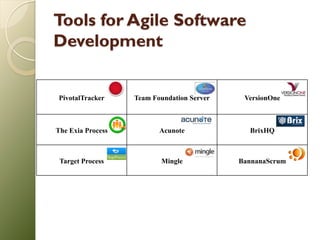
Tools for Agile Software
Development


PivotalTracker     Team Foundation Server    VersionOne


The Exia Process          Acunote             BrixHQ


 Target Process           Mingle            BannanaScrum
Tools for Agile Software
Development
Evaluation model:
 Basic description
 Team collaboration and source code
  management
 Tool configuration
 Reporting and documentation
 Specific product characteristics

                                 Results
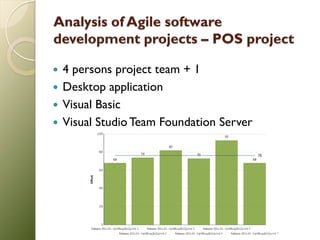
Analysis of Agile software
development projects – POS project

 4 persons project team + 1
 Desktop application
 Visual Basic
 Visual Studio Team Foundation Server
Analysis of Agile software
development projects – POS project


Question 1:
 Is it possible for the Product Owner to
 be a Scrum Master at the same time?
Analysis of Agile software
development projects – POS project


Question 2:
 What does the one story point
 actually indicate?
Analysis of Agile software
development projects – POS project


Question 3:
 Is it possible to add user stories during
 the sprint?
Analysis of Agile software
development projects – POS project


Question 4:
 What can POS project team do to get
 higher results?
Analysis of Agile software development
projects – Invoicing project

  3 persons project team + 1
  Web application
  Ruby on Rails
  DokuWiki, email, TFS
Analysis of Agile software development
projects – Invoicing project


Question 5:
   Agile methodologies and new
   technologies, how does it fit
   together?
Analysis of Agile software development
projects – Invoicing project


Question 6:
   Is it possible that a Wiki system
   replace an agile project
   management tool?
Analysis of Agile software development
projects – Invoicing project


Question 7:
   Is it possible to practice Scrum
   without planning poker game and
   triangulation?
Analysis of Agile software development
projects – Invoicing project


Question 8:
   How far can the team go in agile
   methodology adoption?
Analysis of Agile software development
projects – Invoicing project


Question 9:
   What can Invoice project team do
   to get higher results?
Analysis of Agile software development
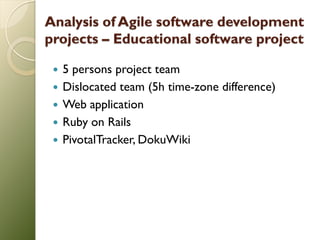
projects – Educational software project

    5 persons project team
    Dislocated team (5h time-zone difference)
    Web application
    Ruby on Rails
    PivotalTracker, DokuWiki
Analysis of Agile software development
projects – Educational software project


Question 10:
   Is it possible and is it needed to
   perform daily meetings in
   distributed project teams?
Analysis of Agile software development
projects – Educational software project


Question 11:
   How do the agile methodologies
   respond to the needs of distributed
   teams?
Analysis of Agile software development
projects – Educational software project


Question 12:
   What can Educational software
   project team do to get higher
   results?
Conclusion
 When starting agile, a methodology
  should be chosen and all of the concepts
  should be adopted
 Coach, project management tool and wiki
  system are desirable
         Best tool
   Team communication is essential
Future work…
 Agile documentation
 Managing distributed systems
 Transaction of knowledge between senior
  and junior programmers


   http://agile-only.com/
Literature
1. The Standish Group. The Standish Group Report CHAOS. [Online] [Cited: 12 September 2011.] http://www.projectsmart.co.uk/docs/chaos-report.pdf.
2. —. CHAOS Report Press Release. The Standish Group. [Online] [Cited: 12 September 2011.] http://www1.standishgroup.com/newsroom/chaos_2009.php.
3. PMI, Project management institute. A Guide to the Project Management Body of Knowledge (PMBOK Guide)- 4th edition. s.l. : Project management institute, December 31,
      2008.
4. Barry, Timothy R. Top 10 Qualities of a Project Manager. Project Smart. [Online] 2010. [Cited: 22 March 2011.] http://www.projectsmart.co.uk/top-10-qualities-project-
      manager.html.
5. Sommerville, Ian. Software engineering - 8th edition. s.l. : Addison Wesley, June 4, 2006.
6. Abran, Alain, et al. Guide to the Software Engineering Body of Knowledge (SWEBOK). s.l. : IEEE, 2004.
7. Awad, Mohamed. Comparison between Agile and Traditional Software Development Methodologies. [Online] [Cited: 25 February 2011.]
     http://pds10.egloos.com/pds/200808/13/85/A_comparision_between_Agile_and_Traditional_SW_development_methodologies.pdf.
8. IBM Rational Unified Process. Wikipedia, The Free Encyclopaedia. [Online] [Cited: 1 March 2011.] http://en.wikipedia.org/wiki/IBM_Rational_Unified_Process.
9. IBM Rational Unified Process (RUP). IBM Official Web Pages. [Online] [Cited: 1 March 2011.] http://www-01.ibm.com/software/awdtools/rup/.
10. Agile values. Agile manifesto official web page. [Online] [Cited: 2 March 2011.] http://agilemanifesto.org/.
11. Granville, Miller G. The Characteristics of Agile Software Processes. [Online] [Cited: 2 March 2011.]
      http://faculty.salisbury.edu/~xswang/Research/Papers/SERelated/Agile/12510385.pdf.
12. Rittenbruch, Markus, et al. Official web pages of Linkoping University. [Online] June 2002. [Cited: 25 February 2011.]
       http://www.ida.liu.se/~TDDD26/material/extremeparticipation.pdf.
13. Shore, James and Warden, Shane. The Art of Agile Development. s.l. : O'Reilly Media, Inc., 2008.
14. Bachan & Catherine. Essence of Scrum. Conscires Agile Practices. [Online] [Cited: 17 September 2011.] http://agile.conscires.com/2010/09/18/essence-of-scrum/.
15. Cohn, Mike. Mountain Goat Software. [Online] [Cited: 18 February 2011.] http://www.mountaingoatsoftware.com/topics/scrum.
16. Watts, Geoff. Scrum Alliance. [Online] 11 January 2010. http://www.scrumalliance.org/articles/321-getting-retrained-to-be-a-scrummaster.
17. Waters, Kelly. Using Scrum on Larger Projects: "Scrum of Scrums". [Online] [Cited: 22 February 2011.] http://www.allaboutagile.com/using-scrum-on-larger-projects-
     scrum-of-scrums/.
18. Eclipse. Eclipse organization. [Online] [Cited: 22 February 2011.]
       http://epf.eclipse.org/wikis/scrumpt/Scrum/guidances/supportingmaterials/resources/ScrumLargeLabelled.png.
19. Brothersoft. Brothersoft. [Online] [Cited: 22 February 2011.] http://img.brothersoft.com/screenshots/softimage/v/virtual_scrum_board-180890-1.jpeg.
20. InfoQ. InfoQ. [Online] [Cited: 22 February 2011.] http://www.infoq.com/resource/articles/agile-kanban-boards/en/resources/Fig1_task-board.jpg.
21. Scrum Alliance.org. Glossary of Scrum Terms. Scrum alliance. [Online] [Cited: 22 February 2011.] http://www.scrumalliance.org/articles/39-glossary-of-scrum-
      terms#1113.
22. Demeer, Peter and Benefield, Gabrielle. An introduction to Project Management with Scrum. Rally Dev. [Online] [Cited: 22 February 2011.]
      http://www.rallydev.com/documents/scrumprimer.pdf
23. Team Foundation Server. Microsoft Visual Studio. [Online] [Cited: 18 June 2011.] http://msdn.microsoft.com/en-us/vstudio/ff637362 .
24. Pivotal Tracker. Pivotal Tracker. [Online] [Cited: 18 June 2011.] http://www.pivotaltracker.com/.
Literature
26. The Exia Process. The Exia Process. [Online] [Cited: 19 June 2011.] http://www.exiaprocess.com/.
27. Acunote. Acunote. [Online] [Cited: 19 June 2011.] http://www.acunote.com/promo.
28. Banana Scrum. Banana Scrum. [Online] [Cited: 19 June 2011.] http://www.bananascrum.com/.
29. ThoughtWorks. Mingle . [Online] [Cited: 19 June 2011.] http://www.thoughtworks-studios.com/mingle-agile-project-management.
30. BrixHQ. BrixHQ. [Online] [Cited: 19 June 2011.] http://www.brixhq.com/.
31. VersionOne. VersionOne. [Online] [Cited: 19 June 2011.] http://versionone.com/.
32. TargetProcess. TargetProcess. [Online] [Cited: 19 June 2011.] http://www.targetprocess.com/.
33. Finance portal of Portugal. Finance portal of Portugal. [Online] [Cited: 17 February 2011.] http://info.portaldasfinancas.gov.pt/pt/dgci/.
34. Lewison, Mark. Can Product Owner and Scrum Master be combined? InfoQ. [Online] [Cited: 24 February 2011.] http://www.infoq.com/news/2008/12/scrum-master-
      product-owner.
35. Nelson, Barbara. Scrum and the Product Owner. Pragmatic Marketing. [Online] [Cited: 24 February 2011.] http://www.pragmaticmarketing.com/resources/ask/scrum-
      and-the-product-owner.
36. Marchenko, Artem. Product Manager VS. Scrum Product Owner. Agile Software Development. [Online] [Cited: 24 February 2011.]
      http://agilesoftwaredevelopment.com/blog/artem/product-manager-vs-scrum-product-own.
37. FiscoLex. Portuguese collection of fiscal and trade data. FiscoLex. [Online] [Cited: 22 February 2011.]
       http://www.fiscolex.com.br/dest_18796967_NOVAS_REGRAS_IRPF_2011.aspx.
38. Milunsky, Jack. Switching user stories mid sprint. The Agile Buddy Blog. [Online] [Cited: 24 February 2011.] http://blog.agilebuddy.com/2009/07/switching-user-stories-mid-
       sprint.html.
39. Cohn, Mike. Succeeding with agile; Bugs on the product blog. Mountain Goat Software. [Online] [Cited: 24 February 2011.] http://blog.mountaingoatsoftware.com/tag/user-
      stories.
40. DokuWiki. DokuWiki. [Online] [Cited: 14 July 2011.] http://www.dokuwiki.org/dokuwiki.
41. Cockburn, Alistair. Agile Software Development Joins the "Would-be" Crowd. Agile Alliance. [Online] [Cited: 13 September 2011.]
      http://cf.agilealliance.org/articles/system/article/file/782/file.pdf.
42. Cleland, David I. and Ireland, Lewis R. Project management. strategic design and implementation- 5th edition. s.l. : The McGraw-Fill Companies Inc., 2007.
43. McMahon, Paul E. Bridging Agile & Traditional Development Methods: A Project Management Perspective. [Online] [Cited: 25 February 2011.] : http://www.sstc-
      online.org/proceedings/2004/PDFFiles/PEM972.pdf.
44. Viliet, Hans van. Software Engineering. Principles and Practice. s.l. : Wiley, 2007.
45. Scrum (development). Wikipedia The Free Encylopaedia. [Online] [Cited: 16 February 2011.] http://en.wikipedia.org/wiki/Scrum_(development).
46. Miller, Grancille G. The Characteristics of Agile Software Processes. Official pages of Alisbury university. [Online] [Cited: 18 5 2011.]
       http://faculty.salisbury.edu/~xswang/Research/Papers/SERelated/Agile/12510385.pdf.
47. Hazrati, Vikas. Slide Share. [Online] [Cited: 25 February 2011.] http://www.slideshare.net/nashjain/introduction-to-extreme-programming.
48. Microsoft. Microsoft MSDN. [Online] [Cited: 21 February 2011.] http://i.msdn.microsoft.com/dd347827.fig09_L(en-us).gif.
49. The Standish Group. The Standish Group Report. CHAOS. 1995.

Managing Agile Software Development Projects

  • 1.
    UNIVERSITY OF ZAGREB FACULTY OF ORGANIZATION AND INFORMATICS VARAŽDIN MANAGING AGILE SOFTWARE DEVELOPMENT PROJECTS: BEST PRACTICES AND PROJECT MANAGEMENT TOOLS MASTER THESIS Mentor: Ph.D. Ruben Picek, assistant professor Student: Martina Šimičić ID Number: 38805/09-R Information and Software Engineering Graduate Study Varaždin, Rujan 2011.
  • 2.
    Contents 1. Introduction 2. Project management 3. Software development methodologies 1. Traditional 2. Agile 1. Extreme programming 2. Scrum 4. Tools for Agile Software Development 5. Analysis of Agile software development projects 1. POS project 2. Invoicing project 3. Educational software project 6. Conclusion 7. Literature
  • 3.
    Introduction  The fastestand the most efficient way of developing software?  Deliver software on budget, on time, satisfy customer, allocate resources?  Traditional or Agile Methodology?  Project management tool?
  • 4.
    Project management Customers Project Steering Director Committee Executive sponsor Project team Stakeholders Key Stakeholders Vendors
  • 5.
    Software development methodologies According to Sommerville [ (5), page 13] there are three key challenges facing software engineering nowadays:  The heterogeneity challenge  The delivery challenge  The trust challenge (5) Sommerville, Ian. Software engineering - 8th edition. s.l. : Addison Wesley, June 4, 2006.
  • 6.
    Software development methodologies - Traditional According to Awad [ (7), page 6] there are four main characteristics of heavyweight methodologies:  Predictive approach  Comprehensive documentation  Process oriented  Tool oriented (7) Awad, Mohamed. Comparison between Agile and Traditional Software Development Methodologies. [Online] [Cited: 25 February 2011.] http://pds10.egloos.com/pds/200808/13/85/A_comparision_between_Agile_and_Traditional_SW _development_methodologies.pdf.
  • 7.
    Software development methodologies - Agile Agile methodologies are introduced by four basic values [ (10)]:  Individuals and interactions over processes and tools  Working software over comprehensive documentation  Customer collaboration over contract negotiation  Responding to change over following a plan (10) Agile values. Agile manifesto official web page. [Online] [Cited: 2 March 2011.] http://agilemanifesto.org/.
  • 8.
    Software development methodologies - Agile Agile process Modularity Collaborative Iterative People- Time-Bound Oriented Convergent Parsimony Incremental Adaptive Granville, Miller G. The Characteristics of Agile Software Processes. [Online] [Cited: 2 March 2011.] http://faculty.salisbury.edu/~xswang/Research/Papers/SERelated/Agile/12510385.pdf.
  • 9.
    Extreme programming -XP Best practices Principles Values
  • 10.
    Extreme programming -XP On-site customers Product Coaches Owner Domain Stakeholders experts Testers Roles Business analysts Designer Technical and specialists architects Interactions Programmers designers
  • 11.
    Extreme programming -XP Concepts and best practices:  Test Driven Development  Refactoring  Timeboxing  The Last Responsible Moment  Technical Debt  Stories  Iterations  Velocity  Theory of Constraints  Mindfulness
  • 12.
    Scrum Values and principles Empiricism  Emergence  Timeboxing  Prioritization  Self-organization
  • 13.
    Scrum Product Owner  Smaller teams Roles  For bigger - Scrum Project Scrum of Scrums team Master (17) Waters, Kelly. Using Scrum on Larger Projects: "Scrum of Scrums". [Online] [Cited: 22 February 2011.] http://www.allaboutagile.com/using-scrum-on-larger-projects-scrum-of- scrums/.
  • 14.
    Scrum (18) Eclipse. Eclipseorganization. [Online] [Cited: 22 February 2011.] http://epf.eclipse.org/wikis/scrumpt/Scrum/guidances/supportingmaterials/resources/ScrumLarge Labelled.png
  • 15.
    Tools for AgileSoftware Development PivotalTracker Team Foundation Server VersionOne The Exia Process Acunote BrixHQ Target Process Mingle BannanaScrum
  • 16.
    Tools for AgileSoftware Development Evaluation model:  Basic description  Team collaboration and source code management  Tool configuration  Reporting and documentation  Specific product characteristics Results
  • 17.
    Analysis of Agilesoftware development projects – POS project  4 persons project team + 1  Desktop application  Visual Basic  Visual Studio Team Foundation Server
  • 18.
    Analysis of Agilesoftware development projects – POS project Question 1: Is it possible for the Product Owner to be a Scrum Master at the same time?
  • 19.
    Analysis of Agilesoftware development projects – POS project Question 2: What does the one story point actually indicate?
  • 20.
    Analysis of Agilesoftware development projects – POS project Question 3: Is it possible to add user stories during the sprint?
  • 21.
    Analysis of Agilesoftware development projects – POS project Question 4: What can POS project team do to get higher results?
  • 22.
    Analysis of Agilesoftware development projects – Invoicing project  3 persons project team + 1  Web application  Ruby on Rails  DokuWiki, email, TFS
  • 23.
    Analysis of Agilesoftware development projects – Invoicing project Question 5: Agile methodologies and new technologies, how does it fit together?
  • 24.
    Analysis of Agilesoftware development projects – Invoicing project Question 6: Is it possible that a Wiki system replace an agile project management tool?
  • 25.
    Analysis of Agilesoftware development projects – Invoicing project Question 7: Is it possible to practice Scrum without planning poker game and triangulation?
  • 26.
    Analysis of Agilesoftware development projects – Invoicing project Question 8: How far can the team go in agile methodology adoption?
  • 27.
    Analysis of Agilesoftware development projects – Invoicing project Question 9: What can Invoice project team do to get higher results?
  • 28.
    Analysis of Agilesoftware development projects – Educational software project  5 persons project team  Dislocated team (5h time-zone difference)  Web application  Ruby on Rails  PivotalTracker, DokuWiki
  • 29.
    Analysis of Agilesoftware development projects – Educational software project Question 10: Is it possible and is it needed to perform daily meetings in distributed project teams?
  • 30.
    Analysis of Agilesoftware development projects – Educational software project Question 11: How do the agile methodologies respond to the needs of distributed teams?
  • 31.
    Analysis of Agilesoftware development projects – Educational software project Question 12: What can Educational software project team do to get higher results?
  • 32.
    Conclusion  When startingagile, a methodology should be chosen and all of the concepts should be adopted  Coach, project management tool and wiki system are desirable Best tool  Team communication is essential
  • 33.
    Future work…  Agiledocumentation  Managing distributed systems  Transaction of knowledge between senior and junior programmers  http://agile-only.com/
  • 34.
    Literature 1. The StandishGroup. The Standish Group Report CHAOS. [Online] [Cited: 12 September 2011.] http://www.projectsmart.co.uk/docs/chaos-report.pdf. 2. —. CHAOS Report Press Release. The Standish Group. [Online] [Cited: 12 September 2011.] http://www1.standishgroup.com/newsroom/chaos_2009.php. 3. PMI, Project management institute. A Guide to the Project Management Body of Knowledge (PMBOK Guide)- 4th edition. s.l. : Project management institute, December 31, 2008. 4. Barry, Timothy R. Top 10 Qualities of a Project Manager. Project Smart. [Online] 2010. [Cited: 22 March 2011.] http://www.projectsmart.co.uk/top-10-qualities-project- manager.html. 5. Sommerville, Ian. Software engineering - 8th edition. s.l. : Addison Wesley, June 4, 2006. 6. Abran, Alain, et al. Guide to the Software Engineering Body of Knowledge (SWEBOK). s.l. : IEEE, 2004. 7. Awad, Mohamed. Comparison between Agile and Traditional Software Development Methodologies. [Online] [Cited: 25 February 2011.] http://pds10.egloos.com/pds/200808/13/85/A_comparision_between_Agile_and_Traditional_SW_development_methodologies.pdf. 8. IBM Rational Unified Process. Wikipedia, The Free Encyclopaedia. [Online] [Cited: 1 March 2011.] http://en.wikipedia.org/wiki/IBM_Rational_Unified_Process. 9. IBM Rational Unified Process (RUP). IBM Official Web Pages. [Online] [Cited: 1 March 2011.] http://www-01.ibm.com/software/awdtools/rup/. 10. Agile values. Agile manifesto official web page. [Online] [Cited: 2 March 2011.] http://agilemanifesto.org/. 11. Granville, Miller G. The Characteristics of Agile Software Processes. [Online] [Cited: 2 March 2011.] http://faculty.salisbury.edu/~xswang/Research/Papers/SERelated/Agile/12510385.pdf. 12. Rittenbruch, Markus, et al. Official web pages of Linkoping University. [Online] June 2002. [Cited: 25 February 2011.] http://www.ida.liu.se/~TDDD26/material/extremeparticipation.pdf. 13. Shore, James and Warden, Shane. The Art of Agile Development. s.l. : O'Reilly Media, Inc., 2008. 14. Bachan & Catherine. Essence of Scrum. Conscires Agile Practices. [Online] [Cited: 17 September 2011.] http://agile.conscires.com/2010/09/18/essence-of-scrum/. 15. Cohn, Mike. Mountain Goat Software. [Online] [Cited: 18 February 2011.] http://www.mountaingoatsoftware.com/topics/scrum. 16. Watts, Geoff. Scrum Alliance. [Online] 11 January 2010. http://www.scrumalliance.org/articles/321-getting-retrained-to-be-a-scrummaster. 17. Waters, Kelly. Using Scrum on Larger Projects: "Scrum of Scrums". [Online] [Cited: 22 February 2011.] http://www.allaboutagile.com/using-scrum-on-larger-projects- scrum-of-scrums/. 18. Eclipse. Eclipse organization. [Online] [Cited: 22 February 2011.] http://epf.eclipse.org/wikis/scrumpt/Scrum/guidances/supportingmaterials/resources/ScrumLargeLabelled.png. 19. Brothersoft. Brothersoft. [Online] [Cited: 22 February 2011.] http://img.brothersoft.com/screenshots/softimage/v/virtual_scrum_board-180890-1.jpeg. 20. InfoQ. InfoQ. [Online] [Cited: 22 February 2011.] http://www.infoq.com/resource/articles/agile-kanban-boards/en/resources/Fig1_task-board.jpg. 21. Scrum Alliance.org. Glossary of Scrum Terms. Scrum alliance. [Online] [Cited: 22 February 2011.] http://www.scrumalliance.org/articles/39-glossary-of-scrum- terms#1113. 22. Demeer, Peter and Benefield, Gabrielle. An introduction to Project Management with Scrum. Rally Dev. [Online] [Cited: 22 February 2011.] http://www.rallydev.com/documents/scrumprimer.pdf 23. Team Foundation Server. Microsoft Visual Studio. [Online] [Cited: 18 June 2011.] http://msdn.microsoft.com/en-us/vstudio/ff637362 . 24. Pivotal Tracker. Pivotal Tracker. [Online] [Cited: 18 June 2011.] http://www.pivotaltracker.com/.
  • 35.
    Literature 26. The ExiaProcess. The Exia Process. [Online] [Cited: 19 June 2011.] http://www.exiaprocess.com/. 27. Acunote. Acunote. [Online] [Cited: 19 June 2011.] http://www.acunote.com/promo. 28. Banana Scrum. Banana Scrum. [Online] [Cited: 19 June 2011.] http://www.bananascrum.com/. 29. ThoughtWorks. Mingle . [Online] [Cited: 19 June 2011.] http://www.thoughtworks-studios.com/mingle-agile-project-management. 30. BrixHQ. BrixHQ. [Online] [Cited: 19 June 2011.] http://www.brixhq.com/. 31. VersionOne. VersionOne. [Online] [Cited: 19 June 2011.] http://versionone.com/. 32. TargetProcess. TargetProcess. [Online] [Cited: 19 June 2011.] http://www.targetprocess.com/. 33. Finance portal of Portugal. Finance portal of Portugal. [Online] [Cited: 17 February 2011.] http://info.portaldasfinancas.gov.pt/pt/dgci/. 34. Lewison, Mark. Can Product Owner and Scrum Master be combined? InfoQ. [Online] [Cited: 24 February 2011.] http://www.infoq.com/news/2008/12/scrum-master- product-owner. 35. Nelson, Barbara. Scrum and the Product Owner. Pragmatic Marketing. [Online] [Cited: 24 February 2011.] http://www.pragmaticmarketing.com/resources/ask/scrum- and-the-product-owner. 36. Marchenko, Artem. Product Manager VS. Scrum Product Owner. Agile Software Development. [Online] [Cited: 24 February 2011.] http://agilesoftwaredevelopment.com/blog/artem/product-manager-vs-scrum-product-own. 37. FiscoLex. Portuguese collection of fiscal and trade data. FiscoLex. [Online] [Cited: 22 February 2011.] http://www.fiscolex.com.br/dest_18796967_NOVAS_REGRAS_IRPF_2011.aspx. 38. Milunsky, Jack. Switching user stories mid sprint. The Agile Buddy Blog. [Online] [Cited: 24 February 2011.] http://blog.agilebuddy.com/2009/07/switching-user-stories-mid- sprint.html. 39. Cohn, Mike. Succeeding with agile; Bugs on the product blog. Mountain Goat Software. [Online] [Cited: 24 February 2011.] http://blog.mountaingoatsoftware.com/tag/user- stories. 40. DokuWiki. DokuWiki. [Online] [Cited: 14 July 2011.] http://www.dokuwiki.org/dokuwiki. 41. Cockburn, Alistair. Agile Software Development Joins the "Would-be" Crowd. Agile Alliance. [Online] [Cited: 13 September 2011.] http://cf.agilealliance.org/articles/system/article/file/782/file.pdf. 42. Cleland, David I. and Ireland, Lewis R. Project management. strategic design and implementation- 5th edition. s.l. : The McGraw-Fill Companies Inc., 2007. 43. McMahon, Paul E. Bridging Agile & Traditional Development Methods: A Project Management Perspective. [Online] [Cited: 25 February 2011.] : http://www.sstc- online.org/proceedings/2004/PDFFiles/PEM972.pdf. 44. Viliet, Hans van. Software Engineering. Principles and Practice. s.l. : Wiley, 2007. 45. Scrum (development). Wikipedia The Free Encylopaedia. [Online] [Cited: 16 February 2011.] http://en.wikipedia.org/wiki/Scrum_(development). 46. Miller, Grancille G. The Characteristics of Agile Software Processes. Official pages of Alisbury university. [Online] [Cited: 18 5 2011.] http://faculty.salisbury.edu/~xswang/Research/Papers/SERelated/Agile/12510385.pdf. 47. Hazrati, Vikas. Slide Share. [Online] [Cited: 25 February 2011.] http://www.slideshare.net/nashjain/introduction-to-extreme-programming. 48. Microsoft. Microsoft MSDN. [Online] [Cited: 21 February 2011.] http://i.msdn.microsoft.com/dd347827.fig09_L(en-us).gif. 49. The Standish Group. The Standish Group Report. CHAOS. 1995.