MILLENNIUM
DEVELOPMENT
GOALS (MDGS)
INDIAN MILLENNIUM
DEVELOPMENT GOALS (MDGS) :-
Introduction
Shri G. K. Vasan, Minister of State
(independent charge), Ministry of
Statistics and Programme
Implementation, released the first
Millennium Development Goals -
India Country Report for the year
2005 on 13th February 2006 in a
simple function at Delhi.
THE MILLENNIUM DEVELOPMENT GOALS ARE:-
1. Eradicate extreme poverty and hunger.
2. Achieve universal primary education.
3.Promote gender equality and empower
women.
4.Reduce child mortality.
5.Improve maternal health.
6. Combat HIV/ AIDS, malaria and other
diseases.
7. Ensure environmental sustainability and
8. Develop a global partnership for
development
INDIA'S POSITION WITH REFERENCE TO
THE VARIOUS GOALS IS GIVEN BELOW
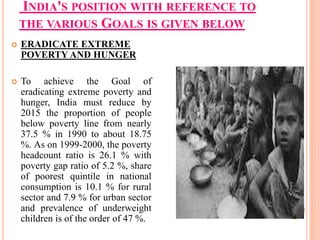
 ERADICATE EXTREME
POVERTY AND HUNGER
 To achieve the Goal of
eradicating extreme poverty and
hunger, India must reduce by
2015 the proportion of people
below poverty line from nearly
37.5 % in 1990 to about 18.75
%. As on 1999-2000, the poverty
headcount ratio is 26.1 % with
poverty gap ratio of 5.2 %, share
of poorest quintile in national
consumption is 10.1 % for rural
sector and 7.9 % for urban sector
and prevalence of underweight
children is of the order of 47 %.
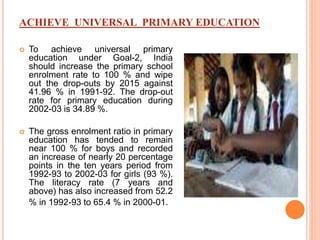
ACHIEVE UNIVERSAL PRIMARY EDUCATION
 To achieve universal primary
education under Goal-2, India
should increase the primary school
enrolment rate to 100 % and wipe
out the drop-outs by 2015 against
41.96 % in 1991-92. The drop-out
rate for primary education during
2002-03 is 34.89 %.
 The gross enrolment ratio in primary
education has tended to remain
near 100 % for boys and recorded
an increase of nearly 20 percentage
points in the ten years period from
1992-93 to 2002-03 for girls (93 %).
The literacy rate (7 years and
above) has also increased from 52.2
% in 1992-93 to 65.4 % in 2000-01.
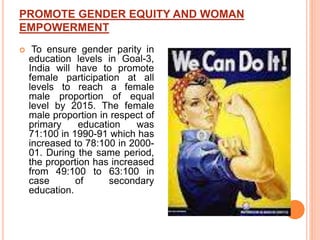
PROMOTE GENDER EQUITY AND WOMAN
EMPOWERMENT
 To ensure gender parity in
education levels in Goal-3,
India will have to promote
female participation at all
levels to reach a female
male proportion of equal
level by 2015. The female
male proportion in respect of
primary education was
71:100 in 1990-91 which has
increased to 78:100 in 2000-
01. During the same period,
the proportion has increased
from 49:100 to 63:100 in
case of secondary
education.
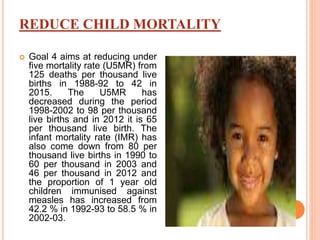
REDUCE CHILD MORTALITY
 Goal 4 aims at reducing under
five mortality rate (U5MR) from
125 deaths per thousand live
births in 1988-92 to 42 in
2015. The U5MR has
decreased during the period
1998-2002 to 98 per thousand
live births and in 2012 it is 65
per thousand live birth. The
infant mortality rate (IMR) has
also come down from 80 per
thousand live births in 1990 to
60 per thousand in 2003 and
46 per thousand in 2012 and
the proportion of 1 year old
children immunised against
measles has increased from
42.2 % in 1992-93 to 58.5 % in
2002-03.
IMPROVE MATERNAL HEALTH
 To achieve Goal-5, India should
reduce maternal mortality (MMR)
from 437 deaths per 100,000 live
births in 1991 to 109 by 2015. The
value of MMR for 1998 is 407 and in
2008 is 230 per 1 lakh population.
The proportion of births attended by
skilled health personnel has been
continuously increasing, (from 25.5
% in 1992-93 to 39.8% in 2002-03)
thereby reducing the chances of
occurrence of maternal deaths.
COMBAT HIV-AIDS, MALARIAAND
OTHER DISEASES
 Goal-6 is concerned, though India has a low
prevalence of HIV among pregnant women as
compared to other developing countries, yet
the prevalence rate has increased from 0.74
per thousand pregnant women in 2002 to 0.86
in 2003.
 The prevalence and death rates associated
with malaria are consistently coming down. The
death rate associated with TB has come down
from 67 deaths per 100.000 population in 1990
to 33 per 100,000 population in 2003. The
proportion of TB patients successfully treated
has also risen from 81% in 1996 to 86% in
2003.
ENSURE ENVIRONMENTAL
SUSTAINIBILITY
 Goal-7 aims at ensuring
environmental sustainability. As
per assessment made in 2003,
total land area covered under
different forests has been
20.64% due to Government's
persistent efforts to preserve
the natural resources.
 The proportion of population
without sustainable access to
safe drinking water and
sanitation is to be halved by
2015 and India is on track to
achieve this target.
 DEVLOP A GLOBAL PARTNERSHIP FOR
DEVELOPMET
 Goal-8 is regarding the developing global partnership for
development. It is basically meant for the Developed Countries
to provide development assistance to developing countries.
 With regard to one of the targets of the Goal 8, i.e. in
cooperation with the private sector, make available the benefits
of new technologies, especially information and
communications, India has made substantial progress in recent
years.
 The Government of India holds the following
views regarding the role of the developed
countries in achieving this goal:
The financial support needed to achieve the targets
under this Goal had been estimated for the least
developed land locked and small countries by a
high-level panel on 'Financing for Development at an
additional amount of US $ 50 billion which would be
required for this purpose every year till 2015.
 With regard to one of the targets of the Goal 8, i.e. in
cooperation with the private sector, make available
the benefits of new technologies, especially
information and communications, India has made
substantial progress in recent years.
Milllennium Development Goals

Milllennium Development Goals

  • 1.
  • 2.
    INDIAN MILLENNIUM DEVELOPMENT GOALS(MDGS) :- Introduction Shri G. K. Vasan, Minister of State (independent charge), Ministry of Statistics and Programme Implementation, released the first Millennium Development Goals - India Country Report for the year 2005 on 13th February 2006 in a simple function at Delhi.
  • 3.
    THE MILLENNIUM DEVELOPMENTGOALS ARE:- 1. Eradicate extreme poverty and hunger. 2. Achieve universal primary education. 3.Promote gender equality and empower women. 4.Reduce child mortality.
  • 4.
    5.Improve maternal health. 6.Combat HIV/ AIDS, malaria and other diseases. 7. Ensure environmental sustainability and 8. Develop a global partnership for development
  • 5.
    INDIA'S POSITION WITHREFERENCE TO THE VARIOUS GOALS IS GIVEN BELOW  ERADICATE EXTREME POVERTY AND HUNGER  To achieve the Goal of eradicating extreme poverty and hunger, India must reduce by 2015 the proportion of people below poverty line from nearly 37.5 % in 1990 to about 18.75 %. As on 1999-2000, the poverty headcount ratio is 26.1 % with poverty gap ratio of 5.2 %, share of poorest quintile in national consumption is 10.1 % for rural sector and 7.9 % for urban sector and prevalence of underweight children is of the order of 47 %.
  • 6.
    ACHIEVE UNIVERSAL PRIMARYEDUCATION  To achieve universal primary education under Goal-2, India should increase the primary school enrolment rate to 100 % and wipe out the drop-outs by 2015 against 41.96 % in 1991-92. The drop-out rate for primary education during 2002-03 is 34.89 %.  The gross enrolment ratio in primary education has tended to remain near 100 % for boys and recorded an increase of nearly 20 percentage points in the ten years period from 1992-93 to 2002-03 for girls (93 %). The literacy rate (7 years and above) has also increased from 52.2 % in 1992-93 to 65.4 % in 2000-01.
  • 7.
    PROMOTE GENDER EQUITYAND WOMAN EMPOWERMENT  To ensure gender parity in education levels in Goal-3, India will have to promote female participation at all levels to reach a female male proportion of equal level by 2015. The female male proportion in respect of primary education was 71:100 in 1990-91 which has increased to 78:100 in 2000- 01. During the same period, the proportion has increased from 49:100 to 63:100 in case of secondary education.
  • 8.
    REDUCE CHILD MORTALITY Goal 4 aims at reducing under five mortality rate (U5MR) from 125 deaths per thousand live births in 1988-92 to 42 in 2015. The U5MR has decreased during the period 1998-2002 to 98 per thousand live births and in 2012 it is 65 per thousand live birth. The infant mortality rate (IMR) has also come down from 80 per thousand live births in 1990 to 60 per thousand in 2003 and 46 per thousand in 2012 and the proportion of 1 year old children immunised against measles has increased from 42.2 % in 1992-93 to 58.5 % in 2002-03.
  • 9.
    IMPROVE MATERNAL HEALTH To achieve Goal-5, India should reduce maternal mortality (MMR) from 437 deaths per 100,000 live births in 1991 to 109 by 2015. The value of MMR for 1998 is 407 and in 2008 is 230 per 1 lakh population. The proportion of births attended by skilled health personnel has been continuously increasing, (from 25.5 % in 1992-93 to 39.8% in 2002-03) thereby reducing the chances of occurrence of maternal deaths.
  • 10.
    COMBAT HIV-AIDS, MALARIAAND OTHERDISEASES  Goal-6 is concerned, though India has a low prevalence of HIV among pregnant women as compared to other developing countries, yet the prevalence rate has increased from 0.74 per thousand pregnant women in 2002 to 0.86 in 2003.  The prevalence and death rates associated with malaria are consistently coming down. The death rate associated with TB has come down from 67 deaths per 100.000 population in 1990 to 33 per 100,000 population in 2003. The proportion of TB patients successfully treated has also risen from 81% in 1996 to 86% in 2003.
  • 11.
    ENSURE ENVIRONMENTAL SUSTAINIBILITY  Goal-7aims at ensuring environmental sustainability. As per assessment made in 2003, total land area covered under different forests has been 20.64% due to Government's persistent efforts to preserve the natural resources.  The proportion of population without sustainable access to safe drinking water and sanitation is to be halved by 2015 and India is on track to achieve this target.
  • 12.
     DEVLOP AGLOBAL PARTNERSHIP FOR DEVELOPMET  Goal-8 is regarding the developing global partnership for development. It is basically meant for the Developed Countries to provide development assistance to developing countries.  With regard to one of the targets of the Goal 8, i.e. in cooperation with the private sector, make available the benefits of new technologies, especially information and communications, India has made substantial progress in recent years.
  • 13.
     The Governmentof India holds the following views regarding the role of the developed countries in achieving this goal:
  • 14.
    The financial supportneeded to achieve the targets under this Goal had been estimated for the least developed land locked and small countries by a high-level panel on 'Financing for Development at an additional amount of US $ 50 billion which would be required for this purpose every year till 2015.  With regard to one of the targets of the Goal 8, i.e. in cooperation with the private sector, make available the benefits of new technologies, especially information and communications, India has made substantial progress in recent years.