
Epidemiology
A career Introduction
Epidemiology - definition
• Epidemiology is derived from the words epi,
demo and ology.
• epi – means “on, befall”
 epidermis: upon the body, skin
• demo – means man
 As used in demographics
• ology – means study of
• Epidemiology means what befalls man.
Epidemiology - definition
• While some people regard epidemiology s a science, other
scholars view it as a method.
• Generally seen as a scientific method to investigate disease.
• The study would therefore be the study of different methods of
investigating diseases.
Epidemiology – What is it?
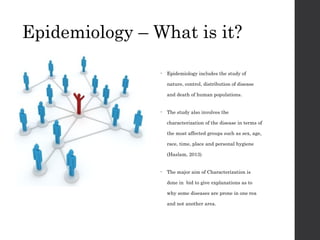
• Epidemiology includes the study of
nature, control, distribution of disease
and death of human populations.
• The study also involves the
characterization of the disease in terms of
the most affected groups such as sex, age,
race, time, place and personal hygiene
(Haslam, 2013)
• The major aim of Characterization is
done in bid to give explanations as to
why some diseases are prone in one rea
and not another area.
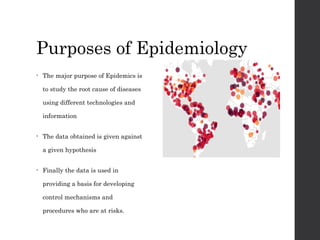
Purposes of Epidemiology
• The major purpose of Epidemics is
to study the root cause of diseases
using different technologies and
information
• The data obtained is given against
a given hypothesis
• Finally the data is used in
providing a basis for developing
control mechanisms and
procedures who are at risks.
Major Terms in Epidemiology
• Disease: A response to an injury or foreign inversion to the body. It can also
be defined as abnormal state in which the body is not able to respond to the
required functions (De Onis & Blossner, 2010).
• Pathogens These are organisms such as bacteria which causes viruses or
that are capable of producing them in the body.
• Pathogenesis This is the process of generating disease to the body.
• Pathogenic means disease causing or producing (Haslam, 2013)
• Pathogenicity describes the potential ability and strength of a pathogenic
substance to cause disease
Terms to know
• endemic: The usual level of a disease presence in a
given demography.
• Hyperendemic: persistent level of activity beyond or
above the expected prevalence
• holoendemic: a disease that is highly prevalent in a
population and is commonly acquired early in life in most
all of the children of the population
Terms to know
• Prevalence: the number of people within a population
who have a certain disease at a given point in time
• Point prevalence: how many cases of a disease exist in
a group of people at that moment.
• Prevalence relies on 2 factors:
 How many people have had the disease in the past
 Duration of the disease in the population
The Epidemiology Triangle
• Outbreaks in a population often involves several factor and entities
• Many objects and people become the various avenues in which a
disease can be spread (Peter et al., Michael, 2005).
• The work of Epidemiologist is to explain the disease transmission, this
is referred to as Epidemiology Triangle.
The Epidemiology Triangle
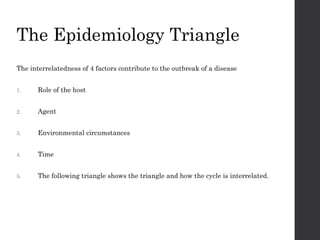
The interrelatedness of 4 factors contribute to the outbreak of a disease
1. Role of the host
2. Agent
3. Environmental circumstances
4. Time
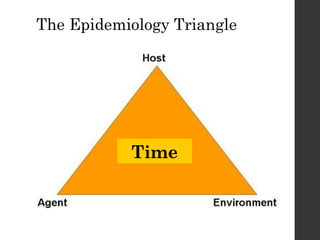
5. The following triangle shows the triangle and how the cycle is interrelated.
The Epidemiology Triangle
Time
The work Of Epidemiologist
• The mission of the Epidemiologist is to break one leg of the triangle above.
• Another goal of public health officer is control and prevention of the diseases.
• By breaking the leg it means that the public can realize the goals and stop the epidemics.
• By breaking one of the legs of the triangle, public health intervention can partially realize these goals and
stop epidemics
• An epidemic can be stopped when one factor in the triangle is stopped.
• An epidemic can be stopped when one of the elements of the triangle is interfered with, altered, changed
or removed from existence.
Disease Transmission
• Incubatory carrier: exposed to and harbors a disease
and is in the beginning stages of the disease, showing
symptoms, and has the ability to transmit the disease
• Intermittent carrier: exposed to and harbors disease
and can intermittently spread the disease
• Passive carrier: exposed to and harbors disease
causing organism, but has no signs or symptoms
Modes Disease Transmission
• Modes of disease transmission
 methods by which an agent can be passed from one host to the next
 or can exit the host to infect another susceptible host (either person or animal)
• Two general modes
 direct
 indirect
• Direct transmission or person to person
 Immediate transfer of the pathogen or agent
Modes Disease Transmission
• Direct transmission or person to person
 Immediate transfer of the pathogen or agent from a host/reservoir to a
susceptible host
 Can occur through direct physical contact or direct personal contact such as
touching contaminated hands, kissing or sex
• Indirect transmission
 pathogens or agents are transferred or carried by some intermediate item or
organism, means or process to a susceptible host
 done in one or more following ways:
 airborne, waterborne, vehicleborne, vectorborne
Modes Disease Transmission
• Indirect transmission
 Airborne
 Droplets or dust particles carry the pathogen to the host and
infect it
 Sneezing, coughing, talking all spray microscopic droplets in
the air
 Waterborne
 Carried in drinking water, swimming pool, streams or lakes
used for swimming. Examples: cholera
Modes Disease Transmission
 Vehicleborne
 Related to fomites
 Vectorborne
 A pathogen uses a host (fly, flea, louse, or rat) as a mechanism for
a ride or nourishment this is mechanical transmission
 biological transmission when the pathogen undergoes changes
as part of its life cycle, while within the host/vector and before
being transmitted to the new host
Classes of Epidemics / Outbreaks
• Propagated Epidemic when a single source cannot be identified,
yet the epidemic or diseases continues to spread from person to person
 Usually experiences exponential growth
 Cases occur over and over longer than one incubation period
• Mixed Epidemic a common source epidemic is followed by person-to-
person contact and the disease is spread as a propagated outbreak
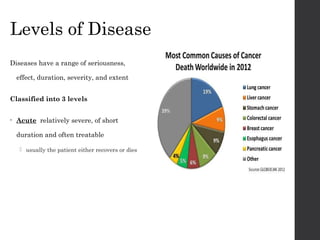
Levels of Disease
Diseases have a range of seriousness,
effect, duration, severity, and extent
Classified into 3 levels
• Acute relatively severe, of short
duration and often treatable
 usually the patient either recovers or dies
Levels of Disease
• Subacute intermediate in severity and duration, having some acute
aspects to the disease but of longer duration and with a degree of
severity that detracts from a complete state of health
 Patient expected to eventually heal (Wang, Monteiro & Popkin, 2012)
• Chronic less severe but of long and continuous duration, lasting over
a long time periods, if not a lifetime
 Patient may not fully recover and the disease can get worse overtime
 Life not immediately threatened, but may be over long term
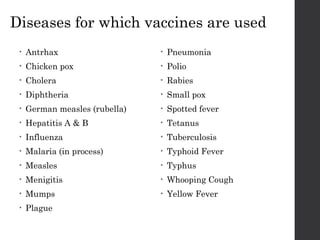
Diseases for which vaccines are used
• Antrhax
• Chicken pox
• Cholera
• Diphtheria
• German measles (rubella)
• Hepatitis A & B
• Influenza
• Malaria (in process)
• Measles
• Menigitis
• Mumps
• Plague
• Pneumonia
• Polio
• Rabies
• Small pox
• Spotted fever
• Tetanus
• Tuberculosis
• Typhoid Fever
• Typhus
• Whooping Cough
• Yellow Fever
References
• De Onis M and Blossner M. (2000). Prevalence and trends of
overweight among preschool children in developing countries. Am
J ClinNutr; 72:1032–1039.
• Wang Y, Monteiro C and Popkin BM. (2002) Trends of obesity
and underweight in older children and adolescents in the United
States, Brazil, China, and Russia. Am J Clin Nutr.75:971-7.
• Godwin Stewart. (2013) Globalization, Education, and
Emiratisation: A Study of the United Arab Emirates. EJISDC.
• Haslam D. (2013) Obesity: a medical history. Obes Rev.; 8 Suppl
1:31-6.
• Peter G. Kopelman, Ian D. Caterson, Michael J. (2005) Stock and
William H. Dietz. Clinical obesity in adults and children: In
Adults and Children. Blackwell Publishing.

Epidemiology power point_ajb

  • 1.
  • 2.
    Epidemiology - definition •Epidemiology is derived from the words epi, demo and ology. • epi – means “on, befall”  epidermis: upon the body, skin • demo – means man  As used in demographics • ology – means study of • Epidemiology means what befalls man.
  • 3.
    Epidemiology - definition •While some people regard epidemiology s a science, other scholars view it as a method. • Generally seen as a scientific method to investigate disease. • The study would therefore be the study of different methods of investigating diseases.
  • 4.
    Epidemiology – Whatis it? • Epidemiology includes the study of nature, control, distribution of disease and death of human populations. • The study also involves the characterization of the disease in terms of the most affected groups such as sex, age, race, time, place and personal hygiene (Haslam, 2013) • The major aim of Characterization is done in bid to give explanations as to why some diseases are prone in one rea and not another area.
  • 5.
    Purposes of Epidemiology •The major purpose of Epidemics is to study the root cause of diseases using different technologies and information • The data obtained is given against a given hypothesis • Finally the data is used in providing a basis for developing control mechanisms and procedures who are at risks.
  • 6.
    Major Terms inEpidemiology • Disease: A response to an injury or foreign inversion to the body. It can also be defined as abnormal state in which the body is not able to respond to the required functions (De Onis & Blossner, 2010). • Pathogens These are organisms such as bacteria which causes viruses or that are capable of producing them in the body. • Pathogenesis This is the process of generating disease to the body. • Pathogenic means disease causing or producing (Haslam, 2013) • Pathogenicity describes the potential ability and strength of a pathogenic substance to cause disease
  • 7.
    Terms to know •endemic: The usual level of a disease presence in a given demography. • Hyperendemic: persistent level of activity beyond or above the expected prevalence • holoendemic: a disease that is highly prevalent in a population and is commonly acquired early in life in most all of the children of the population
  • 8.
    Terms to know •Prevalence: the number of people within a population who have a certain disease at a given point in time • Point prevalence: how many cases of a disease exist in a group of people at that moment. • Prevalence relies on 2 factors:  How many people have had the disease in the past  Duration of the disease in the population
  • 9.
    The Epidemiology Triangle •Outbreaks in a population often involves several factor and entities • Many objects and people become the various avenues in which a disease can be spread (Peter et al., Michael, 2005). • The work of Epidemiologist is to explain the disease transmission, this is referred to as Epidemiology Triangle.
  • 10.
    The Epidemiology Triangle Theinterrelatedness of 4 factors contribute to the outbreak of a disease 1. Role of the host 2. Agent 3. Environmental circumstances 4. Time 5. The following triangle shows the triangle and how the cycle is interrelated.
  • 11.
  • 12.
    The work OfEpidemiologist • The mission of the Epidemiologist is to break one leg of the triangle above. • Another goal of public health officer is control and prevention of the diseases. • By breaking the leg it means that the public can realize the goals and stop the epidemics. • By breaking one of the legs of the triangle, public health intervention can partially realize these goals and stop epidemics • An epidemic can be stopped when one factor in the triangle is stopped. • An epidemic can be stopped when one of the elements of the triangle is interfered with, altered, changed or removed from existence.
  • 13.
    Disease Transmission • Incubatorycarrier: exposed to and harbors a disease and is in the beginning stages of the disease, showing symptoms, and has the ability to transmit the disease • Intermittent carrier: exposed to and harbors disease and can intermittently spread the disease • Passive carrier: exposed to and harbors disease causing organism, but has no signs or symptoms
  • 14.
    Modes Disease Transmission •Modes of disease transmission  methods by which an agent can be passed from one host to the next  or can exit the host to infect another susceptible host (either person or animal) • Two general modes  direct  indirect • Direct transmission or person to person  Immediate transfer of the pathogen or agent
  • 15.
    Modes Disease Transmission •Direct transmission or person to person  Immediate transfer of the pathogen or agent from a host/reservoir to a susceptible host  Can occur through direct physical contact or direct personal contact such as touching contaminated hands, kissing or sex • Indirect transmission  pathogens or agents are transferred or carried by some intermediate item or organism, means or process to a susceptible host  done in one or more following ways:  airborne, waterborne, vehicleborne, vectorborne
  • 16.
    Modes Disease Transmission •Indirect transmission  Airborne  Droplets or dust particles carry the pathogen to the host and infect it  Sneezing, coughing, talking all spray microscopic droplets in the air  Waterborne  Carried in drinking water, swimming pool, streams or lakes used for swimming. Examples: cholera
  • 17.
    Modes Disease Transmission Vehicleborne  Related to fomites  Vectorborne  A pathogen uses a host (fly, flea, louse, or rat) as a mechanism for a ride or nourishment this is mechanical transmission  biological transmission when the pathogen undergoes changes as part of its life cycle, while within the host/vector and before being transmitted to the new host
  • 18.
    Classes of Epidemics/ Outbreaks • Propagated Epidemic when a single source cannot be identified, yet the epidemic or diseases continues to spread from person to person  Usually experiences exponential growth  Cases occur over and over longer than one incubation period • Mixed Epidemic a common source epidemic is followed by person-to- person contact and the disease is spread as a propagated outbreak
  • 19.
    Levels of Disease Diseaseshave a range of seriousness, effect, duration, severity, and extent Classified into 3 levels • Acute relatively severe, of short duration and often treatable  usually the patient either recovers or dies
  • 20.
    Levels of Disease •Subacute intermediate in severity and duration, having some acute aspects to the disease but of longer duration and with a degree of severity that detracts from a complete state of health  Patient expected to eventually heal (Wang, Monteiro & Popkin, 2012) • Chronic less severe but of long and continuous duration, lasting over a long time periods, if not a lifetime  Patient may not fully recover and the disease can get worse overtime  Life not immediately threatened, but may be over long term
  • 21.
    Diseases for whichvaccines are used • Antrhax • Chicken pox • Cholera • Diphtheria • German measles (rubella) • Hepatitis A & B • Influenza • Malaria (in process) • Measles • Menigitis • Mumps • Plague • Pneumonia • Polio • Rabies • Small pox • Spotted fever • Tetanus • Tuberculosis • Typhoid Fever • Typhus • Whooping Cough • Yellow Fever
  • 22.
    References • De OnisM and Blossner M. (2000). Prevalence and trends of overweight among preschool children in developing countries. Am J ClinNutr; 72:1032–1039. • Wang Y, Monteiro C and Popkin BM. (2002) Trends of obesity and underweight in older children and adolescents in the United States, Brazil, China, and Russia. Am J Clin Nutr.75:971-7. • Godwin Stewart. (2013) Globalization, Education, and Emiratisation: A Study of the United Arab Emirates. EJISDC. • Haslam D. (2013) Obesity: a medical history. Obes Rev.; 8 Suppl 1:31-6. • Peter G. Kopelman, Ian D. Caterson, Michael J. (2005) Stock and William H. Dietz. Clinical obesity in adults and children: In Adults and Children. Blackwell Publishing.

Editor's Notes

  • #2 The word epidemiology comes from the Greek words epi, meaning on or upon, demos, meaning people, and logos, meaning the study of. In other words, the word epidemiology has its roots in the study of what befalls a population. Many definitions have been proposed, but the following definition captures the underlying principles and public health spirit of epidemiology:
  • #3 Epidemiology is a scientific discipline with sound methods of scientific inquiry at its foundation. Epidemiology is data-driven and relies on a systematic and unbiased approach to the collection, analysis, and interpretation of data. Basic epidemiologic methods tend to rely on careful observation and use of valid comparison groups to assess whether what was observed, such as the number of cases of disease in a particular area during a particular time period or the frequency of an exposure among persons with disease, differs from what might be expected.
  • #4 Frequency refers not only to the number of health events such as the number of cases of meningitis or diabetes in a population, but also to the relationship of that number to the size of the population. The resulting rate allows epidemiologists to compare disease occurrence across different populations.
  • #5 Pattern refers to the occurrence of health-related events by time, place, and person. Time patterns may be annual, seasonal, weekly, daily, hourly, weekday versus weekend, or any other breakdown of time that may influence disease or injury occurrence.
  • #6 Epidemiology has many purposes, including to: (1) study the course, or natural history, of disease, (2) determine the frequency of disease in populations, (3) identify the patterns of disease occurrence, (4) identify risk factors for and potential causes of disease, and (5) evaluate the effectiveness of preventative and treatment measures.
  • #7 Epidemiology often focuses on measuring the occurrence of disease in populations. The basic measures of disease frequency in epidemiology are incidence and prevalence. Incidence1 is the number of new cases of disease in a population occurring over a defined period of time. Prevalence, on the other hand, measures the number of existing cases, both new cases and cases that have been diagnosed in the past, in a population at any given point in time.
  • #8 One of the most important considerations in conducting epidemiologic research is the source of data, as this will often determine the ability to conduct a study and the quality of the results.
  • #9 When epidemiologists look to determine population-level estimates of disease frequency, the ideal data source would include everyone in the population. This, however, is almost always impossible to achieve in large populations.
  • #10 It is often the case, particularly in low-resource countries with limited public health infrastructure and research capacity, that these expansive data sources are not available. In situations such as these, epidemiologic techniques for collecting data often involve special data collection approaches. In order to do this feasibly with available resources these approaches often will rely on screening.
  • #11 The Triangle has three corners (called vertices):  Agent, or microbe that causes the disease (the “what” of the Triangle)  Host, or organism harboring the disease (the “who” of the Triangle)  Environment, or those external factors that cause or allow disease transmission (the “where” of the Triangle)
  • #12 The Triangle has three corners (called vertices):  Agent, or microbe that causes the disease (the “what” of the Triangle)  Host, or organism harboring the disease (the “who” of the Triangle)  Environment, or those external factors that cause or allow disease transmission (the “where” of the Triangle)
  • #13 Epidemiologic findings have the potential to influence governments, public health agencies, and medical organizations policies and practices. It can also create greater public awareness and galvanize the community.
  • #14 For instance, based on recent epidemiologic findings in the United States suggesting that the prevalence of autism has risen dramatically from approximately 2-3/10,000 children in the 1980’s to a stunning 1/150 children today, Congress passed the Combating Autism Act of 2006, which, over the next five years, will allocate approximately one billion dollars to combating autism spectrum disorders thorough increased education, service, and research
  • #15 Just as understanding the prevalence of autism in the United States was critical to it’s emergence as a public health priority here, children in nations around the world will benefit when their governments come to understand how common this condition is
  • #16 Transmission occurs when droplets containing microorganisms generated during coughing, sneezing and talking are propelled through the air. These microorganisms land on another person, entering that new person’s system through contact with his/her conjunctivae, nasal mucosa or mouth. These microorganisms are relatively large and travel only short distances.
  • #17 However these infected droplets may linger on surfaces for long periods of time, so these surfaces (within the range of the coughing/sneezing person) will need additional cleaning. For this reason there may be both Droplet and Contact Precautions required at the same time
  • #18 Applies to microorganisms that are transmitted by contaminated items such as food, water, medications, medical devices and equipment. To inhibit the transmission of microorganisms by this mode: • Clean patient equipment between uses with different patients • Handle, store and prepare food properly
  • #19 Point source outbreaks (epidemics) involve a common source, such as contaminated food or an infected food handler, and all the exposures tend to occur in a relatively brief period. Consequently, point source outbreaks tend to have epidemic curves with a rapid increase in cases followed by a somewhat slower decline, and all of the cases tend to fall within one incubation period. 
  • #21 Aspects of Disease to Teach that Correlate with Stage of Development 1 Exposure Epidemiology, Risk Factors, Genetics (a Type of Exposure) 2 Acquisition Cellular Mechanisms, Immunology, Diagnosis, Tests and Imaging 3 Advancement/Progression Pathophysiology, Monitoring of Disease Status, Treatment Mechanisms and Effects 4 Complications Pathological Mechanisms, Medical and Surgical Interventions, Inpatient Care,