PACKAGING
UP MILLENNIAL
SUCCESS
INTRODUCTION
Millennials are the largest and most
influential generation of consumers
yet. They’re young, aspirational
and demanding; and they spend
approximately $600 billion annually1.
They’re coveted by major brands and
represent a significant and disruptive
force for the global food and
beverage industry.
But who are the Millennials and what
makes them so disruptive? Tetra Pak
examines this question, identifying the
needs that characterize this group of
consumers and in turn demonstrates
how brands can optimize their products
and packaging to meet these needs.
MEET THE MILLENNIALS
Millennials are one of the largest
generations of consumers who are
about to hit their prime spending years.
Recent research from Goldman Sachs,
suggests that, “Millennials are poised
to reshape the economy; their unique
experiences will change the ways we buy and
sell, forcing companies to examine how they
do business for decades to come.”2
At Tetra Pak, we believe this generation of
consumers are characterized by six underlying
needs, which can be targeted through both
product formulation and packaging when
wanting to attract their attention.
COMING OF AGE
Definitions of Millennials vary, but it is
typically accepted that the term refers to
a category of consumers born between
1980 and 2000, and for the purpose
of this whitepaper, Tetra Pak defines
Millennials as consumers aged between
20 and 35.
As the first generation to have grown up with
the internet and digital technology, Millennials
are a unique generation, who have only ever
known a truly globalised world. That said, it is
also the generation that bore the brunt of the
financial crisis in 2008. It is the combination
of these two factors that have driven the
development of their underlying needs.
Today, many Millennials find themselves at
the point of major life changes – including
transitions towards long term relationships,
marriage and potentially children. However,
the cloud of 2008 remains present, with the
challenge of employment and income forcing
many to push back the notion of “settling
down”. Despite being seven years on from
the global financial crisis, the position of the
economy remains the key issue for many
Millennial consumers. Yet many remain
individually optimistic with a number citing a
successful career, a good home, and making
their parents proud as major goals3.
It is these experiences, opinions and outlooks
that shape Tetra Pak’s “six needs” that we
believe brands should target when marketing
to this generation.
THE SIX MILLENNIAL NEEDS
	 Global
Millennials are the first globalised generation
to have grown up in a world where technology
makes 2,000 miles as close as two. This
has elevated the outlook and network of
influencers that Millennials have to a truly
global scale. More than half have friends that
live abroad and 20% have spent time studying
or working overseas4.
	 Connected
Millennials are the first digitally native
generation. They are more connected and
more reliant on digital technology than any
other generation and the majority don’t
remember a time before mobile internet.
Today, more than 84% of Millennials own
a smart phone5 and report checking in for
updates more than 40 times daily6. As a result,
they expect brands to be just as connected.
2 2
4 4
6 6
1 1
3 3
5 5
	 Social online & offline
Millennials are highly social and consistently
look to their peers for guidance and
recommendations on shopping decisions.
Millennials view online social activity as an
important supplement to the offline world,
with 54% of Millennials stating that social
networking has helped them to build stronger
relationships with friends and family7.
	 Hungry for experiences
Millennials are often regarded as more
adventurous, compared to older generations,
always on the lookout for new products
and services, searching for novelty and fun
even in everyday products. For instance,
65% of Millennials in the USA said they are
interested in trying everything from opera to
rock-climbing compared to just 39% of other
generations.8 Millennials have a greater
interest in travel, which often translates itself
into adventurous eating habits, demonstrating
how they want to buy an experience rather
than a product.
	 Impulse shoppers
This is a generation characterized by impulse –
whether it’s planning meal and food purchases
on a day by day basis or deciding to treat
themselves to a special purchase, Millennials
are interested in convenience. They look for
food and drink options that are easy, simple
to deal with and fit into ever busier lives. As a
result, 41% of Millennials are prepared to pay
more for products that make their lives easier.9
	 Smart consumers
Millennials are savvy shoppers, who are able
to navigate the balance between price and
value. They’re interested in a healthy and more
environmentally friendly lifestyle, with 53% of
Millennials reporting that they would like to do
more for the environment but that they don’t
know how.10
UNDERSTANDING MILLENNIAL FOOD AND
BEVERAGE CONSUMPTION HABITS
Millennial consumers are foodies. They
spend a lot of time shopping for food
and nearly 58% claim to cook for fun
at least once a week11, highlighting
the need for impulsive and convenient
shopping opportunities.
Food is all about the experience and the opportunities it provides for socialising. 83% of this
generation in the USA share meals as a way to socialise and a further 75% like to try adventurous
food12. More so than any other age group, Millennials are passionate about cooking, and
are particularly keen on experimenting with new and different ingredients and flavours. They
are increasingly reliant on technologies such as mobiles and tablets to research and buy their
groceries.
HEALTHY EATING: AN IMPORTANT FACTOR
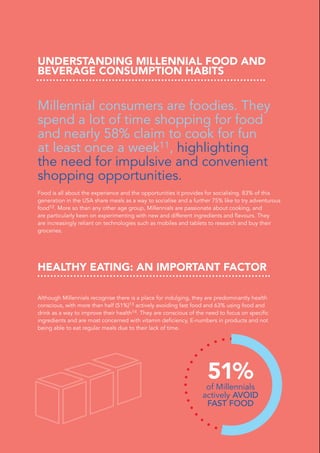
Although Millennials recognise there is a place for indulging, they are predominantly health
conscious, with more than half (51%)13 actively avoiding fast food and 63% using food and
drink as a way to improve their health14. They are conscious of the need to focus on specific
ingredients and are most concerned with vitamin deficiency, E-numbers in products and not
being able to eat regular meals due to their lack of time.
51%of Millennials
actively AVOID
FAST FOOD
FLEXIBLE EATING ROUTINES
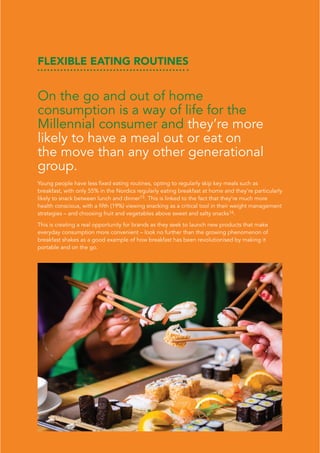
On the go and out of home
consumption is a way of life for the
Millennial consumer and they’re more
likely to have a meal out or eat on
the move than any other generational
group.
Young people have less fixed eating routines, opting to regularly skip key meals such as
breakfast, with only 55% in the Nordics regularly eating breakfast at home and they’re particularly
likely to snack between lunch and dinner15. This is linked to the fact that they’re much more
health conscious, with a fifth (19%) viewing snacking as a critical tool in their weight management
strategies – and choosing fruit and vegetables above sweet and salty snacks16.
This is creating a real opportunity for brands as they seek to launch new products that make
everyday consumption more convenient – look no further than the growing phenomenon of
breakfast shakes as a good example of how breakfast has been revolutionised by making it
portable and on the go.
HOW ARE BRANDS RESPONDING TO
MILLENNIAL CONSUMPTION PATTERNS?
The trend is to respond through
innovation and differentiation, with a
focus on addressing different product
solutions for different occasions.
Unilever’s AdeS, a combination of soya milk and fruit juice, has become a big success in Latin
America, holding onto around 50% of market share in Brazil in a category that has grown by
19% a year. Unilever produces varying sizes and formulations of AdeS for different consumer
groups, recently launching a portion-sized version in Tetra Prisma Aseptic DreamCap, specifically
targeting teenagers and young adults for out of home consumption. Marketing support for the
product has been focused on its protein value for the ‘go-getters’ Unilever aims to reach.
Millennials are also major consumers of sport & energy drinks. For example coconut water has
benefited significantly from its positioning as a natural alternative for recovery during and after
physical activity.
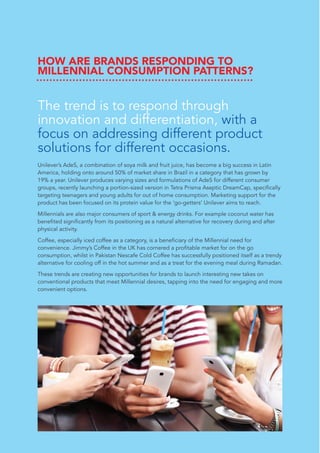
Coffee, especially iced coffee as a category, is a beneficiary of the Millennial need for
convenience. Jimmy’s Coffee in the UK has cornered a profitable market for on the go
consumption, whilst in Pakistan Nescafe Cold Coffee has successfully positioned itself as a trendy
alternative for cooling off in the hot summer and as a treat for the evening meal during Ramadan.
These trends are creating new opportunities for brands to launch interesting new takes on
conventional products that meet Millennial desires, tapping into the need for engaging and more
convenient options.
PACKAGING UP PORTION-SIZED SUCCESS
Millennial consumers look for five
key attributes when picking a single
portioned package off the shelf; how
the package looks, how easy it is to hold
and carry, how easy it is to drink from,
whether it can be resealed and how
environmentally-friendly it is.
The visual appeal of a package is very important and this is particularly evident in South America
and Asia. For example, younger Mexican Millennials are more likely to purchase a product
based on its appearance over other factors such as; safety, practicality and size. In addition, the
combination of both the visual appeal of a package and its suitability for drinking from it directly,
are significant factors that influence purchasing in China, Indonesia and Brazil.
As a sign of the emphasis Millennials put on attractive and engaging packaging, Coca-Cola’s and
Nutella’s recent successes with personalised packaging gained the highest levels of engagement
with Millennials.
For packages designed to be used outside of the home, convenience is a key factor when
Millennials make a product choice. This generation expects both portability, and an easy drinking
experience, along with resealability from product packaging:
-	 Millennials look for convenient portion packages, to be carried with them and easily used
on the go
-	 They are used to drinking directly from the package, so “easy to drink from” is a key
package requirement for them
-	 Across the majority of global markets, a package that provides a resealable cap over a
straw is very much in demand, particularly for larger cartons
Finally, Millennials globally are choosing eco-friendly products and are willing to pay for them.
They actively seek out information about a product’s sustainability credentials and expect brands
to help them consume smarter, with less packaging, less waste and more recycling.
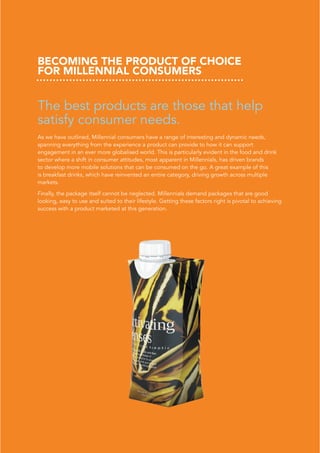
BECOMING THE PRODUCT OF CHOICE
FOR MILLENNIAL CONSUMERS
The best products are those that help
satisfy consumer needs.
As we have outlined, Millennial consumers have a range of interesting and dynamic needs,
spanning everything from the experience a product can provide to how it can support
engagement in an ever more globalised world. This is particularly evident in the food and drink
sector where a shift in consumer attitudes, most apparent in Millennials, has driven brands
to develop more mobile solutions that can be consumed on the go. A great example of this
is breakfast drinks, which have reinvented an entire category, driving growth across multiple
markets.
Finally, the package itself cannot be neglected. Millennials demand packages that are good
looking, easy to use and suited to their lifestyle. Getting these factors right is pivotal to achieving
success with a product marketed at this generation.
REFERENCES
1.	 http://www.goldmansachs.com/our-thinking/outlook/Millennials/
2.	 Kairos Future , “Global Youth 2013”, on-line survey conducted in 11 countries, Sweden ,
China, Australia, Brazil, India, Russia, South Africa,Spain, Turkey, UK, US. Target age group
16-29
3.	 Kairos Future , “Global Youth 2013”, on-line survey conducted in 11 countries, Sweden ,
China, Australia, Brazil, India, Russia, South Africa, Spain, Turkey, UK, US. Target age group
16-29
4.	 Roper Reports Worldwide 2014 (core 20 countries)
5.	 Understanding How Millennials View Food & Nutrition, UK & USA, BuzzBack Webinar, 2015
6.	 Mintel – Attitudes toward healthy foods (2012)
7.	 Barkley, USA 2012
8.	 Roper Reports Worldwide 2014 (core 20 countries)
9.	 Roper Reports Worldwide 2013 (mixed-mode, core 25 countries)
10.	 Roper Reports Worldwide 2014 (core 20 countries)
11.	 Understanding How Millennials View Food & Nutrition, BuzzBack Webinar, 2015
12.	 Roper Reports Worldwide 2013 (mixed-mode, core 25 countries)
13.	 Datamonitor Consumer Survey 2014
14.	 Eating & Drinking Study, Nordics (2011)
15.	 Barkley, USA 2012

Millennials report marketing educacional

  • 1.
  • 2.
    INTRODUCTION Millennials are thelargest and most influential generation of consumers yet. They’re young, aspirational and demanding; and they spend approximately $600 billion annually1. They’re coveted by major brands and represent a significant and disruptive force for the global food and beverage industry. But who are the Millennials and what makes them so disruptive? Tetra Pak examines this question, identifying the needs that characterize this group of consumers and in turn demonstrates how brands can optimize their products and packaging to meet these needs.
  • 3.
    MEET THE MILLENNIALS Millennialsare one of the largest generations of consumers who are about to hit their prime spending years. Recent research from Goldman Sachs, suggests that, “Millennials are poised to reshape the economy; their unique experiences will change the ways we buy and sell, forcing companies to examine how they do business for decades to come.”2 At Tetra Pak, we believe this generation of consumers are characterized by six underlying needs, which can be targeted through both product formulation and packaging when wanting to attract their attention.
  • 4.
    COMING OF AGE Definitionsof Millennials vary, but it is typically accepted that the term refers to a category of consumers born between 1980 and 2000, and for the purpose of this whitepaper, Tetra Pak defines Millennials as consumers aged between 20 and 35. As the first generation to have grown up with the internet and digital technology, Millennials are a unique generation, who have only ever known a truly globalised world. That said, it is also the generation that bore the brunt of the financial crisis in 2008. It is the combination of these two factors that have driven the development of their underlying needs. Today, many Millennials find themselves at the point of major life changes – including transitions towards long term relationships, marriage and potentially children. However, the cloud of 2008 remains present, with the challenge of employment and income forcing many to push back the notion of “settling down”. Despite being seven years on from the global financial crisis, the position of the economy remains the key issue for many Millennial consumers. Yet many remain individually optimistic with a number citing a successful career, a good home, and making their parents proud as major goals3. It is these experiences, opinions and outlooks that shape Tetra Pak’s “six needs” that we believe brands should target when marketing to this generation.
  • 5.
    THE SIX MILLENNIALNEEDS Global Millennials are the first globalised generation to have grown up in a world where technology makes 2,000 miles as close as two. This has elevated the outlook and network of influencers that Millennials have to a truly global scale. More than half have friends that live abroad and 20% have spent time studying or working overseas4. Connected Millennials are the first digitally native generation. They are more connected and more reliant on digital technology than any other generation and the majority don’t remember a time before mobile internet. Today, more than 84% of Millennials own a smart phone5 and report checking in for updates more than 40 times daily6. As a result, they expect brands to be just as connected. 2 2 4 4 6 6 1 1 3 3 5 5 Social online & offline Millennials are highly social and consistently look to their peers for guidance and recommendations on shopping decisions. Millennials view online social activity as an important supplement to the offline world, with 54% of Millennials stating that social networking has helped them to build stronger relationships with friends and family7. Hungry for experiences Millennials are often regarded as more adventurous, compared to older generations, always on the lookout for new products and services, searching for novelty and fun even in everyday products. For instance, 65% of Millennials in the USA said they are interested in trying everything from opera to rock-climbing compared to just 39% of other generations.8 Millennials have a greater interest in travel, which often translates itself into adventurous eating habits, demonstrating how they want to buy an experience rather than a product. Impulse shoppers This is a generation characterized by impulse – whether it’s planning meal and food purchases on a day by day basis or deciding to treat themselves to a special purchase, Millennials are interested in convenience. They look for food and drink options that are easy, simple to deal with and fit into ever busier lives. As a result, 41% of Millennials are prepared to pay more for products that make their lives easier.9 Smart consumers Millennials are savvy shoppers, who are able to navigate the balance between price and value. They’re interested in a healthy and more environmentally friendly lifestyle, with 53% of Millennials reporting that they would like to do more for the environment but that they don’t know how.10
  • 6.
    UNDERSTANDING MILLENNIAL FOODAND BEVERAGE CONSUMPTION HABITS Millennial consumers are foodies. They spend a lot of time shopping for food and nearly 58% claim to cook for fun at least once a week11, highlighting the need for impulsive and convenient shopping opportunities. Food is all about the experience and the opportunities it provides for socialising. 83% of this generation in the USA share meals as a way to socialise and a further 75% like to try adventurous food12. More so than any other age group, Millennials are passionate about cooking, and are particularly keen on experimenting with new and different ingredients and flavours. They are increasingly reliant on technologies such as mobiles and tablets to research and buy their groceries. HEALTHY EATING: AN IMPORTANT FACTOR Although Millennials recognise there is a place for indulging, they are predominantly health conscious, with more than half (51%)13 actively avoiding fast food and 63% using food and drink as a way to improve their health14. They are conscious of the need to focus on specific ingredients and are most concerned with vitamin deficiency, E-numbers in products and not being able to eat regular meals due to their lack of time. 51%of Millennials actively AVOID FAST FOOD
  • 7.
    FLEXIBLE EATING ROUTINES Onthe go and out of home consumption is a way of life for the Millennial consumer and they’re more likely to have a meal out or eat on the move than any other generational group. Young people have less fixed eating routines, opting to regularly skip key meals such as breakfast, with only 55% in the Nordics regularly eating breakfast at home and they’re particularly likely to snack between lunch and dinner15. This is linked to the fact that they’re much more health conscious, with a fifth (19%) viewing snacking as a critical tool in their weight management strategies – and choosing fruit and vegetables above sweet and salty snacks16. This is creating a real opportunity for brands as they seek to launch new products that make everyday consumption more convenient – look no further than the growing phenomenon of breakfast shakes as a good example of how breakfast has been revolutionised by making it portable and on the go.
  • 8.
    HOW ARE BRANDSRESPONDING TO MILLENNIAL CONSUMPTION PATTERNS? The trend is to respond through innovation and differentiation, with a focus on addressing different product solutions for different occasions. Unilever’s AdeS, a combination of soya milk and fruit juice, has become a big success in Latin America, holding onto around 50% of market share in Brazil in a category that has grown by 19% a year. Unilever produces varying sizes and formulations of AdeS for different consumer groups, recently launching a portion-sized version in Tetra Prisma Aseptic DreamCap, specifically targeting teenagers and young adults for out of home consumption. Marketing support for the product has been focused on its protein value for the ‘go-getters’ Unilever aims to reach. Millennials are also major consumers of sport & energy drinks. For example coconut water has benefited significantly from its positioning as a natural alternative for recovery during and after physical activity. Coffee, especially iced coffee as a category, is a beneficiary of the Millennial need for convenience. Jimmy’s Coffee in the UK has cornered a profitable market for on the go consumption, whilst in Pakistan Nescafe Cold Coffee has successfully positioned itself as a trendy alternative for cooling off in the hot summer and as a treat for the evening meal during Ramadan. These trends are creating new opportunities for brands to launch interesting new takes on conventional products that meet Millennial desires, tapping into the need for engaging and more convenient options.
  • 9.
    PACKAGING UP PORTION-SIZEDSUCCESS Millennial consumers look for five key attributes when picking a single portioned package off the shelf; how the package looks, how easy it is to hold and carry, how easy it is to drink from, whether it can be resealed and how environmentally-friendly it is. The visual appeal of a package is very important and this is particularly evident in South America and Asia. For example, younger Mexican Millennials are more likely to purchase a product based on its appearance over other factors such as; safety, practicality and size. In addition, the combination of both the visual appeal of a package and its suitability for drinking from it directly, are significant factors that influence purchasing in China, Indonesia and Brazil. As a sign of the emphasis Millennials put on attractive and engaging packaging, Coca-Cola’s and Nutella’s recent successes with personalised packaging gained the highest levels of engagement with Millennials. For packages designed to be used outside of the home, convenience is a key factor when Millennials make a product choice. This generation expects both portability, and an easy drinking experience, along with resealability from product packaging: - Millennials look for convenient portion packages, to be carried with them and easily used on the go - They are used to drinking directly from the package, so “easy to drink from” is a key package requirement for them - Across the majority of global markets, a package that provides a resealable cap over a straw is very much in demand, particularly for larger cartons Finally, Millennials globally are choosing eco-friendly products and are willing to pay for them. They actively seek out information about a product’s sustainability credentials and expect brands to help them consume smarter, with less packaging, less waste and more recycling.
  • 10.
    BECOMING THE PRODUCTOF CHOICE FOR MILLENNIAL CONSUMERS The best products are those that help satisfy consumer needs. As we have outlined, Millennial consumers have a range of interesting and dynamic needs, spanning everything from the experience a product can provide to how it can support engagement in an ever more globalised world. This is particularly evident in the food and drink sector where a shift in consumer attitudes, most apparent in Millennials, has driven brands to develop more mobile solutions that can be consumed on the go. A great example of this is breakfast drinks, which have reinvented an entire category, driving growth across multiple markets. Finally, the package itself cannot be neglected. Millennials demand packages that are good looking, easy to use and suited to their lifestyle. Getting these factors right is pivotal to achieving success with a product marketed at this generation.
  • 11.
    REFERENCES 1. http://www.goldmansachs.com/our-thinking/outlook/Millennials/ 2. KairosFuture , “Global Youth 2013”, on-line survey conducted in 11 countries, Sweden , China, Australia, Brazil, India, Russia, South Africa,Spain, Turkey, UK, US. Target age group 16-29 3. Kairos Future , “Global Youth 2013”, on-line survey conducted in 11 countries, Sweden , China, Australia, Brazil, India, Russia, South Africa, Spain, Turkey, UK, US. Target age group 16-29 4. Roper Reports Worldwide 2014 (core 20 countries) 5. Understanding How Millennials View Food & Nutrition, UK & USA, BuzzBack Webinar, 2015 6. Mintel – Attitudes toward healthy foods (2012) 7. Barkley, USA 2012 8. Roper Reports Worldwide 2014 (core 20 countries) 9. Roper Reports Worldwide 2013 (mixed-mode, core 25 countries) 10. Roper Reports Worldwide 2014 (core 20 countries) 11. Understanding How Millennials View Food & Nutrition, BuzzBack Webinar, 2015 12. Roper Reports Worldwide 2013 (mixed-mode, core 25 countries) 13. Datamonitor Consumer Survey 2014 14. Eating & Drinking Study, Nordics (2011) 15. Barkley, USA 2012