trendwatching.com’s free monthly Trend Briefing

November 2013

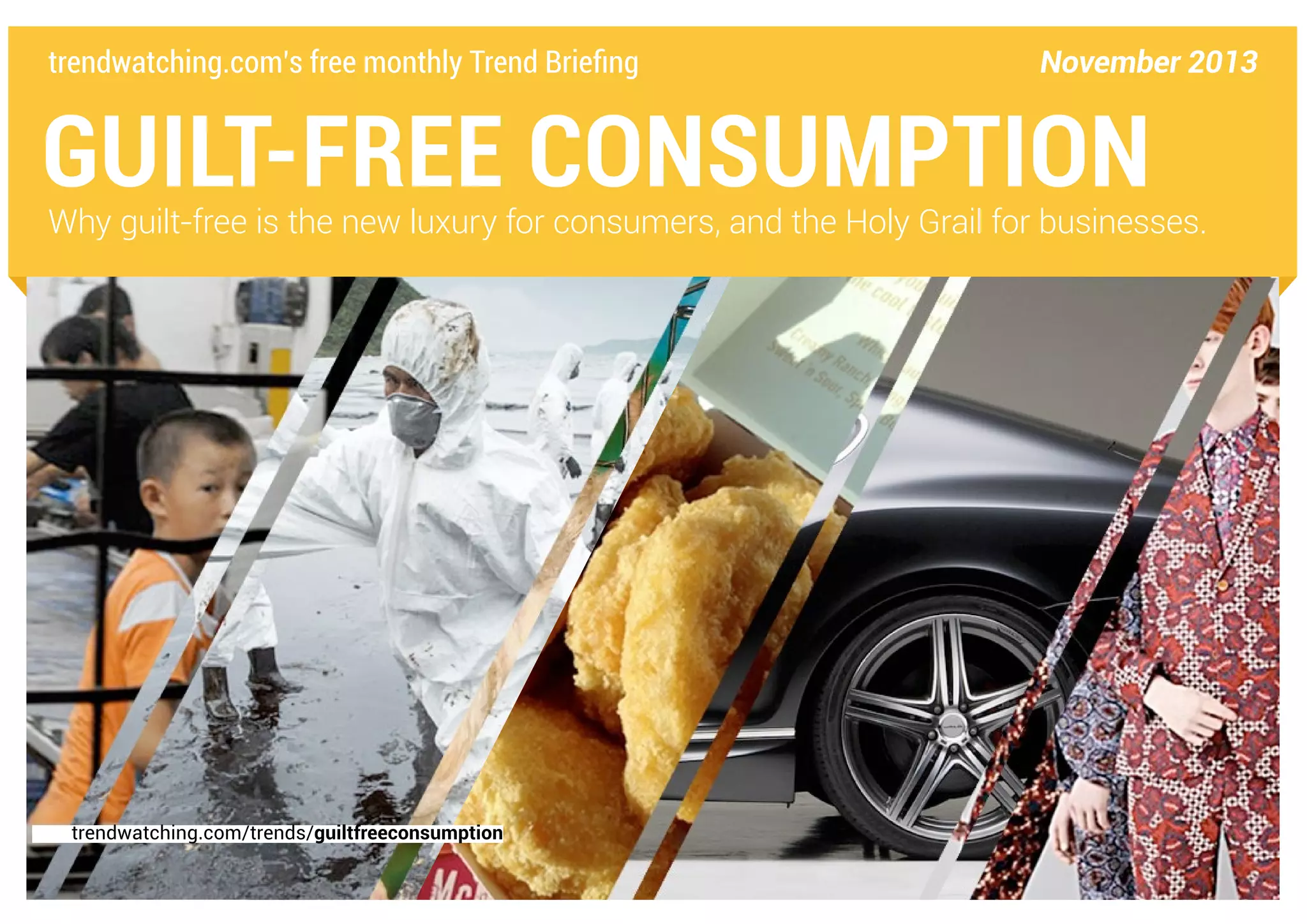
GUILT-FREE CONSUMPTION

Why guilt-free is the new luxury for consumers, and the Holy Grail for businesses.

trendwatching.com/trends/guiltfreeconsumption
DEFINITION
This month’s Trend Briefing highlights nothing less than
the future of consumerism, if not that of business at large
(yes, the future of humanity will follow next month ;).
Building on our recent Trend Briefings on CLEAN SLATE
BRANDS and DEMANDING BRANDS, and bringing
together various strands of the HUMAN BRANDS
and BETTER BUSINESS mega-trends, GUILT-FREE
CONSUMPTION (GFC) is a compelling answer to the
current, epic quest for more aware, more ethical, more
sustainable consumerism.
Note: This Trend Briefing was inspired by a recent comment from Gerald
Lawless, CEO of Jumeirah Hotels, on how the future of luxury would be ‘guiltfree’.

w w w. t r e n d w a t c h i n g . c o m

GUILT-FREE CONSUMPTION

2

Fueled by a pervasive awareness of the
conflicts between their consumerist
impulses and their aspirations to be
‘good’, experienced consumers are
increasingly wracked with guilt. The
result? A growing hunger for a new kind
of consumption: one free from worry
(or at least with less worry) about
its negative impact, while allowing
continued indulgence.
1. THE DIVIDED SELF

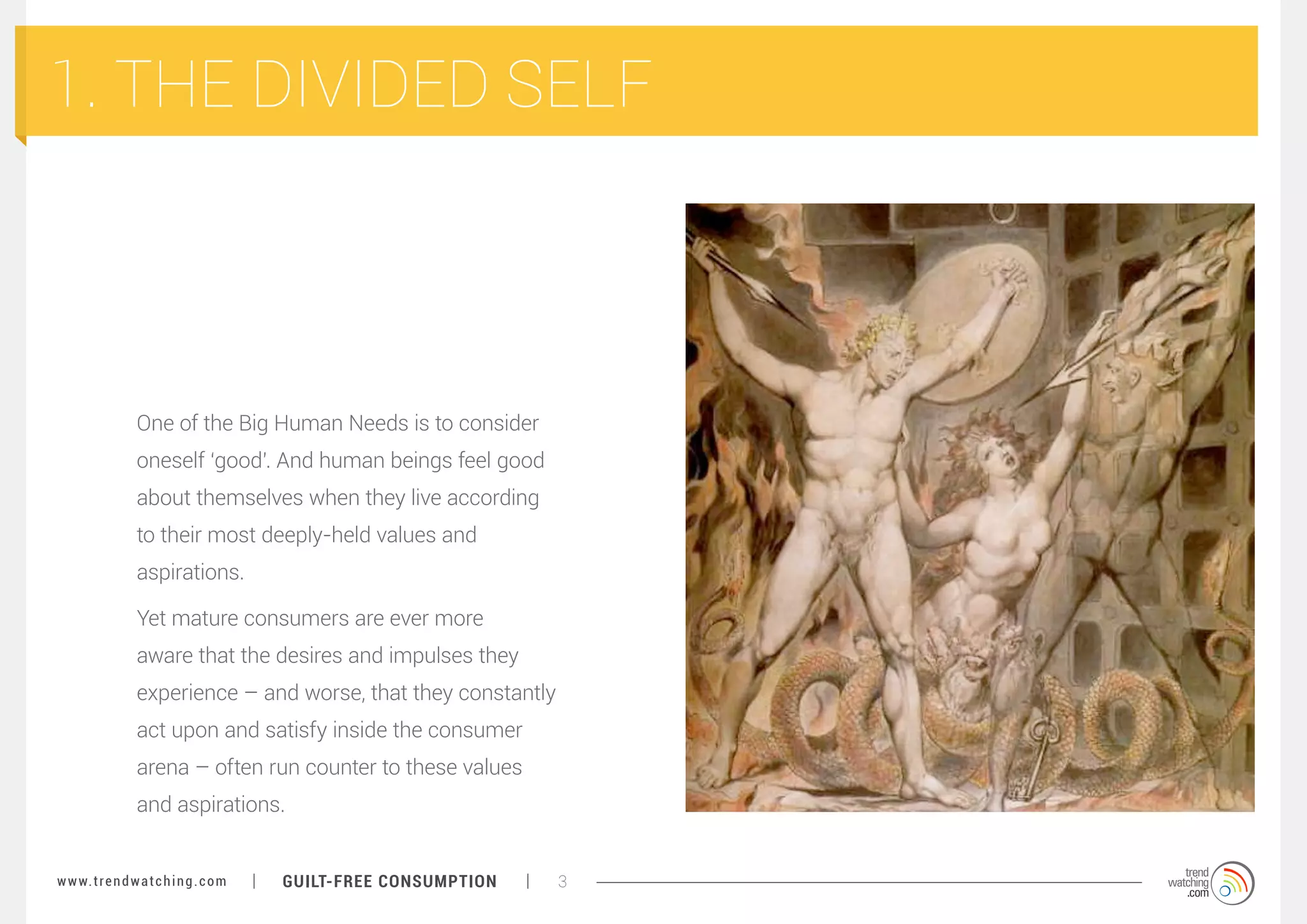
One of the Big Human Needs is to consider
oneself ‘good’. And human beings feel good
about themselves when they live according
to their most deeply-held values and
aspirations.
Yet mature consumers are ever more
aware that the desires and impulses they
experience – and worse, that they constantly
act upon and satisfy inside the consumer
arena – often run counter to these values
and aspirations.
w w w. t r e n d w a t c h i n g . c o m

GUILT-FREE CONSUMPTION

3
1. THE DIVIDED SELF
Transparency
Triumph

Clean
Contrast

Can’t Stop,
Won’t Stop

Every day, consumers are served more

While on top of this, the flaunting of ethical and

However, a very human mix of status,

information on dysfunctional business

responsible behavior by a whole host of CLEAN

indulgence, conditioning, addiction and genuine

processes and ethics, hear the strained voices

SLATE BRANDS only highlights the deeply

pleasure (derived from everything from tasty

of workers from developing countries, or receive

flawed nature of many established products

Whoppers, to romantic easyJet/AirAsia/JetBlue

scientific insights on the health drawbacks

and brands. Take condoms, for example.

city breaks, to dirt-cheap-yet-coolish H&M

of many a favorite (and processed) snack or

How many consumers considered the ethical

outfits, to shiny phablets), stops consumers

beverage.

dimensions of condoms before Sustain

from substantially changing their knowingly

Condoms highlighted the environmental and

damaging consumption needs and patterns.

It has thus become completely impossible
for any individual in near- and fully mature
consumer societies to claim ignorance over

social abuses often found in the production of
latex?

the havoc his or her consumption is and has

With every brand that shouts

been wreaking.

about not employing 9 year old child workers
in Bangladesh, about not force-feeding poultry,
whose products do not depend on tarry oilfueled engines, consumer doubt towards those
that keep quiet grows.

w w w. t r e n d w a t c h i n g . c o m

GUILT-FREE CONSUMPTION

4
2. NEXT: THE GUILT-SPIRAL

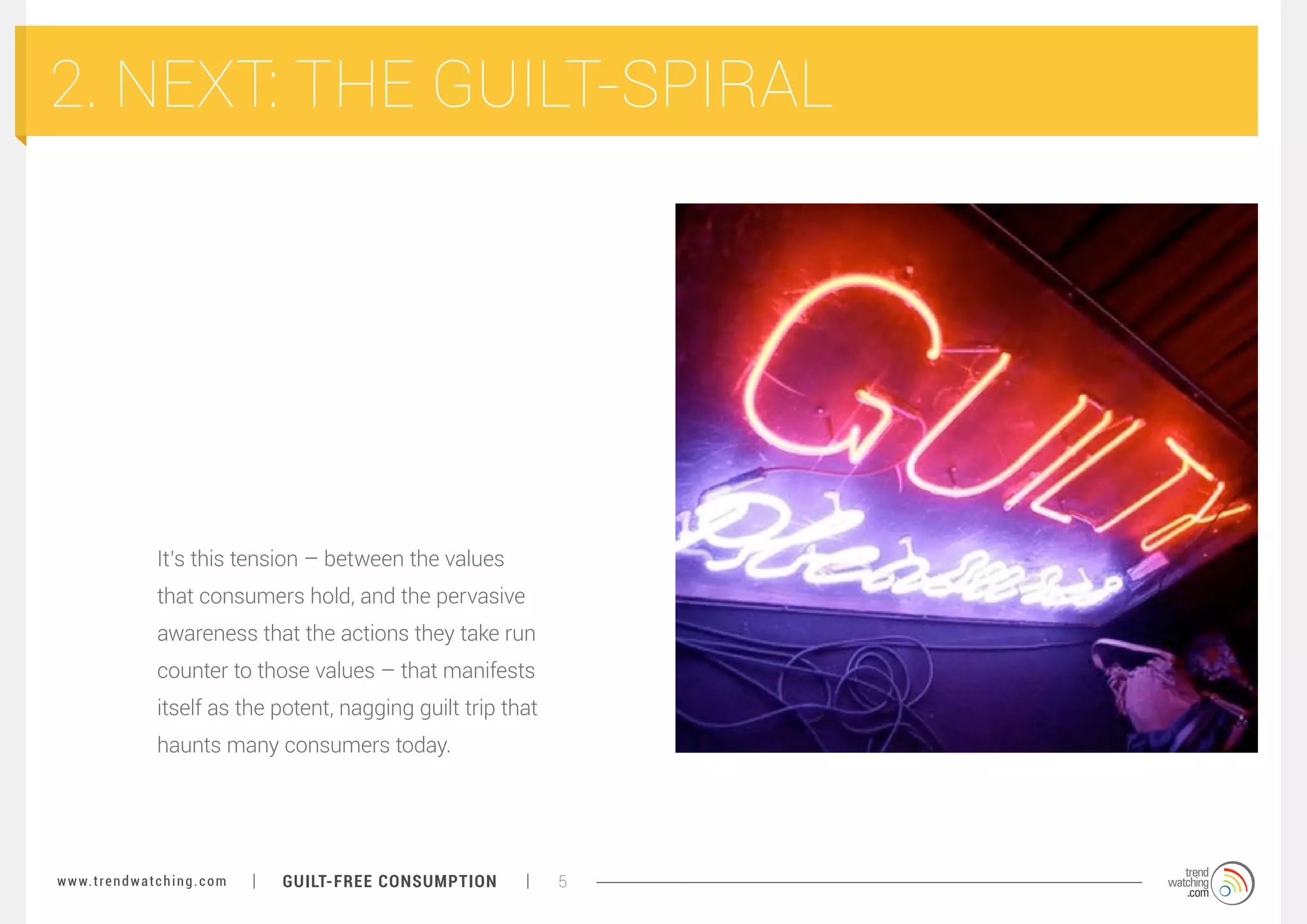
It’s this tension – between the values
that consumers hold, and the pervasive
awareness that the actions they take run
counter to those values – that manifests
itself as the potent, nagging guilt trip that
haunts many consumers today.

w w w. t r e n d w a t c h i n g . c o m

GUILT-FREE CONSUMPTION

5
2. NEXT: THE GUILT-SPIRAL
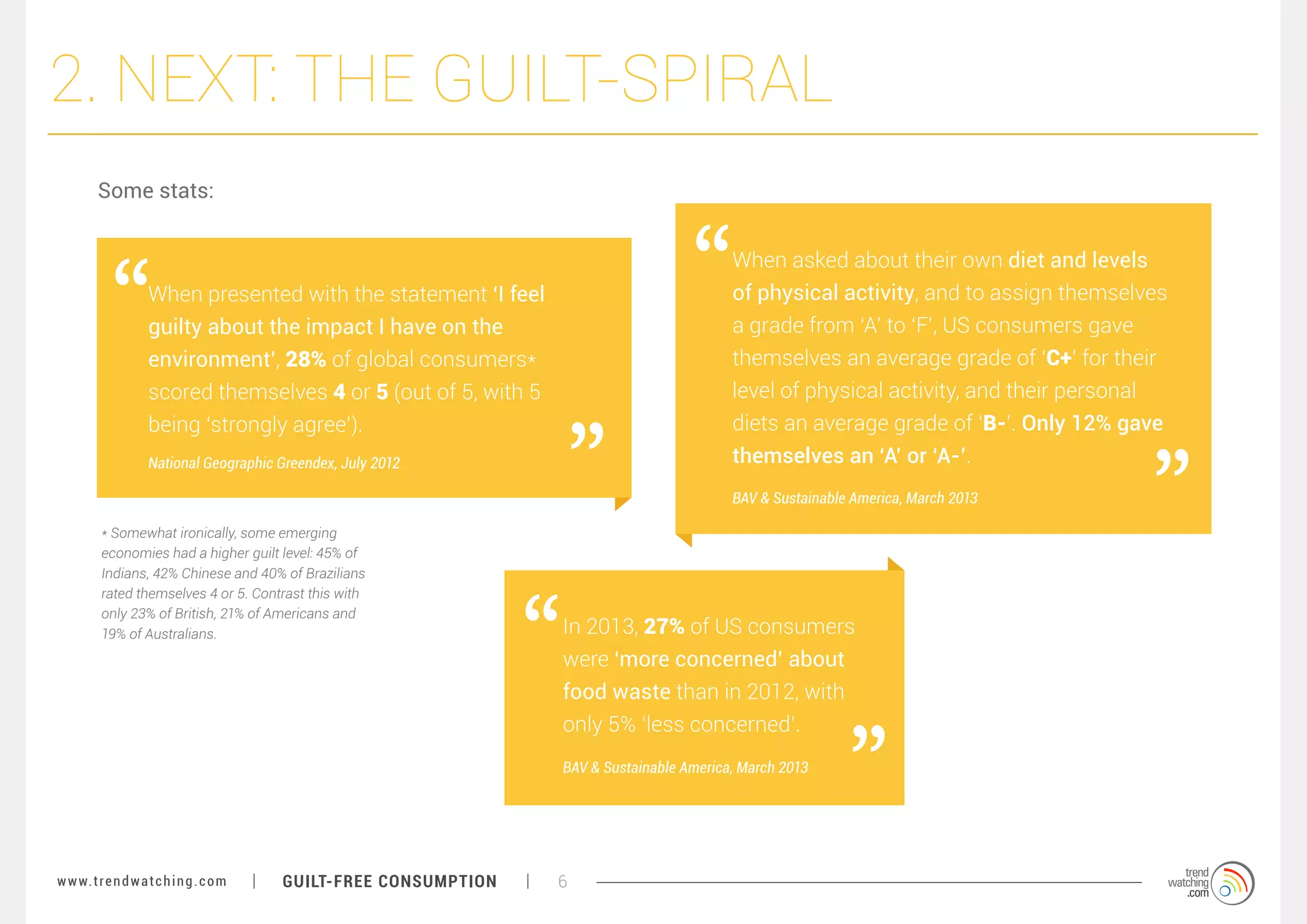
Some stats:
When asked about their own diet and levels
of physical activity, and to assign themselves
a grade from ‘A’ to ‘F’, US consumers gave
themselves an average grade of ‘C+’ for their
level of physical activity, and their personal
diets an average grade of ‘B-’. Only 12% gave
themselves an ‘A’ or ‘A-’.

When presented with the statement ‘I feel
guilty about the impact I have on the
environment’, 28% of global consumers*
scored themselves 4 or 5 (out of 5, with 5
being ‘strongly agree’).
National Geographic Greendex, July 2012

BAV & Sustainable America, March 2013
* Somewhat ironically, some emerging
economies had a higher guilt level: 45% of
Indians, 42% Chinese and 40% of Brazilians
rated themselves 4 or 5. Contrast this with
only 23% of British, 21% of Americans and
19% of Australians.

In 2013, 27% of US consumers
were ‘more concerned’ about
food waste than in 2012, with
only 5% ‘less concerned’.
BAV & Sustainable America, March 2013

w w w. t r e n d w a t c h i n g . c o m

GUILT-FREE CONSUMPTION

6
2. NEXT: THE GUILT-SPIRAL

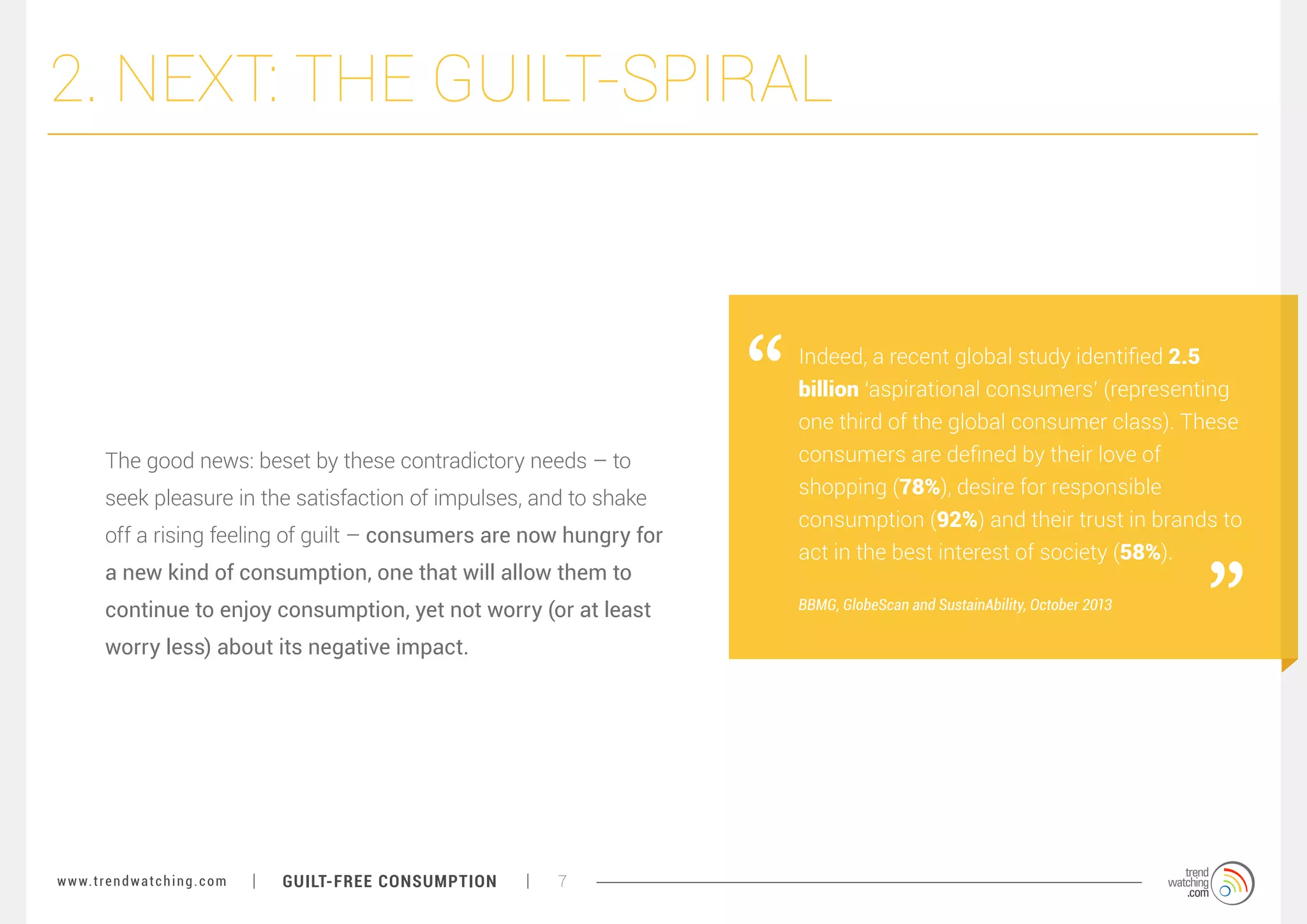
The good news: beset by these contradictory needs – to
seek pleasure in the satisfaction of impulses, and to shake
off a rising feeling of guilt – consumers are now hungry for
a new kind of consumption, one that will allow them to
continue to enjoy consumption, yet not worry (or at least
worry less) about its negative impact.

w w w. t r e n d w a t c h i n g . c o m

GUILT-FREE CONSUMPTION

7

Indeed, a recent global study identified 2.5
billion ‘aspirational consumers’ (representing
one third of the global consumer class). These
consumers are defined by their love of
shopping (78%), desire for responsible
consumption (92%) and their trust in brands to
act in the best interest of society (58%).
BBMG, GlobeScan and SustainAbility, October 2013
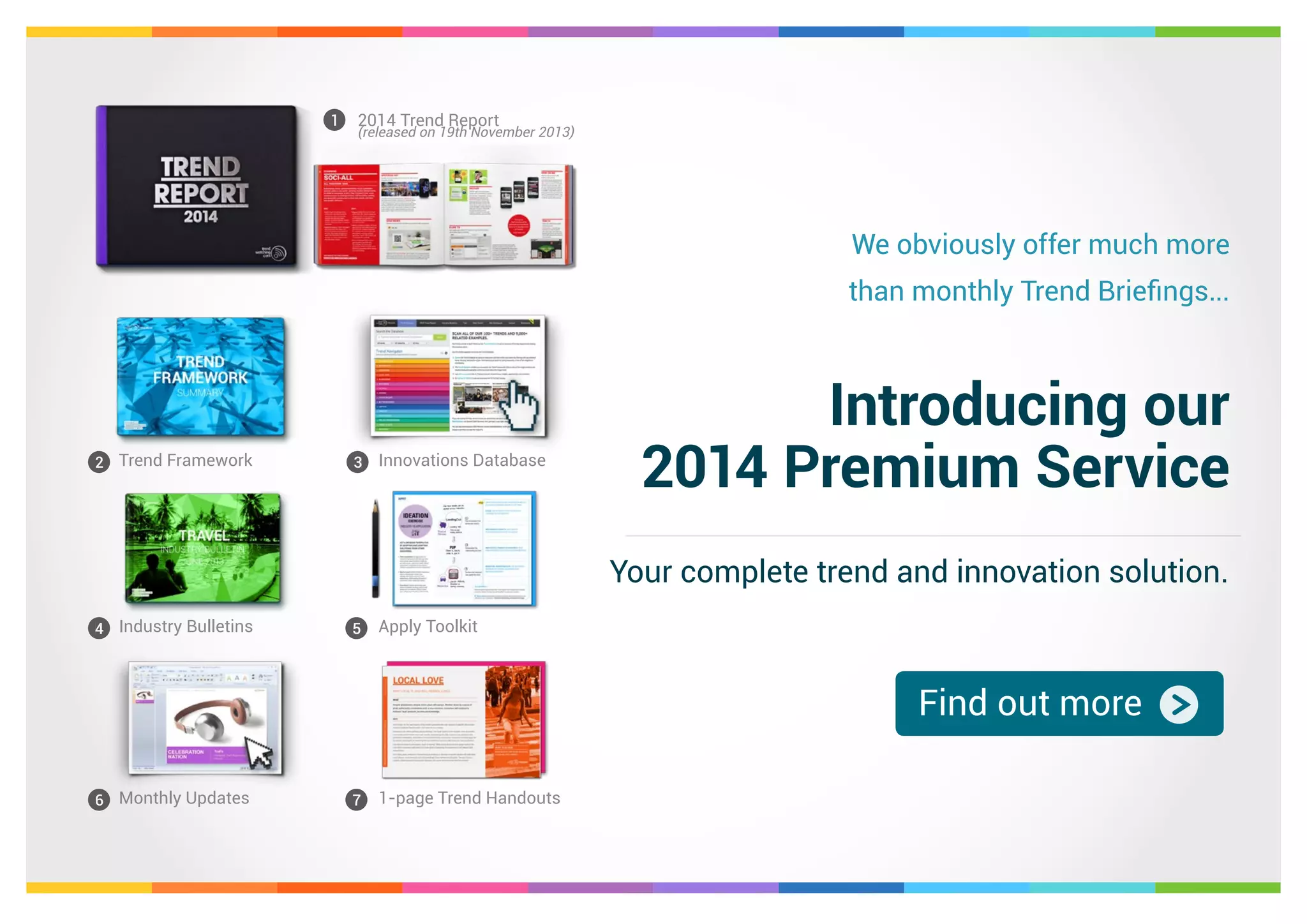
1

2014 Trend Report

We obviously offer much more
than monthly Trend Briefings...

2 Trend Framework

3

Innovations Database

Introducing our
2014 Premium Service
Your complete trend and innovation solution.

4 Industry Bulletins

5

Apply Toolkit

Find out more
6 Monthly Updates

7

1-page Trend Handouts
3. ABSOLVING GUILT
To become a GFC brand, brands need to first understand the various kinds of
guilt currently tormenting ‘aware’ consumers. Three* types of consumer guilt:

GFC & Self
Guilt about what one brings on oneself.

GFC & Society
Guilt about what one causes, directly and indirectly, to
other people (and other living creatures).

GFC & Planet
Guilt about one’s impact on the environment at large.

* When it comes to guilt, these aren’t the only dimensions of course. Witness how newlyminted urban emerging market consumers often experience ‘cultural’ guilt: split between their
desire to dive into the global consumer arena and the thought that they are ‘abandoning’ their
identity and heritage (to assuage that guilt, turn to our CELEBRATION NATION trend ;)

w w w. t r e n d w a t c h i n g . c o m

GUILT-FREE CONSUMPTION

9
3. ABSOLVING GUILT

Now, GUILT-FREE doesn’t have to mean either zero-impact, ethically perfect,
health-optimum consumption, or even no consumption at all**.
Most consumers do not hold values that mean that even the slightest negative
impact on the planet, on society or on themselves is unacceptable to them. They
just want to know that this impact is as little as practically possible.
Indeed, for now at least, the most potent GFC innovations will target those
areas where there is greatest tension between consumer values and impulses,
and help absolve the most tormenting guilt.

** Only truly reducing one’s consumption, i.e. consuming less, offers the ultimate redemption.
But that’s something 99% of consumers seem not ready for yet. And neither are most brands.

w w w. t r e n d w a t c h i n g . c o m

GUILT-FREE CONSUMPTION

10
3. ABSOLVING GUILT
GFC & Self
As a brand, identify the consumption choices that cause
most guilt when it comes to physical and mental wellbeing:
sugar, fat, alcohol, inactivity, and more. Then take steps to
absolve that guilt.
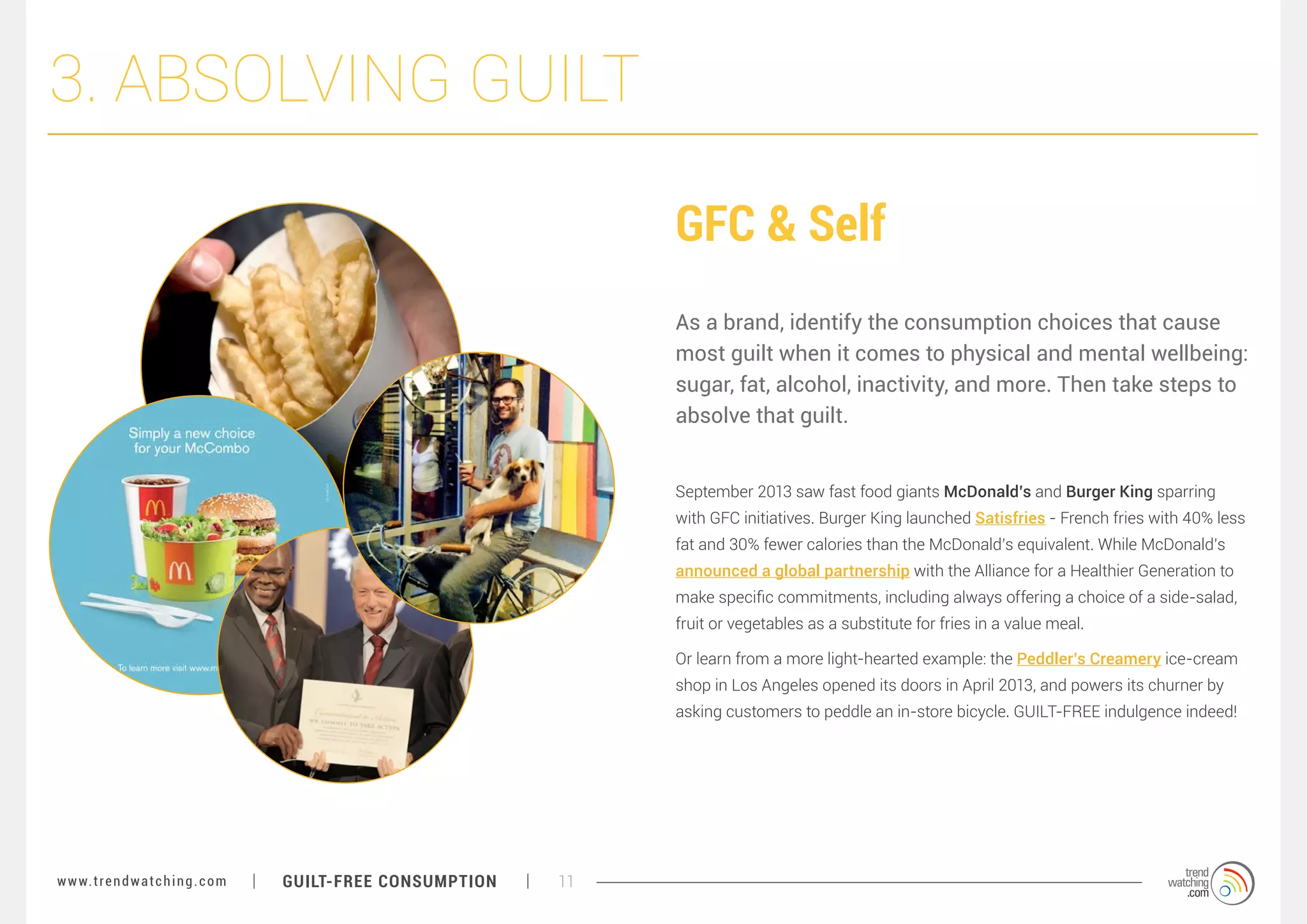
September 2013 saw fast food giants McDonald’s and Burger King sparring
with GFC initiatives. Burger King launched Satisfries - French fries with 40% less
fat and 30% fewer calories than the McDonald’s equivalent. While McDonald’s
announced a global partnership with the Alliance for a Healthier Generation to
make specific commitments, including always offering a choice of a side-salad,
fruit or vegetables as a substitute for fries in a value meal.
Or learn from a more light-hearted example: the Peddler’s Creamery ice-cream
shop in Los Angeles opened its doors in April 2013, and powers its churner by
asking customers to peddle an in-store bicycle. GUILT-FREE indulgence indeed!

w w w. t r e n d w a t c h i n g . c o m

GUILT-FREE CONSUMPTION

11
3. ABSOLVING GUILT
GFC & Society
As a brand, identify the consumption choices that cause
most guilt when it comes to other people: poor working
conditions, sub-poverty wages, exploitation, and more. Go
ahead: absolve the guilt!
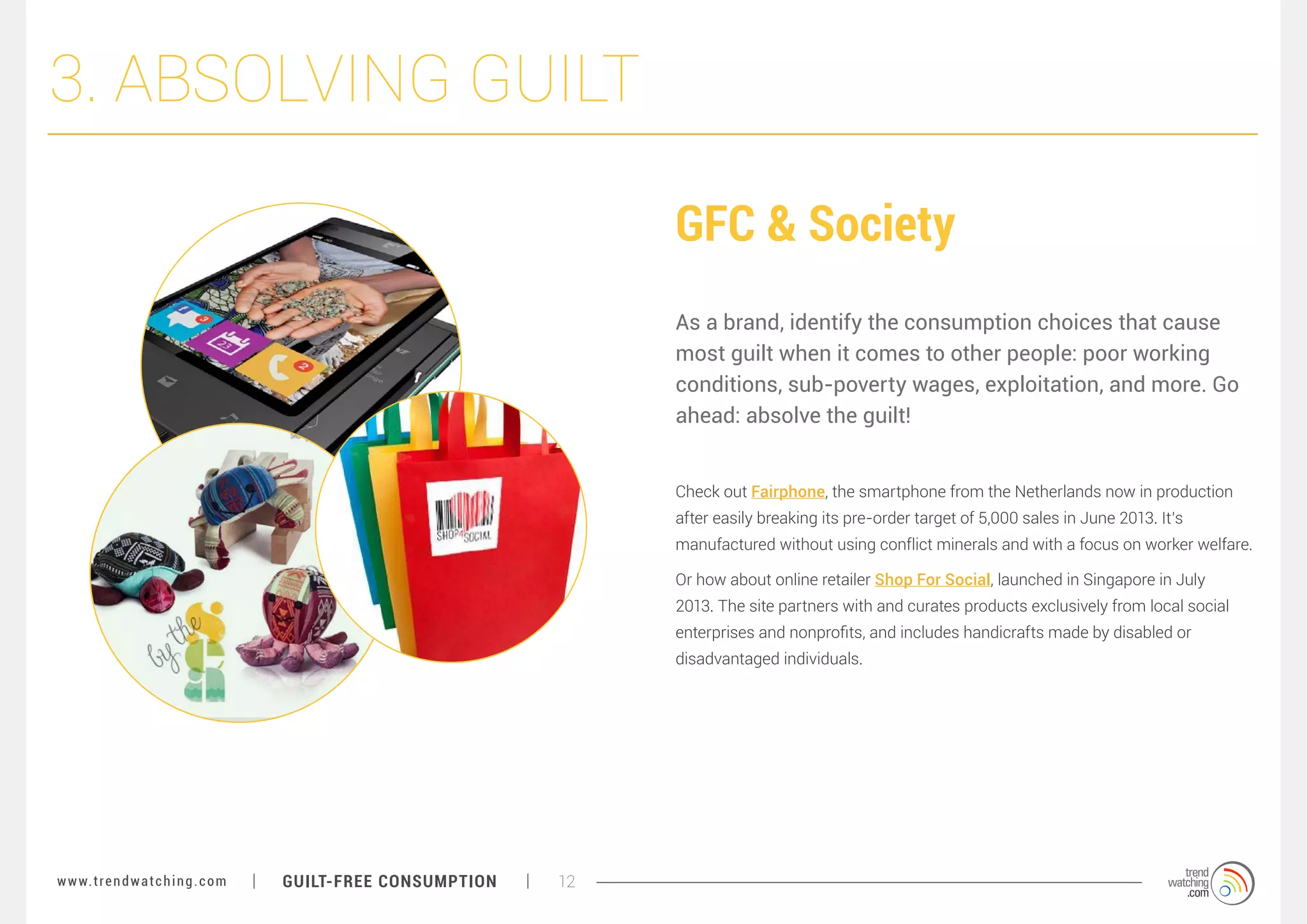
Check out Fairphone, the smartphone from the Netherlands now in production
after easily breaking its pre-order target of 5,000 sales in June 2013. It’s
manufactured without using conflict minerals and with a focus on worker welfare.
Or how about online retailer Shop For Social, launched in Singapore in July
2013. The site partners with and curates products exclusively from local social
enterprises and nonprofits, and includes handicrafts made by disabled or
disadvantaged individuals.

w w w. t r e n d w a t c h i n g . c o m

GUILT-FREE CONSUMPTION

12
3. ABSOLVING GUILT
GFC & Planet
Fossil fuels and CO2 emissions, wasteful packaging, nonbiodegradable materials, rainforest destruction: there is no
shortage of potent guilt when it comes to the planet.

A few recent examples to learn from:
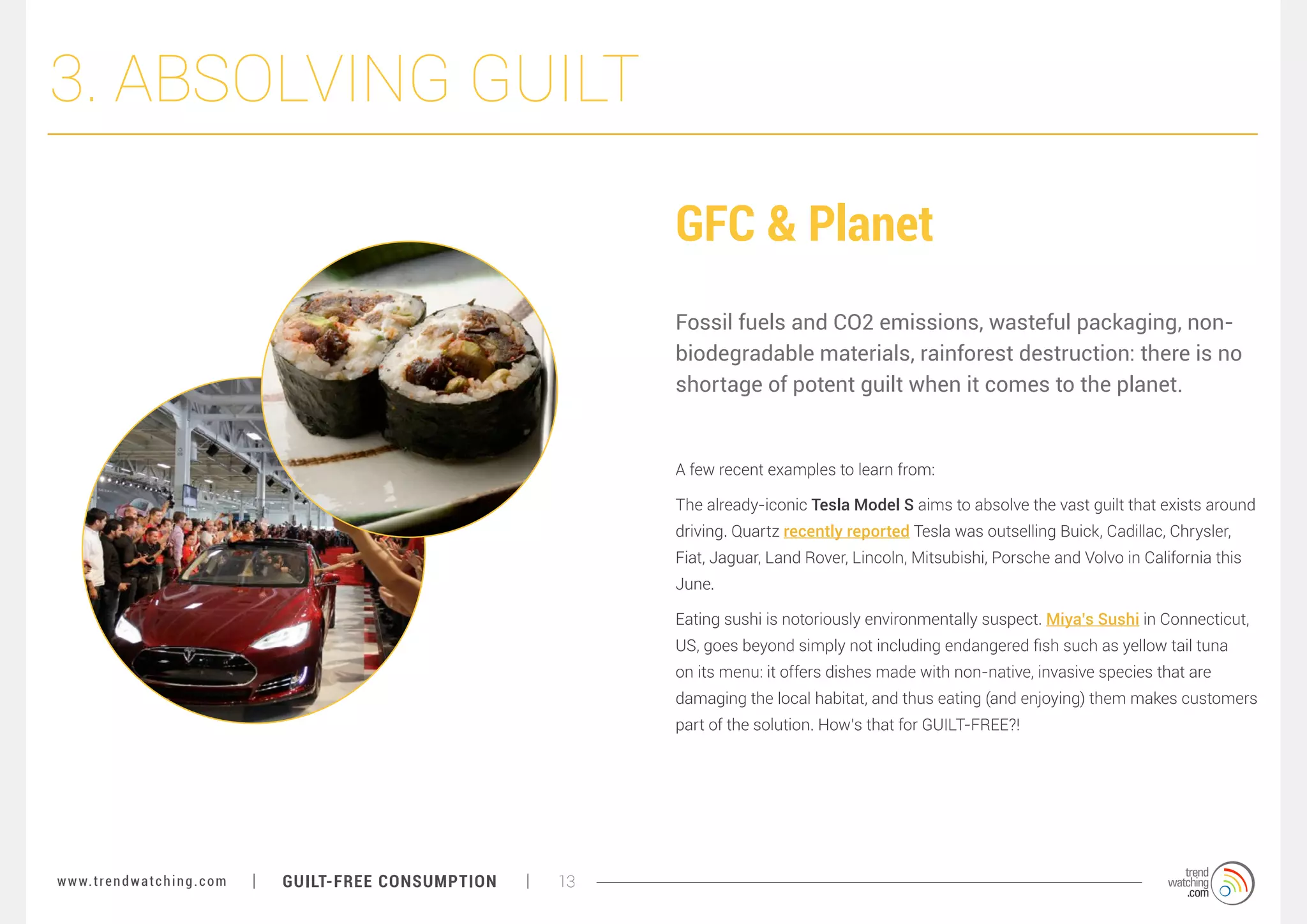
The already-iconic Tesla Model S aims to absolve the vast guilt that exists around
driving. Quartz recently reported Tesla was outselling Buick, Cadillac, Chrysler,
Fiat, Jaguar, Land Rover, Lincoln, Mitsubishi, Porsche and Volvo in California this
June.
Eating sushi is notoriously environmentally suspect. Miya’s Sushi in Connecticut,
US, goes beyond simply not including endangered fish such as yellow tail tuna
on its menu: it offers dishes made with non-native, invasive species that are
damaging the local habitat, and thus eating (and enjoying) them makes customers
part of the solution. How’s that for GUILT-FREE?!

w w w. t r e n d w a t c h i n g . c o m

GUILT-FREE CONSUMPTION

13
3. ABSOLVING GUILT
GFC & Planet (cont.)
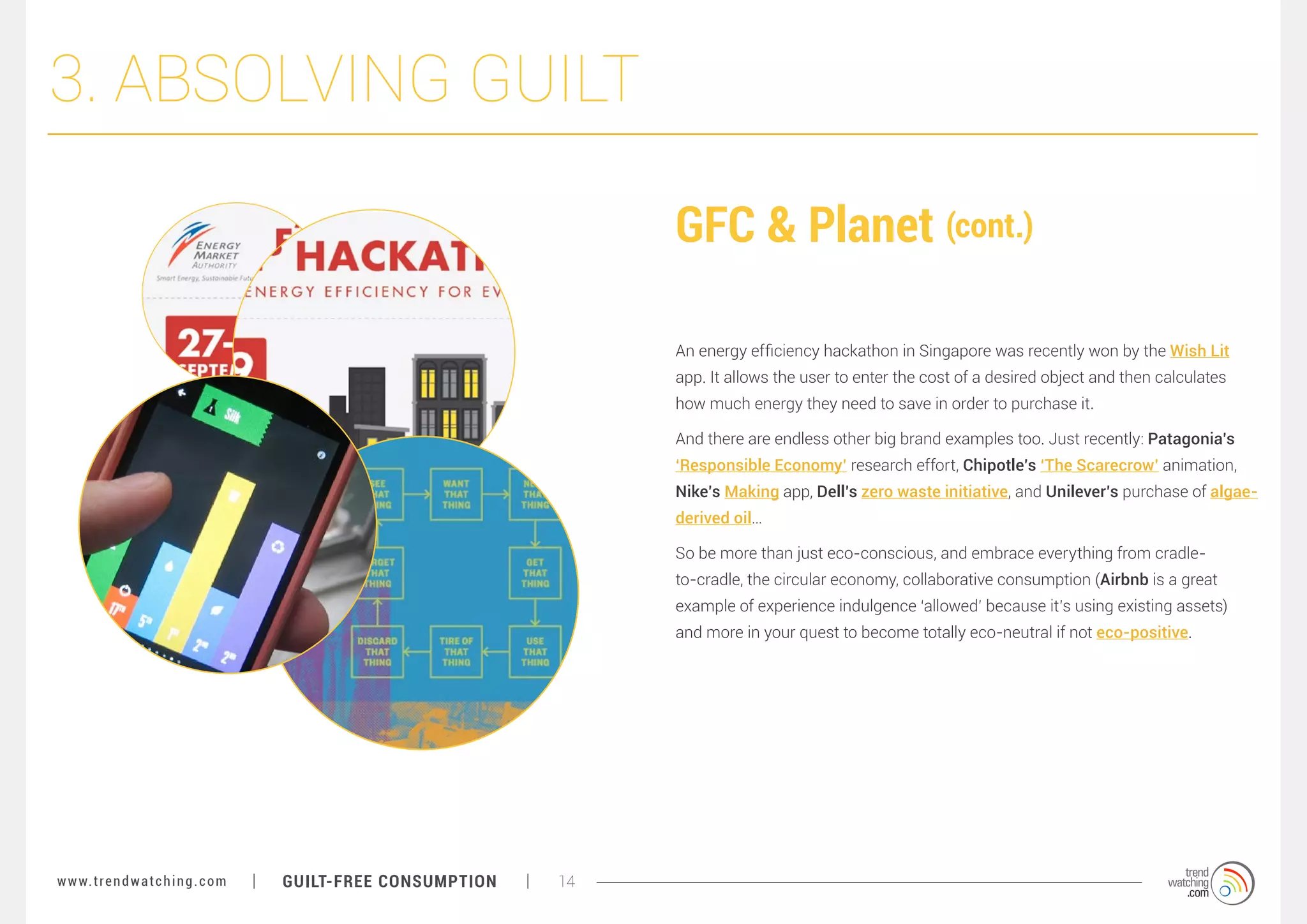
An energy efficiency hackathon in Singapore was recently won by the Wish Lit
app. It allows the user to enter the cost of a desired object and then calculates
how much energy they need to save in order to purchase it.
And there are endless other big brand examples too. Just recently: Patagonia’s
‘Responsible Economy’ research effort, Chipotle’s ‘The Scarecrow’ animation,
Nike’s Making app, Dell’s zero waste initiative, and Unilever’s purchase of algaederived oil…
So be more than just eco-conscious, and embrace everything from cradleto-cradle, the circular economy, collaborative consumption (Airbnb is a great
example of experience indulgence ‘allowed’ because it’s using existing assets)
and more in your quest to become totally eco-neutral if not eco-positive.

w w w. t r e n d w a t c h i n g . c o m

GUILT-FREE CONSUMPTION

14
3. ABSOLVING GUILT
Total GFC
The sweet spot for any GUILT-FREE brand is, of course, to
deliver in all three categories simultaneously.
If your brand can identify the guilt attached to what you do across the SELF,
SOCIETY and PLANET domains, and then absolve it, you’re nearing TOTAL GUILTFREE CONSUMPTION.
The ultimate? Consumption that goes beyond GUILT-FREE, and becomes actively
positive in its impact across every domain. That is, true consumption nirvana. Is
it possible? How big is the universe? We don’t know! Yet ;)

w w w. t r e n d w a t c h i n g . c o m

GUILT-FREE CONSUMPTION

15
NEXT
The opportunity to absolve consumers is an enormous one. Sure, virtually
every brand now claims to be a green brand, a responsible brand, a human
brand, a sustainable brand, an honest brand, or a transparent brand. But
striving towards offering GFC might encourage more purpose and
direction – internally too – than lofty social or environmental goals,
especially since GFC is focused on what counts most in business: actual
end users’ (deep) needs.
With that in mind, we look forward to your innovations, and are expecting
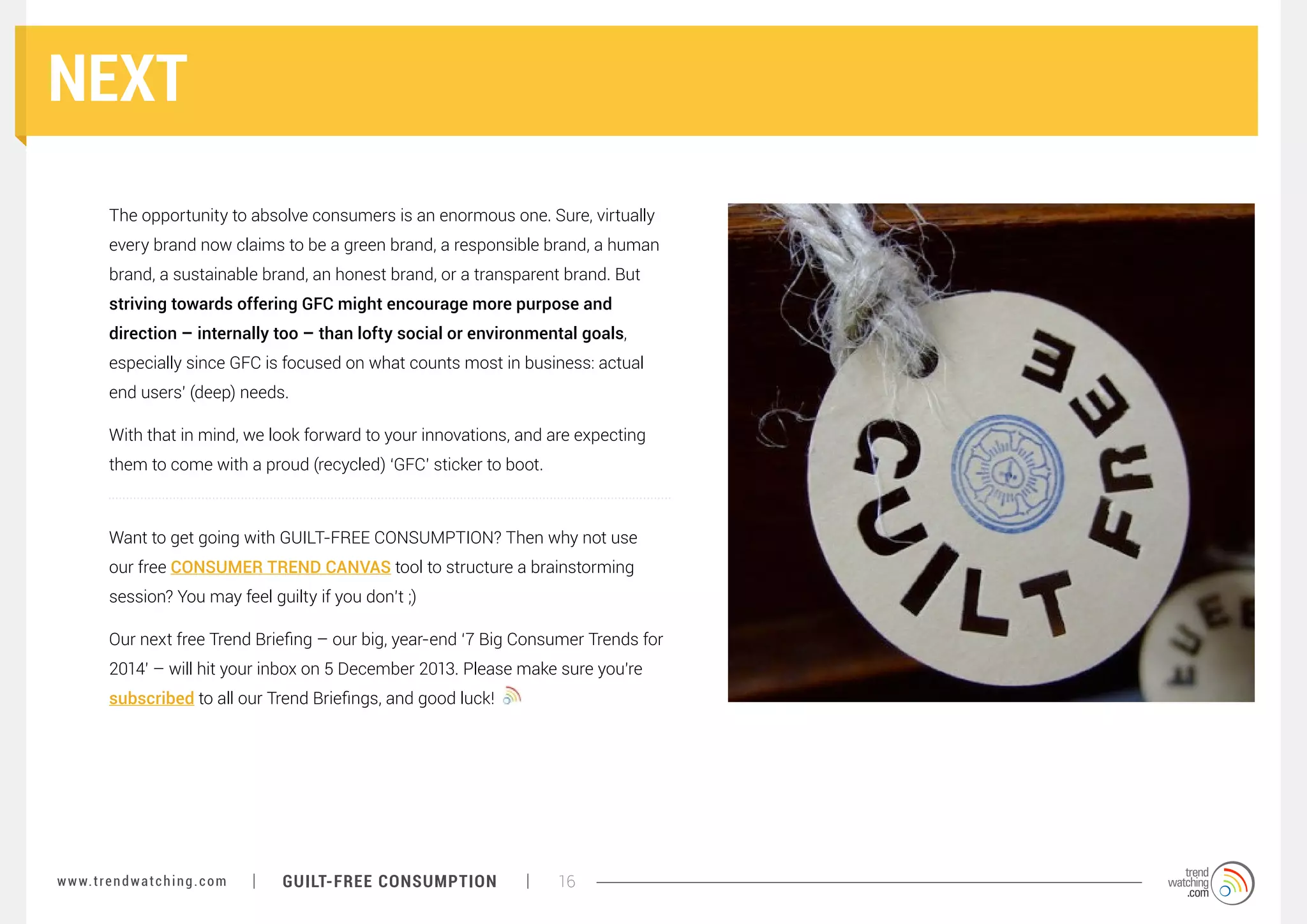
them to come with a proud (recycled) ‘GFC’ sticker to boot.

Want to get going with GUILT-FREE CONSUMPTION? Then why not use
our free CONSUMER TREND CANVAS tool to structure a brainstorming
session? You may feel guilty if you don’t ;)
Our next free Trend Briefing – our big, year-end ‘7 Big Consumer Trends for
2014’ – will hit your inbox on 5 December 2013. Please make sure you’re
subscribed to all our Trend Briefings, and good luck!

w w w. t r e n d w a t c h i n g . c o m

GUILT-FREE CONSUMPTION

16
MORE...
Enjoyed this Trend Briefing? Want more?

1. Our free monthly Trend Briefings

Join the 225,000
subscribers who receive
our free monthly Trend
Briefings

2. Our 2014 Premium Service

Should you be one of
our 1,000+ Premium
clients?

SUBSCRIBE ME »

If you have any comments, suggestions
or questions then please do let us know.
Just email:

PAUL BACKMAN
Client Services Manager
paul@trendwatching.com

About us
Established in 2002, trendwatching.com
is the world’s leading trend firm, scanning
the globe for the most promising consumer
trends, insights and related hands-on
business ideas. Our Premium Service counts

many of the world’s leading brands as
clients, while our free monthly Trend Briefings
go out to over 225,000 subscribers in 180
countries.
More at

www.trendwatching.com

trendwatching.com’s GUILT-FREE CONSUMPTION

  • 1.
    trendwatching.com’s free monthlyTrend Briefing November 2013 GUILT-FREE CONSUMPTION Why guilt-free is the new luxury for consumers, and the Holy Grail for businesses. trendwatching.com/trends/guiltfreeconsumption
  • 2.
    DEFINITION This month’s TrendBriefing highlights nothing less than the future of consumerism, if not that of business at large (yes, the future of humanity will follow next month ;). Building on our recent Trend Briefings on CLEAN SLATE BRANDS and DEMANDING BRANDS, and bringing together various strands of the HUMAN BRANDS and BETTER BUSINESS mega-trends, GUILT-FREE CONSUMPTION (GFC) is a compelling answer to the current, epic quest for more aware, more ethical, more sustainable consumerism. Note: This Trend Briefing was inspired by a recent comment from Gerald Lawless, CEO of Jumeirah Hotels, on how the future of luxury would be ‘guiltfree’. w w w. t r e n d w a t c h i n g . c o m GUILT-FREE CONSUMPTION 2 Fueled by a pervasive awareness of the conflicts between their consumerist impulses and their aspirations to be ‘good’, experienced consumers are increasingly wracked with guilt. The result? A growing hunger for a new kind of consumption: one free from worry (or at least with less worry) about its negative impact, while allowing continued indulgence.
  • 3.
    1. THE DIVIDEDSELF One of the Big Human Needs is to consider oneself ‘good’. And human beings feel good about themselves when they live according to their most deeply-held values and aspirations. Yet mature consumers are ever more aware that the desires and impulses they experience – and worse, that they constantly act upon and satisfy inside the consumer arena – often run counter to these values and aspirations. w w w. t r e n d w a t c h i n g . c o m GUILT-FREE CONSUMPTION 3
  • 4.
    1. THE DIVIDEDSELF Transparency Triumph Clean Contrast Can’t Stop, Won’t Stop Every day, consumers are served more While on top of this, the flaunting of ethical and However, a very human mix of status, information on dysfunctional business responsible behavior by a whole host of CLEAN indulgence, conditioning, addiction and genuine processes and ethics, hear the strained voices SLATE BRANDS only highlights the deeply pleasure (derived from everything from tasty of workers from developing countries, or receive flawed nature of many established products Whoppers, to romantic easyJet/AirAsia/JetBlue scientific insights on the health drawbacks and brands. Take condoms, for example. city breaks, to dirt-cheap-yet-coolish H&M of many a favorite (and processed) snack or How many consumers considered the ethical outfits, to shiny phablets), stops consumers beverage. dimensions of condoms before Sustain from substantially changing their knowingly Condoms highlighted the environmental and damaging consumption needs and patterns. It has thus become completely impossible for any individual in near- and fully mature consumer societies to claim ignorance over social abuses often found in the production of latex? the havoc his or her consumption is and has With every brand that shouts been wreaking. about not employing 9 year old child workers in Bangladesh, about not force-feeding poultry, whose products do not depend on tarry oilfueled engines, consumer doubt towards those that keep quiet grows. w w w. t r e n d w a t c h i n g . c o m GUILT-FREE CONSUMPTION 4
  • 5.
    2. NEXT: THEGUILT-SPIRAL It’s this tension – between the values that consumers hold, and the pervasive awareness that the actions they take run counter to those values – that manifests itself as the potent, nagging guilt trip that haunts many consumers today. w w w. t r e n d w a t c h i n g . c o m GUILT-FREE CONSUMPTION 5
  • 6.
    2. NEXT: THEGUILT-SPIRAL Some stats: When asked about their own diet and levels of physical activity, and to assign themselves a grade from ‘A’ to ‘F’, US consumers gave themselves an average grade of ‘C+’ for their level of physical activity, and their personal diets an average grade of ‘B-’. Only 12% gave themselves an ‘A’ or ‘A-’. When presented with the statement ‘I feel guilty about the impact I have on the environment’, 28% of global consumers* scored themselves 4 or 5 (out of 5, with 5 being ‘strongly agree’). National Geographic Greendex, July 2012 BAV & Sustainable America, March 2013 * Somewhat ironically, some emerging economies had a higher guilt level: 45% of Indians, 42% Chinese and 40% of Brazilians rated themselves 4 or 5. Contrast this with only 23% of British, 21% of Americans and 19% of Australians. In 2013, 27% of US consumers were ‘more concerned’ about food waste than in 2012, with only 5% ‘less concerned’. BAV & Sustainable America, March 2013 w w w. t r e n d w a t c h i n g . c o m GUILT-FREE CONSUMPTION 6
  • 7.
    2. NEXT: THEGUILT-SPIRAL The good news: beset by these contradictory needs – to seek pleasure in the satisfaction of impulses, and to shake off a rising feeling of guilt – consumers are now hungry for a new kind of consumption, one that will allow them to continue to enjoy consumption, yet not worry (or at least worry less) about its negative impact. w w w. t r e n d w a t c h i n g . c o m GUILT-FREE CONSUMPTION 7 Indeed, a recent global study identified 2.5 billion ‘aspirational consumers’ (representing one third of the global consumer class). These consumers are defined by their love of shopping (78%), desire for responsible consumption (92%) and their trust in brands to act in the best interest of society (58%). BBMG, GlobeScan and SustainAbility, October 2013
  • 8.
    1 2014 Trend Report Weobviously offer much more than monthly Trend Briefings... 2 Trend Framework 3 Innovations Database Introducing our 2014 Premium Service Your complete trend and innovation solution. 4 Industry Bulletins 5 Apply Toolkit Find out more 6 Monthly Updates 7 1-page Trend Handouts
  • 9.
    3. ABSOLVING GUILT Tobecome a GFC brand, brands need to first understand the various kinds of guilt currently tormenting ‘aware’ consumers. Three* types of consumer guilt: GFC & Self Guilt about what one brings on oneself. GFC & Society Guilt about what one causes, directly and indirectly, to other people (and other living creatures). GFC & Planet Guilt about one’s impact on the environment at large. * When it comes to guilt, these aren’t the only dimensions of course. Witness how newlyminted urban emerging market consumers often experience ‘cultural’ guilt: split between their desire to dive into the global consumer arena and the thought that they are ‘abandoning’ their identity and heritage (to assuage that guilt, turn to our CELEBRATION NATION trend ;) w w w. t r e n d w a t c h i n g . c o m GUILT-FREE CONSUMPTION 9
  • 10.
    3. ABSOLVING GUILT Now,GUILT-FREE doesn’t have to mean either zero-impact, ethically perfect, health-optimum consumption, or even no consumption at all**. Most consumers do not hold values that mean that even the slightest negative impact on the planet, on society or on themselves is unacceptable to them. They just want to know that this impact is as little as practically possible. Indeed, for now at least, the most potent GFC innovations will target those areas where there is greatest tension between consumer values and impulses, and help absolve the most tormenting guilt. ** Only truly reducing one’s consumption, i.e. consuming less, offers the ultimate redemption. But that’s something 99% of consumers seem not ready for yet. And neither are most brands. w w w. t r e n d w a t c h i n g . c o m GUILT-FREE CONSUMPTION 10
  • 11.
    3. ABSOLVING GUILT GFC& Self As a brand, identify the consumption choices that cause most guilt when it comes to physical and mental wellbeing: sugar, fat, alcohol, inactivity, and more. Then take steps to absolve that guilt. September 2013 saw fast food giants McDonald’s and Burger King sparring with GFC initiatives. Burger King launched Satisfries - French fries with 40% less fat and 30% fewer calories than the McDonald’s equivalent. While McDonald’s announced a global partnership with the Alliance for a Healthier Generation to make specific commitments, including always offering a choice of a side-salad, fruit or vegetables as a substitute for fries in a value meal. Or learn from a more light-hearted example: the Peddler’s Creamery ice-cream shop in Los Angeles opened its doors in April 2013, and powers its churner by asking customers to peddle an in-store bicycle. GUILT-FREE indulgence indeed! w w w. t r e n d w a t c h i n g . c o m GUILT-FREE CONSUMPTION 11
  • 12.
    3. ABSOLVING GUILT GFC& Society As a brand, identify the consumption choices that cause most guilt when it comes to other people: poor working conditions, sub-poverty wages, exploitation, and more. Go ahead: absolve the guilt! Check out Fairphone, the smartphone from the Netherlands now in production after easily breaking its pre-order target of 5,000 sales in June 2013. It’s manufactured without using conflict minerals and with a focus on worker welfare. Or how about online retailer Shop For Social, launched in Singapore in July 2013. The site partners with and curates products exclusively from local social enterprises and nonprofits, and includes handicrafts made by disabled or disadvantaged individuals. w w w. t r e n d w a t c h i n g . c o m GUILT-FREE CONSUMPTION 12
  • 13.
    3. ABSOLVING GUILT GFC& Planet Fossil fuels and CO2 emissions, wasteful packaging, nonbiodegradable materials, rainforest destruction: there is no shortage of potent guilt when it comes to the planet. A few recent examples to learn from: The already-iconic Tesla Model S aims to absolve the vast guilt that exists around driving. Quartz recently reported Tesla was outselling Buick, Cadillac, Chrysler, Fiat, Jaguar, Land Rover, Lincoln, Mitsubishi, Porsche and Volvo in California this June. Eating sushi is notoriously environmentally suspect. Miya’s Sushi in Connecticut, US, goes beyond simply not including endangered fish such as yellow tail tuna on its menu: it offers dishes made with non-native, invasive species that are damaging the local habitat, and thus eating (and enjoying) them makes customers part of the solution. How’s that for GUILT-FREE?! w w w. t r e n d w a t c h i n g . c o m GUILT-FREE CONSUMPTION 13
  • 14.
    3. ABSOLVING GUILT GFC& Planet (cont.) An energy efficiency hackathon in Singapore was recently won by the Wish Lit app. It allows the user to enter the cost of a desired object and then calculates how much energy they need to save in order to purchase it. And there are endless other big brand examples too. Just recently: Patagonia’s ‘Responsible Economy’ research effort, Chipotle’s ‘The Scarecrow’ animation, Nike’s Making app, Dell’s zero waste initiative, and Unilever’s purchase of algaederived oil… So be more than just eco-conscious, and embrace everything from cradleto-cradle, the circular economy, collaborative consumption (Airbnb is a great example of experience indulgence ‘allowed’ because it’s using existing assets) and more in your quest to become totally eco-neutral if not eco-positive. w w w. t r e n d w a t c h i n g . c o m GUILT-FREE CONSUMPTION 14
  • 15.
    3. ABSOLVING GUILT TotalGFC The sweet spot for any GUILT-FREE brand is, of course, to deliver in all three categories simultaneously. If your brand can identify the guilt attached to what you do across the SELF, SOCIETY and PLANET domains, and then absolve it, you’re nearing TOTAL GUILTFREE CONSUMPTION. The ultimate? Consumption that goes beyond GUILT-FREE, and becomes actively positive in its impact across every domain. That is, true consumption nirvana. Is it possible? How big is the universe? We don’t know! Yet ;) w w w. t r e n d w a t c h i n g . c o m GUILT-FREE CONSUMPTION 15
  • 16.
    NEXT The opportunity toabsolve consumers is an enormous one. Sure, virtually every brand now claims to be a green brand, a responsible brand, a human brand, a sustainable brand, an honest brand, or a transparent brand. But striving towards offering GFC might encourage more purpose and direction – internally too – than lofty social or environmental goals, especially since GFC is focused on what counts most in business: actual end users’ (deep) needs. With that in mind, we look forward to your innovations, and are expecting them to come with a proud (recycled) ‘GFC’ sticker to boot. Want to get going with GUILT-FREE CONSUMPTION? Then why not use our free CONSUMER TREND CANVAS tool to structure a brainstorming session? You may feel guilty if you don’t ;) Our next free Trend Briefing – our big, year-end ‘7 Big Consumer Trends for 2014’ – will hit your inbox on 5 December 2013. Please make sure you’re subscribed to all our Trend Briefings, and good luck! w w w. t r e n d w a t c h i n g . c o m GUILT-FREE CONSUMPTION 16
  • 17.
    MORE... Enjoyed this TrendBriefing? Want more? 1. Our free monthly Trend Briefings Join the 225,000 subscribers who receive our free monthly Trend Briefings 2. Our 2014 Premium Service Should you be one of our 1,000+ Premium clients? SUBSCRIBE ME » If you have any comments, suggestions or questions then please do let us know. Just email: PAUL BACKMAN Client Services Manager paul@trendwatching.com About us Established in 2002, trendwatching.com is the world’s leading trend firm, scanning the globe for the most promising consumer trends, insights and related hands-on business ideas. Our Premium Service counts many of the world’s leading brands as clients, while our free monthly Trend Briefings go out to over 225,000 subscribers in 180 countries. More at www.trendwatching.com