BBMG PRESENTS 
Reclaimism 
Aspirational Consumers 
and Emerging Trends 
JUNE 2014
2 
reclaimism 
[ree-kleym-ism] 
noun 
1. the art and science of reselling, 
remaking and rediscovering 
used products. 
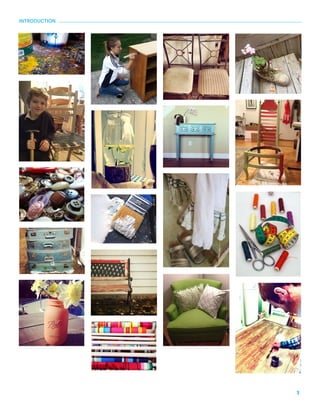
INTRODUCTION
3 
INTRODUCTION
Pioneering apparel brand Patagonia takes 
out a single full-page ad. “Do not buy our 
jackets,” it says. Repair them instead. Yerdle, 
a new startup based in San Francisco, urges 
members to “nab” items from each other, 
a more sophisticated take on the “freecycling” 
movement. And Macklemore and Ryan 
Lewis, a white hip-hop duo from Seattle, win 
multiple Grammy awards for their hit 
single “Thrift Shop,” a playful critique 
of conspicuous consumption. 
4 
Once again used is cool. 
But where previous 
throw-backs to “what’s 
old is new again” focused 
mainly on vintage apparel 
and paid homage to 
certain styles (e.g., 
fifties leather bomber 
jacket, anyone?), today’s 
movement finds higher 
purpose in extending the 
lives of category-spanning 
products through repairing, 
reselling or finding other 
creative uses for them. 
The rise of localism, the 
Do-It-Yourself movement 
and collaborative 
consumption business 
models (think AirBnB, 
Uber, TaskRabbit) are 
corollaries to the trend 
we call reclaimism, part of 
an emerging ecosystem 
of products, services and 
experiences that make it 
easier to live well and do 
good. Big brands are taking 
notice, too, recognizing the 
trend as a key signifier of 
Aspirational consumers, a 
fast-growing segment that 
refuses to compromise and 
wants to unite style and 
status with social purpose. 
This snapshot—the first 
in a series from brand 
innovation firm BBMG— 
brings the trend to life by 
articulating its key themes, 
providing related brand 
examples, consumer 
stories and clear takeaways 
for today’s forward-thinking 
brands. 
INTRODUCTION
5 
INTRODUCTION 
“50% of Aspirational 
consumers are 
making, repairing 
or reusing products 
rather than buying 
new ones.” 
Rethinking Consumption: Consumers and the Future of Sustainability (2013)1 
The insights are based on our primary research, both 
quantitative research conducted with GlobeScan in 
20 markets and qualitative research conducted with 
The Collective, BBMG’s online community of 2,500+ 
Aspirational consumers. 
If you enjoy the report, by all means please share it. 
Sign-up to receive future trend snapshots at bbmg.com. 
Or check TheAspirationals.com for regular updates. This 
microsite houses key data points, expert commentary, 
press clips, videos and more about how Aspirationals are 
driving a profound shift toward sustainable consumption. 
The power of reclaimism is not to be underestimated. 
The most sustainable product, after all, is one that 
already exists.
Trend Drivers. 
Why are we seeing such a big uptick around reclaimism? 
The following pages explore five key drivers of the trend. 
All are unfolding against a backdrop of social change 
influenced by increasing globalization, protracted 
economic recession, disruptive new technologies and 
generational shifts bringing new perspectives 
on individual and corporate responsibility.
7 
No wonder consumers feel 
good about buying used— 
they’re saving money. And 
though it’s often cheaper 
to purchase used over 
new, buying second-hand 
now carries a certain 
caché: you’re doing your 
part, keeping items from 
landfills, saving resources, 
conscious about the 
implications of your 
consumption, proud to be 
part of a larger movement 
interested in sharing, 
wasting less and enjoying 
more of what matters in 
life. The larger economic 
climate is only spurring 
the trend. 
“Resale shops are thriving, 
popping up across the 
country,” says Adele Meyer, 
executive director of the 
Association of Resale 
Professionals, which 
tracked a 7% increase 
in the number of resale 
shops within the last year.2 
“The thrift store is now 
cooler than the mall,” she 
says. About 20 percent of 
consumers now shop in 
thrift stores, compared to 
14 percent in 2008. 
An e-commerce startup like 
Rent the Runway—whose 
membership in its first four 
years went from zero to 3.5 
million—allows members 
to rent used haute couture 
1. Save money. Do good. 
looks with a few clicks of 
a computer mouse. 
Jennifer Fleiss, Rent the 
Runway’s co-founder, says 
that the company’s core 
demographic includes 
Millennial women who 
generally wouldn’t be able 
to buy high-end designer 
dresses. Side benefit: 
renting luxury goods 
becomes a pathway to 
empowerment for many. 
“We see young women 
putting on these dresses 
and feeling empowered, 
twirling in the mirror,” says 
Fleiss. “That’s amazingly 
gratifying.” 3 
TREND DRIVERS
8 
TREND DRIVERS 
“Most people 
share because 
of convenience 
and price, not 
an overwhelming 
desire to live 
sustainably.” 
Ariel Schwartz, FastCo.Exist 
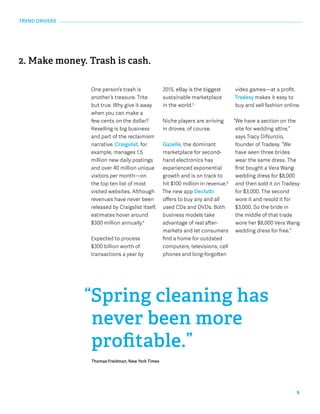
Angie, 42, Minnesota, loves buying used, 
“new-to-me” clothing for many reasons. 
“I often get my clothes from either a clothing swap 
or second-hand store. The clothes are in great 
condition. I save tons of money. I discover fun things 
that I might not otherwise try, and I keep more 
things from being manufactured.”
9 
One person’s trash is 
another’s treasure. Trite 
but true. Why give it away 
when you can make a 
few cents on the dollar? 
Reselling is big business 
and part of the reclaimism 
narrative. Craigslist, for 
example, manages 1.5 
million new daily postings 
and over 40 million unique 
visitors per month—on 
the top ten list of most 
visited websites. Although 
revenues have never been 
released by Craigslist itself, 
estimates hover around 
$300 million annually.4 
Expected to process 
$300 billion worth of 
transactions a year by 
2015, eBay is the biggest 
sustainable marketplace 
in the world.5 
Niche players are arriving 
in droves, of course. 
Gazelle, the dominant 
marketplace for second-hand 
electronics has 
experienced exponential 
growth and is on track to 
hit $100 million in revenue.6 
The new app Decluttr 
offers to buy any and all 
used CDs and DVDs. Both 
business models take 
advantage of real after-markets 
and let consumers 
find a home for outdated 
computers, televisions, cell 
phones and long-forgotten 
2. Make money. Trash is cash. 
video games—at a profit. 
Tradesy makes it easy to 
buy and sell fashion online. 
“We have a section on the 
site for wedding attire,” 
says Tracy DiNunzio, 
founder of Tradesy. “We 
have seen three brides 
wear the same dress. The 
first bought a Vera Wang 
wedding dress for $8,000 
and then sold it on Tradesy 
for $3,000. The second 
wore it and resold it for 
$3,000. So the bride in 
the middle of that trade 
wore her $8,000 Vera Wang 
wedding dress for free.” 
“Spring cleaning has 
never been more 
profitable.” 
Thomas Freidman, New York Times 
TREND DRIVERS
10 
Platforms like Tradesy remove the friction and risk from 
multiparty transactions. Consumers feel empowered 
to sell their space, their belongings and their time in ways 
that weren’t previously possible. Durable goods cease 
to be ‘belongings’ but objects to enjoy and pass along, 
either by selling or giving them away. This has the added 
benefit of promoting better care: you’ll get more money 
if it’s in great shape. And it cuts down on clutter, the 
hassle of accumulating more stuff than you need. In sum, 
it’s about access to good stuff rather than the stuff itself. 
“We’re moving from 
a world where we’re 
organized around 
ownership to one 
organized around 
access to assets.” 
Lisa Gansky, author of The Mesh: 
Why the Future of Business Is Sharing 
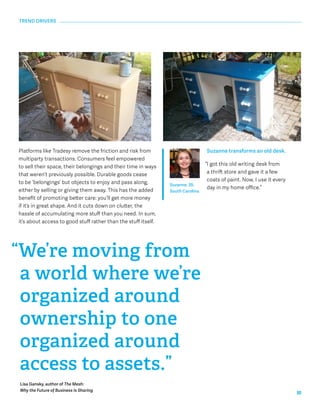
Suzanne transforms an old desk. 
“I got this old writing desk from 
a thrift store and gave it a few 
coats of paint. Now, I use it every 
Suzanne, 39, day in my home office.” 
South Carolina 
TREND DRIVERS
11 
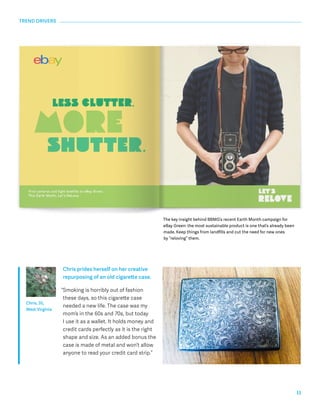
The key insight behind BBMG’s recent Earth Month campaign for 
eBay Green: the most sustainable product is one that’s already been 
made. Keep things from landfills and cut the need for new ones 
by “reloving” them. 
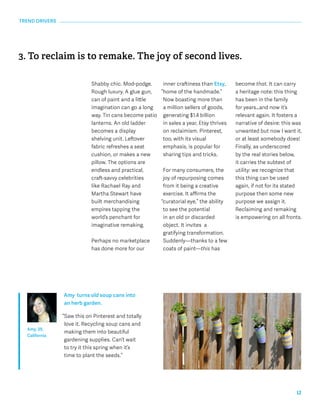
Chris prides herself on her creative 
repurposing of an old cigarette case. 
“Smoking is horribly out of fashion 
these days, so this cigarette case 
needed a new life. The case was my 
mom’s in the 60s and 70s, but today 
I use it as a wallet. It holds money and 
credit cards perfectly as it is the right 
shape and size. As an added bonus the 
case is made of metal and won’t allow 
anyone to read your credit card strip.” 
TREND DRIVERS 
Chris, 35, 
West Virginia
12 
TREND DRIVERS 
3. To reclaim is to remake. The joy of second lives. 
Shabby chic. Mod-podge. 
Rough luxury. A glue gun, 
can of paint and a little 
imagination can go a long 
way. Tin cans become patio 
lanterns. An old ladder 
becomes a display 
shelving unit. Leftover 
fabric refreshes a seat 
cushion, or makes a new 
pillow. The options are 
endless and practical, 
craft-savvy celebrities 
like Rachael Ray and 
Martha Stewart have 
built merchandising 
empires tapping the 
world’s penchant for 
imaginative remaking. 
Perhaps no marketplace 
has done more for our 
inner craftiness than Etsy, 
“home of the handmade.” 
Now boasting more than 
a million sellers of goods, 
generating $1.4 billion 
in sales a year, Etsy thrives 
on reclaimism. Pinterest, 
too, with its visual 
emphasis, is popular for 
sharing tips and tricks. 
For many consumers, the 
joy of repurposing comes 
from it being a creative 
exercise. It affirms the 
“curatorial eye,” the ability 
to see the potential 
in an old or discarded 
object. It invites a 
gratifying transformation. 
Suddenly—thanks to a few 
coats of paint—this has 
become that. It can carry 
a heritage note: this thing 
has been in the family 
for years…and now it’s 
relevant again. It fosters a 
narrative of desire: this was 
unwanted but now I want it, 
or at least somebody does! 
Finally, as underscored 
by the real stories below, 
it carries the subtext of 
utility: we recognize that 
this thing can be used 
again, if not for its stated 
purpose then some new 
purpose we assign it. 
Reclaiming and remaking 
is empowering on all fronts. 
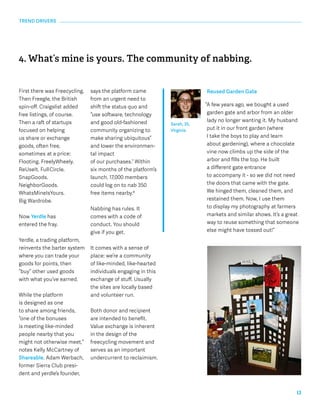
Amy turns old soup cans into 
an herb garden. 
“Saw this on Pinterest and totally 
love it. Recycling soup cans and 
making them into beautiful 
gardening supplies. Can’t wait 
to try it this spring when it’s 
time to plant the seeds.” 
Amy, 39, 
California
13 
4. What’s mine is yours. The community of nabbing. 
Reused Garden Gate 
“A few years ago, we bought a used 
garden gate and arbor from an older 
lady no longer wanting it. My husband 
put it in our front garden (where 
I take the boys to play and learn 
about gardening), where a chocolate 
vine now climbs up the side of the 
arbor and fills the top. He built 
a different gate entrance 
to accompany it - so we did not need 
the doors that came with the gate. 
We hinged them, cleaned them, and 
restained them. Now, I use them 
to display my photography at farmers 
markets and similar shows. It’s a great 
way to reuse something that someone 
else might have tossed out!” 
Sarah, 35, 
Virginia 
TREND DRIVERS 
First there was Freecycling. 
Then Freegle, the British 
spin-off. Craigslist added 
free listings, of course. 
Then a raft of startups 
focused on helping 
us share or exchange 
goods, often free, 
sometimes 
at a price: 
Flooting. FreelyWheely. 
ReUseIt. Full 
Circle. 
SnapGoods. 
NeighborGoods. 
WhatsMineIsYours. 
Big Wardrobe. 
Now Yerdle has 
entered the fray. 
Yerdle, a trading platform, 
reinvents the barter system 
where you can trade your 
goods for points, then 
“buy” other used goods 
with what you’ve earned. 
While the platform 
is designed as one 
to share among friends, 
“one of the bonuses 
is meeting like-minded 
people nearby that you 
might not otherwise meet,” 
notes Kelly McCartney of 
Shareable. Adam Werbach, 
former Sierra Club presi-dent 
and yerdle’s founder, 
says the platform came 
from an urgent need to 
shift the status quo and 
“use software, technology 
and good old-fashioned 
community organizing to 
make sharing ubiquitous” 
and lower the environmen-tal 
impact 
of our purchases.7 Within 
six months of the platform’s 
launch, 17,000 members 
could log on to nab 350 
free items nearby.8 
Nabbing has rules. It 
comes with a code of 
conduct. You should 
give if you get. 
It comes with a sense of 
place: we’re a community 
of like-minded, like-hearted 
individuals engaging in this 
exchange of stuff. Usually 
the sites are locally based 
and volunteer run. 
Both donor and recipient 
are intended to benefit. 
Value exchange is inherent 
in the design of the 
freecycling movement and 
serves as an important 
undercurrent to reclaimism.
14 
“We need to radically 
change the way 
we acquire the 
things we want.” 
Adam Werbach, founder of yerdle 
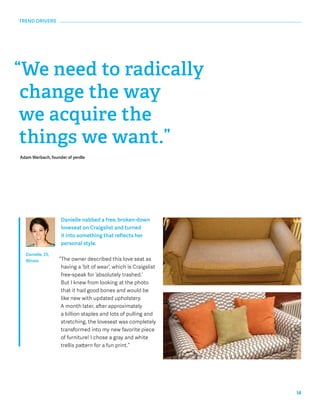
Danielle nabbed a free, broken-down 
loveseat on Craigslist and turned 
it into something that reflects her 
personal style. 
“The owner described this love seat as 
having a ‘bit of wear’, which is Craigslist 
free-speak for ‘absolutely trashed.’ 
But I knew from looking at the photo 
that it had good bones and would be 
like new with updated upholstery. 
A month later, after approximately 
a billion staples and lots of pulling and 
stretching, the loveseat was completely 
transformed into my new favorite piece 
of furniture! I chose a gray and white 
trellis pattern for a fun print.” 
TREND DRIVERS 
Danielle, 25, 
Illinois
15 
We’d like our clothes 
back now, thanks very 
much. Big brands have 
started moving to meet 
the growing consumer 
desire for sharing and 
repurposing. It makes 
sense. The designers, 
makers and distributors 
have roles to play in 
promoting reclaimism but 
also stand to gain loyalty 
and reputation by adopting 
a proactive stance. 
In 2013 Eileen Fisher 
released a cheeky Earth 
Month campaign that 
launched their “Green 
Eileen” Collection Program. 
It encouraged shoppers to 
return gently worn apparel 
in exchange for a tax 
receipt and $5 Recycling 
Rewards coupon, valid at 
any Eileen Fisher store 
or online. The brand also 
launched a new store 
concept under the “Green 
Eileen” umbrella to sell 
the gently worn items 
consumers returned at four 
locations nation-wide. This 
move is environmentally-and 
socially-impactful: 
the proceeds from any 
sales go toward funding 
one of a slew of non-profit 
causes, from the National 
Women’s History Museum 
to Planned Parenthood. 
To date, the program 
has collected 203,000 
garments and raised more 
than $450,000 in its first 
two years.9 
Through its Common 
Threads Partnership, 
Patagonia helps 
consumers find new homes 
for the Patagonia products 
they no longer use. 
Patagonia buys back used 
items and consumers can 
shop returned products in 
stores and on eBay. With its 
“Worn Wear” blog, Patagonia 
shares consumers’ stories 
of travel, adventure and 
the resilient clothing that 
makes it all possible. 
As of last year, 60,000 
consumers have taken the 
Common Threads Pledge, 
agreeing to buy only what 
they need, repair what 
breaks and share what 
they don’t need. Vickie 
Achee, Patagonia’s head of 
retail marketing, says “Our 
customers love knowing 
they can find their gear 
a second home while 
earning credit toward 
new or used products for 
themselves, all while doing 
their part to reuse, recycle 
and keep Patagonia gear 
out of the landfill.”10 
Sprint has a buyback 
program, too, one of 
the first of its kind— 
consumers trade in their 
old wireless devices 
and receive up to $300 
in account credit. As of 
March 2014, Sprint Buyback 
and the brand’s other 
wireless device recycling 
initiatives have collected 
more than 50 million items. 
TREND DRIVERS 
5. Take me back. Branding the good loop.
16 
TREND DRIVERS 
Darren Beck, director of Sprint’s environmental initiatives, 
noted that the “buyback program can help customers 
offset some of the cost of their next device and helps 
Sprint avoid substantial operating costs by reusing most 
of the devices we collect. It also helps our communities, 
reducing electronics in landfills and reducing the 
resources, energy and emissions required to produce 
even more new devices.”11 
In 2013, Sprint broke the Guinness World Record for the 
“most cell phones recycled in one week” with 103,582 
phones recycled, more than twice the previous record.12 
Lululemon’s recent missteps showed the folly of trying to 
fight reclaimism. Following a massive recall and offensive 
comments referencing plus-size consumers, the 
company made a puzzling but concerted effort to stop 
consumer attempts at creating a second-hand market 
for Lululemon apparel and accessories, going so far as 
to ban some customers from the brand’s e-commerce 
site and trying to dissuade consumers from reselling 
merchandise on eBay. Predictable backlash and bad PR 
followed with the company finally, reluctantly, issuing 
an apology. Many experts note, however, that the 
brand’s ethos—promoting mindfulness—has been 
called into question.13
Implications. 
In the end, reclaimism is sure to rise in frequency and 
import, spurred by sustainable brand innovation and 
consumers’ increasing desire to do good, save money, 
make money, have fun, be creative and support local 
communities and brand partners that get it.
18 
IMPLICATIONS 
How might you leverage this trend to drive growth, 
loyalty and deeper consumer engagement? 
Here are a few thought-starters and implications given 
the dynamics at work: 
Embed it. 
Authenticity is key. Host a visioning workshop 
to determine how reclaimism can strategically and 
authentically fit into your ethos or mission—not 
become “tacked on” to an existing marketing strategy. 
Make it easy. 
Pre-paid postage. Bins in stores. Partnerships with 
local programs or take-back facilities. How can 
you take friction out of the process and ensure 
participation that closes the loop? Do whatever 
it takes to make it easy. Otherwise it’s just lip 
service and not part of a long-term strategy. 
Make it rewarding. 
Incentivize participation through a mix of benefits. 
Discounts on future purchases. Points that can 
be redeemed for goods/services from your brand 
or from affinity brand partners. Badges that 
recognize frequency, volume or level 
of engagement with the program. 
Happy 
reclaiming.
19 
1. BBMG, GlobeScan & SustainAbility. (2012, November 12). 
Rethinking Consumption: Consumers and the Future 
of Sustainability. 
2. Tully, J. (2012, July 12). Recession has many looking thrift store 
chic. USA TODAY 
3. Galbraith, S. (2013, December 3). The Secret Behind Rent the 
Runway’s Success. Forbes. 
4. Kidd, G. (2011, June 6). White Paper: Craigslist: By the 
Numbers. 3Taps. 
5. Friedman, T. (2013, December 21). How to Monetize Your 
Closet. The New York Times. 
6. Kirsner, S. (2013, April 12). Electronics reseller Gazelle on track 
to hit $100 million in revenue for 2013. Boston.com. 
7. McCartney, K., & Gorenflo, N. (2012, November 23). 
AdamWerbach Launches yerdle on Black Friday with 10,000 
Free Items. Shareable. 
8. Aster, N. (2013, June 15). Video Interview: Adam Werbach, 
yerdle’s 6 Month Progress Report. Triple Pundit RSS. 
9. Green Eileen Store Opens in Yonkers. (2011, December 
1). Westchester Putnam NY Natural Awakenings. 
10. Patagonia’s Common Threads Worn Wear™ Program Comes to 
Denver. Transworld Business RSS. 
11. Sprint. (2014, March 14). As Wireless Carriers Race to Reclaim 
Phones, Sprint Phone Trade-in Program Remains No. 1. 
12. Sprint. (2013, September 4). Sprint Breaks GUINNESS WORLD 
RECORDS® Record for the Most Cell Phones Recycled 
in One Week. 
13. Shayon, S. (2014, February 20). Lululemon Tried to Ban 
Customers from Reselling Clothes, Because That’s Going to 
Go Over Well. Brand Channel. 
END NOTES
This snapshot is designed to inspire dialogue about the emerging 
trend of reclaimism, as evidenced by the attitudes, behaviors and 
values of Aspirational consumers, a global consumer segment 
that cares about uniting style, status and sustainability. 
For the latest data points, trends and best practices, visit 
TheAspirationals.com 
Executive Creative Director: Mitch Baranowski 
Associate Creative Director: Casey Coyle 
Designer: Maddie Young 
Strategist: Suzanna Schumacher 
Associate Editor: Carola Beeney

Reclaimism: Aspirational Consumers and Emerging Trends

  • 1.
    BBMG PRESENTS Reclaimism Aspirational Consumers and Emerging Trends JUNE 2014
  • 2.
    2 reclaimism [ree-kleym-ism] noun 1. the art and science of reselling, remaking and rediscovering used products. INTRODUCTION
  • 3.
  • 4.
    Pioneering apparel brandPatagonia takes out a single full-page ad. “Do not buy our jackets,” it says. Repair them instead. Yerdle, a new startup based in San Francisco, urges members to “nab” items from each other, a more sophisticated take on the “freecycling” movement. And Macklemore and Ryan Lewis, a white hip-hop duo from Seattle, win multiple Grammy awards for their hit single “Thrift Shop,” a playful critique of conspicuous consumption. 4 Once again used is cool. But where previous throw-backs to “what’s old is new again” focused mainly on vintage apparel and paid homage to certain styles (e.g., fifties leather bomber jacket, anyone?), today’s movement finds higher purpose in extending the lives of category-spanning products through repairing, reselling or finding other creative uses for them. The rise of localism, the Do-It-Yourself movement and collaborative consumption business models (think AirBnB, Uber, TaskRabbit) are corollaries to the trend we call reclaimism, part of an emerging ecosystem of products, services and experiences that make it easier to live well and do good. Big brands are taking notice, too, recognizing the trend as a key signifier of Aspirational consumers, a fast-growing segment that refuses to compromise and wants to unite style and status with social purpose. This snapshot—the first in a series from brand innovation firm BBMG— brings the trend to life by articulating its key themes, providing related brand examples, consumer stories and clear takeaways for today’s forward-thinking brands. INTRODUCTION
  • 5.
    5 INTRODUCTION “50%of Aspirational consumers are making, repairing or reusing products rather than buying new ones.” Rethinking Consumption: Consumers and the Future of Sustainability (2013)1 The insights are based on our primary research, both quantitative research conducted with GlobeScan in 20 markets and qualitative research conducted with The Collective, BBMG’s online community of 2,500+ Aspirational consumers. If you enjoy the report, by all means please share it. Sign-up to receive future trend snapshots at bbmg.com. Or check TheAspirationals.com for regular updates. This microsite houses key data points, expert commentary, press clips, videos and more about how Aspirationals are driving a profound shift toward sustainable consumption. The power of reclaimism is not to be underestimated. The most sustainable product, after all, is one that already exists.
  • 6.
    Trend Drivers. Whyare we seeing such a big uptick around reclaimism? The following pages explore five key drivers of the trend. All are unfolding against a backdrop of social change influenced by increasing globalization, protracted economic recession, disruptive new technologies and generational shifts bringing new perspectives on individual and corporate responsibility.
  • 7.
    7 No wonderconsumers feel good about buying used— they’re saving money. And though it’s often cheaper to purchase used over new, buying second-hand now carries a certain caché: you’re doing your part, keeping items from landfills, saving resources, conscious about the implications of your consumption, proud to be part of a larger movement interested in sharing, wasting less and enjoying more of what matters in life. The larger economic climate is only spurring the trend. “Resale shops are thriving, popping up across the country,” says Adele Meyer, executive director of the Association of Resale Professionals, which tracked a 7% increase in the number of resale shops within the last year.2 “The thrift store is now cooler than the mall,” she says. About 20 percent of consumers now shop in thrift stores, compared to 14 percent in 2008. An e-commerce startup like Rent the Runway—whose membership in its first four years went from zero to 3.5 million—allows members to rent used haute couture 1. Save money. Do good. looks with a few clicks of a computer mouse. Jennifer Fleiss, Rent the Runway’s co-founder, says that the company’s core demographic includes Millennial women who generally wouldn’t be able to buy high-end designer dresses. Side benefit: renting luxury goods becomes a pathway to empowerment for many. “We see young women putting on these dresses and feeling empowered, twirling in the mirror,” says Fleiss. “That’s amazingly gratifying.” 3 TREND DRIVERS
  • 8.
    8 TREND DRIVERS “Most people share because of convenience and price, not an overwhelming desire to live sustainably.” Ariel Schwartz, FastCo.Exist Angie, 42, Minnesota, loves buying used, “new-to-me” clothing for many reasons. “I often get my clothes from either a clothing swap or second-hand store. The clothes are in great condition. I save tons of money. I discover fun things that I might not otherwise try, and I keep more things from being manufactured.”
  • 9.
    9 One person’strash is another’s treasure. Trite but true. Why give it away when you can make a few cents on the dollar? Reselling is big business and part of the reclaimism narrative. Craigslist, for example, manages 1.5 million new daily postings and over 40 million unique visitors per month—on the top ten list of most visited websites. Although revenues have never been released by Craigslist itself, estimates hover around $300 million annually.4 Expected to process $300 billion worth of transactions a year by 2015, eBay is the biggest sustainable marketplace in the world.5 Niche players are arriving in droves, of course. Gazelle, the dominant marketplace for second-hand electronics has experienced exponential growth and is on track to hit $100 million in revenue.6 The new app Decluttr offers to buy any and all used CDs and DVDs. Both business models take advantage of real after-markets and let consumers find a home for outdated computers, televisions, cell phones and long-forgotten 2. Make money. Trash is cash. video games—at a profit. Tradesy makes it easy to buy and sell fashion online. “We have a section on the site for wedding attire,” says Tracy DiNunzio, founder of Tradesy. “We have seen three brides wear the same dress. The first bought a Vera Wang wedding dress for $8,000 and then sold it on Tradesy for $3,000. The second wore it and resold it for $3,000. So the bride in the middle of that trade wore her $8,000 Vera Wang wedding dress for free.” “Spring cleaning has never been more profitable.” Thomas Freidman, New York Times TREND DRIVERS
  • 10.
    10 Platforms likeTradesy remove the friction and risk from multiparty transactions. Consumers feel empowered to sell their space, their belongings and their time in ways that weren’t previously possible. Durable goods cease to be ‘belongings’ but objects to enjoy and pass along, either by selling or giving them away. This has the added benefit of promoting better care: you’ll get more money if it’s in great shape. And it cuts down on clutter, the hassle of accumulating more stuff than you need. In sum, it’s about access to good stuff rather than the stuff itself. “We’re moving from a world where we’re organized around ownership to one organized around access to assets.” Lisa Gansky, author of The Mesh: Why the Future of Business Is Sharing Suzanne transforms an old desk. “I got this old writing desk from a thrift store and gave it a few coats of paint. Now, I use it every Suzanne, 39, day in my home office.” South Carolina TREND DRIVERS
  • 11.
    11 The keyinsight behind BBMG’s recent Earth Month campaign for eBay Green: the most sustainable product is one that’s already been made. Keep things from landfills and cut the need for new ones by “reloving” them. Chris prides herself on her creative repurposing of an old cigarette case. “Smoking is horribly out of fashion these days, so this cigarette case needed a new life. The case was my mom’s in the 60s and 70s, but today I use it as a wallet. It holds money and credit cards perfectly as it is the right shape and size. As an added bonus the case is made of metal and won’t allow anyone to read your credit card strip.” TREND DRIVERS Chris, 35, West Virginia
  • 12.
    12 TREND DRIVERS 3. To reclaim is to remake. The joy of second lives. Shabby chic. Mod-podge. Rough luxury. A glue gun, can of paint and a little imagination can go a long way. Tin cans become patio lanterns. An old ladder becomes a display shelving unit. Leftover fabric refreshes a seat cushion, or makes a new pillow. The options are endless and practical, craft-savvy celebrities like Rachael Ray and Martha Stewart have built merchandising empires tapping the world’s penchant for imaginative remaking. Perhaps no marketplace has done more for our inner craftiness than Etsy, “home of the handmade.” Now boasting more than a million sellers of goods, generating $1.4 billion in sales a year, Etsy thrives on reclaimism. Pinterest, too, with its visual emphasis, is popular for sharing tips and tricks. For many consumers, the joy of repurposing comes from it being a creative exercise. It affirms the “curatorial eye,” the ability to see the potential in an old or discarded object. It invites a gratifying transformation. Suddenly—thanks to a few coats of paint—this has become that. It can carry a heritage note: this thing has been in the family for years…and now it’s relevant again. It fosters a narrative of desire: this was unwanted but now I want it, or at least somebody does! Finally, as underscored by the real stories below, it carries the subtext of utility: we recognize that this thing can be used again, if not for its stated purpose then some new purpose we assign it. Reclaiming and remaking is empowering on all fronts. Amy turns old soup cans into an herb garden. “Saw this on Pinterest and totally love it. Recycling soup cans and making them into beautiful gardening supplies. Can’t wait to try it this spring when it’s time to plant the seeds.” Amy, 39, California
  • 13.
    13 4. What’smine is yours. The community of nabbing. Reused Garden Gate “A few years ago, we bought a used garden gate and arbor from an older lady no longer wanting it. My husband put it in our front garden (where I take the boys to play and learn about gardening), where a chocolate vine now climbs up the side of the arbor and fills the top. He built a different gate entrance to accompany it - so we did not need the doors that came with the gate. We hinged them, cleaned them, and restained them. Now, I use them to display my photography at farmers markets and similar shows. It’s a great way to reuse something that someone else might have tossed out!” Sarah, 35, Virginia TREND DRIVERS First there was Freecycling. Then Freegle, the British spin-off. Craigslist added free listings, of course. Then a raft of startups focused on helping us share or exchange goods, often free, sometimes at a price: Flooting. FreelyWheely. ReUseIt. Full Circle. SnapGoods. NeighborGoods. WhatsMineIsYours. Big Wardrobe. Now Yerdle has entered the fray. Yerdle, a trading platform, reinvents the barter system where you can trade your goods for points, then “buy” other used goods with what you’ve earned. While the platform is designed as one to share among friends, “one of the bonuses is meeting like-minded people nearby that you might not otherwise meet,” notes Kelly McCartney of Shareable. Adam Werbach, former Sierra Club presi-dent and yerdle’s founder, says the platform came from an urgent need to shift the status quo and “use software, technology and good old-fashioned community organizing to make sharing ubiquitous” and lower the environmen-tal impact of our purchases.7 Within six months of the platform’s launch, 17,000 members could log on to nab 350 free items nearby.8 Nabbing has rules. It comes with a code of conduct. You should give if you get. It comes with a sense of place: we’re a community of like-minded, like-hearted individuals engaging in this exchange of stuff. Usually the sites are locally based and volunteer run. Both donor and recipient are intended to benefit. Value exchange is inherent in the design of the freecycling movement and serves as an important undercurrent to reclaimism.
  • 14.
    14 “We needto radically change the way we acquire the things we want.” Adam Werbach, founder of yerdle Danielle nabbed a free, broken-down loveseat on Craigslist and turned it into something that reflects her personal style. “The owner described this love seat as having a ‘bit of wear’, which is Craigslist free-speak for ‘absolutely trashed.’ But I knew from looking at the photo that it had good bones and would be like new with updated upholstery. A month later, after approximately a billion staples and lots of pulling and stretching, the loveseat was completely transformed into my new favorite piece of furniture! I chose a gray and white trellis pattern for a fun print.” TREND DRIVERS Danielle, 25, Illinois
  • 15.
    15 We’d likeour clothes back now, thanks very much. Big brands have started moving to meet the growing consumer desire for sharing and repurposing. It makes sense. The designers, makers and distributors have roles to play in promoting reclaimism but also stand to gain loyalty and reputation by adopting a proactive stance. In 2013 Eileen Fisher released a cheeky Earth Month campaign that launched their “Green Eileen” Collection Program. It encouraged shoppers to return gently worn apparel in exchange for a tax receipt and $5 Recycling Rewards coupon, valid at any Eileen Fisher store or online. The brand also launched a new store concept under the “Green Eileen” umbrella to sell the gently worn items consumers returned at four locations nation-wide. This move is environmentally-and socially-impactful: the proceeds from any sales go toward funding one of a slew of non-profit causes, from the National Women’s History Museum to Planned Parenthood. To date, the program has collected 203,000 garments and raised more than $450,000 in its first two years.9 Through its Common Threads Partnership, Patagonia helps consumers find new homes for the Patagonia products they no longer use. Patagonia buys back used items and consumers can shop returned products in stores and on eBay. With its “Worn Wear” blog, Patagonia shares consumers’ stories of travel, adventure and the resilient clothing that makes it all possible. As of last year, 60,000 consumers have taken the Common Threads Pledge, agreeing to buy only what they need, repair what breaks and share what they don’t need. Vickie Achee, Patagonia’s head of retail marketing, says “Our customers love knowing they can find their gear a second home while earning credit toward new or used products for themselves, all while doing their part to reuse, recycle and keep Patagonia gear out of the landfill.”10 Sprint has a buyback program, too, one of the first of its kind— consumers trade in their old wireless devices and receive up to $300 in account credit. As of March 2014, Sprint Buyback and the brand’s other wireless device recycling initiatives have collected more than 50 million items. TREND DRIVERS 5. Take me back. Branding the good loop.
  • 16.
    16 TREND DRIVERS Darren Beck, director of Sprint’s environmental initiatives, noted that the “buyback program can help customers offset some of the cost of their next device and helps Sprint avoid substantial operating costs by reusing most of the devices we collect. It also helps our communities, reducing electronics in landfills and reducing the resources, energy and emissions required to produce even more new devices.”11 In 2013, Sprint broke the Guinness World Record for the “most cell phones recycled in one week” with 103,582 phones recycled, more than twice the previous record.12 Lululemon’s recent missteps showed the folly of trying to fight reclaimism. Following a massive recall and offensive comments referencing plus-size consumers, the company made a puzzling but concerted effort to stop consumer attempts at creating a second-hand market for Lululemon apparel and accessories, going so far as to ban some customers from the brand’s e-commerce site and trying to dissuade consumers from reselling merchandise on eBay. Predictable backlash and bad PR followed with the company finally, reluctantly, issuing an apology. Many experts note, however, that the brand’s ethos—promoting mindfulness—has been called into question.13
  • 17.
    Implications. In theend, reclaimism is sure to rise in frequency and import, spurred by sustainable brand innovation and consumers’ increasing desire to do good, save money, make money, have fun, be creative and support local communities and brand partners that get it.
  • 18.
    18 IMPLICATIONS Howmight you leverage this trend to drive growth, loyalty and deeper consumer engagement? Here are a few thought-starters and implications given the dynamics at work: Embed it. Authenticity is key. Host a visioning workshop to determine how reclaimism can strategically and authentically fit into your ethos or mission—not become “tacked on” to an existing marketing strategy. Make it easy. Pre-paid postage. Bins in stores. Partnerships with local programs or take-back facilities. How can you take friction out of the process and ensure participation that closes the loop? Do whatever it takes to make it easy. Otherwise it’s just lip service and not part of a long-term strategy. Make it rewarding. Incentivize participation through a mix of benefits. Discounts on future purchases. Points that can be redeemed for goods/services from your brand or from affinity brand partners. Badges that recognize frequency, volume or level of engagement with the program. Happy reclaiming.
  • 19.
    19 1. BBMG,GlobeScan & SustainAbility. (2012, November 12). Rethinking Consumption: Consumers and the Future of Sustainability. 2. Tully, J. (2012, July 12). Recession has many looking thrift store chic. USA TODAY 3. Galbraith, S. (2013, December 3). The Secret Behind Rent the Runway’s Success. Forbes. 4. Kidd, G. (2011, June 6). White Paper: Craigslist: By the Numbers. 3Taps. 5. Friedman, T. (2013, December 21). How to Monetize Your Closet. The New York Times. 6. Kirsner, S. (2013, April 12). Electronics reseller Gazelle on track to hit $100 million in revenue for 2013. Boston.com. 7. McCartney, K., & Gorenflo, N. (2012, November 23). AdamWerbach Launches yerdle on Black Friday with 10,000 Free Items. Shareable. 8. Aster, N. (2013, June 15). Video Interview: Adam Werbach, yerdle’s 6 Month Progress Report. Triple Pundit RSS. 9. Green Eileen Store Opens in Yonkers. (2011, December 1). Westchester Putnam NY Natural Awakenings. 10. Patagonia’s Common Threads Worn Wear™ Program Comes to Denver. Transworld Business RSS. 11. Sprint. (2014, March 14). As Wireless Carriers Race to Reclaim Phones, Sprint Phone Trade-in Program Remains No. 1. 12. Sprint. (2013, September 4). Sprint Breaks GUINNESS WORLD RECORDS® Record for the Most Cell Phones Recycled in One Week. 13. Shayon, S. (2014, February 20). Lululemon Tried to Ban Customers from Reselling Clothes, Because That’s Going to Go Over Well. Brand Channel. END NOTES
  • 20.
    This snapshot isdesigned to inspire dialogue about the emerging trend of reclaimism, as evidenced by the attitudes, behaviors and values of Aspirational consumers, a global consumer segment that cares about uniting style, status and sustainability. For the latest data points, trends and best practices, visit TheAspirationals.com Executive Creative Director: Mitch Baranowski Associate Creative Director: Casey Coyle Designer: Maddie Young Strategist: Suzanna Schumacher Associate Editor: Carola Beeney