Radhika D Prabhu
II sem F&N
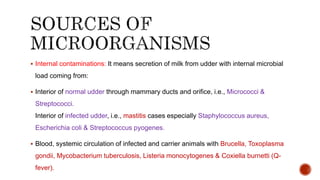
 Internal contaminations: It means secretion of milk from udder with internal microbial
load coming from:
 Interior of normal udder through mammary ducts and orifice, i.e., Micrococci &
Streptococci.
Interior of infected udder, i.e., mastitis cases especially Staphylococcus aureus,
Escherichia coli & Streptococcus pyogenes.
 Blood, systemic circulation of infected and carrier animals with Brucella, Toxoplasma
gondii, Mycobacterium tuberculosis, Listeria monocytogenes & Coxiella burnetti (Q-
fever).
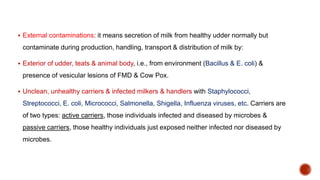
 External contaminations: it means secretion of milk from healthy udder normally but
contaminate during production, handling, transport & distribution of milk by:
 Exterior of udder, teats & animal body, i.e., from environment (Bacillus & E. coli) &
presence of vesicular lesions of FMD & Cow Pox.
 Unclean, unhealthy carriers & infected milkers & handlers with Staphylococci,
Streptococci, E. coli, Micrococci, Salmonella, Shigella, Influenza viruses, etc. Carriers are
of two types: active carriers, those individuals infected and diseased by microbes &
passive carriers, those healthy individuals just exposed neither infected nor diseased by
microbes.
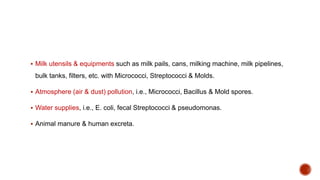
 Milk utensils & equipments such as milk pails, cans, milking machine, milk pipelines,
bulk tanks, filters, etc. with Micrococci, Streptococci & Molds.
 Atmosphere (air & dust) pollution, i.e., Micrococci, Bacillus & Mold spores.
 Water supplies, i.e., E. coli, fecal Streptococci & pseudomonas.
 Animal manure & human excreta.
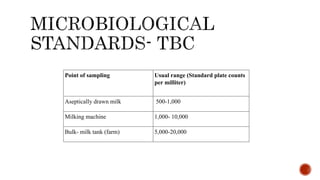
Point of sampling Usual range (Standard plate counts
per milliter)
Aseptically drawn milk 500-1,000
Milking machine 1,000- 10,000
Bulk- milk tank (farm) 5,000-20,000
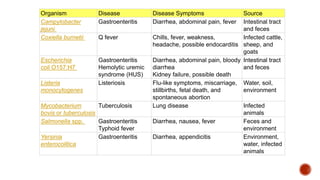
Organism Disease Disease Symptoms Source
Campylobacter
jejuni
Gastroenteritis Diarrhea, abdominal pain, fever Intestinal tract
and feces
Coxiella burnetii Q fever Chills, fever, weakness,
headache, possible endocarditis
Infected cattle,
sheep, and
goats
Escherichia
coli O157:H7
Gastroenteritis
Hemolytic uremic
syndrome (HUS)
Diarrhea, abdominal pain, bloody
diarrhea
Kidney failure, possible death
Intestinal tract
and feces
Listeria
monocytogenes
Listeriosis Flu-like symptoms, miscarriage,
stillbirths, fetal death, and
spontaneous abortion
Water, soil,
environment
Mycobacterium
bovis or tuberculosis
Tuberculosis Lung disease Infected
animals
Salmonella spp. Gastroenteritis
Typhoid fever
Diarrhea, nausea, fever Feces and
environment
Yersinia
enterocolitica
Gastroenteritis Diarrhea, appendicitis Environment,
water, infected
animals
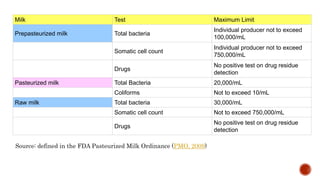
Milk Test Maximum Limit
Prepasteurized milk Total bacteria
Individual producer not to exceed
100,000/mL
Somatic cell count
Individual producer not to exceed
750,000/mL
Drugs
No positive test on drug residue
detection
Pasteurized milk Total Bacteria 20,000/mL
Coliforms Not to exceed 10/mL
Raw milk Total bacteria 30,000/mL
Somatic cell count Not to exceed 750,000/mL
Drugs
No positive test on drug residue
detection
Source: defined in the FDA Pasteurized Milk Ordinance (PMO, 2009)
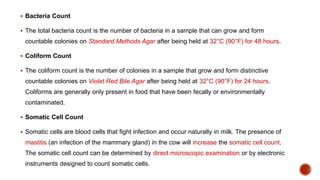
 Bacteria Count
 The total bacteria count is the number of bacteria in a sample that can grow and form
countable colonies on Standard Methods Agar after being held at 32°C (90°F) for 48 hours.
 Coliform Count
 The coliform count is the number of colonies in a sample that grow and form distinctive
countable colonies on Violet Red Bile Agar after being held at 32°C (90°F) for 24 hours.
Coliforms are generally only present in food that have been fecally or environmentally
contaminated.
 Somatic Cell Count
 Somatic cells are blood cells that fight infection and occur naturally in milk. The presence of
mastitis (an infection of the mammary gland) in the cow will increase the somatic cell count.
The somatic cell count can be determined by direct microscopic examination or by electronic
instruments designed to count somatic cells.
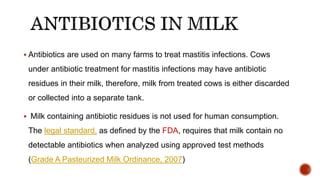
 Antibiotics are used on many farms to treat mastitis infections. Cows
under antibiotic treatment for mastitis infections may have antibiotic
residues in their milk, therefore, milk from treated cows is either discarded
or collected into a separate tank.
 Milk containing antibiotic residues is not used for human consumption.
The legal standard, as defined by the FDA, requires that milk contain no
detectable antibiotics when analyzed using approved test methods
(Grade A Pasteurized Milk Ordinance, 2007)
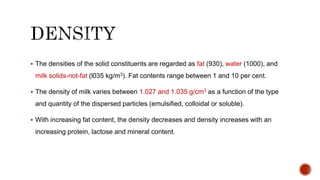
 The densities of the solid constituents are regarded as fat (930), water (1000), and
milk solids-not-fat (l035 kg/m3). Fat contents range between 1 and 10 per cent.
 The density of milk varies between 1.027 and 1.035 g/cm3 as a function of the type
and quantity of the dispersed particles (emulsified, colloidal or soluble).
 With increasing fat content, the density decreases and density increases with an
increasing protein, lactose and mineral content.
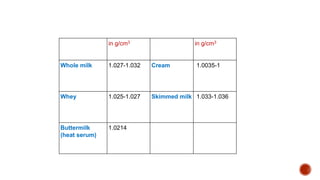
in g/cm3 in g/cm3
Whole milk 1.027-1.032 Cream 1.0035-1
Whey 1.025-1.027 Skimmed milk 1.033-1.036
Buttermilk
(heat serum)
1.0214
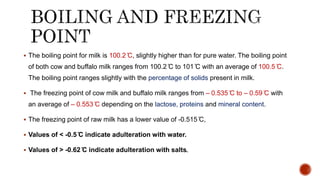
 The boiling point for milk is 100.2 ̊C, slightly higher than for pure water. The boiling point
of both cow and buffalo milk ranges from 100.2 ̊C to 101 ̊̊C with an average of 100.5 ̊C.
The boiling point ranges slightly with the percentage of solids present in milk.
 The freezing point of cow milk and buffalo milk ranges from – 0.535 ̊C to – 0.59 ̊C with
an average of – 0.553 ̊C depending on the lactose, proteins and mineral content.
 The freezing point of raw milk has a lower value of -0.515 ̊C,
 Values of < -0.5 ̊C indicate adulteration with water.
 Values of > -0.62 ̊C indicate adulteration with salts.
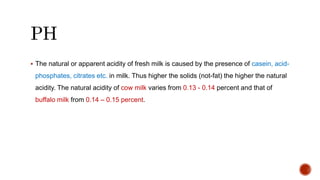
 The natural or apparent acidity of fresh milk is caused by the presence of casein, acid-
phosphates, citrates etc. in milk. Thus higher the solids (not-fat) the higher the natural
acidity. The natural acidity of cow milk varies from 0.13 - 0.14 percent and that of
buffalo milk from 0.14 – 0.15 percent.
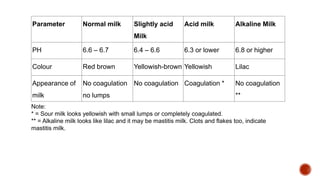
Parameter Normal milk Slightly acid
Milk
Acid milk Alkaline Milk
PH 6.6 – 6.7 6.4 – 6.6 6.3 or lower 6.8 or higher
Colour Red brown Yellowish-brown Yellowish Lilac
Appearance of
milk
No coagulation
no lumps
No coagulation Coagulation * No coagulation
**
Note:
* = Sour milk looks yellowish with small lumps or completely coagulated.
** = Alkaline milk looks like lilac and it may be mastitis milk. Clots and flakes too, indicate
mastitis milk.
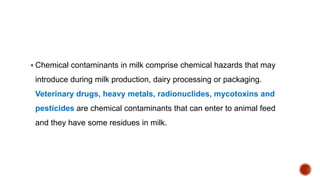
 Chemical contaminants in milk comprise chemical hazards that may
introduce during milk production, dairy processing or packaging.
Veterinary drugs, heavy metals, radionuclides, mycotoxins and
pesticides are chemical contaminants that can enter to animal feed
and they have some residues in milk.
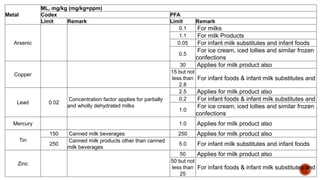
Metal
ML, mg/kg (mg/kg=ppm)
Codex PFA
Limit Remark Limit Remark
Arsenic
0.1 For milks
1.1 For milk Products
0.05 For infant milk substitutes and infant foods
0.5
For ice cream, iced lollies and similar frozen
confections
Copper
30 Applies for milk product also
15 but not
less than
2.8
For infant foods & infant milk substitutes and
Lead 0.02
Concentration factor applies for partially
and wholly dehydrated milks
2.5 Applies for milk product also
0.2 For infant foods & infant milk substitutes and
1.0
For ice cream, iced lollies and similar frozen
confections
Mercury 1.0 Applies for milk product also
Tin
150 Canned milk beverages 250 Applies for milk product also
250
Canned milk products other than canned
milk beverages
5.0 For infant milk substitutes and infant foods
Zinc
50 Applies for milk product also
50 but not
less than
25
For infant foods & infant milk substitutes and
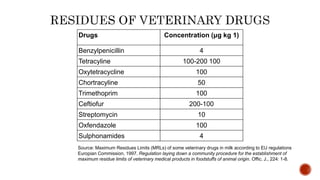
Drugs Concentration (μg kg 1)
Benzylpenicillin 4
Tetracyline 100-200 100
Oxytetracycline 100
Chortracyline 50
Trimethoprim 100
Ceftiofur 200-100
Streptomycin 10
Oxfendazole 100
Sulphonamides 4
Source: Maximum Residues Limits (MRLs) of some veterinary drugs in milk according to EU regulations
Europian Commission, 1997. Regulation laying down a community procedure for the establishment of
maximum residue limits of veterinary medical products in foodstuffs of animal origin. Offic. J., 224: 1-8.
 Food Safety and Standards Authority of India Expert Group on Milk and Milk Products
 Base Working Paper on Strategy and Action Plan for Ensuring Safety of Milk and Milk
Products
 Milk Processing Guide Series, Volume 2, Published by: FAO/TCP/KEN/6611 Project
Training Programme for Small Scale Dairy Sector and Dairy Training Institute -
Naivasha
 Food Microbiology by Frazier
 Gh. R. Jahed Khaniki , 2007. Chemical Contaminants in Milk and Public Health
Concerns: A Review. International Journal of Dairy Science, 2: 104-115.

Milk microbiology (standards)

  • 1.
  • 2.
     Internal contaminations:It means secretion of milk from udder with internal microbial load coming from:  Interior of normal udder through mammary ducts and orifice, i.e., Micrococci & Streptococci. Interior of infected udder, i.e., mastitis cases especially Staphylococcus aureus, Escherichia coli & Streptococcus pyogenes.  Blood, systemic circulation of infected and carrier animals with Brucella, Toxoplasma gondii, Mycobacterium tuberculosis, Listeria monocytogenes & Coxiella burnetti (Q- fever).
  • 3.
     External contaminations:it means secretion of milk from healthy udder normally but contaminate during production, handling, transport & distribution of milk by:  Exterior of udder, teats & animal body, i.e., from environment (Bacillus & E. coli) & presence of vesicular lesions of FMD & Cow Pox.  Unclean, unhealthy carriers & infected milkers & handlers with Staphylococci, Streptococci, E. coli, Micrococci, Salmonella, Shigella, Influenza viruses, etc. Carriers are of two types: active carriers, those individuals infected and diseased by microbes & passive carriers, those healthy individuals just exposed neither infected nor diseased by microbes.
  • 4.
     Milk utensils& equipments such as milk pails, cans, milking machine, milk pipelines, bulk tanks, filters, etc. with Micrococci, Streptococci & Molds.  Atmosphere (air & dust) pollution, i.e., Micrococci, Bacillus & Mold spores.  Water supplies, i.e., E. coli, fecal Streptococci & pseudomonas.  Animal manure & human excreta.
  • 5.
    Point of samplingUsual range (Standard plate counts per milliter) Aseptically drawn milk 500-1,000 Milking machine 1,000- 10,000 Bulk- milk tank (farm) 5,000-20,000
  • 7.
    Organism Disease DiseaseSymptoms Source Campylobacter jejuni Gastroenteritis Diarrhea, abdominal pain, fever Intestinal tract and feces Coxiella burnetii Q fever Chills, fever, weakness, headache, possible endocarditis Infected cattle, sheep, and goats Escherichia coli O157:H7 Gastroenteritis Hemolytic uremic syndrome (HUS) Diarrhea, abdominal pain, bloody diarrhea Kidney failure, possible death Intestinal tract and feces Listeria monocytogenes Listeriosis Flu-like symptoms, miscarriage, stillbirths, fetal death, and spontaneous abortion Water, soil, environment Mycobacterium bovis or tuberculosis Tuberculosis Lung disease Infected animals Salmonella spp. Gastroenteritis Typhoid fever Diarrhea, nausea, fever Feces and environment Yersinia enterocolitica Gastroenteritis Diarrhea, appendicitis Environment, water, infected animals
  • 9.
    Milk Test MaximumLimit Prepasteurized milk Total bacteria Individual producer not to exceed 100,000/mL Somatic cell count Individual producer not to exceed 750,000/mL Drugs No positive test on drug residue detection Pasteurized milk Total Bacteria 20,000/mL Coliforms Not to exceed 10/mL Raw milk Total bacteria 30,000/mL Somatic cell count Not to exceed 750,000/mL Drugs No positive test on drug residue detection Source: defined in the FDA Pasteurized Milk Ordinance (PMO, 2009)
  • 11.
     Bacteria Count The total bacteria count is the number of bacteria in a sample that can grow and form countable colonies on Standard Methods Agar after being held at 32°C (90°F) for 48 hours.  Coliform Count  The coliform count is the number of colonies in a sample that grow and form distinctive countable colonies on Violet Red Bile Agar after being held at 32°C (90°F) for 24 hours. Coliforms are generally only present in food that have been fecally or environmentally contaminated.  Somatic Cell Count  Somatic cells are blood cells that fight infection and occur naturally in milk. The presence of mastitis (an infection of the mammary gland) in the cow will increase the somatic cell count. The somatic cell count can be determined by direct microscopic examination or by electronic instruments designed to count somatic cells.
  • 12.
     Antibiotics areused on many farms to treat mastitis infections. Cows under antibiotic treatment for mastitis infections may have antibiotic residues in their milk, therefore, milk from treated cows is either discarded or collected into a separate tank.  Milk containing antibiotic residues is not used for human consumption. The legal standard, as defined by the FDA, requires that milk contain no detectable antibiotics when analyzed using approved test methods (Grade A Pasteurized Milk Ordinance, 2007)
  • 14.
     The densitiesof the solid constituents are regarded as fat (930), water (1000), and milk solids-not-fat (l035 kg/m3). Fat contents range between 1 and 10 per cent.  The density of milk varies between 1.027 and 1.035 g/cm3 as a function of the type and quantity of the dispersed particles (emulsified, colloidal or soluble).  With increasing fat content, the density decreases and density increases with an increasing protein, lactose and mineral content.
  • 15.
    in g/cm3 ing/cm3 Whole milk 1.027-1.032 Cream 1.0035-1 Whey 1.025-1.027 Skimmed milk 1.033-1.036 Buttermilk (heat serum) 1.0214
  • 16.
     The boilingpoint for milk is 100.2 ̊C, slightly higher than for pure water. The boiling point of both cow and buffalo milk ranges from 100.2 ̊C to 101 ̊̊C with an average of 100.5 ̊C. The boiling point ranges slightly with the percentage of solids present in milk.  The freezing point of cow milk and buffalo milk ranges from – 0.535 ̊C to – 0.59 ̊C with an average of – 0.553 ̊C depending on the lactose, proteins and mineral content.  The freezing point of raw milk has a lower value of -0.515 ̊C,  Values of < -0.5 ̊C indicate adulteration with water.  Values of > -0.62 ̊C indicate adulteration with salts.
  • 17.
     The naturalor apparent acidity of fresh milk is caused by the presence of casein, acid- phosphates, citrates etc. in milk. Thus higher the solids (not-fat) the higher the natural acidity. The natural acidity of cow milk varies from 0.13 - 0.14 percent and that of buffalo milk from 0.14 – 0.15 percent.
  • 18.
    Parameter Normal milkSlightly acid Milk Acid milk Alkaline Milk PH 6.6 – 6.7 6.4 – 6.6 6.3 or lower 6.8 or higher Colour Red brown Yellowish-brown Yellowish Lilac Appearance of milk No coagulation no lumps No coagulation Coagulation * No coagulation ** Note: * = Sour milk looks yellowish with small lumps or completely coagulated. ** = Alkaline milk looks like lilac and it may be mastitis milk. Clots and flakes too, indicate mastitis milk.
  • 20.
     Chemical contaminantsin milk comprise chemical hazards that may introduce during milk production, dairy processing or packaging. Veterinary drugs, heavy metals, radionuclides, mycotoxins and pesticides are chemical contaminants that can enter to animal feed and they have some residues in milk.
  • 21.
    Metal ML, mg/kg (mg/kg=ppm) CodexPFA Limit Remark Limit Remark Arsenic 0.1 For milks 1.1 For milk Products 0.05 For infant milk substitutes and infant foods 0.5 For ice cream, iced lollies and similar frozen confections Copper 30 Applies for milk product also 15 but not less than 2.8 For infant foods & infant milk substitutes and Lead 0.02 Concentration factor applies for partially and wholly dehydrated milks 2.5 Applies for milk product also 0.2 For infant foods & infant milk substitutes and 1.0 For ice cream, iced lollies and similar frozen confections Mercury 1.0 Applies for milk product also Tin 150 Canned milk beverages 250 Applies for milk product also 250 Canned milk products other than canned milk beverages 5.0 For infant milk substitutes and infant foods Zinc 50 Applies for milk product also 50 but not less than 25 For infant foods & infant milk substitutes and
  • 22.
    Drugs Concentration (μgkg 1) Benzylpenicillin 4 Tetracyline 100-200 100 Oxytetracycline 100 Chortracyline 50 Trimethoprim 100 Ceftiofur 200-100 Streptomycin 10 Oxfendazole 100 Sulphonamides 4 Source: Maximum Residues Limits (MRLs) of some veterinary drugs in milk according to EU regulations Europian Commission, 1997. Regulation laying down a community procedure for the establishment of maximum residue limits of veterinary medical products in foodstuffs of animal origin. Offic. J., 224: 1-8.
  • 23.
     Food Safetyand Standards Authority of India Expert Group on Milk and Milk Products  Base Working Paper on Strategy and Action Plan for Ensuring Safety of Milk and Milk Products  Milk Processing Guide Series, Volume 2, Published by: FAO/TCP/KEN/6611 Project Training Programme for Small Scale Dairy Sector and Dairy Training Institute - Naivasha  Food Microbiology by Frazier  Gh. R. Jahed Khaniki , 2007. Chemical Contaminants in Milk and Public Health Concerns: A Review. International Journal of Dairy Science, 2: 104-115.