1
Amjad Khan Afridi 9th
August,2016
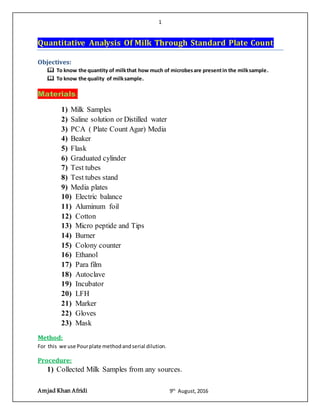
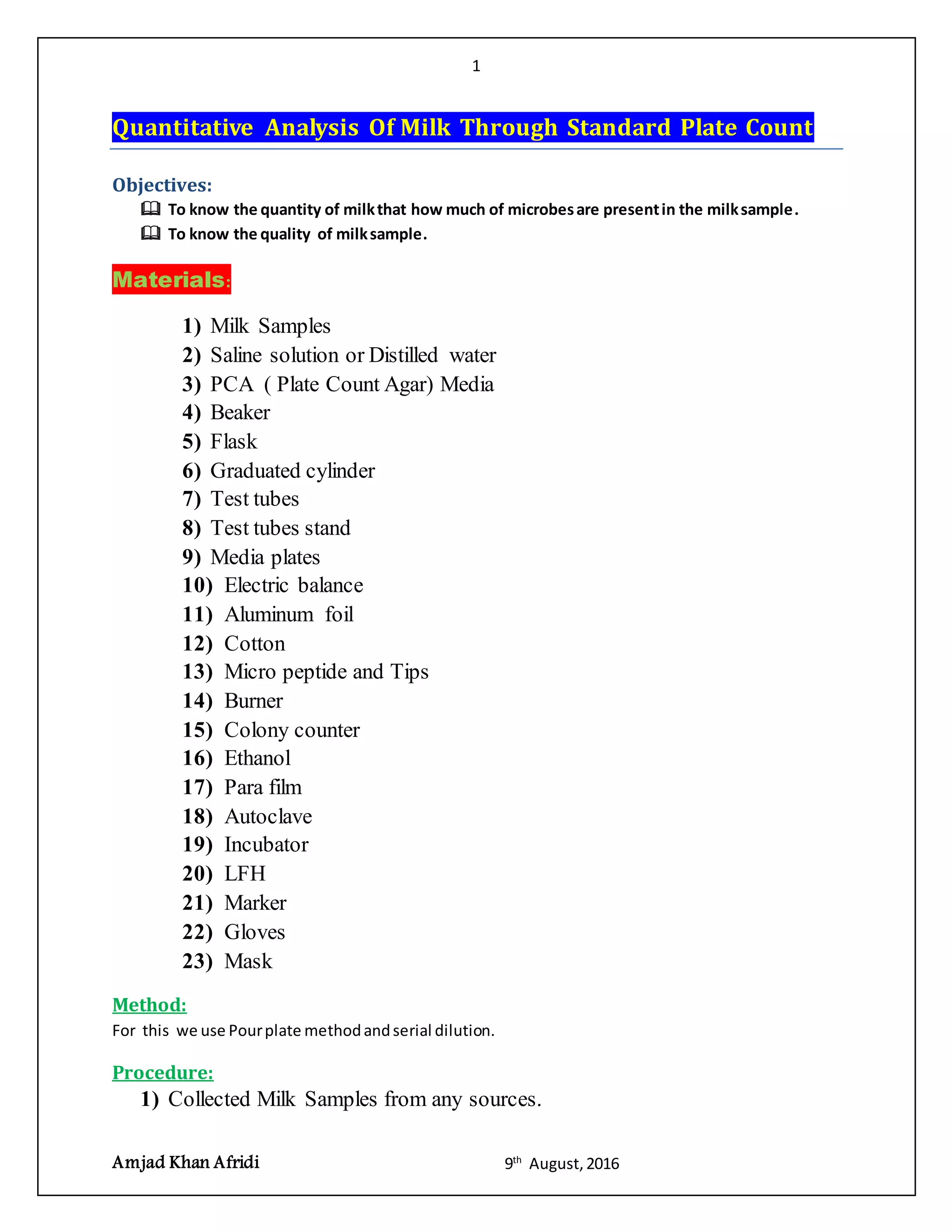
Quantitative Analysis Of Milk Through Standard Plate Count
Objectives:
 To know the quantity of milkthat how much of microbesare presentin the milksample.
 To know the quality of milksample.
Materials:
1) Milk Samples
2) Saline solution or Distilled water
3) PCA ( Plate Count Agar) Media
4) Beaker
5) Flask
6) Graduated cylinder
7) Test tubes
8) Test tubes stand
9) Media plates
10) Electric balance
11) Aluminum foil
12) Cotton
13) Micro peptide and Tips
14) Burner
15) Colony counter
16) Ethanol
17) Para film
18) Autoclave
19) Incubator
20) LFH
21) Marker
22) Gloves
23) Mask
Method:
For this we use Pourplate methodandserial dilution.
Procedure:
1) Collected Milk Samples from any sources.
2
Amjad Khan Afridi 9th
August,2016
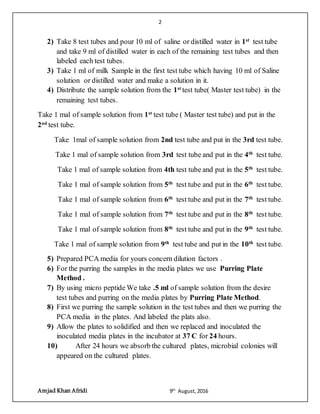
2) Take 8 test tubes and pour 10 ml of saline or distilled water in 1st
test tube
and take 9 ml of distilled water in each of the remaining test tubes and then
labeled each test tubes.
3) Take 1 ml of milk Sample in the first test tube which having 10 ml of Saline
solution or distilled water and make a solution in it.
4) Distribute the sample solution from the 1st
test tube( Master test tube) in the
remaining test tubes.
Take 1 mal of sample solution from 1st
test tube ( Master test tube) and put in the
2nd
test tube.
Take 1mal of sample solution from 2nd test tube and put in the 3rd test tube.
Take 1 mal of sample solution from 3rd test tube and put in the 4th
test tube.
Take 1 mal of sample solution from 4th test tube and put in the 5th
test tube.
Take 1 mal of sample solution from 5th
test tube and put in the 6th
test tube.
Take 1 mal of sample solution from 6th
test tube and put in the 7th
test tube.
Take 1 mal of sample solution from 7th
test tube and put in the 8th
test tube.
Take 1 mal of sample solution from 8th
test tube and put in the 9th
test tube.
Take 1 mal of sample solution from 9th
test tube and put in the 10th
test tube.
5) Prepared PCA media for yours concern dilution factors .
6) For the purring the samples in the media plates we use Purring Plate
Method .
7) By using micro peptide We take .5 ml of sample solution from the desire
test tubes and purring on the media plates by Purring Plate Method.
8) First we purring the sample solution in the test tubes and then we purring the
PCA media in the plates. And labeled the plats also.
9) Allow the plates to solidified and then we replaced and inoculated the
inoculated media plates in the incubator at 37 C for 24 hours.
10) After 24 hours we absorb the cultured plates, microbial colonies will
appeared on the cultured plates.
3
Amjad Khan Afridi 9th
August,2016
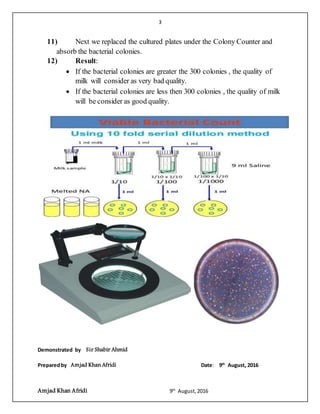
11) Next we replaced the cultured plates under the Colony Counter and
absorb the bacterial colonies.
12) Result:
 If the bacterial colonies are greater the 300 colonies , the quality of
milk will consider as very bad quality.
 If the bacterial colonies are less then 300 colonies , the quality of milk
will be consider as good quality.
Demonstrated by Sir Shabir Ahmid
Preparedby Amjad Khan Afridi Date: 9th
August, 2016

Milk analysis

  • 1.
    1 Amjad Khan Afridi9th August,2016 Quantitative Analysis Of Milk Through Standard Plate Count Objectives:  To know the quantity of milkthat how much of microbesare presentin the milksample.  To know the quality of milksample. Materials: 1) Milk Samples 2) Saline solution or Distilled water 3) PCA ( Plate Count Agar) Media 4) Beaker 5) Flask 6) Graduated cylinder 7) Test tubes 8) Test tubes stand 9) Media plates 10) Electric balance 11) Aluminum foil 12) Cotton 13) Micro peptide and Tips 14) Burner 15) Colony counter 16) Ethanol 17) Para film 18) Autoclave 19) Incubator 20) LFH 21) Marker 22) Gloves 23) Mask Method: For this we use Pourplate methodandserial dilution. Procedure: 1) Collected Milk Samples from any sources.
  • 2.
    2 Amjad Khan Afridi9th August,2016 2) Take 8 test tubes and pour 10 ml of saline or distilled water in 1st test tube and take 9 ml of distilled water in each of the remaining test tubes and then labeled each test tubes. 3) Take 1 ml of milk Sample in the first test tube which having 10 ml of Saline solution or distilled water and make a solution in it. 4) Distribute the sample solution from the 1st test tube( Master test tube) in the remaining test tubes. Take 1 mal of sample solution from 1st test tube ( Master test tube) and put in the 2nd test tube. Take 1mal of sample solution from 2nd test tube and put in the 3rd test tube. Take 1 mal of sample solution from 3rd test tube and put in the 4th test tube. Take 1 mal of sample solution from 4th test tube and put in the 5th test tube. Take 1 mal of sample solution from 5th test tube and put in the 6th test tube. Take 1 mal of sample solution from 6th test tube and put in the 7th test tube. Take 1 mal of sample solution from 7th test tube and put in the 8th test tube. Take 1 mal of sample solution from 8th test tube and put in the 9th test tube. Take 1 mal of sample solution from 9th test tube and put in the 10th test tube. 5) Prepared PCA media for yours concern dilution factors . 6) For the purring the samples in the media plates we use Purring Plate Method . 7) By using micro peptide We take .5 ml of sample solution from the desire test tubes and purring on the media plates by Purring Plate Method. 8) First we purring the sample solution in the test tubes and then we purring the PCA media in the plates. And labeled the plats also. 9) Allow the plates to solidified and then we replaced and inoculated the inoculated media plates in the incubator at 37 C for 24 hours. 10) After 24 hours we absorb the cultured plates, microbial colonies will appeared on the cultured plates.
  • 3.
    3 Amjad Khan Afridi9th August,2016 11) Next we replaced the cultured plates under the Colony Counter and absorb the bacterial colonies. 12) Result:  If the bacterial colonies are greater the 300 colonies , the quality of milk will consider as very bad quality.  If the bacterial colonies are less then 300 colonies , the quality of milk will be consider as good quality. Demonstrated by Sir Shabir Ahmid Preparedby Amjad Khan Afridi Date: 9th August, 2016