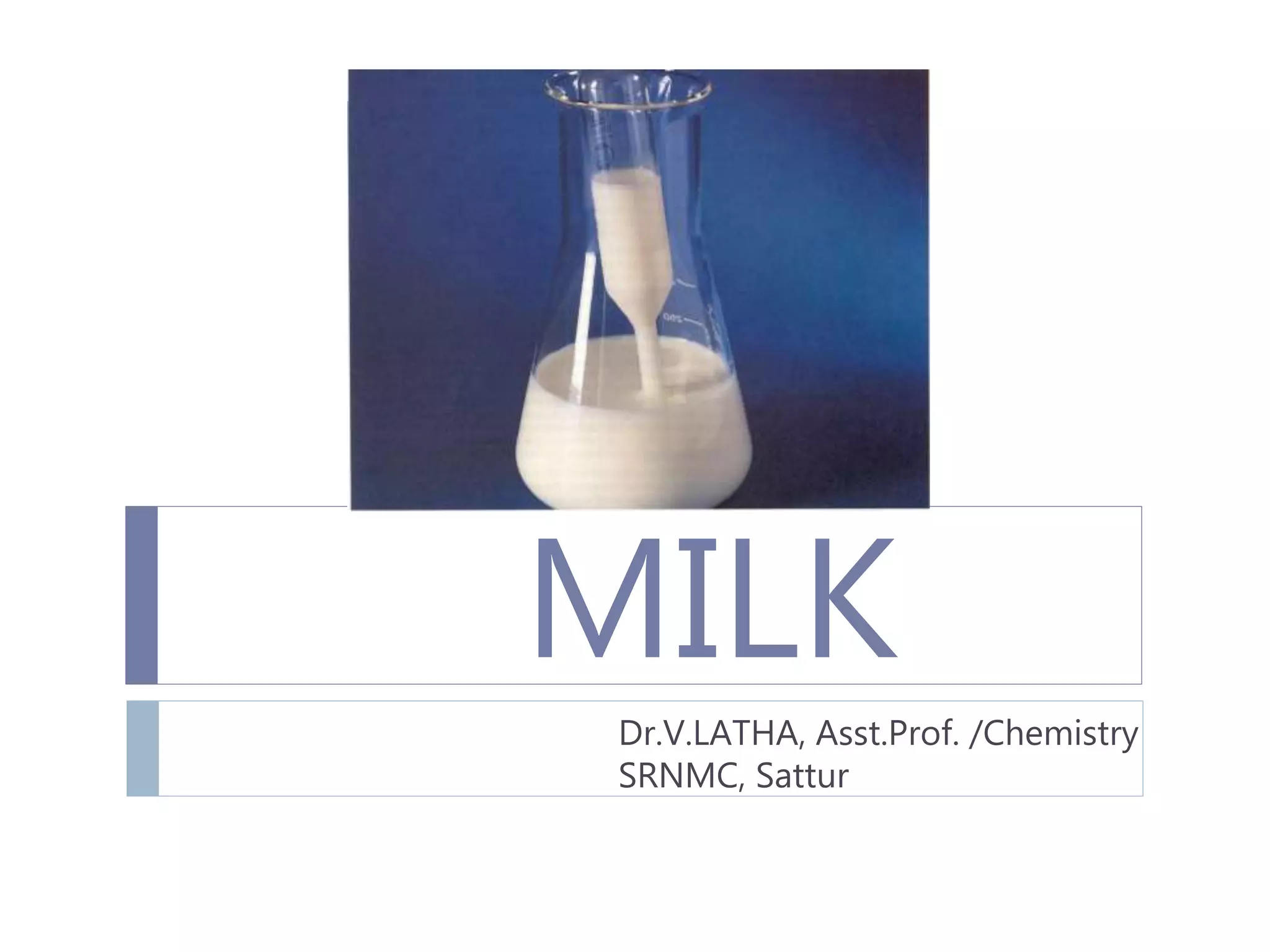
MILK
Dr.V.LATHA, Asst.Prof. /Chemistry
SRNMC, Sattur
Def:
It is the secretion of mammary glands in human and animals
after labour.
 It is the only food for newborn for a long period till weaning
time.
 Before birth the fetus receives its nutrition through the
placenta.
2
 Milk secretion is stimulated by Prolactin.
 Milk flow is decreased by Estrogen and
Progesterone while increased by
Thyroxin.
 Also Squalene present in HELBA
increase milk flow.
 Initiation of lactation may result from
sudden removal of the placenta and other
factors.
 Oxytocin (posterior pituitary hormone)
responsible for milk ejection
3
Milk is considered as a complete diet as:-
It contains all of the components necessary for growth,
maintenance of life and reproduction.
e.g:
Carbohydrates, Lipid, Protein, Minerals and Vitamins.
But, it is deficient in:
Vitamin C, Vitamin D, Vitamin K, Iron, Copper
4
Physical Properties of Milk
5
Property 1- Color
White color → due to presence of:
 Fat globules in emulsion form.
 Protein in colloidal form.
 Ca. phosphate and Ca. Casinate.
Yellowish (creamy) color → due to presence of
 Carotene and
 Xanthophyll pigments (specially in cow's milk) and
colostrums (1st fresh milk in pregnancy).
6
Property 2 - Reaction
Fresh milk is amphoteric in reaction as it contains acid & base.
 Milk is an excellent buffer as it contain:
 Protein.
 Phosphate.
 Bicarbonate.
 Citrate.
 pH of fresh milk:
 6.6 – 6.8 Cow's milk.
 6.8 – 7.4 Human's milk
 Milk pH is changed to alkaline in case of:
 Mastitis
 Late period of lactation.
 If the milk left to stand for a long period specially in warm
temperature, lactose is fermented to lactic acid by bacteria present
normally in milk as:
 Streptococcus Lactis
 Lactobacillus Lactis
7
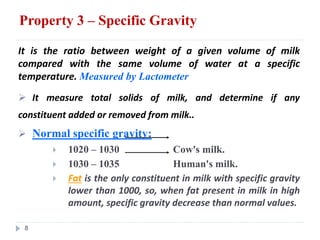
Property 3 – Specific Gravity
It is the ratio between weight of a given volume of milk
compared with the same volume of water at a specific
temperature. Measured by Lactometer
 It measure total solids of milk, and determine if any
constituent added or removed from milk..
 Normal specific gravity:
 1020 – 1030 Cow's milk.
 1030 – 1035 Human's milk.
 Fat is the only constituent in milk with specific gravity
lower than 1000, so, when fat present in milk in high
amount, specific gravity decrease than normal values.
8
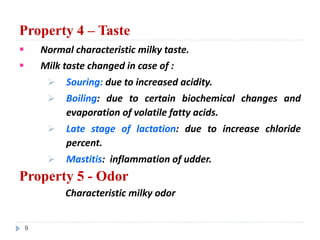
Property 4 – Taste
 Normal characteristic milky taste.
 Milk taste changed in case of :
 Souring: due to increased acidity.
 Boiling: due to certain biochemical changes and
evaporation of volatile fatty acids.
 Late stage of lactation: due to increase chloride
percent.
 Mastitis: inflammation of udder.
Property 5 - Odor
Characteristic milky odor
9
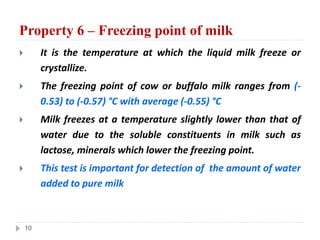
Property 6 – Freezing point of milk
 It is the temperature at which the liquid milk freeze or
crystallize.
 The freezing point of cow or buffalo milk ranges from (-
0.53) to (-0.57) °C with average (-0.55) °C
 Milk freezes at a temperature slightly lower than that of
water due to the soluble constituents in milk such as
lactose, minerals which lower the freezing point.
 This test is important for detection of the amount of water
added to pure milk
10
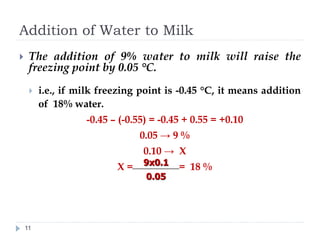
Addition of Water to Milk
 The addition of 9% water to milk will raise the
freezing point by 0.05 °C.
 i.e., if milk freezing point is -0.45 °C, it means addition
of 18% water.
-0.45 – (-0.55) = -0.45 + 0.55 = +0.10
0.05 → 9 %
0.10 → X
X = = 18 %
9x0.1
0.05
11
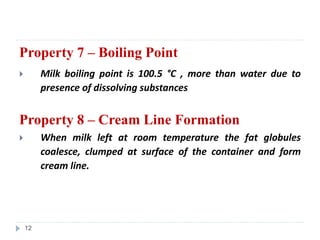
Property 7 – Boiling Point
 Milk boiling point is 100.5 °C , more than water due to
presence of dissolving substances
Property 8 – Cream Line Formation
 When milk left at room temperature the fat globules
coalesce, clumped at surface of the container and form
cream line.
12
Normal
Chemical composition
of milk
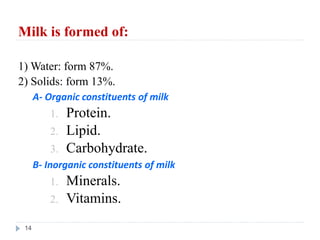
Milk is formed of:
1) Water: form 87%.
2) Solids: form 13%.
A- Organic constituents of milk
1. Protein.
2. Lipid.
3. Carbohydrate.
B- Inorganic constituents of milk
1. Minerals.
2. Vitamins.
14
A- Organic Constituents of Milk
15
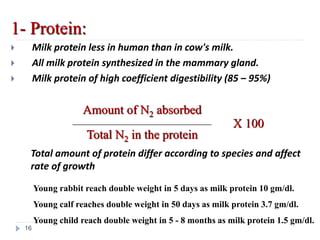
1- Protein:
 Milk protein less in human than in cow's milk.
 All milk protein synthesized in the mammary gland.
 Milk protein of high coefficient digestibility (85 – 95%)
X 100
Amount of N2 absorbed
Total N2 in the protein
Total amount of protein differ according to species and affect
rate of growth
Young rabbit reach double weight in 5 days as milk protein 10 gm/dl.
Young calf reaches double weight in 50 days as milk protein 3.7 gm/dl.
Young child reach double weight in 5 - 8 months as milk protein 1.5 gm/dl.
16
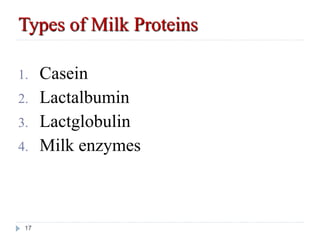
Types of Milk Proteins
1. Casein
2. Lactalbumin
3. Lactglobulin
4. Milk enzymes
17
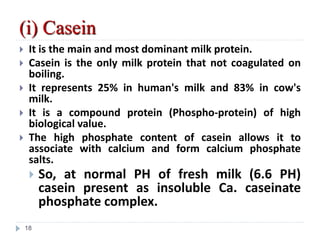
(i) Casein
 It is the main and most dominant milk protein.
 Casein is the only milk protein that not coagulated on
boiling.
 It represents 25% in human's milk and 83% in cow's
milk.
 It is a compound protein (Phospho-protein) of high
biological value.
 The high phosphate content of casein allows it to
associate with calcium and form calcium phosphate
salts.
 So, at normal PH of fresh milk (6.6 PH)
casein present as insoluble Ca. caseinate
phosphate complex.
18
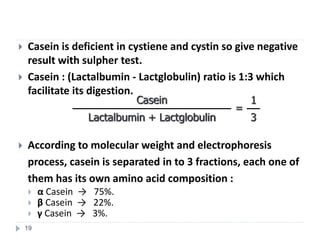
 Casein is deficient in cystiene and cystin so give negative
result with sulpher test.
 Casein : (Lactalbumin - Lactglobulin) ratio is 1:3 which
facilitate its digestion.
 According to molecular weight and electrophoresis
process, casein is separated in to 3 fractions, each one of
them has its own amino acid composition :
 α Casein → 75%.
 β Casein → 22%.
 γ Casein → 3%.
1
=
Casein
3
Lactalbumin + Lactglobulin
19
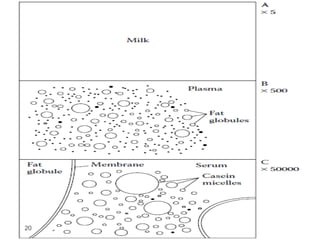
20
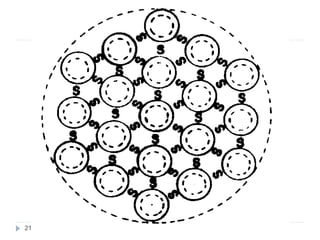
21
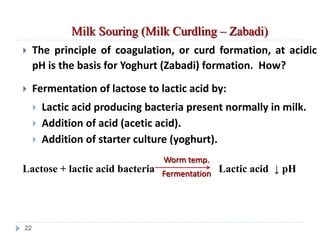
Milk Souring (Milk Curdling – Zabadi)
 The principle of coagulation, or curd formation, at acidic
pH is the basis for Yoghurt (Zabadi) formation. How?
 Fermentation of lactose to lactic acid by:
 Lactic acid producing bacteria present normally in milk.
 Addition of acid (acetic acid).
 Addition of starter culture (yoghurt).
Lactose + lactic acid bacteria Lactic acid ↓ pH
Worm temp.
Fermentation
22
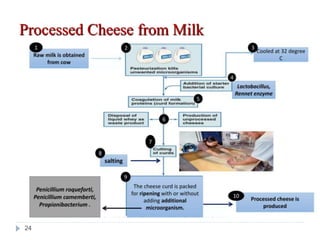
Milk Clotting (Cheese Manufacturing)
During digestion (in new born):
Rennin enzyme acts on casein, converting it to soluble
Paracaseinate which is bounded to Ca and form insoluble
Ca. paracaseinate (milk clot).
Rennin enzyme:
Derived from 4th stomach of calves and used externally in
cheese manufacture.
It is secreted inactive as pro-rennin.
Its optimum PH 4.
It is absent in adult stomach.
Formation of milk clot: prevents rapid passage of milk from
stomach to intestine so give the sense of fullness to
newborn.
23
Processed Cheese from Milk
24
(ii) Lactalbumin
 Represent 87% of whey protein.
 PPT by full saturation with ammonium sulphate.
 Rich in cystein and cystin so give +ve result with sulpher test.
 Simple, soluble and easily digested protein.
 Consists of two fractions:
 α Lactalbumin 32% of whey protein.
 β lactglobulin 55% of whey protein.
Where,
β lactglobulin called globulin because it need small amount of
NaCl to be dissolved but it is not PPT by half saturation as
albumin.
25
(iii) Lactglobulin
 Represent 13% of whey protein.
 PPT by half saturation with ammonium sulphate solution.
 Rich in cystein and cystin so give +ve result with sulpher test.
 Simple, soluble and easily digested protein.
 Consists of two fractions:
 True globulin (Euglobulin) 50%.
 False globulin (Pseudoglobulin) 50%.
 They carry antibodies causing immunity so called
immunoglobulins.
 They present in higher concentration in colostrum.
26
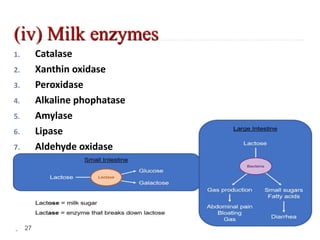
(iv) Milk enzymes
1. Catalase
2. Xanthin oxidase
3. Peroxidase
4. Alkaline phophatase
5. Amylase
6. Lipase
7. Aldehyde oxidase
27
1- Catalase:
 Carried by fat globules.
 Act on hydrogen peroxide (H2O2) producing water and
oxygen.
 Increased in case of mastitis.
2- Xanthin oxidase:
Carried by fat globules.
Act on hypoxanthin and xanthin to produce uric acid.
Milk enzymes
28
3- Peroxidase:
 Carried by lactalbumin.
 Act on hydrogen peroxide (H2O2).
 It is heat stable enzyme (resist destruction by heat).
 It is destroyed by milk sterilization.
Milk sterilization:
Heating of milk to 116◦C for 15 minutes which destroy all
harmful and non harmful microorganisms.
 Milk sterilization leads to alteration in milk taste and
destruction of vitamin C and vitamin B2.
N.B:
Absence of peroxidase enzyme indicates milk sterilization.
Milk enzymes
29
4 - Alkaline phophatase:
 Carried by fat globules.
 Catalyze hydrolysis of phosphate ester.
 Destroyed by the same temperature that destroys the
harmful bacteria.
e.g:
Tubercle bacilli.
 Absence of Alkaline phophatase enzyme indicates milk
pasteurization.
 Milk pasteurization:
Heating of milk to 60◦C for 30 minutes or 70◦C for 15 minutes
followed by sudden cooling which destroy the harmful
microorganisms only.
Milk enzymes
30
5- Amylase:
 Carried by lactalbumin.
 Catalyze hydrolysis of α 1, 4 glycosidic linkage of starch and glycogen.
 Increased in case of mastitis.
Milk enzymes
6- Lipase:
 Carried by casein.
 Catalyze hydrolysis of primary ester linkage in triacylglycerol.
 Act on milk fat producing free fatty acids and undesirable taste
(Rancidity).
7- Aldehyde oxidase (Schardinger's enzyme):
 Its absence indicates milk boiling.
 Schardinger's test:
Milk + Methyl blue + Formaldehyde
 Blue color appeared in case of boiled milk.
 Colorless in case of unboiled milk.
31
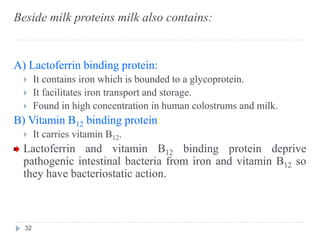
Beside milk proteins milk also contains:
A) Lactoferrin binding protein:
 It contains iron which is bounded to a glycoprotein.
 It facilitates iron transport and storage.
 Found in high concentration in human colostrums and milk.
B) Vitamin B12 binding protein:
 It carries vitamin B12.
Lactoferrin and vitamin B12 binding protein deprive
pathogenic intestinal bacteria from iron and vitamin B12 so
they have bacteriostatic action.
32
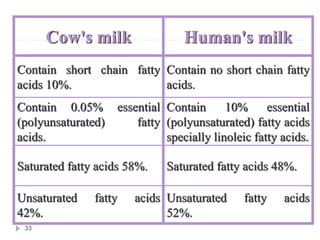
Human's milk
Cow's milk
Contain no short chain fatty
acids.
Contain short chain fatty
acids 10%.
Contain 10% essential
(polyunsaturated) fatty acids
specially linoleic fatty acids.
Contain 0.05% essential
(polyunsaturated) fatty
acids.
Saturated fatty acids 48%.
Saturated fatty acids 58%.
Unsaturated fatty acids
52%.
Unsaturated fatty acids
42%.
33
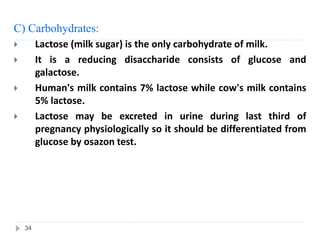
C) Carbohydrates:
 Lactose (milk sugar) is the only carbohydrate of milk.
 It is a reducing disaccharide consists of glucose and
galactose.
 Human's milk contains 7% lactose while cow's milk contains
5% lactose.
 Lactose may be excreted in urine during last third of
pregnancy physiologically so it should be differentiated from
glucose by osazon test.
34
B-Inorganic constituents
of milk
1- Minerals:
 Human milk contain less mineral elements (0.4%) than cow's milk (0.8%).
 Milk rich in Ca and P which are present in their proper ratio for
absorption (2:1) in human milk while in cow's milk (1:2) which is not
suitable for their maximum absorption .
 Ca and P are essential for:
1. Growth of bone and teeth.
2. Stability of casein.
 Milk is deficient in Fe and Cu which are supplied by their storage in
liver during prenatal life (this store is sufficient till weaning time).
 N.B:
 Milk is deficient in Iron but it is more in human milk than cow's milk
Thus anaemia in breast feeding is less common.
 Milk contain adequate amount of Na, K, Mg.
 Human milk contains Na:K (1:2) which is suitable for the optimal
growth of newborn.
36
2- Vitamins:
 Milk is deficient in: Vitamin C, Vitamin D, Vitamin K.
 Milk contain adequate amount of vitamin B complex which are sufficient
for first week of life. e.g: Pantothenic acid
 Although milk is deficient in Fe, Cu, vitamin C, vitamin D, and vitamin K it
is complete natural food for the following reasons:
1. Easily digested absorbed and metabolized.
2. Contain all the nutrients required for the newborn at early stage of
life.
3. Balanced ratio between carbohydrates, lipid and protein.
4. Milk Protein of high biological value as:
 It contains all essential amino acids.
 Easily digested.
 Easily absorbed.
 Easily metabolized.
37
Humanization of cow's milk
Definition:
It is a process by which cow's milk is made to be as near as
human's milk.
Aim:
 Protein of human's milk (casein) form 25% of milk protein
while casein in cow's milk form 5/6 of milk protein so it
form dense clot in newborn stomach which can't be
digested leading to vomition.
 Lactose in human's milk higher than that in cow's milk
(7:5).
39
Steps:
1. Pasteurization of milk:
 Heating of milk to 60 ◦C for 30 minutes followed by sudden
cooling then the pasteurized milk left in cool place for 4 hours
to allow separation of cream.
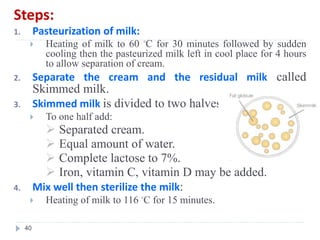
2. Separate the cream and the residual milk called
Skimmed milk.
3. Skimmed milk is divided to two halves.
 To one half add:
 Separated cream.
 Equal amount of water.
 Complete lactose to 7%.
 Iron, vitamin C, vitamin D may be added.
4. Mix well then sterilize the milk:
 Heating of milk to 116 ◦C for 15 minutes.
40
Advantages of human milk (Breast Feeding)
1. Psychological effect on both child and mother.
2. Breast milk is supplied in suitable temperature.
3. Sterile and not liable to be contaminated.
4. Cheaper than animal milk.
5. Not liable to adulteration.
6. Lactation may act as a contraceptive measure.
7. Lactation minimize the risk of breast tumors.
8. Lactation help involution of the uterus.
41
ESTIMATION OF LACTOSE IN MILK
Defn: Lactose in milk is estimated in the clear filtrate after
precipitating proteins. Tungestic acid, and
Trichloroacetic acid can be used to precipitate milk
proteins.
Useful Instruments:
1. Estimated pipette.
2. Volumetric flask.
3. Funnel.
4. Beaker.
5. Burette.
6. Burette holder.
7. Porcelain dish.
43
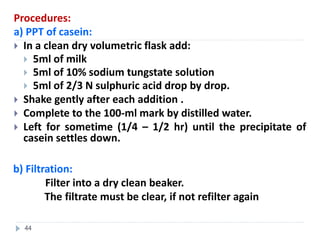
Procedures:
a) PPT of casein:
 In a clean dry volumetric flask add:
 5ml of milk
 5ml of 10% sodium tungstate solution
 5ml of 2/3 N sulphuric acid drop by drop.
 Shake gently after each addition .
 Complete to the 100-ml mark by distilled water.
 Left for sometime (1/4 – 1/2 hr) until the precipitate of
casein settles down.
b) Filtration:
Filter into a dry clean beaker.
The filtrate must be clear, if not refilter again
44
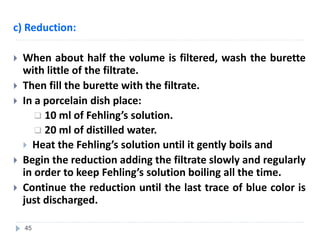
c) Reduction:
 When about half the volume is filtered, wash the burette
with little of the filtrate.
 Then fill the burette with the filtrate.
 In a porcelain dish place:
 10 ml of Fehling’s solution.
 20 ml of distilled water.
 Heat the Fehling’s solution until it gently boils and
 Begin the reduction adding the filtrate slowly and regularly
in order to keep Fehling’s solution boiling all the time.
 Continue the reduction until the last trace of blue color is
just discharged.
45
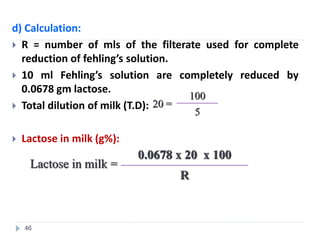
d) Calculation:
 R = number of mls of the filterate used for complete
reduction of fehling’s solution.
 10 ml Fehling’s solution are completely reduced by
0.0678 gm lactose.
 Total dilution of milk (T.D):
 Lactose in milk (g%):
0.0678 x 20 x 100
Lactose in milk =
R
100
20 =
5
46
Estimation of glucose or lactose in solution
47
Principle of the test:
The quantitative determination of glucose or lactose in
gm/dl in the solution depends upon their reducing
property to Fehling’s solution.
Instruments used in the estimation:
 Pipette 5 and 10-ml capacity.
 Conical flask of 100 cc capacity.
 Burette 50 ml capacity
 Burette holder.
 Porcelain dish.
 Beaker.
48
Reagents and solutions required:
 Glucose or lactose, solution under estimation.
 Fehling quantitative reagent.
 Potassium ferrocyanide acidified with glacial acetic acid
(external indicator).
Significance of the test:
 This test considered the bases of tests used for the
determination of blood glucose.
 Used for estimation of lactose in milk, for detection of
adulteration of milk by the addition of water.
49
procedures:
(A) Rough estimation:
 Fill the burette with glucose or lactose solution after its careful
rinsing with water.
 Put in the porcelain dish
10-ml of Fehling quantitative reagent.
20 ml of distilled.
 Heat until the Fehling boils in the dish.
 Begin the reduction by slow addition of solution in order to
keep the Fehling boiling all the time.
 Continue reduction till the last trace of the blue color of the
Fehling’s reagent turn to red brown PPT of Cu2O.
 Record the rough reading R (number of mls of glucose or
lactose descended from the burette).
 If the (R) rough reading is below 5ml make dilution to the
glucose or the lactose solution under the estimation.
 If the (R) rough reading is above 5ml calculate the percentage of
glucose or the lactose solution under the estimation.
50
(B) Preparation of diluted sugar solution:
 Mutiply the (R) by 4.
 The result is equaled to 5, 10 or 20.
 In 100 ml volumetric flask add:
? ml of the glucose or lactose sugar solution.
Completed with distilled water to 100 ml mark and well
mixed.
 In this case the sugar solution is diluted 5, 10 or 20 times.
51
(C) Accurate estimation:
 Wash the burette with distilled water and rinse it with little of
diluted sugar,
 fill it again with the diluted sugar.
 In the porcelain dish add:
10 ml of Fehling’s quantitative solution.
 20 ml of distilled water.
 Heat till gentile boiling.
 Begin the reduction by slow addition of the diluted sugar
solution drop by drop in order to keep the Fehling’s solution
boiling all the time.
 Continue reduction till the last trace of the blue color
disappeared and changed to red brown PPT of Cu2O
52
 Using an external indicator near the end point (Potassium
Ferrocyanide solution acidified with Glacial Acetic acid) to
ensure the complete reduction of Fehling's solution:
 If no brown color or PPT is formed on the addition of one
drop of the solution to the external indicator it indicates:
 complete reduction of Fehling's solution.
 If brown color or PPT appeared it indicates:
 Incomplete reduction of Fehling's solution.
 Complete reduction till the yellow color of the indicator
doesn’t change.
 Record the number of mls used for reduction of 10 ml Fehling’s
quantitative solution and give it symbol (V) ml.
53
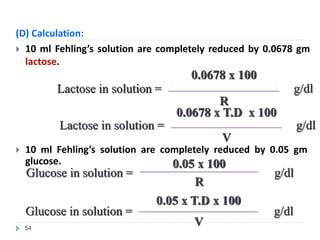
(D) Calculation:
 10 ml Fehling’s solution are completely reduced by 0.0678 gm
lactose.
g/dl
0.0678 x T.D x 100
Lactose in solution =
V
g/dl
0.0678 x 100
Lactose in solution =
R
 10 ml Fehling’s solution are completely reduced by 0.05 gm
glucose.
g/dl
0.05 x 100
Glucose in solution =
R
g/dl
0.05 x T.D x 100
Glucose in solution =
V
54

Milk-final.pptx

  • 1.
  • 2.
    Def: It is thesecretion of mammary glands in human and animals after labour.  It is the only food for newborn for a long period till weaning time.  Before birth the fetus receives its nutrition through the placenta. 2
  • 3.
     Milk secretionis stimulated by Prolactin.  Milk flow is decreased by Estrogen and Progesterone while increased by Thyroxin.  Also Squalene present in HELBA increase milk flow.  Initiation of lactation may result from sudden removal of the placenta and other factors.  Oxytocin (posterior pituitary hormone) responsible for milk ejection 3
  • 4.
    Milk is consideredas a complete diet as:- It contains all of the components necessary for growth, maintenance of life and reproduction. e.g: Carbohydrates, Lipid, Protein, Minerals and Vitamins. But, it is deficient in: Vitamin C, Vitamin D, Vitamin K, Iron, Copper 4
  • 5.
  • 6.
    Property 1- Color Whitecolor → due to presence of:  Fat globules in emulsion form.  Protein in colloidal form.  Ca. phosphate and Ca. Casinate. Yellowish (creamy) color → due to presence of  Carotene and  Xanthophyll pigments (specially in cow's milk) and colostrums (1st fresh milk in pregnancy). 6
  • 7.
    Property 2 -Reaction Fresh milk is amphoteric in reaction as it contains acid & base.  Milk is an excellent buffer as it contain:  Protein.  Phosphate.  Bicarbonate.  Citrate.  pH of fresh milk:  6.6 – 6.8 Cow's milk.  6.8 – 7.4 Human's milk  Milk pH is changed to alkaline in case of:  Mastitis  Late period of lactation.  If the milk left to stand for a long period specially in warm temperature, lactose is fermented to lactic acid by bacteria present normally in milk as:  Streptococcus Lactis  Lactobacillus Lactis 7
  • 8.
    Property 3 –Specific Gravity It is the ratio between weight of a given volume of milk compared with the same volume of water at a specific temperature. Measured by Lactometer  It measure total solids of milk, and determine if any constituent added or removed from milk..  Normal specific gravity:  1020 – 1030 Cow's milk.  1030 – 1035 Human's milk.  Fat is the only constituent in milk with specific gravity lower than 1000, so, when fat present in milk in high amount, specific gravity decrease than normal values. 8
  • 9.
    Property 4 –Taste  Normal characteristic milky taste.  Milk taste changed in case of :  Souring: due to increased acidity.  Boiling: due to certain biochemical changes and evaporation of volatile fatty acids.  Late stage of lactation: due to increase chloride percent.  Mastitis: inflammation of udder. Property 5 - Odor Characteristic milky odor 9
  • 10.
    Property 6 –Freezing point of milk  It is the temperature at which the liquid milk freeze or crystallize.  The freezing point of cow or buffalo milk ranges from (- 0.53) to (-0.57) °C with average (-0.55) °C  Milk freezes at a temperature slightly lower than that of water due to the soluble constituents in milk such as lactose, minerals which lower the freezing point.  This test is important for detection of the amount of water added to pure milk 10
  • 11.
    Addition of Waterto Milk  The addition of 9% water to milk will raise the freezing point by 0.05 °C.  i.e., if milk freezing point is -0.45 °C, it means addition of 18% water. -0.45 – (-0.55) = -0.45 + 0.55 = +0.10 0.05 → 9 % 0.10 → X X = = 18 % 9x0.1 0.05 11
  • 12.
    Property 7 –Boiling Point  Milk boiling point is 100.5 °C , more than water due to presence of dissolving substances Property 8 – Cream Line Formation  When milk left at room temperature the fat globules coalesce, clumped at surface of the container and form cream line. 12
  • 13.
  • 14.
    Milk is formedof: 1) Water: form 87%. 2) Solids: form 13%. A- Organic constituents of milk 1. Protein. 2. Lipid. 3. Carbohydrate. B- Inorganic constituents of milk 1. Minerals. 2. Vitamins. 14
  • 15.
  • 16.
    1- Protein:  Milkprotein less in human than in cow's milk.  All milk protein synthesized in the mammary gland.  Milk protein of high coefficient digestibility (85 – 95%) X 100 Amount of N2 absorbed Total N2 in the protein Total amount of protein differ according to species and affect rate of growth Young rabbit reach double weight in 5 days as milk protein 10 gm/dl. Young calf reaches double weight in 50 days as milk protein 3.7 gm/dl. Young child reach double weight in 5 - 8 months as milk protein 1.5 gm/dl. 16
  • 17.
    Types of MilkProteins 1. Casein 2. Lactalbumin 3. Lactglobulin 4. Milk enzymes 17
  • 18.
    (i) Casein  Itis the main and most dominant milk protein.  Casein is the only milk protein that not coagulated on boiling.  It represents 25% in human's milk and 83% in cow's milk.  It is a compound protein (Phospho-protein) of high biological value.  The high phosphate content of casein allows it to associate with calcium and form calcium phosphate salts.  So, at normal PH of fresh milk (6.6 PH) casein present as insoluble Ca. caseinate phosphate complex. 18
  • 19.
     Casein isdeficient in cystiene and cystin so give negative result with sulpher test.  Casein : (Lactalbumin - Lactglobulin) ratio is 1:3 which facilitate its digestion.  According to molecular weight and electrophoresis process, casein is separated in to 3 fractions, each one of them has its own amino acid composition :  α Casein → 75%.  β Casein → 22%.  γ Casein → 3%. 1 = Casein 3 Lactalbumin + Lactglobulin 19
  • 20.
  • 21.
  • 22.
    Milk Souring (MilkCurdling – Zabadi)  The principle of coagulation, or curd formation, at acidic pH is the basis for Yoghurt (Zabadi) formation. How?  Fermentation of lactose to lactic acid by:  Lactic acid producing bacteria present normally in milk.  Addition of acid (acetic acid).  Addition of starter culture (yoghurt). Lactose + lactic acid bacteria Lactic acid ↓ pH Worm temp. Fermentation 22
  • 23.
    Milk Clotting (CheeseManufacturing) During digestion (in new born): Rennin enzyme acts on casein, converting it to soluble Paracaseinate which is bounded to Ca and form insoluble Ca. paracaseinate (milk clot). Rennin enzyme: Derived from 4th stomach of calves and used externally in cheese manufacture. It is secreted inactive as pro-rennin. Its optimum PH 4. It is absent in adult stomach. Formation of milk clot: prevents rapid passage of milk from stomach to intestine so give the sense of fullness to newborn. 23
  • 24.
  • 25.
    (ii) Lactalbumin  Represent87% of whey protein.  PPT by full saturation with ammonium sulphate.  Rich in cystein and cystin so give +ve result with sulpher test.  Simple, soluble and easily digested protein.  Consists of two fractions:  α Lactalbumin 32% of whey protein.  β lactglobulin 55% of whey protein. Where, β lactglobulin called globulin because it need small amount of NaCl to be dissolved but it is not PPT by half saturation as albumin. 25
  • 26.
    (iii) Lactglobulin  Represent13% of whey protein.  PPT by half saturation with ammonium sulphate solution.  Rich in cystein and cystin so give +ve result with sulpher test.  Simple, soluble and easily digested protein.  Consists of two fractions:  True globulin (Euglobulin) 50%.  False globulin (Pseudoglobulin) 50%.  They carry antibodies causing immunity so called immunoglobulins.  They present in higher concentration in colostrum. 26
  • 27.
    (iv) Milk enzymes 1.Catalase 2. Xanthin oxidase 3. Peroxidase 4. Alkaline phophatase 5. Amylase 6. Lipase 7. Aldehyde oxidase 27
  • 28.
    1- Catalase:  Carriedby fat globules.  Act on hydrogen peroxide (H2O2) producing water and oxygen.  Increased in case of mastitis. 2- Xanthin oxidase: Carried by fat globules. Act on hypoxanthin and xanthin to produce uric acid. Milk enzymes 28
  • 29.
    3- Peroxidase:  Carriedby lactalbumin.  Act on hydrogen peroxide (H2O2).  It is heat stable enzyme (resist destruction by heat).  It is destroyed by milk sterilization. Milk sterilization: Heating of milk to 116◦C for 15 minutes which destroy all harmful and non harmful microorganisms.  Milk sterilization leads to alteration in milk taste and destruction of vitamin C and vitamin B2. N.B: Absence of peroxidase enzyme indicates milk sterilization. Milk enzymes 29
  • 30.
    4 - Alkalinephophatase:  Carried by fat globules.  Catalyze hydrolysis of phosphate ester.  Destroyed by the same temperature that destroys the harmful bacteria. e.g: Tubercle bacilli.  Absence of Alkaline phophatase enzyme indicates milk pasteurization.  Milk pasteurization: Heating of milk to 60◦C for 30 minutes or 70◦C for 15 minutes followed by sudden cooling which destroy the harmful microorganisms only. Milk enzymes 30
  • 31.
    5- Amylase:  Carriedby lactalbumin.  Catalyze hydrolysis of α 1, 4 glycosidic linkage of starch and glycogen.  Increased in case of mastitis. Milk enzymes 6- Lipase:  Carried by casein.  Catalyze hydrolysis of primary ester linkage in triacylglycerol.  Act on milk fat producing free fatty acids and undesirable taste (Rancidity). 7- Aldehyde oxidase (Schardinger's enzyme):  Its absence indicates milk boiling.  Schardinger's test: Milk + Methyl blue + Formaldehyde  Blue color appeared in case of boiled milk.  Colorless in case of unboiled milk. 31
  • 32.
    Beside milk proteinsmilk also contains: A) Lactoferrin binding protein:  It contains iron which is bounded to a glycoprotein.  It facilitates iron transport and storage.  Found in high concentration in human colostrums and milk. B) Vitamin B12 binding protein:  It carries vitamin B12. Lactoferrin and vitamin B12 binding protein deprive pathogenic intestinal bacteria from iron and vitamin B12 so they have bacteriostatic action. 32
  • 33.
    Human's milk Cow's milk Containno short chain fatty acids. Contain short chain fatty acids 10%. Contain 10% essential (polyunsaturated) fatty acids specially linoleic fatty acids. Contain 0.05% essential (polyunsaturated) fatty acids. Saturated fatty acids 48%. Saturated fatty acids 58%. Unsaturated fatty acids 52%. Unsaturated fatty acids 42%. 33
  • 34.
    C) Carbohydrates:  Lactose(milk sugar) is the only carbohydrate of milk.  It is a reducing disaccharide consists of glucose and galactose.  Human's milk contains 7% lactose while cow's milk contains 5% lactose.  Lactose may be excreted in urine during last third of pregnancy physiologically so it should be differentiated from glucose by osazon test. 34
  • 35.
  • 36.
    1- Minerals:  Humanmilk contain less mineral elements (0.4%) than cow's milk (0.8%).  Milk rich in Ca and P which are present in their proper ratio for absorption (2:1) in human milk while in cow's milk (1:2) which is not suitable for their maximum absorption .  Ca and P are essential for: 1. Growth of bone and teeth. 2. Stability of casein.  Milk is deficient in Fe and Cu which are supplied by their storage in liver during prenatal life (this store is sufficient till weaning time).  N.B:  Milk is deficient in Iron but it is more in human milk than cow's milk Thus anaemia in breast feeding is less common.  Milk contain adequate amount of Na, K, Mg.  Human milk contains Na:K (1:2) which is suitable for the optimal growth of newborn. 36
  • 37.
    2- Vitamins:  Milkis deficient in: Vitamin C, Vitamin D, Vitamin K.  Milk contain adequate amount of vitamin B complex which are sufficient for first week of life. e.g: Pantothenic acid  Although milk is deficient in Fe, Cu, vitamin C, vitamin D, and vitamin K it is complete natural food for the following reasons: 1. Easily digested absorbed and metabolized. 2. Contain all the nutrients required for the newborn at early stage of life. 3. Balanced ratio between carbohydrates, lipid and protein. 4. Milk Protein of high biological value as:  It contains all essential amino acids.  Easily digested.  Easily absorbed.  Easily metabolized. 37
  • 38.
  • 39.
    Definition: It is aprocess by which cow's milk is made to be as near as human's milk. Aim:  Protein of human's milk (casein) form 25% of milk protein while casein in cow's milk form 5/6 of milk protein so it form dense clot in newborn stomach which can't be digested leading to vomition.  Lactose in human's milk higher than that in cow's milk (7:5). 39
  • 40.
    Steps: 1. Pasteurization ofmilk:  Heating of milk to 60 ◦C for 30 minutes followed by sudden cooling then the pasteurized milk left in cool place for 4 hours to allow separation of cream. 2. Separate the cream and the residual milk called Skimmed milk. 3. Skimmed milk is divided to two halves.  To one half add:  Separated cream.  Equal amount of water.  Complete lactose to 7%.  Iron, vitamin C, vitamin D may be added. 4. Mix well then sterilize the milk:  Heating of milk to 116 ◦C for 15 minutes. 40
  • 41.
    Advantages of humanmilk (Breast Feeding) 1. Psychological effect on both child and mother. 2. Breast milk is supplied in suitable temperature. 3. Sterile and not liable to be contaminated. 4. Cheaper than animal milk. 5. Not liable to adulteration. 6. Lactation may act as a contraceptive measure. 7. Lactation minimize the risk of breast tumors. 8. Lactation help involution of the uterus. 41
  • 42.
  • 43.
    Defn: Lactose inmilk is estimated in the clear filtrate after precipitating proteins. Tungestic acid, and Trichloroacetic acid can be used to precipitate milk proteins. Useful Instruments: 1. Estimated pipette. 2. Volumetric flask. 3. Funnel. 4. Beaker. 5. Burette. 6. Burette holder. 7. Porcelain dish. 43
  • 44.
    Procedures: a) PPT ofcasein:  In a clean dry volumetric flask add:  5ml of milk  5ml of 10% sodium tungstate solution  5ml of 2/3 N sulphuric acid drop by drop.  Shake gently after each addition .  Complete to the 100-ml mark by distilled water.  Left for sometime (1/4 – 1/2 hr) until the precipitate of casein settles down. b) Filtration: Filter into a dry clean beaker. The filtrate must be clear, if not refilter again 44
  • 45.
    c) Reduction:  Whenabout half the volume is filtered, wash the burette with little of the filtrate.  Then fill the burette with the filtrate.  In a porcelain dish place:  10 ml of Fehling’s solution.  20 ml of distilled water.  Heat the Fehling’s solution until it gently boils and  Begin the reduction adding the filtrate slowly and regularly in order to keep Fehling’s solution boiling all the time.  Continue the reduction until the last trace of blue color is just discharged. 45
  • 46.
    d) Calculation:  R= number of mls of the filterate used for complete reduction of fehling’s solution.  10 ml Fehling’s solution are completely reduced by 0.0678 gm lactose.  Total dilution of milk (T.D):  Lactose in milk (g%): 0.0678 x 20 x 100 Lactose in milk = R 100 20 = 5 46
  • 47.
    Estimation of glucoseor lactose in solution 47
  • 48.
    Principle of thetest: The quantitative determination of glucose or lactose in gm/dl in the solution depends upon their reducing property to Fehling’s solution. Instruments used in the estimation:  Pipette 5 and 10-ml capacity.  Conical flask of 100 cc capacity.  Burette 50 ml capacity  Burette holder.  Porcelain dish.  Beaker. 48
  • 49.
    Reagents and solutionsrequired:  Glucose or lactose, solution under estimation.  Fehling quantitative reagent.  Potassium ferrocyanide acidified with glacial acetic acid (external indicator). Significance of the test:  This test considered the bases of tests used for the determination of blood glucose.  Used for estimation of lactose in milk, for detection of adulteration of milk by the addition of water. 49
  • 50.
    procedures: (A) Rough estimation: Fill the burette with glucose or lactose solution after its careful rinsing with water.  Put in the porcelain dish 10-ml of Fehling quantitative reagent. 20 ml of distilled.  Heat until the Fehling boils in the dish.  Begin the reduction by slow addition of solution in order to keep the Fehling boiling all the time.  Continue reduction till the last trace of the blue color of the Fehling’s reagent turn to red brown PPT of Cu2O.  Record the rough reading R (number of mls of glucose or lactose descended from the burette).  If the (R) rough reading is below 5ml make dilution to the glucose or the lactose solution under the estimation.  If the (R) rough reading is above 5ml calculate the percentage of glucose or the lactose solution under the estimation. 50
  • 51.
    (B) Preparation ofdiluted sugar solution:  Mutiply the (R) by 4.  The result is equaled to 5, 10 or 20.  In 100 ml volumetric flask add: ? ml of the glucose or lactose sugar solution. Completed with distilled water to 100 ml mark and well mixed.  In this case the sugar solution is diluted 5, 10 or 20 times. 51
  • 52.
    (C) Accurate estimation: Wash the burette with distilled water and rinse it with little of diluted sugar,  fill it again with the diluted sugar.  In the porcelain dish add: 10 ml of Fehling’s quantitative solution.  20 ml of distilled water.  Heat till gentile boiling.  Begin the reduction by slow addition of the diluted sugar solution drop by drop in order to keep the Fehling’s solution boiling all the time.  Continue reduction till the last trace of the blue color disappeared and changed to red brown PPT of Cu2O 52
  • 53.
     Using anexternal indicator near the end point (Potassium Ferrocyanide solution acidified with Glacial Acetic acid) to ensure the complete reduction of Fehling's solution:  If no brown color or PPT is formed on the addition of one drop of the solution to the external indicator it indicates:  complete reduction of Fehling's solution.  If brown color or PPT appeared it indicates:  Incomplete reduction of Fehling's solution.  Complete reduction till the yellow color of the indicator doesn’t change.  Record the number of mls used for reduction of 10 ml Fehling’s quantitative solution and give it symbol (V) ml. 53
  • 54.
    (D) Calculation:  10ml Fehling’s solution are completely reduced by 0.0678 gm lactose. g/dl 0.0678 x T.D x 100 Lactose in solution = V g/dl 0.0678 x 100 Lactose in solution = R  10 ml Fehling’s solution are completely reduced by 0.05 gm glucose. g/dl 0.05 x 100 Glucose in solution = R g/dl 0.05 x T.D x 100 Glucose in solution = V 54