MILK
1
WHAT IS
MILK?
 Milk is normal mammary gland secretion of female
mammals or it can be specifically said as the whole,
fresh lacteal secretion obtained by the complete
milking of one or more healthy cows, excluding that
obtained within 15 days before and 5 days after calving,
or such longer period as may be necessary to render
the milk practically colostrum free.
 It consists largely of water, milk fat, lactose or milk
sugar, protein and mineral matter.
 Milk is one of the most important foods in the human
diet because it has many components present in very
small quantities that are essential to growth and well-
being.
2
WHAT DOES
MILK
CONTAIN?
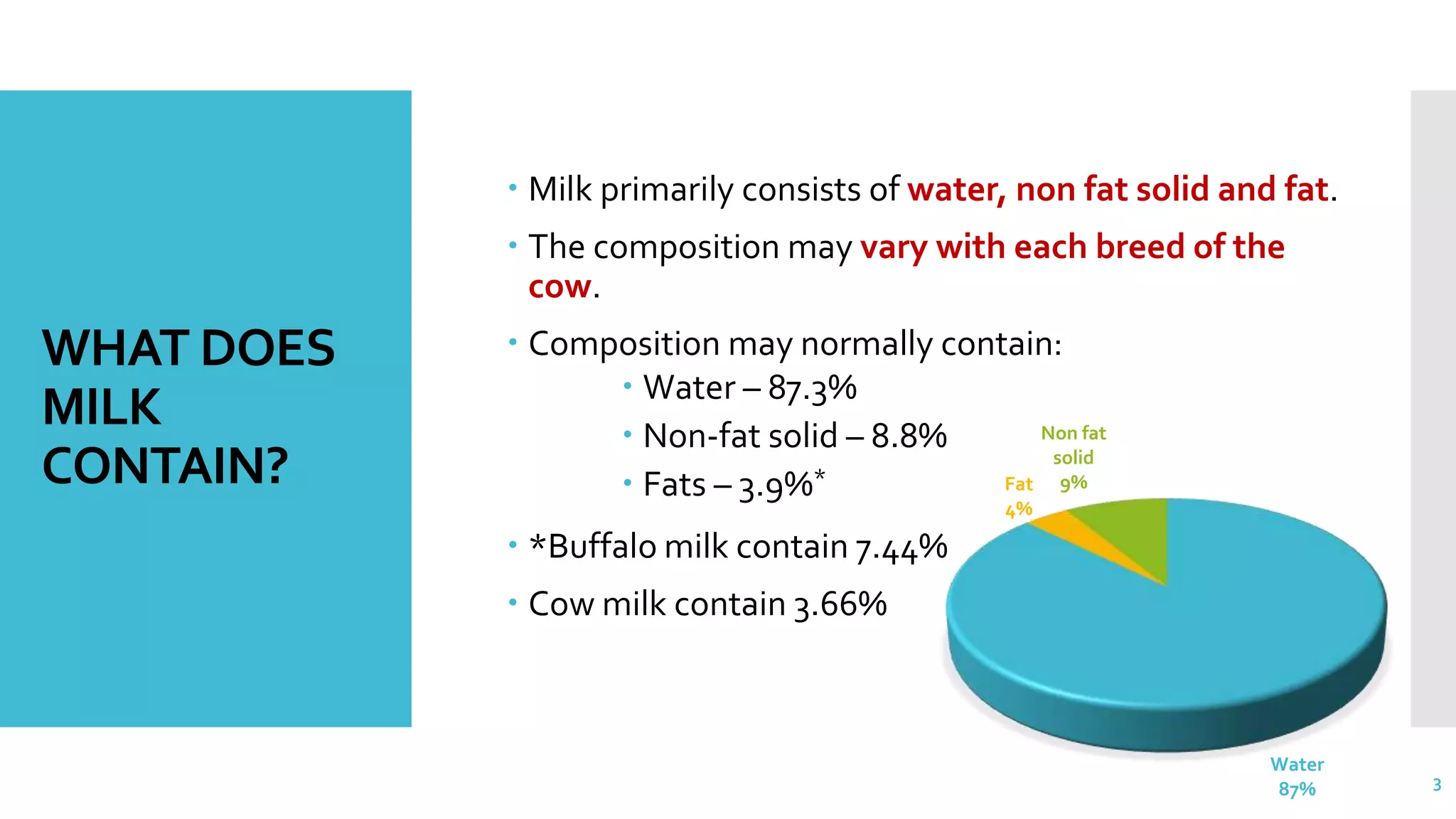
 Milk primarily consists of water, non fat solid and fat.
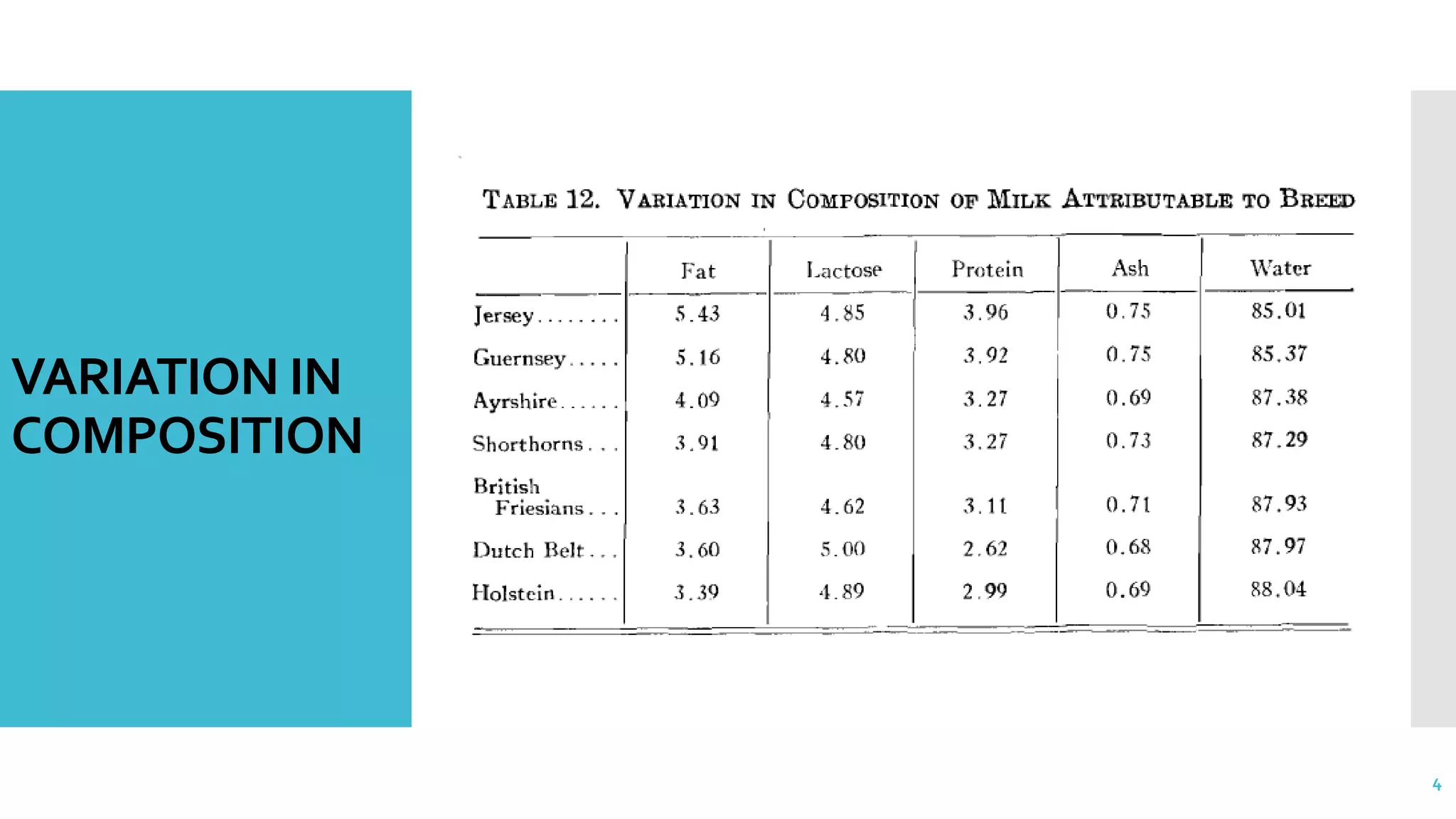
 The composition may vary with each breed of the
cow.
 Composition may normally contain:
 Water – 87.3%
 Non-fat solid – 8.8%
 Fats – 3.9%*
 *Buffalo milk contain 7.44%
 Cow milk contain 3.66%
Water
87%
Fat
4%
Non fat
solid
9%
3
VARIATION IN
COMPOSITION
4
TYPESOF
MILK
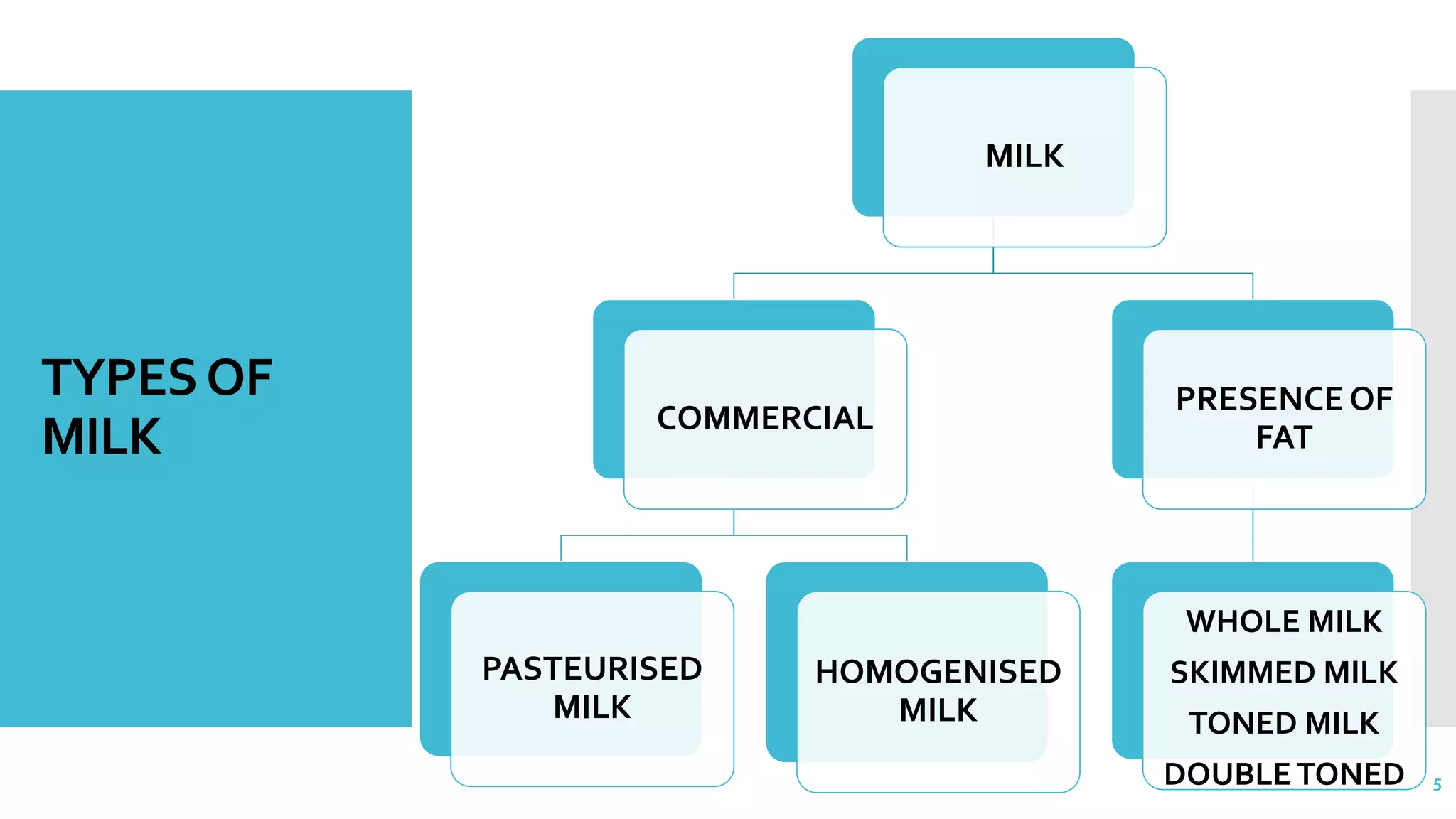
MILK
COMMERCIAL
PASTEURISED
MILK
HOMOGENISED
MILK
PRESENCE OF
FAT
WHOLE MILK
SKIMMED MILK
TONED MILK
DOUBLETONED 5
BASEDON
COMMERCIAL
USE
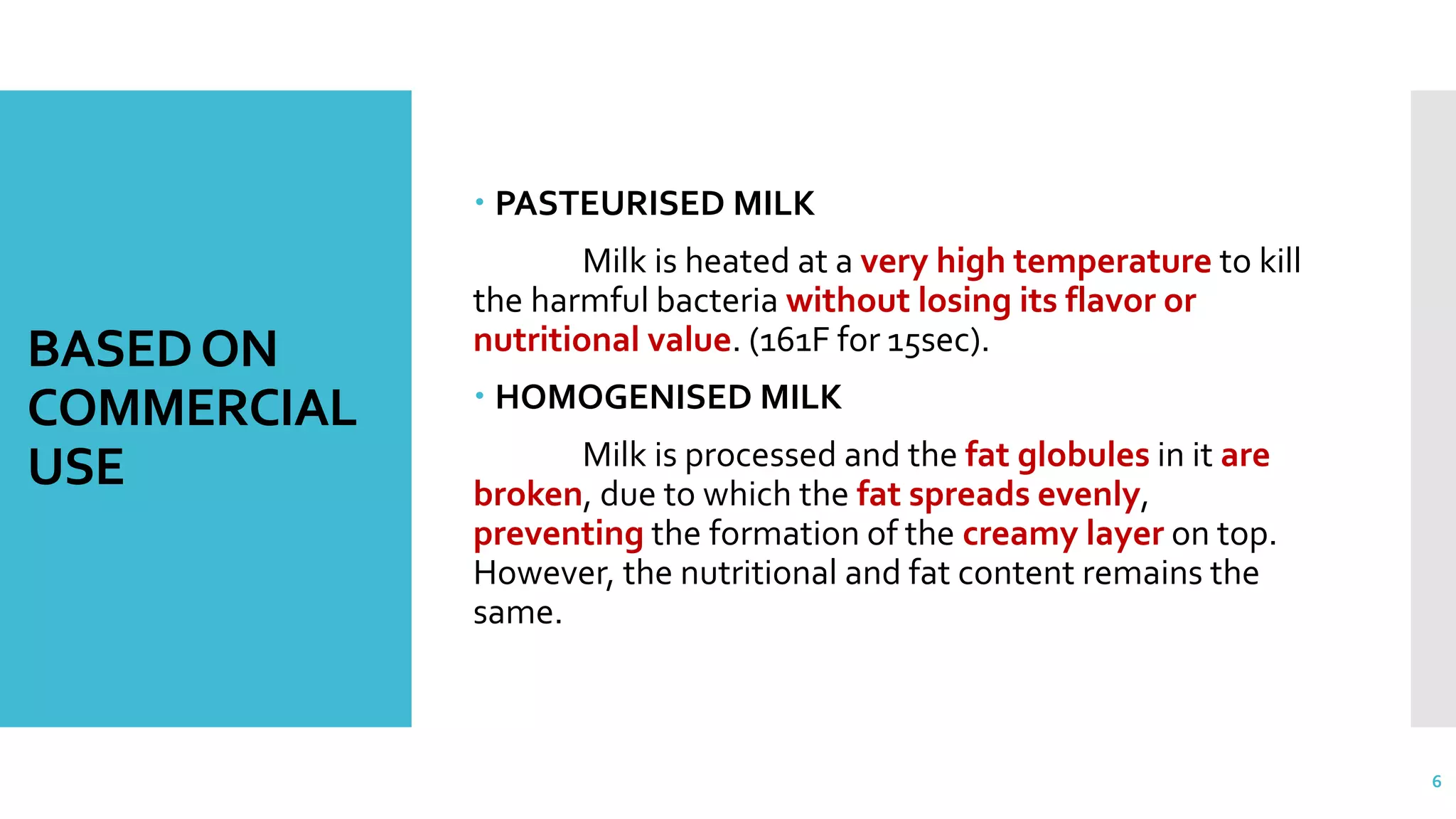
 PASTEURISED MILK
Milk is heated at a very high temperature to kill
the harmful bacteria without losing its flavor or
nutritional value. (161F for 15sec).
 HOMOGENISED MILK
Milk is processed and the fat globules in it are
broken, due to which the fat spreads evenly,
preventing the formation of the creamy layer on top.
However, the nutritional and fat content remains the
same.
6
PRESENCE
OF FAT
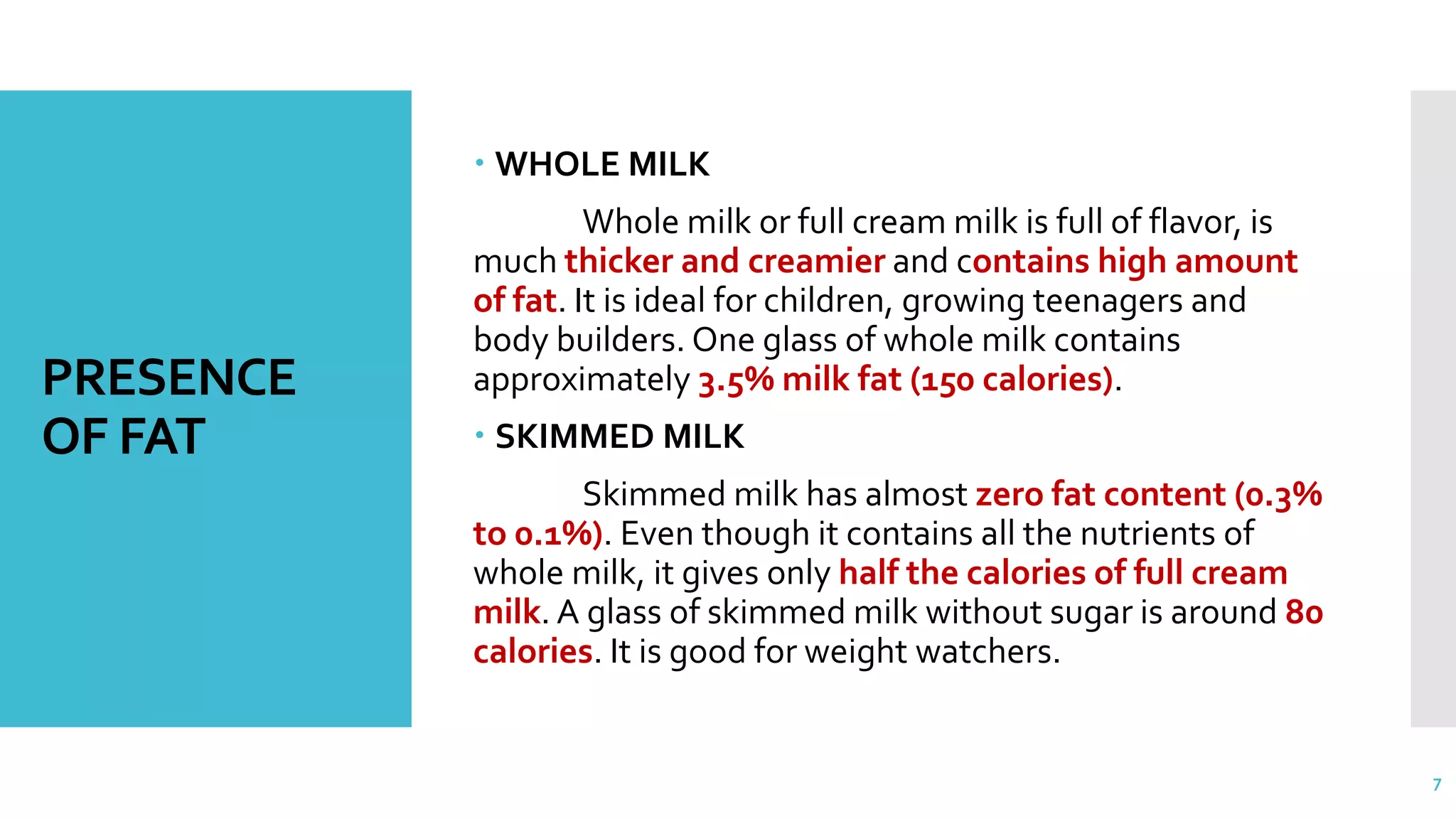
 WHOLE MILK
Whole milk or full cream milk is full of flavor, is
much thicker and creamier and contains high amount
of fat. It is ideal for children, growing teenagers and
body builders. One glass of whole milk contains
approximately 3.5% milk fat (150 calories).
 SKIMMED MILK
Skimmed milk has almost zero fat content (0.3%
to 0.1%). Even though it contains all the nutrients of
whole milk, it gives only half the calories of full cream
milk. A glass of skimmed milk without sugar is around 80
calories. It is good for weight watchers.
7
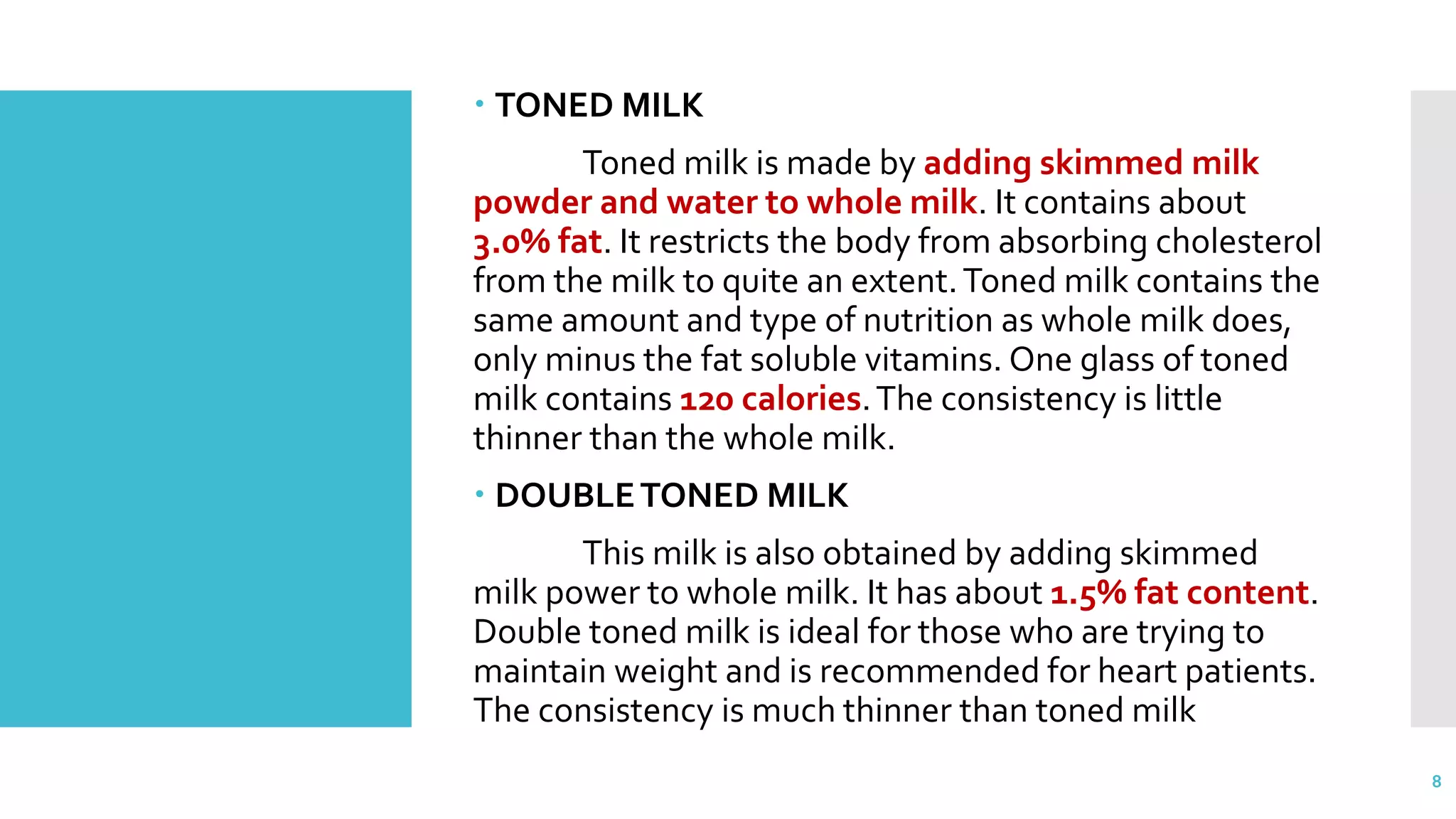
 TONED MILK
Toned milk is made by adding skimmed milk
powder and water to whole milk. It contains about
3.0% fat. It restricts the body from absorbing cholesterol
from the milk to quite an extent.Toned milk contains the
same amount and type of nutrition as whole milk does,
only minus the fat soluble vitamins. One glass of toned
milk contains 120 calories.The consistency is little
thinner than the whole milk.
 DOUBLETONED MILK
This milk is also obtained by adding skimmed
milk power to whole milk. It has about 1.5% fat content.
Double toned milk is ideal for those who are trying to
maintain weight and is recommended for heart patients.
The consistency is much thinner than toned milk
8
OTHER
TYPESOF
MILK
Categorisation based on the milked animal:
 COW’S MILK
It is less thick and creamier, high on cholesterol
but low on fat and calories and is easily digestible.
Preferred for small children.
 BUFFALO’S MILK
It is much thicker and creamier, low on
cholesterol but high on fat and calories. Preserved
time is more as compared to cow’s milk. Ideal for dairy
products like khoya, paneer, sweets and other dairy stuff.
9
MILK
PRODUCTS
 Butter
 Cheese
 Ice cream
 Margarine
 Dry milk powder
 Yogurt
10
GENERAL
ANALYTICAL
METHODSOF
MILK
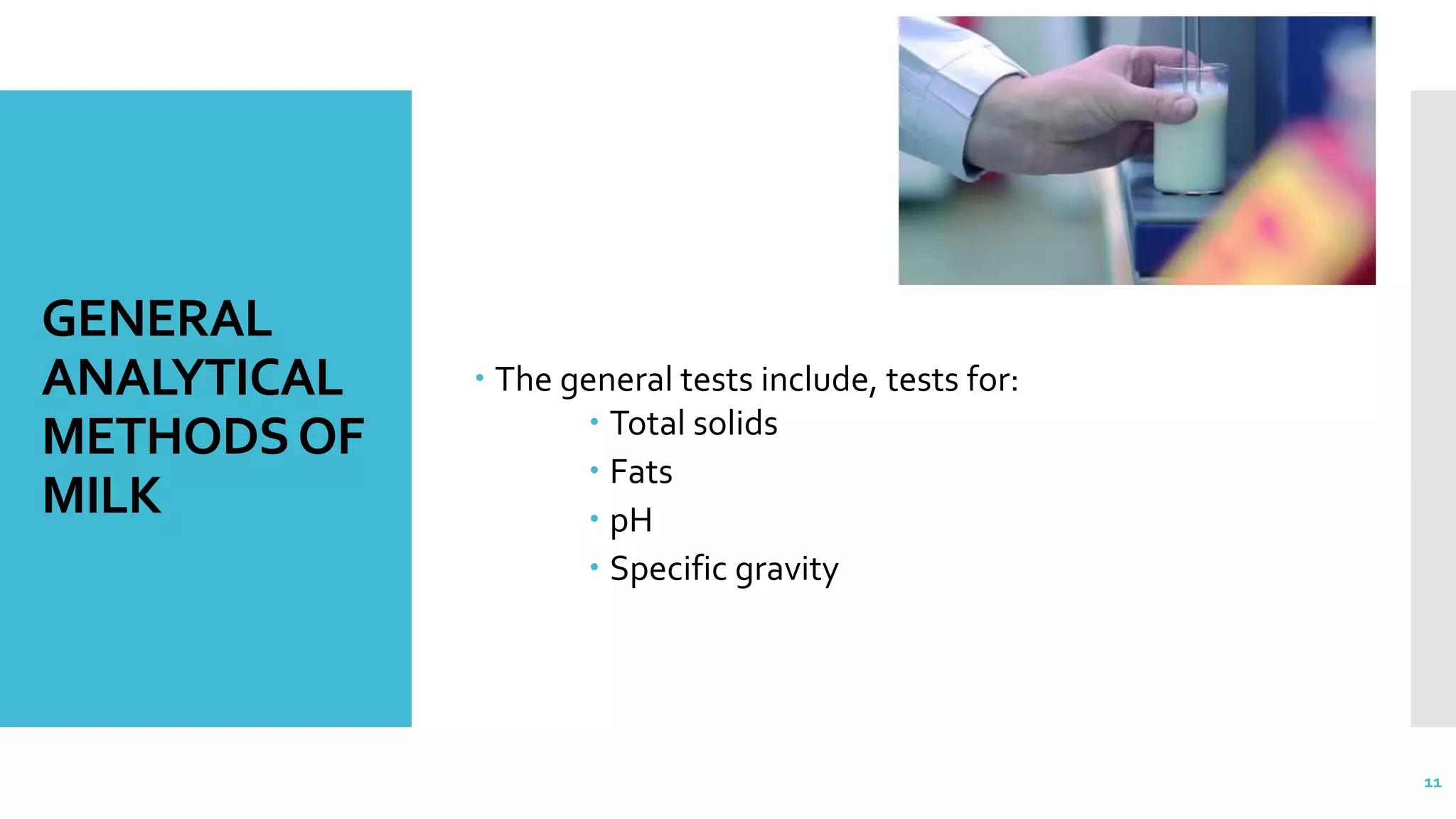
 The general tests include, tests for:
 Total solids
 Fats
 pH
 Specific gravity
11
PREPARATION
OFSAMPLE
 Warm the sample to 37- 40°C by transferring it to the
beaker and keeping it in a water bath.
 Stir slowly for proper homogenisation.
 Mix sample thoroughly by pouring back into the bottle,
mixing to dislodge any residual fat sticking to the sides
and pour it back in the beaker. During mixing do not
shake the bottle vigorously.
 Allow the sample to come to room temperature (26-
28°C) and withdraw immediately for analysis.
 If small clots or lumps are observed in the sample a few
drops of liquor ammonia may be used.
 After homogenization, if the sample shows lumps or
clots are visible suggestive of curdling /splitting of
milk, the sample should be deemed unfit for analysis
and rejected.
12
DETERMINATION
OFTOTALSOLIDS
(GRAVIMETRIC
METHOD)
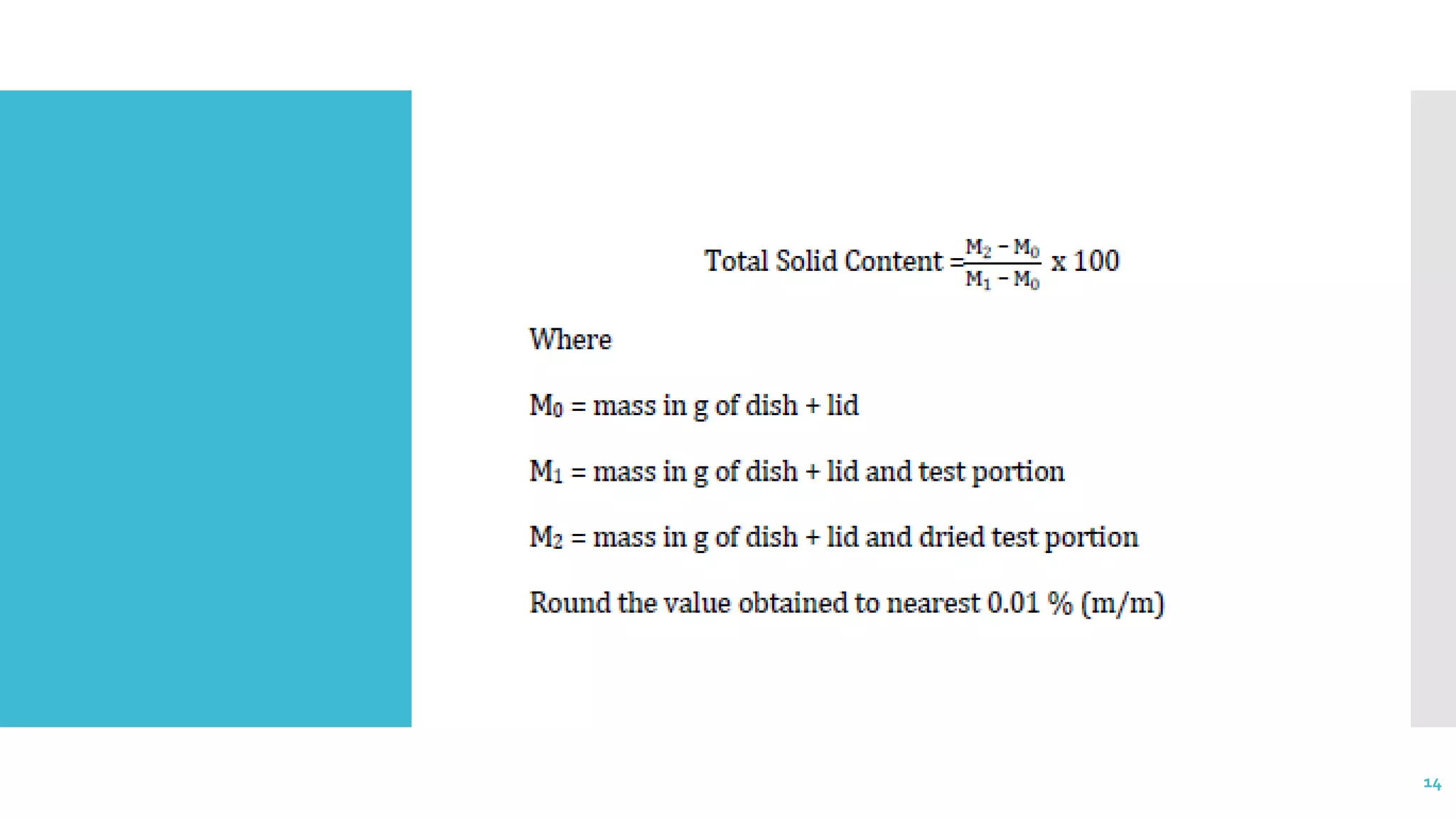
 In this procedure, a known quantity of milk is dried on a
boiling water bath.
 Subsequently sample is dried in hot air oven at
102 ±2°C and from the weight of the residue, the total
solids content in milk is determined.
13
14
DETERMINATION
OF FAT IN MILK
15
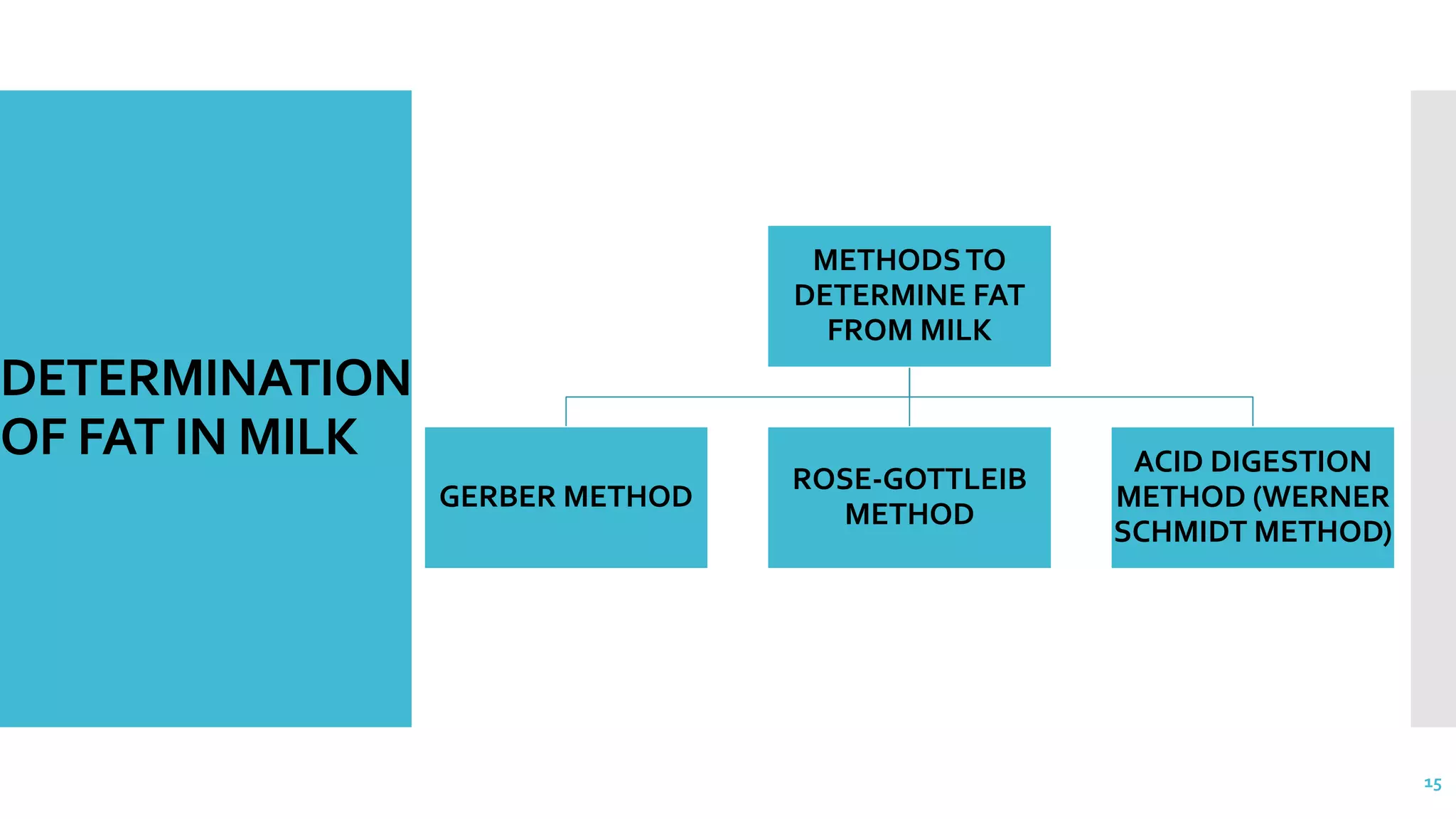
METHODSTO
DETERMINE FAT
FROM MILK
GERBER METHOD
ROSE-GOTTLEIB
METHOD
ACID DIGESTION
METHOD (WERNER
SCHMIDT METHOD)
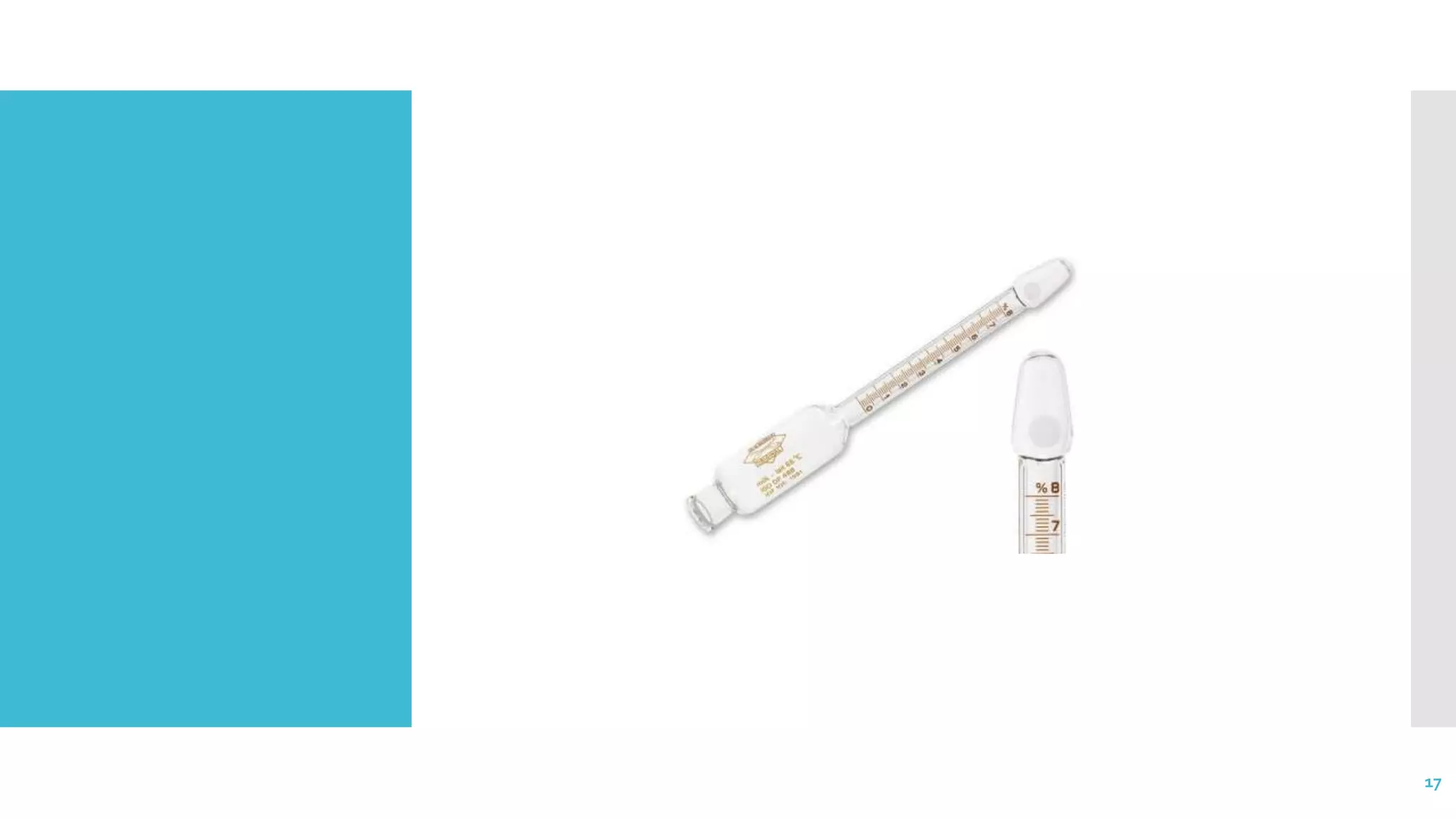
GERBER
METHOD
 The milk is mixed with sulphuric acid and iso-amyl
alcohol in a special Gerber tube, permitting
dissolution of the protein and release of fat.
 The tubes are centrifuged and the fat rising into the
calibrated part of the tube is measured as a
percentage of the fat content of the milk sample.
 The method is suitable as a routine or screening test.
 It is an empirical method and reproducible results can
be obtained if procedure is followed correctly.
16
17
ROSE-
GOTTLIEB
METHOD
 The milk sample is treated with ammonia and ethyl
alcohol; the former to dissolve the protein and the
latter to help to precipitate the proteins.
 Fat is extracted with diethyl ether and petroleum ether.
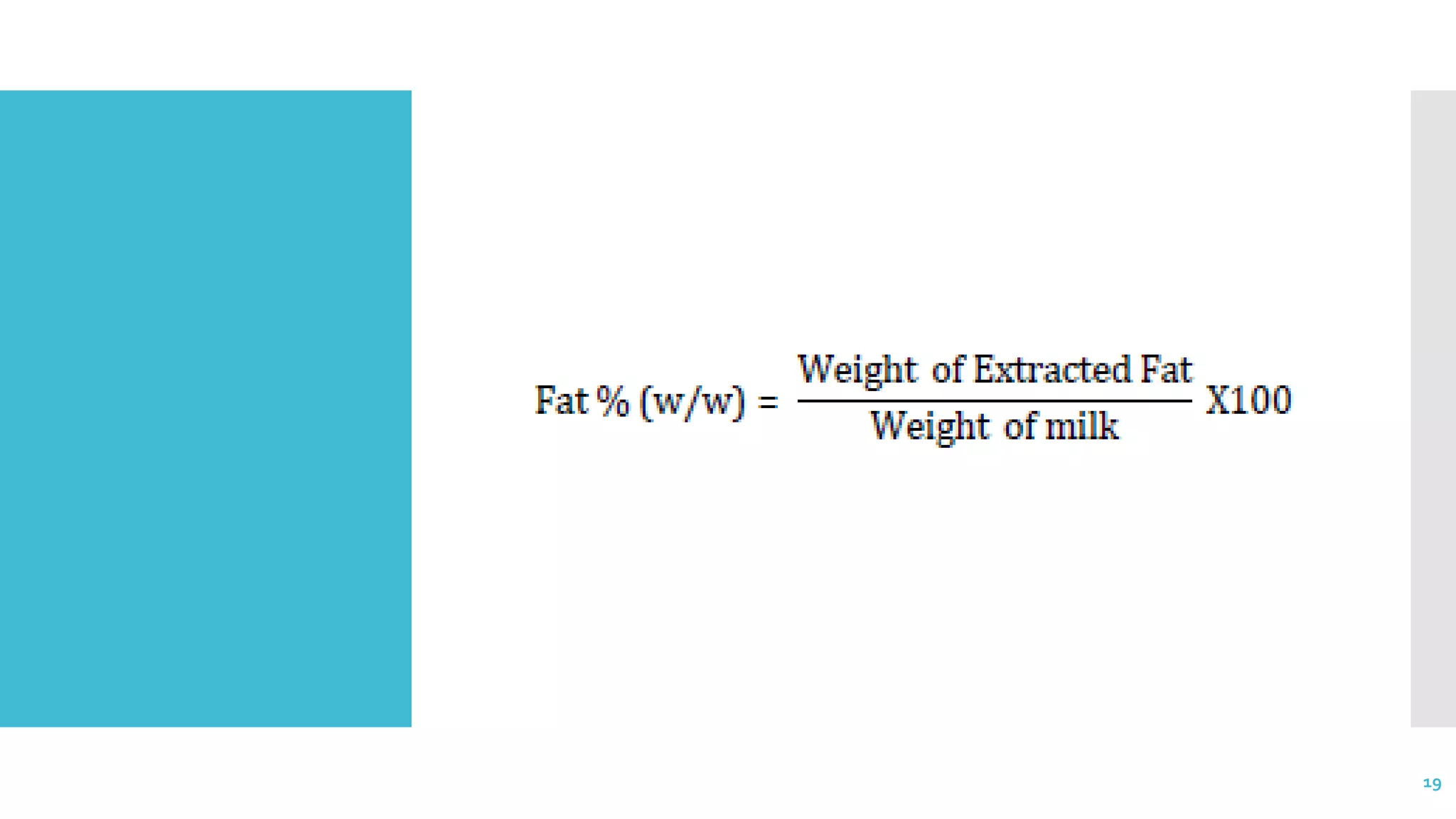
 Mixed ethers are evaporated and the residue
weighed.
 This method is considered suitable for reference
purposes.
 Strict adherence to details is essential in order to
obtain reliable results.
18
19
ACID
DIGESTION
METHOD
(WERNER
SCHMIDT
METHOD)
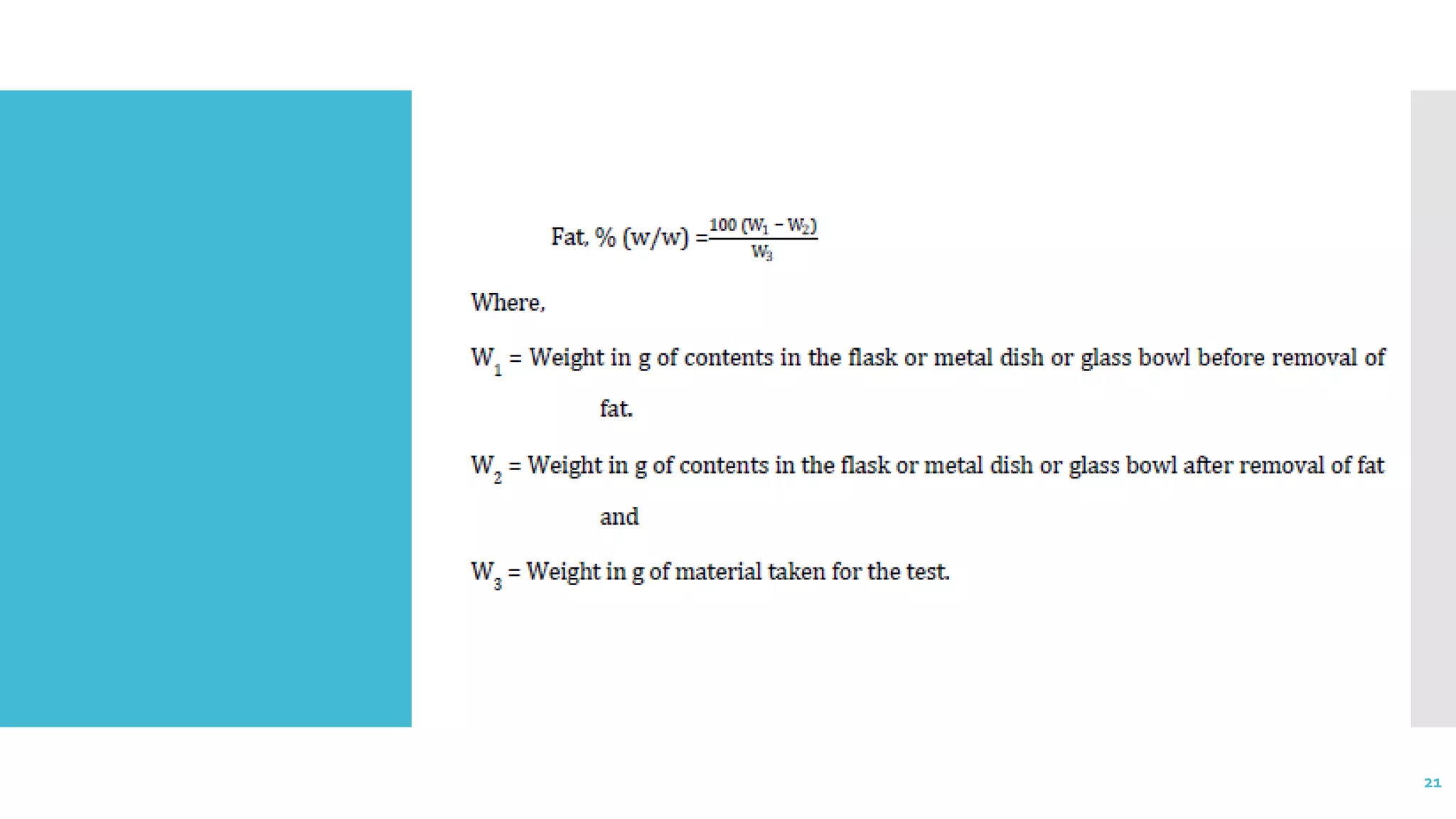
 In this method, milk proteins are digested with
concentrated hydrochloric acid.
 Liberated fat is extracted with alcohol, ethyl ether
and petroleum ether.
 Ethers are evaporated and residue left behind is
weighed to calculate the fat content.
20
21
pH
 pH of the milk should lie between 6.5 and 6.7.
 It can be analysed by potentiometric method.
22
SPECIFIC
GRAVITY
 It has the value between 1.028-1.033.
 It can be analysed by lactometer.
23
24
REFERENCES
 http://www.indushealthplus.com/milk-types-and-
variants.html
 The chemical analysis of foods and food products by
Morris B. Jacobs.
 http://old.fssai.gov.in/Portals/0/Pdf/Draft_Manuals/MIL
K_AND_MILK_PRODUCTS.pdf
 https://archive.org/details/gov.in.is.1479.2.1961
 www.googleimages.com
25

Milk introduction

  • 1.
  • 2.
    WHAT IS MILK?  Milkis normal mammary gland secretion of female mammals or it can be specifically said as the whole, fresh lacteal secretion obtained by the complete milking of one or more healthy cows, excluding that obtained within 15 days before and 5 days after calving, or such longer period as may be necessary to render the milk practically colostrum free.  It consists largely of water, milk fat, lactose or milk sugar, protein and mineral matter.  Milk is one of the most important foods in the human diet because it has many components present in very small quantities that are essential to growth and well- being. 2
  • 3.
    WHAT DOES MILK CONTAIN?  Milkprimarily consists of water, non fat solid and fat.  The composition may vary with each breed of the cow.  Composition may normally contain:  Water – 87.3%  Non-fat solid – 8.8%  Fats – 3.9%*  *Buffalo milk contain 7.44%  Cow milk contain 3.66% Water 87% Fat 4% Non fat solid 9% 3
  • 4.
  • 5.
  • 6.
    BASEDON COMMERCIAL USE  PASTEURISED MILK Milkis heated at a very high temperature to kill the harmful bacteria without losing its flavor or nutritional value. (161F for 15sec).  HOMOGENISED MILK Milk is processed and the fat globules in it are broken, due to which the fat spreads evenly, preventing the formation of the creamy layer on top. However, the nutritional and fat content remains the same. 6
  • 7.
    PRESENCE OF FAT  WHOLEMILK Whole milk or full cream milk is full of flavor, is much thicker and creamier and contains high amount of fat. It is ideal for children, growing teenagers and body builders. One glass of whole milk contains approximately 3.5% milk fat (150 calories).  SKIMMED MILK Skimmed milk has almost zero fat content (0.3% to 0.1%). Even though it contains all the nutrients of whole milk, it gives only half the calories of full cream milk. A glass of skimmed milk without sugar is around 80 calories. It is good for weight watchers. 7
  • 8.
     TONED MILK Tonedmilk is made by adding skimmed milk powder and water to whole milk. It contains about 3.0% fat. It restricts the body from absorbing cholesterol from the milk to quite an extent.Toned milk contains the same amount and type of nutrition as whole milk does, only minus the fat soluble vitamins. One glass of toned milk contains 120 calories.The consistency is little thinner than the whole milk.  DOUBLETONED MILK This milk is also obtained by adding skimmed milk power to whole milk. It has about 1.5% fat content. Double toned milk is ideal for those who are trying to maintain weight and is recommended for heart patients. The consistency is much thinner than toned milk 8
  • 9.
    OTHER TYPESOF MILK Categorisation based onthe milked animal:  COW’S MILK It is less thick and creamier, high on cholesterol but low on fat and calories and is easily digestible. Preferred for small children.  BUFFALO’S MILK It is much thicker and creamier, low on cholesterol but high on fat and calories. Preserved time is more as compared to cow’s milk. Ideal for dairy products like khoya, paneer, sweets and other dairy stuff. 9
  • 10.
    MILK PRODUCTS  Butter  Cheese Ice cream  Margarine  Dry milk powder  Yogurt 10
  • 11.
    GENERAL ANALYTICAL METHODSOF MILK  The generaltests include, tests for:  Total solids  Fats  pH  Specific gravity 11
  • 12.
    PREPARATION OFSAMPLE  Warm thesample to 37- 40°C by transferring it to the beaker and keeping it in a water bath.  Stir slowly for proper homogenisation.  Mix sample thoroughly by pouring back into the bottle, mixing to dislodge any residual fat sticking to the sides and pour it back in the beaker. During mixing do not shake the bottle vigorously.  Allow the sample to come to room temperature (26- 28°C) and withdraw immediately for analysis.  If small clots or lumps are observed in the sample a few drops of liquor ammonia may be used.  After homogenization, if the sample shows lumps or clots are visible suggestive of curdling /splitting of milk, the sample should be deemed unfit for analysis and rejected. 12
  • 13.
    DETERMINATION OFTOTALSOLIDS (GRAVIMETRIC METHOD)  In thisprocedure, a known quantity of milk is dried on a boiling water bath.  Subsequently sample is dried in hot air oven at 102 ±2°C and from the weight of the residue, the total solids content in milk is determined. 13
  • 14.
  • 15.
    DETERMINATION OF FAT INMILK 15 METHODSTO DETERMINE FAT FROM MILK GERBER METHOD ROSE-GOTTLEIB METHOD ACID DIGESTION METHOD (WERNER SCHMIDT METHOD)
  • 16.
    GERBER METHOD  The milkis mixed with sulphuric acid and iso-amyl alcohol in a special Gerber tube, permitting dissolution of the protein and release of fat.  The tubes are centrifuged and the fat rising into the calibrated part of the tube is measured as a percentage of the fat content of the milk sample.  The method is suitable as a routine or screening test.  It is an empirical method and reproducible results can be obtained if procedure is followed correctly. 16
  • 17.
  • 18.
    ROSE- GOTTLIEB METHOD  The milksample is treated with ammonia and ethyl alcohol; the former to dissolve the protein and the latter to help to precipitate the proteins.  Fat is extracted with diethyl ether and petroleum ether.  Mixed ethers are evaporated and the residue weighed.  This method is considered suitable for reference purposes.  Strict adherence to details is essential in order to obtain reliable results. 18
  • 19.
  • 20.
    ACID DIGESTION METHOD (WERNER SCHMIDT METHOD)  In thismethod, milk proteins are digested with concentrated hydrochloric acid.  Liberated fat is extracted with alcohol, ethyl ether and petroleum ether.  Ethers are evaporated and residue left behind is weighed to calculate the fat content. 20
  • 21.
  • 22.
    pH  pH ofthe milk should lie between 6.5 and 6.7.  It can be analysed by potentiometric method. 22
  • 23.
    SPECIFIC GRAVITY  It hasthe value between 1.028-1.033.  It can be analysed by lactometer. 23
  • 24.
  • 25.
    REFERENCES  http://www.indushealthplus.com/milk-types-and- variants.html  Thechemical analysis of foods and food products by Morris B. Jacobs.  http://old.fssai.gov.in/Portals/0/Pdf/Draft_Manuals/MIL K_AND_MILK_PRODUCTS.pdf  https://archive.org/details/gov.in.is.1479.2.1961  www.googleimages.com 25