Migration Trends in the Russian
Federation
在俄罗斯联邦的移民趋势
Dmitry Sanatov, Head of research project team,
Foundation Center for Strategic Research «North-West»
Economic Policy Dialogue among think tanks of emerging economies (Hainan, China)

November 3
2013
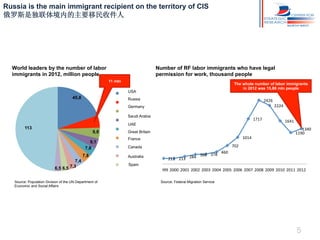
Russia is the main immigrant recipient on the territory of CIS
俄罗斯是独联体境内的主要移民收件人

World leaders by the number of labor
immigrants in 2012, million people

Number of RF labor immigrants who have legal
permission for work, thousand people
11 mln

The whole number of labor immigrants
in 2012 was 15,88 mln people

USA
США	
  

45,8

РФ	
  

Russia

2426	
  

Germany

2224	
  

Германия	
  

Saudi Arabia

1717	
  

Саудовская	
  Аравия	
  
UAE

113

9,8
9,1
7,8
7,8
7,4
7,3
6,5 6,5

Source: Population Division of the UN Department of
Economic and Social Affairs

ОАЭ	
  

Great Britain

1014	
  

Великобритания	
  
France
Canada
Франция	


Канада	
  
Australia
Spain
Австралия	
  

1641	
  
1340	
  
1190	
  

702	
  
378	
   460	
  
284	
   360	
  
211	
   213	
  
1999	
   2000	
   2001	
   2002	
   2003	
   2004	
   2005	
   2006	
   2007	
   2008	
   2009	
   2010	
   2011	
   2012	
  
Source: Federal Migration Service

5
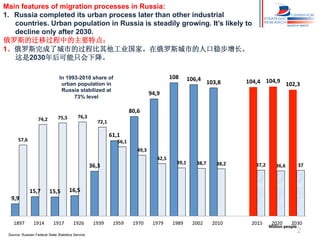
Main features of migration processes in Russia:
1.  Russia completed its urban process later than other industrial
countries. Urban population in Russia is steadily growing. It’s likely to
decline only after 2030.
俄罗斯的迁移过程中的主要特点:
1。俄罗斯完成了城市的过程比其他工业国家。在俄罗斯城市的人口稳步增长。
这是2030年后可能只会下降。
108	
  

In 1993-2010 share of
urban population in
Russia stabilized at
73% level

74,2	
  

75,5	
  

76,3	
  

106,4	
  

103,8	
  

104,4	
   104,9	
   102,3	
  

94,9	
  

2012	


80,6	
  

2008	


72,1	
  

61,1	
  

57,6	
  

56,1	
  
49,3	
  
42,5	
  

36,3	
  

9,9	
  

1897	
  

15,7	
  

1914	
  

15,5	
  

1917	
  

39,1	
  

38,7	
  

38,2	
  

37,2	
  

37	
  

36,6	
  

16,5	
  

1926	
  

Source: Russian Federal State Statistics Service

1939	
  

1959	
  

1970	
  

1979	
  

1989	
  

2002	
  

2010	
  

2015	
  

2020	
  

2030	
  

Million	
  people	
  

2
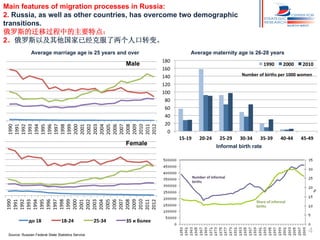
Main features of migration processes in Russia:
2. Russia, as well as other countries, has overcome two demographic
transitions.
俄罗斯的迁移过程中的主要特点:
2。俄罗斯以及其他国家已经克服了两个人口转变。
Average marriage age is 25 years and over

1990	
  
1991	
  
1992	
  
1993	
  
1994	
  
1995	
  
1996	
  
1997	
  
1998	
  
1999	
  
2000	
  
2001	
  
2002	
  
2003	
  
2004	
  
2005	
  
2006	
  
2007	
  
2008	
  
2009	
  
2010	
  
2011	
  
2012	
  

Male

Female

Average maternity age is 26-28 years
180	
  
160	
  
140	
  
120	
  
100	
  
80	
  
60	
  
40	
  
20	
  
0	
  

1990	
  

2000	
  

2010	
  

Number	
  of	
  births	
  per	
  1000	
  women	
  

15-­‐19	
  

20-­‐24	
  

25-­‐29	
  

30-­‐34	
  

35-­‐39	
  

40-­‐44	
  

45-­‐49	
  

Informal birth rate

1990	
  
1991	
  
1992	
  
1993	
  
1994	
  
1995	
  
1996	
  
1997	
  
1998	
  
1999	
  
2000	
  
2001	
  
2002	
  
2003	
  
2004	
  
2005	
  
2006	
  
2007	
  
2008	
  
2009	
  
2010	
  
2011	
  
2012	
  

Number	
  of	
  informal	
  
births	
  

до	
  18	
  

18-­‐24	
  

Source: Russian Federal State Statistics Service

25-­‐34	
  

Share	
  of	
  informal	
  
births	
  

35	
  и	
  более	
  

4
Main features of migration processes in Russia:
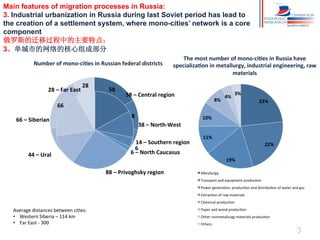
3. Industrial urbanization in Russia during last Soviet period has lead to
the creation of a settlement system, where mono-cities’ network is a core
component
俄罗斯的迁移过程中的主要特点:
3。单城市的网络的核心组成部分
Number	
  of	
  mono-­‐ciHes	
  in	
  Russian	
  federal	
  districts	
  

28	
  –	
  Far	
  East

28	
  

58	
  

The	
  most	
  number	
  of	
  mono-­‐ciHes	
  in	
  Russia	
  have	
  
specializaHon	
  in	
  metallurgy,	
  industrial	
  engineering,	
  raw	
  
materials	


58	
  –	
  Central	
  region

8%	
  

66	
  
38	
  

66	
  –	
  Siberian

38	
  –	
  North-­‐West
14	
  

44	
  
44	
  –	
  Ural

88	
  

14	
  –	
  Southern	
  region
6	
  
6	
  –	
  North	
  Caucasus

88	
  –	
  Privoghsky	
  region

4%	
  

3%	
  
23%	
  

10%	
  
11%	
  
22%	
  
19%	
  
Metallurgy	
  
Transport	
  and	
  equipment	
  producZon	
  
Power	
  generaZon,	
  producZon	
  and	
  distribuZon	
  of	
  water	
  and	
  gaz	
  
ExtracZon	
  of	
  raw	
  materials	
  
Chemical	
  producZon	
  

Average	
  distances	
  between	
  ciZes:	
  	
  
•  Western	
  Siberia	
  –	
  114	
  km	
  
•  Far	
  East	
  -­‐	
  300

Paper	
  and	
  wood	
  producZon	
  
Other	
  nonmetallurgy	
  materials	
  producZon	
  
Others	
  

3
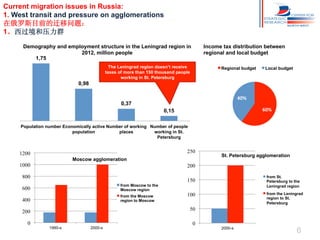
Current migration issues in Russia:
1. West transit and pressure on agglomerations
在俄罗斯目前的迁移问题:
1。西过境和压力群
Demography and employment structure in the Leningrad region in
2012, million people
1,75

Income tax distribution between
regional and local budget

The Leningrad region doesn’t receive
taxes of more than 150 thousand people
working in St. Petersburg

Regional budget

Local budget

0,98
40%	
  

0,37

60%	
  

0,15
Population number Economically active Number of working Number of people
population
places
working in St.
Petersburg

250

1200
Moscow agglomeration

1000

200

800
600

from Moscow to the
Moscow region

400

from the Moscow
region to Moscow

from St.
Petersburg to the
Leningrad region

150

from the Leningrad
region to St.
Petersburg

100
50

200
0

St. Petersburg agglomeration

1990-s

2000-s

0

2000-s

6
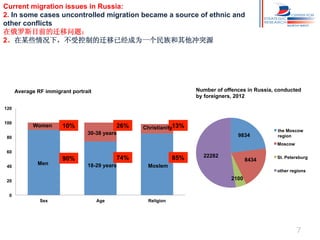
Current migration issues in Russia:
2. In some cases uncontrolled migration became a source of ethnic and
other conflicts
在俄罗斯目前的迁移问题:
2。在某些情况下,不受控制的迁移已经成为一个民族和其他冲突源

Number of offences in Russia, conducted
by foreigners, 2012

Average RF immigrant portrait
120
100

Women

10%

26%
30-38 years

80

Christianity13%
9834

the Moscow
region
Moscow

60
40

Men

74%

90%

18-29 years

85%

22282

8434

Moslem

St. Petersburg
other regions

2100

20
0
Sex

Age

Religion

7
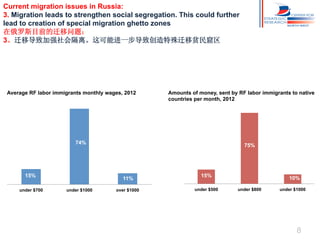
Current migration issues in Russia:
3. Migration leads to strengthen social segregation. This could further
lead to creation of special migration ghetto zones
在俄罗斯目前的迁移问题:
3。迁移导致加强社会隔离。这可能进一步导致创造特殊迁移贫民窟区

Average RF labor immigrants monthly wages, 2012

Amounts of money, sent by RF labor immigrants to native
countries per month, 2012

74%

15%
under $700

75%

11%
under $1000

over $1000

15%
under $500

10%
under $800

under $1000

8
Current migration issues in Russia:
4. There is a gap between educational and cultural level of native
Russians and immigrants
在俄罗斯目前的迁移问题:
4。有一个教育和文化层面,俄罗斯本地人和移民之间的差距
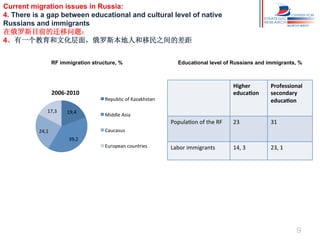
RF immigration structure, %

Educational level of Russians and immigrants, %

17,3	
  

19,4	
  

Professional	
  
secondary	
  
educaHon

PopulaZon	
  of	
  the	
  RF

2006-­‐2010	
  

Higher	
  
educaHon

23

31

Labor	
  immigrants

14,	
  3

23,	
  1

Republic	
  of	
  Kazakhstan	
  
Middle	
  Asia	
  
Caucasus	
  

24,1	
  
39,2	
  

European	
  countries	
  

9
Migration calls to Russia
迁移呼吁俄罗斯

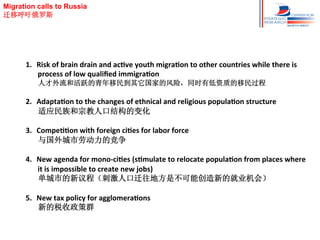
1.  Risk	
  of	
  brain	
  drain	
  and	
  acHve	
  youth	
  migraHon	
  to	
  other	
  countries	
  while	
  there	
  is	
  
process	
  of	
  low	
  qualified	
  immigraHon	
  
人才外流和活跃的青年移民到其它国家的风险,同时有低资质的移民过程	
  

2.  AdaptaHon	
  to	
  the	
  changes	
  of	
  ethnical	
  and	
  religious	
  populaHon	
  structure	
  
适应民族和宗教人口结构的变化	
  
3.  CompeHHon	
  with	
  foreign	
  ciHes	
  for	
  labor	
  force	
  
与国外城市劳动力的竞争	
  
4.  New	
  agenda	
  for	
  mono-­‐ciHes	
  (sHmulate	
  to	
  relocate	
  populaHon	
  from	
  places	
  where	
  
it	
  is	
  impossible	
  to	
  create	
  new	
  jobs)	
  
单城市的新议程(刺激人口迁往地方是不可能创造新的就业机会)	
  
5.  New	
  tax	
  policy	
  for	
  agglomeraHons	
  
新的税收政策群
Foundation Center for Strategic Research “North-West” – independent
think tank

Thank you for your attention!

Address:	
  26	
  line,	
  VI,	
  15-­‐2-­‐A,	
  St.Petersburg,	
  	
  
Russia,	
  199106	
  
Phone	
  (fax):	
  +7	
  812	
  380	
  0320,	
  380	
  0321	
  
E-­‐mail:	
  mail@csr-­‐nw.ru	


Materials	
  are	
  available	
  at	
  	
  www.csr-­‐nw.ru	
  

13

Migration Trends in the Russian Federation

  • 1.
    Migration Trends inthe Russian Federation 在俄罗斯联邦的移民趋势 Dmitry Sanatov, Head of research project team, Foundation Center for Strategic Research «North-West» Economic Policy Dialogue among think tanks of emerging economies (Hainan, China) November 3 2013
  • 2.
    Russia is themain immigrant recipient on the territory of CIS 俄罗斯是独联体境内的主要移民收件人 World leaders by the number of labor immigrants in 2012, million people Number of RF labor immigrants who have legal permission for work, thousand people 11 mln The whole number of labor immigrants in 2012 was 15,88 mln people USA США   45,8 РФ   Russia 2426   Germany 2224   Германия   Saudi Arabia 1717   Саудовская  Аравия   UAE 113 9,8 9,1 7,8 7,8 7,4 7,3 6,5 6,5 Source: Population Division of the UN Department of Economic and Social Affairs ОАЭ   Great Britain 1014   Великобритания   France Canada Франция     Канада   Australia Spain Австралия   1641   1340   1190   702   378   460   284   360   211   213   1999   2000   2001   2002   2003   2004   2005   2006   2007   2008   2009   2010   2011   2012   Source: Federal Migration Service 5
  • 3.
    Main features ofmigration processes in Russia: 1.  Russia completed its urban process later than other industrial countries. Urban population in Russia is steadily growing. It’s likely to decline only after 2030. 俄罗斯的迁移过程中的主要特点: 1。俄罗斯完成了城市的过程比其他工业国家。在俄罗斯城市的人口稳步增长。 这是2030年后可能只会下降。 108   In 1993-2010 share of urban population in Russia stabilized at 73% level 74,2   75,5   76,3   106,4   103,8   104,4   104,9   102,3   94,9   2012     80,6   2008     72,1   61,1   57,6   56,1   49,3   42,5   36,3   9,9   1897   15,7   1914   15,5   1917   39,1   38,7   38,2   37,2   37   36,6   16,5   1926   Source: Russian Federal State Statistics Service 1939   1959   1970   1979   1989   2002   2010   2015   2020   2030   Million  people   2
  • 4.
    Main features ofmigration processes in Russia: 2. Russia, as well as other countries, has overcome two demographic transitions. 俄罗斯的迁移过程中的主要特点: 2。俄罗斯以及其他国家已经克服了两个人口转变。 Average marriage age is 25 years and over 1990   1991   1992   1993   1994   1995   1996   1997   1998   1999   2000   2001   2002   2003   2004   2005   2006   2007   2008   2009   2010   2011   2012   Male Female Average maternity age is 26-28 years 180   160   140   120   100   80   60   40   20   0   1990   2000   2010   Number  of  births  per  1000  women   15-­‐19   20-­‐24   25-­‐29   30-­‐34   35-­‐39   40-­‐44   45-­‐49   Informal birth rate 1990   1991   1992   1993   1994   1995   1996   1997   1998   1999   2000   2001   2002   2003   2004   2005   2006   2007   2008   2009   2010   2011   2012   Number  of  informal   births   до  18   18-­‐24   Source: Russian Federal State Statistics Service 25-­‐34   Share  of  informal   births   35  и  более   4
  • 5.
    Main features ofmigration processes in Russia: 3. Industrial urbanization in Russia during last Soviet period has lead to the creation of a settlement system, where mono-cities’ network is a core component 俄罗斯的迁移过程中的主要特点: 3。单城市的网络的核心组成部分 Number  of  mono-­‐ciHes  in  Russian  federal  districts   28  –  Far  East 28   58   The  most  number  of  mono-­‐ciHes  in  Russia  have   specializaHon  in  metallurgy,  industrial  engineering,  raw   materials     58  –  Central  region 8%   66   38   66  –  Siberian 38  –  North-­‐West 14   44   44  –  Ural 88   14  –  Southern  region 6   6  –  North  Caucasus 88  –  Privoghsky  region 4%   3%   23%   10%   11%   22%   19%   Metallurgy   Transport  and  equipment  producZon   Power  generaZon,  producZon  and  distribuZon  of  water  and  gaz   ExtracZon  of  raw  materials   Chemical  producZon   Average  distances  between  ciZes:     •  Western  Siberia  –  114  km   •  Far  East  -­‐  300 Paper  and  wood  producZon   Other  nonmetallurgy  materials  producZon   Others   3
  • 6.
    Current migration issuesin Russia: 1. West transit and pressure on agglomerations 在俄罗斯目前的迁移问题: 1。西过境和压力群 Demography and employment structure in the Leningrad region in 2012, million people 1,75 Income tax distribution between regional and local budget The Leningrad region doesn’t receive taxes of more than 150 thousand people working in St. Petersburg Regional budget Local budget 0,98 40%   0,37 60%   0,15 Population number Economically active Number of working Number of people population places working in St. Petersburg 250 1200 Moscow agglomeration 1000 200 800 600 from Moscow to the Moscow region 400 from the Moscow region to Moscow from St. Petersburg to the Leningrad region 150 from the Leningrad region to St. Petersburg 100 50 200 0 St. Petersburg agglomeration 1990-s 2000-s 0 2000-s 6
  • 7.
    Current migration issuesin Russia: 2. In some cases uncontrolled migration became a source of ethnic and other conflicts 在俄罗斯目前的迁移问题: 2。在某些情况下,不受控制的迁移已经成为一个民族和其他冲突源 Number of offences in Russia, conducted by foreigners, 2012 Average RF immigrant portrait 120 100 Women 10% 26% 30-38 years 80 Christianity13% 9834 the Moscow region Moscow 60 40 Men 74% 90% 18-29 years 85% 22282 8434 Moslem St. Petersburg other regions 2100 20 0 Sex Age Religion 7
  • 8.
    Current migration issuesin Russia: 3. Migration leads to strengthen social segregation. This could further lead to creation of special migration ghetto zones 在俄罗斯目前的迁移问题: 3。迁移导致加强社会隔离。这可能进一步导致创造特殊迁移贫民窟区 Average RF labor immigrants monthly wages, 2012 Amounts of money, sent by RF labor immigrants to native countries per month, 2012 74% 15% under $700 75% 11% under $1000 over $1000 15% under $500 10% under $800 under $1000 8
  • 9.
    Current migration issuesin Russia: 4. There is a gap between educational and cultural level of native Russians and immigrants 在俄罗斯目前的迁移问题: 4。有一个教育和文化层面,俄罗斯本地人和移民之间的差距 RF immigration structure, % Educational level of Russians and immigrants, % 17,3   19,4   Professional   secondary   educaHon PopulaZon  of  the  RF 2006-­‐2010   Higher   educaHon 23 31 Labor  immigrants 14,  3 23,  1 Republic  of  Kazakhstan   Middle  Asia   Caucasus   24,1   39,2   European  countries   9
  • 10.
    Migration calls toRussia 迁移呼吁俄罗斯 1.  Risk  of  brain  drain  and  acHve  youth  migraHon  to  other  countries  while  there  is   process  of  low  qualified  immigraHon   人才外流和活跃的青年移民到其它国家的风险,同时有低资质的移民过程   2.  AdaptaHon  to  the  changes  of  ethnical  and  religious  populaHon  structure   适应民族和宗教人口结构的变化   3.  CompeHHon  with  foreign  ciHes  for  labor  force   与国外城市劳动力的竞争   4.  New  agenda  for  mono-­‐ciHes  (sHmulate  to  relocate  populaHon  from  places  where   it  is  impossible  to  create  new  jobs)   单城市的新议程(刺激人口迁往地方是不可能创造新的就业机会)   5.  New  tax  policy  for  agglomeraHons   新的税收政策群
  • 11.
    Foundation Center forStrategic Research “North-West” – independent think tank Thank you for your attention! Address:  26  line,  VI,  15-­‐2-­‐A,  St.Petersburg,     Russia,  199106   Phone  (fax):  +7  812  380  0320,  380  0321   E-­‐mail:  mail@csr-­‐nw.ru     Materials  are  available  at    www.csr-­‐nw.ru   13