Purely a histologic term
Osseointegration
used to describe ideal clinical conditions.
It should include a time period of at least 12 months
for implants serving as prosthetic abutments.
Implant success
implants that remains at the time of evaluation,
regardless of any untoward sign and symptoms.
Implant survival
Ten Bruggenkate C, van der Kwast WA, Oosterbeek HS. 1990
Ailing implants are those showing
radiographic bone loss without inflammatory
signs or mobility.
Ailing
implants
Failing implants are characterized by
progressive bone loss, signs of inflammation
and no mobility.
Failing
implants
A failed implant is non-functional and must
be removed.
Failed
implants
-Meffert
• Earlier Concepts
• Schnitman and schulman,1979:
• Mobility less than 1 mm in any direction.
• Bone loss no greater than 1/3of the vertical height of the bone.
• Functional service for 5 years.
• Cranin et al.1982:
• In place 60 months or more.
• No signs of bone loss.
• Freedom from hemorrhage.
• Lack of mobility.
• Absence of pain or percussive tenderness.
• No pericervical granulomatosis or gingival hyperplasia.
• McKinney et al. 1984:
• Subjective criteria
• Adequate function.
• Absence of discomfort.
• Patient belief that esthetics, emotional, and psychological attitude
are improved.
• Objective criteria
• Bone loss no greater than one third of the vertical height of the
implant
• Gingival inflammation vulnerable to treatment.
• Mobility of less than 1 mm buccolingually, mesiodistally, and
vertically.
• Success criterion
• Provides functional service for 5 years
• Albrektsson et al. 1986
• Individual unattached implant that is immobile when
tested clinically
• Radiography that does not demonstrate evidence of
peri-implant radiolucency
• Bone loss 1.2 mm after 1 year of service and less than
0.2 mm annually in subsequent years
• No persistent pain, discomfort or infection
• By these criteria, a success rate of 85% at the end of a
5 year observation period and 80% at the end of a 10
year period are minimum levels for success.
• 1998 Esposito et al. at 1st European Workshop on
Periodontology
• The success criteria, which were initially targeted for
evaluation as 5 years survival has changed with a target
of 10-year survival rate.
• The pink esthetic score (PES) is an index proposed by
Furhauser et al that considers 7 soft tissue parameters,
including an evaluation of the color, contour, and texture
of the surrounding soft tissues (papilla and facial
mucosa).
• The most recent, proposed by Belser et al, combines a
modified PES index with a white esthetic score (WES)- 5
parameters from general tooth form to hue, value,
surface texture, and translucency.
1. Surgical
2. Biologic
3. Mechanical/ technical
4. Esthetic
5. Related to augmentation procedure
6. Related to loading protocols
• Pjetursson et al found that the most common technical
complication:
• fracture of veneers (13.2% after 5 years),
• loss of the screw access hole restoration (8.2% after 5
years),
• abutment/occlusal screw loosening (5.8% after 5 years),
and
• abutment/occlusal screw fracture (1.5% after 5 years).
• Fracture of implants occurred infrequently (0.4% after 5
years; 1.8% after 10 years).
• biologic complications, such as periimplantitis and soft
tissue lesions, occurred in 8.6%
• Goodacre et al. inclusion of edentulous patients having
overdentures, seemed to indicate a significantly higher
percentage of complications.
• Zitzmann and Berglundh periimplant mucositis- 50% of
implant sites.
• Periimplantitis-12% to 43% of implant sites
• Esposito et al biologicalfailures were relatively low at
7.7%.
• Risk factors: smoking, diabetes and previous H/o
Periodontitis.
surgical
Haemorrhage
and
hematoma
Neurosensory
disturbances
Implant
malposition
• Problems due to surgical complications are:
1. Damage to adjacent teeth
2. Impingement on anatomic structures
3. Compromised esthetic/prosthetic outcome
4. Soft tissue and bone dehiscence
• Lifethreatening may happen with surgical procedure
related to anterior mandible or with perforation lingual
mandibular cortex
• In this emergency - primary airway management and
surgical management to isolate and stop bleeding
• Caused by drilling or implant compression of the nerve
• Hypoesthesia or hyperesthesia
• Most common with “Lateral nerve repositioning”. It is
associated with 100% neurosensory dysfunction and
50% remains permanent
• Common reasons for implant malpositioning are:
1. Poor Rx planning
2. Lack of surgical skill
3. Poor communication between surgeon and restorative
dentist
• Ideal position of implant
• To aviod injury to adjacent tooth root, guide pin location
radiograph is necessary.
• Types are:
1. Inflammation and proliferation of peri-implant soft tissue
2. Dehiscence and recession
3. Peri-implantitis and progressive bone loss
4. Implant loss or failure
• Similar to plaque induced gingival
lesions
• Also common with loose implant-
abutment or abutment crown
connection and excessive cement
retained after restoration.
• Correction of precipitating factors
effectively resolves the problem
• Common when the supporting hard and soft tissues are
thin, lacking or lost
• Lindhe and Meyle from the Consensus Report of the 6th
European Workshop on Periodontology concluded that
risk indicators for periimplantitis included
(1) poor oral hygiene,
(2) a history of periodontitis,
(3) diabetes,
(4) cigarette smoking,
(5) alcohol consumption, and
(6) implant surface
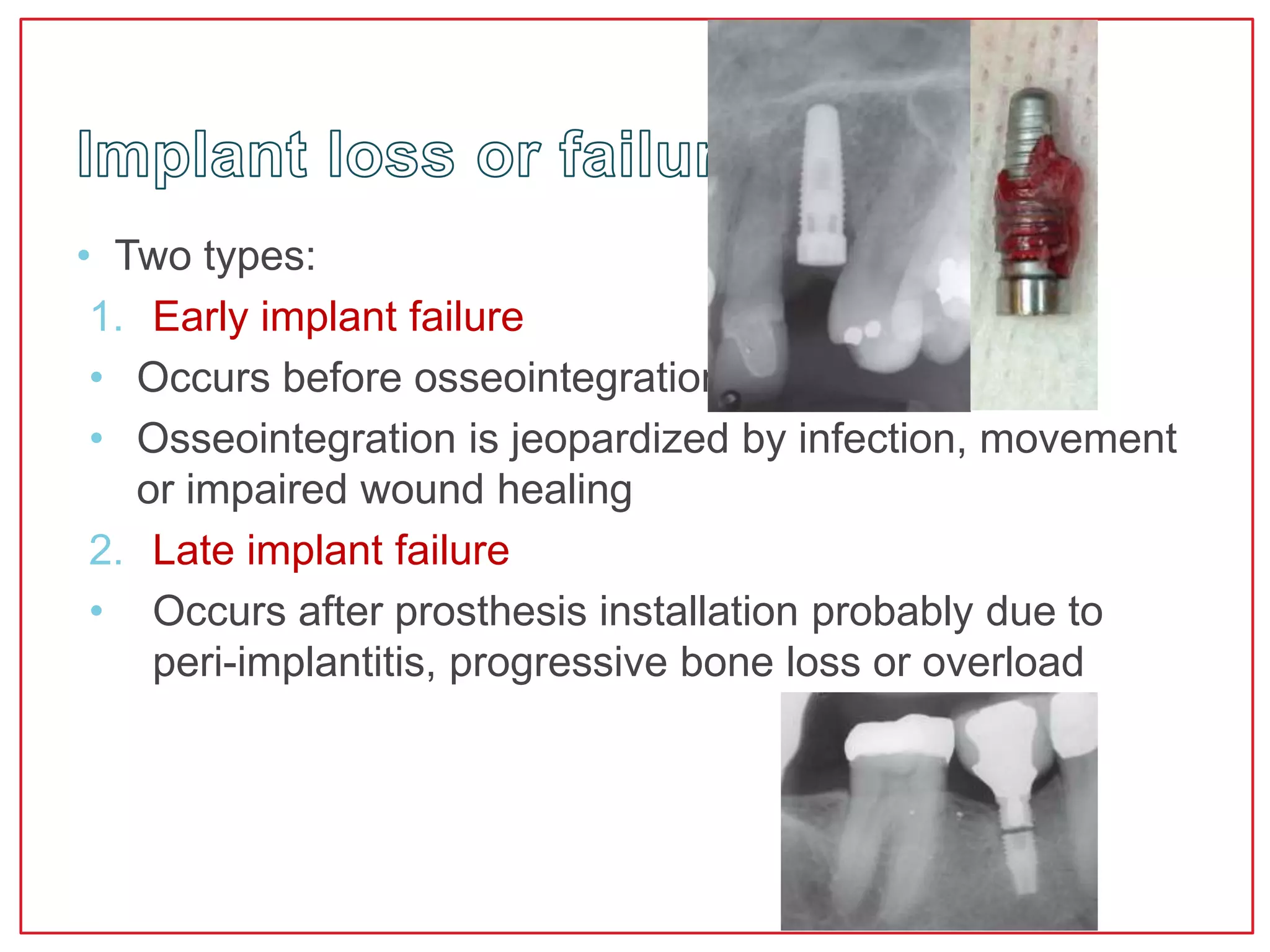
• Two types:
1. Early implant failure
• Occurs before osseointegration.
• Osseointegration is jeopardized by infection, movement
or impaired wound healing
2. Late implant failure
• Occurs after prosthesis installation probably due to
peri-implantitis, progressive bone loss or overload
1. Screw Loosening and Fracture
• frequent in screw-retained FPDs
• screw loosening in 6% to 49% of cases at the first annual
check-up.- Jemt et al. 1994.
• in the patient with a prosthesis retained by multiple
implants, the ability to detect a loose screw is greatly
diminished
• biomechanical support (and resistance) for the
restoration must be evaluated
• 2. implant fracture
• fatigue of implant materials and weakness in prosthetic
design or dimension are the usual causes of implant
fractures
• Balshi listed three categories of causes
(1) design and material,
(2) nonpassive fit of the prosthetic framework, and
(3) physiologic or biomechanical overload.
• The risk for esthetic complications is increased for
patients with high esthetic expectations and less than-
optimal patient-related factors (e.g., high smile line, thin
periodontal soft tissues, or inadequate bone quantity and
quality)
• If the amount of available bone is not ideal… unesthetic
emergence profile.
• Benefits of Gingiva colored materials:
• Improved lip support
• Masking interproximal spaces
• Restoration of gingival symmetry
• Phonetic problems:
• More common with full arch implant supported prosthesis
• Unusual palatal contours
• Space between implant and superstructures
1. Complication associated with autogenous bone
harvesting/grafting
• At donor site, High incidence of neurosensory
disturbance to mandibular anterior teeth and chin region.
• Inferior alveolar nerve injury or trismus
• Recepient site complication, wound dehiscence, flap
necrosis, graft exposure, graft contamination, problem
with graft incorporation and resorption
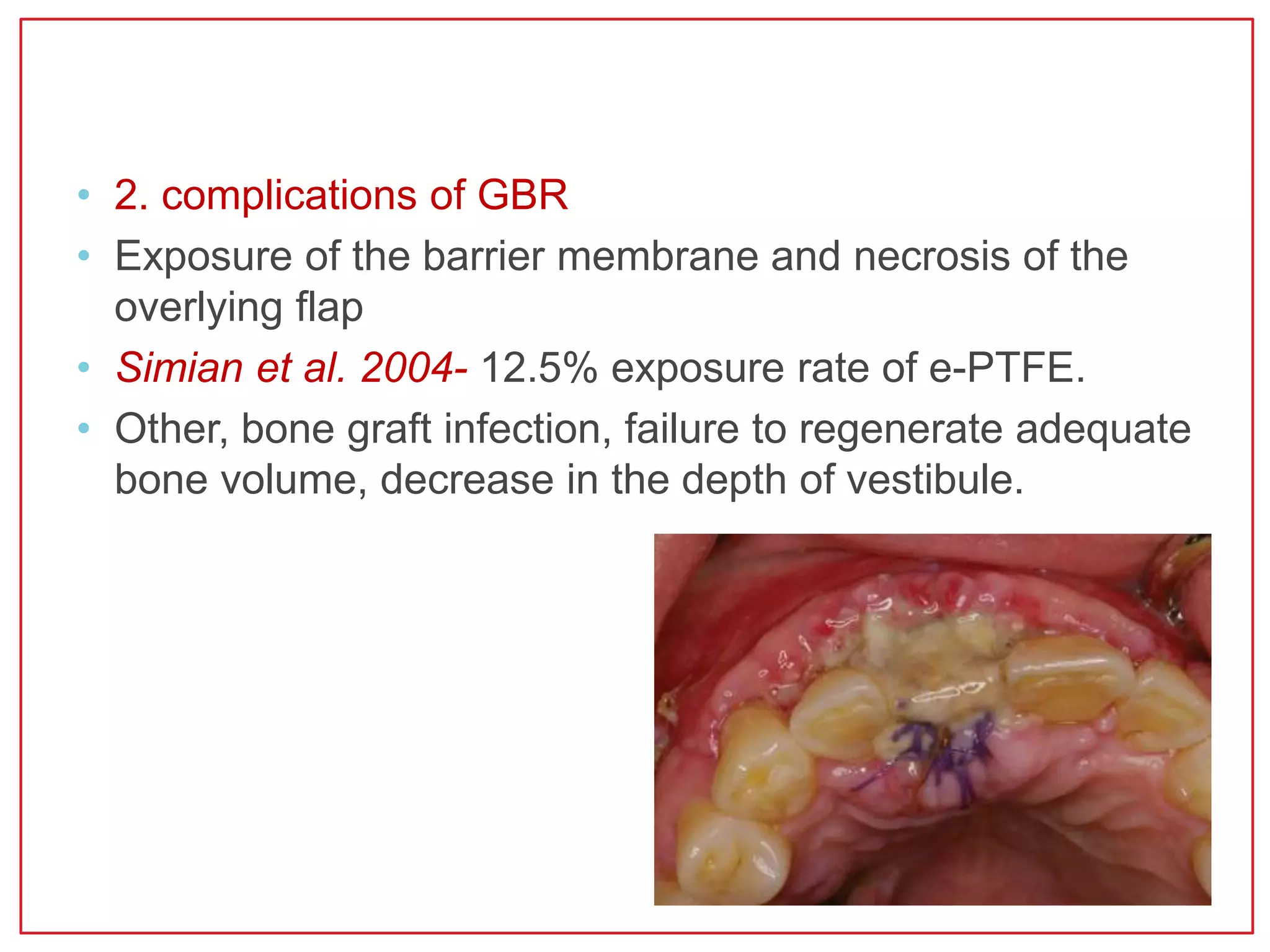
• 2. complications of GBR
• Exposure of the barrier membrane and necrosis of the
overlying flap
• Simian et al. 2004- 12.5% exposure rate of e-PTFE.
• Other, bone graft infection, failure to regenerate adequate
bone volume, decrease in the depth of vestibule.
1. Lateral window sinus lift:
• Schneiderian membrane perforation or bleeding from
nasal cavity
• 20-30% of membrane perforation with conventional
instruments and 7% with piezo surgery- Kasabah 2003
• Infection of the bone graft material placed into sinus in 2-
5.6%.
• 2. crestal (osteotome) sinus augmentation
• BPPV- benign paroxysmal positional vertigo- trauma
induced by percussion with surgical hammer, along with
hyperextension of neck during operation can displace
otoliths in the inner ear.
• Prevalence reported 1.25%
• in suspected cases, patient is informed about the
condition and referred to the otoneurologist to carry out
otolithic reinstatement maneuver
• Prevention using:
• Manual force instead of hammer percussion
• Surgical fraise/ bur in combination with osteotome
• Piezoelectric surgical instuments
• 1. immediate implant placement
• Poor implant position,
• marginal bone loss,
• periimplant soft tissue recession,
• compromised esthetics,
• Failure to attain primary stability and
• Implant failure
• 2. immediate loading
• failure to achieve primary stability
• To avoid complication
• long and wide implants
• Thread design
• for full edentulous arches, mininum 4-6 implants
• Cross-arch stabilization
• Minimizing cantilever
3. Flapless approach
• Complications due to:
• Lack of operator visualization
• Improper positioning
• It is technique sensitive that requires surgical experience,
• Proper Case selection
• an accurate surgical guide and
• knowledge of the anatomy surrounding the implant site
• Signs of infection during healing (6-9 months)
• Swelling, fistulas, suppuration, early/late mucosal dehiscences,
and oseteomyelitis
• Pain
• Mobility
• Dull sound at percussion
• Radiographic signs of failure
• two well-distinct radiographic pictures:
1. A thin peri-fixtural radiolucency surrounding the entire
implant, suggesting the absence of a direct bone-
implant contact and possibly a loss of stability
2. an increased marginal bone loss
• Severe peri-implant bone loss (> 50% of implant length).
• Bone loss involving implant vents or holes.
• Unfavorable advanced bone defect.
• Rapid, severe bone destruction (within 1 yr of loading).
• Nonsurgical or surgical therapy ineffective.
• Esthetic area providing implant surface exposure
1. Dental implants have high predictability and long term
success but its not “fail free or complication free”
2. Surgical complications can be avoided by proper pre-
surgical work ups.
3. Most common prosthetic complications are fracture of
veeners, loosening of abutment, screw or prosthesis.
4. Use of torque controlled screwdrivers and implants with
internal fixation can reduce the risk of loosening
Presurgical diagnosis and Rx planning
Use of surgical guide and adherence
to proven principles
Through understanding of anatomy,
biology and wound healing
No substitute for training and clinical
experience for preventing, recognizing
and managing complictions
1. Fermin A. Carranza, Jr., Michael G. Newman,Textbook of
Clinical periodontology.,1oth ed., WB saunders &Co.,2008
2. Jan Lindhe, Thorkild Karring . Niklaus P. Lang, Textbook of
Clinical Periodontology and Implant Dentistry, 4th ed. by
Blackwell Munksgaard, a Blackwell, Publishing Company,
2003.
3. Albrektsson T, Zarb G, Worthington P, Eriksson AR. The
long-term efficacy of currently used dental implants: A review
and proposed criteria of success. Int J Oral Maxillofac
Implants. 1986;1:11–25.
4. Misch CE. Implant Success, Survival, and Failure: The
International Congress of Oral Implantologists (ICOI) Pisa
Consensus Conference. Implant Dent 2008;17:5–15
5. K. Karthik. Evaluation of implant success: A review of past
and present concepts. J Pharm Bioallied Sci. 2013 Jun;
5(Suppl 1): S117–S119.
6. Prashanti E. Failures in implants. Indian Journal of Dental
Implant related complications and failure

Implant related complications and failure

  • 2.
    Purely a histologicterm Osseointegration used to describe ideal clinical conditions. It should include a time period of at least 12 months for implants serving as prosthetic abutments. Implant success implants that remains at the time of evaluation, regardless of any untoward sign and symptoms. Implant survival Ten Bruggenkate C, van der Kwast WA, Oosterbeek HS. 1990
  • 3.
    Ailing implants arethose showing radiographic bone loss without inflammatory signs or mobility. Ailing implants Failing implants are characterized by progressive bone loss, signs of inflammation and no mobility. Failing implants A failed implant is non-functional and must be removed. Failed implants -Meffert
  • 4.
    • Earlier Concepts •Schnitman and schulman,1979: • Mobility less than 1 mm in any direction. • Bone loss no greater than 1/3of the vertical height of the bone. • Functional service for 5 years. • Cranin et al.1982: • In place 60 months or more. • No signs of bone loss. • Freedom from hemorrhage. • Lack of mobility. • Absence of pain or percussive tenderness. • No pericervical granulomatosis or gingival hyperplasia.
  • 5.
    • McKinney etal. 1984: • Subjective criteria • Adequate function. • Absence of discomfort. • Patient belief that esthetics, emotional, and psychological attitude are improved. • Objective criteria • Bone loss no greater than one third of the vertical height of the implant • Gingival inflammation vulnerable to treatment. • Mobility of less than 1 mm buccolingually, mesiodistally, and vertically. • Success criterion • Provides functional service for 5 years
  • 6.
    • Albrektsson etal. 1986 • Individual unattached implant that is immobile when tested clinically • Radiography that does not demonstrate evidence of peri-implant radiolucency • Bone loss 1.2 mm after 1 year of service and less than 0.2 mm annually in subsequent years • No persistent pain, discomfort or infection • By these criteria, a success rate of 85% at the end of a 5 year observation period and 80% at the end of a 10 year period are minimum levels for success.
  • 7.
    • 1998 Espositoet al. at 1st European Workshop on Periodontology • The success criteria, which were initially targeted for evaluation as 5 years survival has changed with a target of 10-year survival rate.
  • 9.
    • The pinkesthetic score (PES) is an index proposed by Furhauser et al that considers 7 soft tissue parameters, including an evaluation of the color, contour, and texture of the surrounding soft tissues (papilla and facial mucosa). • The most recent, proposed by Belser et al, combines a modified PES index with a white esthetic score (WES)- 5 parameters from general tooth form to hue, value, surface texture, and translucency.
  • 10.
    1. Surgical 2. Biologic 3.Mechanical/ technical 4. Esthetic 5. Related to augmentation procedure 6. Related to loading protocols
  • 11.
    • Pjetursson etal found that the most common technical complication: • fracture of veneers (13.2% after 5 years), • loss of the screw access hole restoration (8.2% after 5 years), • abutment/occlusal screw loosening (5.8% after 5 years), and • abutment/occlusal screw fracture (1.5% after 5 years). • Fracture of implants occurred infrequently (0.4% after 5 years; 1.8% after 10 years). • biologic complications, such as periimplantitis and soft tissue lesions, occurred in 8.6%
  • 12.
    • Goodacre etal. inclusion of edentulous patients having overdentures, seemed to indicate a significantly higher percentage of complications. • Zitzmann and Berglundh periimplant mucositis- 50% of implant sites. • Periimplantitis-12% to 43% of implant sites • Esposito et al biologicalfailures were relatively low at 7.7%. • Risk factors: smoking, diabetes and previous H/o Periodontitis.
  • 14.
    surgical Haemorrhage and hematoma Neurosensory disturbances Implant malposition • Problems dueto surgical complications are: 1. Damage to adjacent teeth 2. Impingement on anatomic structures 3. Compromised esthetic/prosthetic outcome 4. Soft tissue and bone dehiscence
  • 15.
    • Lifethreatening mayhappen with surgical procedure related to anterior mandible or with perforation lingual mandibular cortex • In this emergency - primary airway management and surgical management to isolate and stop bleeding • Caused by drilling or implant compression of the nerve • Hypoesthesia or hyperesthesia • Most common with “Lateral nerve repositioning”. It is associated with 100% neurosensory dysfunction and 50% remains permanent
  • 16.
    • Common reasonsfor implant malpositioning are: 1. Poor Rx planning 2. Lack of surgical skill 3. Poor communication between surgeon and restorative dentist • Ideal position of implant • To aviod injury to adjacent tooth root, guide pin location radiograph is necessary.
  • 18.
    • Types are: 1.Inflammation and proliferation of peri-implant soft tissue 2. Dehiscence and recession 3. Peri-implantitis and progressive bone loss 4. Implant loss or failure
  • 19.
    • Similar toplaque induced gingival lesions • Also common with loose implant- abutment or abutment crown connection and excessive cement retained after restoration. • Correction of precipitating factors effectively resolves the problem
  • 20.
    • Common whenthe supporting hard and soft tissues are thin, lacking or lost
  • 21.
    • Lindhe andMeyle from the Consensus Report of the 6th European Workshop on Periodontology concluded that risk indicators for periimplantitis included (1) poor oral hygiene, (2) a history of periodontitis, (3) diabetes, (4) cigarette smoking, (5) alcohol consumption, and (6) implant surface
  • 22.
    • Two types: 1.Early implant failure • Occurs before osseointegration. • Osseointegration is jeopardized by infection, movement or impaired wound healing 2. Late implant failure • Occurs after prosthesis installation probably due to peri-implantitis, progressive bone loss or overload
  • 24.
    1. Screw Looseningand Fracture • frequent in screw-retained FPDs • screw loosening in 6% to 49% of cases at the first annual check-up.- Jemt et al. 1994. • in the patient with a prosthesis retained by multiple implants, the ability to detect a loose screw is greatly diminished • biomechanical support (and resistance) for the restoration must be evaluated
  • 25.
    • 2. implantfracture • fatigue of implant materials and weakness in prosthetic design or dimension are the usual causes of implant fractures • Balshi listed three categories of causes (1) design and material, (2) nonpassive fit of the prosthetic framework, and (3) physiologic or biomechanical overload.
  • 27.
    • The riskfor esthetic complications is increased for patients with high esthetic expectations and less than- optimal patient-related factors (e.g., high smile line, thin periodontal soft tissues, or inadequate bone quantity and quality) • If the amount of available bone is not ideal… unesthetic emergence profile.
  • 28.
    • Benefits ofGingiva colored materials: • Improved lip support • Masking interproximal spaces • Restoration of gingival symmetry • Phonetic problems: • More common with full arch implant supported prosthesis • Unusual palatal contours • Space between implant and superstructures
  • 30.
    1. Complication associatedwith autogenous bone harvesting/grafting • At donor site, High incidence of neurosensory disturbance to mandibular anterior teeth and chin region. • Inferior alveolar nerve injury or trismus • Recepient site complication, wound dehiscence, flap necrosis, graft exposure, graft contamination, problem with graft incorporation and resorption
  • 31.
    • 2. complicationsof GBR • Exposure of the barrier membrane and necrosis of the overlying flap • Simian et al. 2004- 12.5% exposure rate of e-PTFE. • Other, bone graft infection, failure to regenerate adequate bone volume, decrease in the depth of vestibule.
  • 32.
    1. Lateral windowsinus lift: • Schneiderian membrane perforation or bleeding from nasal cavity • 20-30% of membrane perforation with conventional instruments and 7% with piezo surgery- Kasabah 2003 • Infection of the bone graft material placed into sinus in 2- 5.6%.
  • 33.
    • 2. crestal(osteotome) sinus augmentation • BPPV- benign paroxysmal positional vertigo- trauma induced by percussion with surgical hammer, along with hyperextension of neck during operation can displace otoliths in the inner ear. • Prevalence reported 1.25% • in suspected cases, patient is informed about the condition and referred to the otoneurologist to carry out otolithic reinstatement maneuver • Prevention using: • Manual force instead of hammer percussion • Surgical fraise/ bur in combination with osteotome • Piezoelectric surgical instuments
  • 35.
    • 1. immediateimplant placement • Poor implant position, • marginal bone loss, • periimplant soft tissue recession, • compromised esthetics, • Failure to attain primary stability and • Implant failure
  • 36.
    • 2. immediateloading • failure to achieve primary stability • To avoid complication • long and wide implants • Thread design • for full edentulous arches, mininum 4-6 implants • Cross-arch stabilization • Minimizing cantilever
  • 37.
    3. Flapless approach •Complications due to: • Lack of operator visualization • Improper positioning • It is technique sensitive that requires surgical experience, • Proper Case selection • an accurate surgical guide and • knowledge of the anatomy surrounding the implant site
  • 39.
    • Signs ofinfection during healing (6-9 months) • Swelling, fistulas, suppuration, early/late mucosal dehiscences, and oseteomyelitis • Pain • Mobility • Dull sound at percussion • Radiographic signs of failure • two well-distinct radiographic pictures: 1. A thin peri-fixtural radiolucency surrounding the entire implant, suggesting the absence of a direct bone- implant contact and possibly a loss of stability 2. an increased marginal bone loss
  • 41.
    • Severe peri-implantbone loss (> 50% of implant length). • Bone loss involving implant vents or holes. • Unfavorable advanced bone defect. • Rapid, severe bone destruction (within 1 yr of loading). • Nonsurgical or surgical therapy ineffective. • Esthetic area providing implant surface exposure
  • 43.
    1. Dental implantshave high predictability and long term success but its not “fail free or complication free” 2. Surgical complications can be avoided by proper pre- surgical work ups. 3. Most common prosthetic complications are fracture of veeners, loosening of abutment, screw or prosthesis. 4. Use of torque controlled screwdrivers and implants with internal fixation can reduce the risk of loosening
  • 44.
    Presurgical diagnosis andRx planning Use of surgical guide and adherence to proven principles Through understanding of anatomy, biology and wound healing No substitute for training and clinical experience for preventing, recognizing and managing complictions
  • 45.
    1. Fermin A.Carranza, Jr., Michael G. Newman,Textbook of Clinical periodontology.,1oth ed., WB saunders &Co.,2008 2. Jan Lindhe, Thorkild Karring . Niklaus P. Lang, Textbook of Clinical Periodontology and Implant Dentistry, 4th ed. by Blackwell Munksgaard, a Blackwell, Publishing Company, 2003. 3. Albrektsson T, Zarb G, Worthington P, Eriksson AR. The long-term efficacy of currently used dental implants: A review and proposed criteria of success. Int J Oral Maxillofac Implants. 1986;1:11–25. 4. Misch CE. Implant Success, Survival, and Failure: The International Congress of Oral Implantologists (ICOI) Pisa Consensus Conference. Implant Dent 2008;17:5–15 5. K. Karthik. Evaluation of implant success: A review of past and present concepts. J Pharm Bioallied Sci. 2013 Jun; 5(Suppl 1): S117–S119. 6. Prashanti E. Failures in implants. Indian Journal of Dental

Editor's Notes

  • #13 Edentulous maxilla more prone for failure compared to edentulous mandibe
  • #17 Surgical complications can be easily prevented by: 1. Patient’s past medical history, 2. thorough clinical and radiographical planning 3. good surgical skill