What Are Process Models?
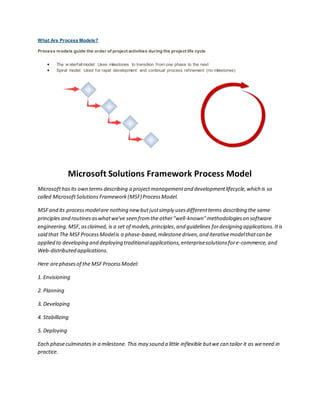
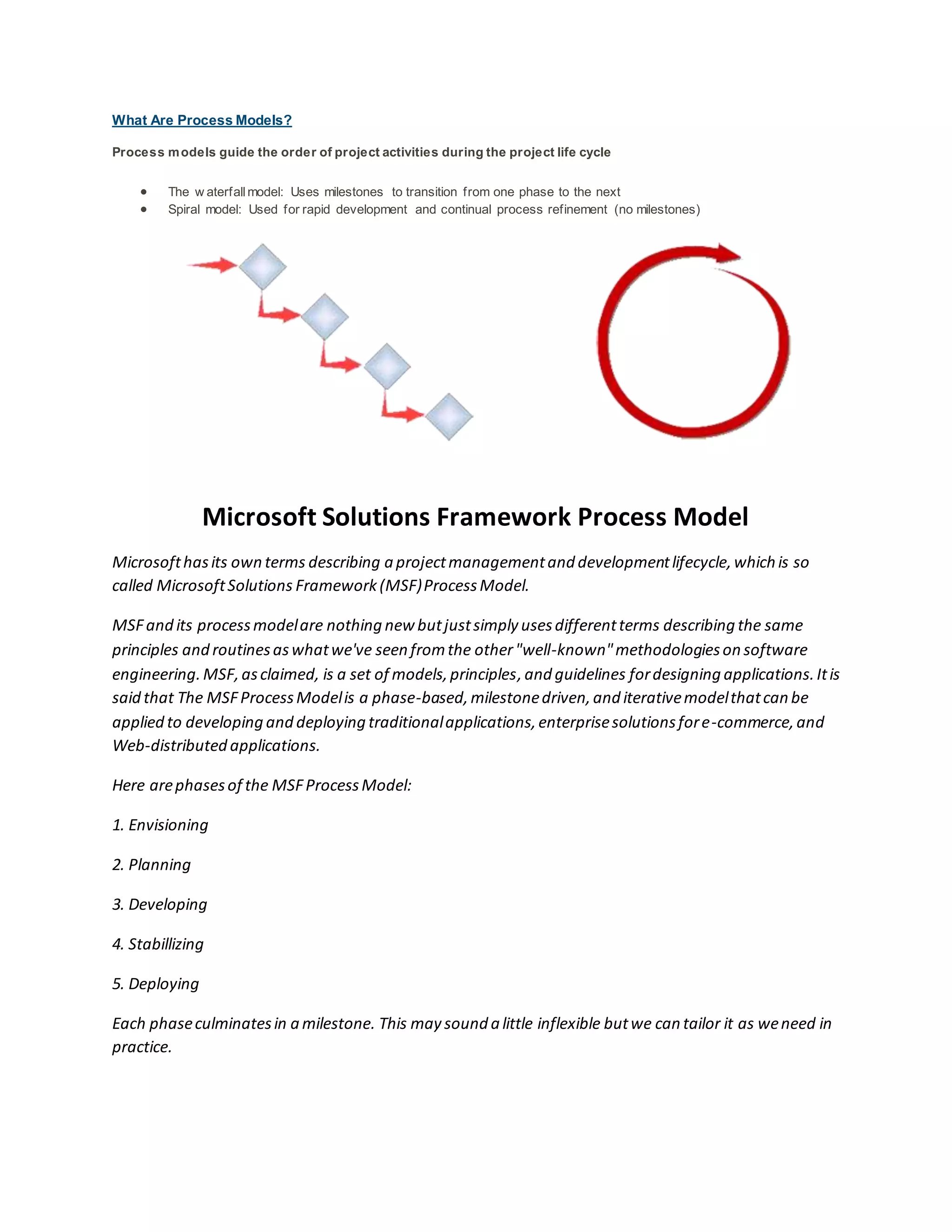
Process models guide the order of project activities during the project life cycle
 The w aterfallmodel: Uses milestones to transition from one phase to the next
 Spiral model: Used for rapid development and continual process refinement (no milestones)
Microsoft Solutions Framework Process Model
Microsofthasits own terms describing a projectmanagementand developmentlifecycle,which is so
called MicrosoftSolutions Framework(MSF)ProcessModel.
MSFand its processmodelare nothing new butjustsimply usesdifferentterms describing the same
principles and routinesaswhatwe've seen fromthe other"well-known"methodologieson software
engineering.MSF,asclaimed, is a set of models,principles,and guidelines fordesigning applications.Itis
said that The MSFProcessModelis a phase-based,milestonedriven,and iterativemodelthatcan be
applied to developing and deploying traditionalapplications,enterprisesolutionsfore-commerce,and
Web-distributed applications.
Here arephasesof the MSFProcessModel:
1. Envisioning
2. Planning
3. Developing
4. Stabillizing
5. Deploying
Each phaseculminatesin a milestone. This may sound a little inflexible butwe can tailor it as weneed in
practice.
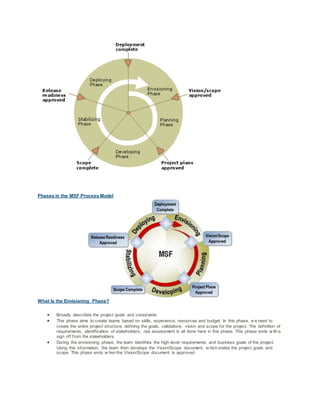
Phases in the MSF Process Model
What Is the Envisioning Phase?
 Broadly describes the project goals and constraints
 This phase aims to create teams based on skills, experience, resources and budget. In this phase, w e need to
create the entire project structure, defining the goals, validations, vision and scope for the project. The definition of
requirements, identification of stakeholders, risk assessment is all done here in this phase. This phase ends w ith a
sign off from the stakeholders.
 During the envisioning phase, the team identifies the high-level requirements and business goals of the project.
Using this information, the team then develops the Vision/Scope document, w hich states the project goals and
scope. This phase ends w hen the Vision/Scope document is approved.
 Deliverables
o Vision/scope document
o Project structure document
o Initial risk assessment document
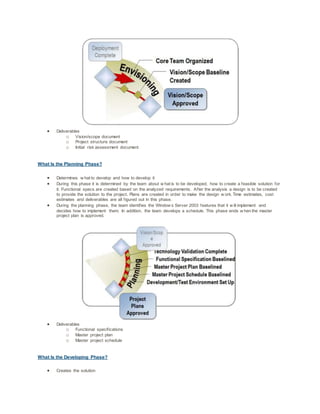
What Is the Planning Phase?
 Determines w hat to develop and how to develop it
 During this phase it is determined by the team about w hat is to be developed, how to create a feasible solution for
it. Functional specs are created based on the analyzed requirements. After the analysis a design is to be created
to provide the solution to the project. Plans are created in order to make the design w ork. Time estimates, cost
estimates and deliverables are all figured out in this phase.
 During the planning phase, the team identifies the Window s Server 2003 features that it w ill implement and
decides how to implement them. In addition, the team develops a schedule. This phase ends w hen the master
project plan is approved.
 Deliverables
o Functional specifications
o Master project plan
o Master project schedule
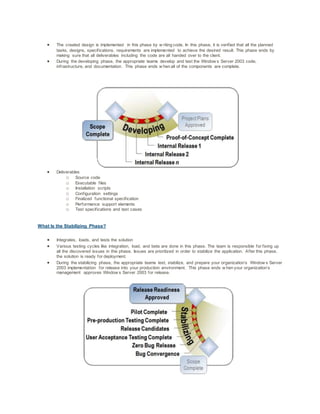
What Is the Developing Phase?
 Creates the solution
 The created design is implemented in this phase by w riting code. In this phase, it is verified that all the planned
tasks, designs, specifications, requirements are implemented to achieve the desired result. This phase ends by
making sure that all deliverables including the code are all handed over to the client.
 During the developing phase, the appropriate teams develop and test the Window s Server 2003 code,
infrastructure, and documentation. This phase ends w hen all of the components are complete.
 Deliverables
o Source code
o Executable files
o Installation scripts
o Configuration settings
o Finalized functional specification
o Performance support elements
o Test specifications and test cases
What Is the Stabilizing Phase?
 Integrates, loads, and tests the solution
 Various testing cycles like integration, load, and beta are done in this phase. The team is responsible for fixing up
all the discovered issues in this phase. Issues are prioritized in order to stabilize the application. After this phase,
the solution is ready for deployment.
 During the stabilizing phase, the appropriate teams test, stabilize, and prepare your organization’s Window s Server
2003 implementation for release into your production environment. This phase ends w hen your organization’s
management approves Window s Server 2003 for release.
 Deliverables
o Final release
o Release notes
o Performance support
o Test results and test tools
o Source code and executable files
o Project documents
o Milestone review
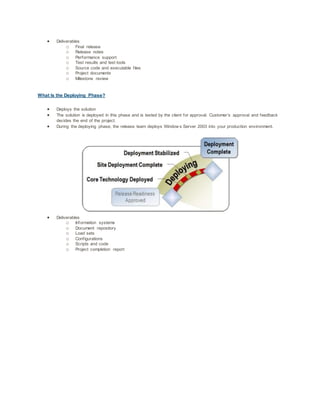
What Is the Deploying Phase?
 Deploys the solution
 The solution is deployed in this phase and is tested by the client for approval. Customer’s approval and feedback
decides the end of the project.
 During the deploying phase, the release team deploys Window s Server 2003 into your production environment.
 Deliverables
o Information systems
o Document repository
o Load sets
o Configurations
o Scripts and code
o Project completion report

MSF process model

  • 1.
    What Are ProcessModels? Process models guide the order of project activities during the project life cycle  The w aterfallmodel: Uses milestones to transition from one phase to the next  Spiral model: Used for rapid development and continual process refinement (no milestones) Microsoft Solutions Framework Process Model Microsofthasits own terms describing a projectmanagementand developmentlifecycle,which is so called MicrosoftSolutions Framework(MSF)ProcessModel. MSFand its processmodelare nothing new butjustsimply usesdifferentterms describing the same principles and routinesaswhatwe've seen fromthe other"well-known"methodologieson software engineering.MSF,asclaimed, is a set of models,principles,and guidelines fordesigning applications.Itis said that The MSFProcessModelis a phase-based,milestonedriven,and iterativemodelthatcan be applied to developing and deploying traditionalapplications,enterprisesolutionsfore-commerce,and Web-distributed applications. Here arephasesof the MSFProcessModel: 1. Envisioning 2. Planning 3. Developing 4. Stabillizing 5. Deploying Each phaseculminatesin a milestone. This may sound a little inflexible butwe can tailor it as weneed in practice.
  • 2.
    Phases in theMSF Process Model What Is the Envisioning Phase?  Broadly describes the project goals and constraints  This phase aims to create teams based on skills, experience, resources and budget. In this phase, w e need to create the entire project structure, defining the goals, validations, vision and scope for the project. The definition of requirements, identification of stakeholders, risk assessment is all done here in this phase. This phase ends w ith a sign off from the stakeholders.  During the envisioning phase, the team identifies the high-level requirements and business goals of the project. Using this information, the team then develops the Vision/Scope document, w hich states the project goals and scope. This phase ends w hen the Vision/Scope document is approved.
  • 3.
     Deliverables o Vision/scopedocument o Project structure document o Initial risk assessment document What Is the Planning Phase?  Determines w hat to develop and how to develop it  During this phase it is determined by the team about w hat is to be developed, how to create a feasible solution for it. Functional specs are created based on the analyzed requirements. After the analysis a design is to be created to provide the solution to the project. Plans are created in order to make the design w ork. Time estimates, cost estimates and deliverables are all figured out in this phase.  During the planning phase, the team identifies the Window s Server 2003 features that it w ill implement and decides how to implement them. In addition, the team develops a schedule. This phase ends w hen the master project plan is approved.  Deliverables o Functional specifications o Master project plan o Master project schedule What Is the Developing Phase?  Creates the solution
  • 4.
     The createddesign is implemented in this phase by w riting code. In this phase, it is verified that all the planned tasks, designs, specifications, requirements are implemented to achieve the desired result. This phase ends by making sure that all deliverables including the code are all handed over to the client.  During the developing phase, the appropriate teams develop and test the Window s Server 2003 code, infrastructure, and documentation. This phase ends w hen all of the components are complete.  Deliverables o Source code o Executable files o Installation scripts o Configuration settings o Finalized functional specification o Performance support elements o Test specifications and test cases What Is the Stabilizing Phase?  Integrates, loads, and tests the solution  Various testing cycles like integration, load, and beta are done in this phase. The team is responsible for fixing up all the discovered issues in this phase. Issues are prioritized in order to stabilize the application. After this phase, the solution is ready for deployment.  During the stabilizing phase, the appropriate teams test, stabilize, and prepare your organization’s Window s Server 2003 implementation for release into your production environment. This phase ends w hen your organization’s management approves Window s Server 2003 for release.
  • 5.
     Deliverables o Finalrelease o Release notes o Performance support o Test results and test tools o Source code and executable files o Project documents o Milestone review What Is the Deploying Phase?  Deploys the solution  The solution is deployed in this phase and is tested by the client for approval. Customer’s approval and feedback decides the end of the project.  During the deploying phase, the release team deploys Window s Server 2003 into your production environment.  Deliverables o Information systems o Document repository o Load sets o Configurations o Scripts and code o Project completion report