Software process life cycles
CSE 432: Object-Oriented Software Engineering
Software and entropy
 A virtue of software: relatively easy to change
 Otherwise it might as well be hardware
 Nevertheless, the more complex a software system
gets, the harder it is to change--why?
 Larger software systems are harder to understand
 The more changes get introduced into a system, the more
it tends toward entropy
 I.e., its internal order breaks down
 Multimedia: http://
www.cse.lehigh.edu/~cimel/prototype.html
Planning for change
 How can good comments facilitate and reduce
the cost of software maintenance?
 Hint: think about invariants, things that don’t change.
 Comments describe meaning of code
 Assuming programmers maintain comments
when they change the code!
 How can modularity help manage change?
 Modules help to isolate and localize change
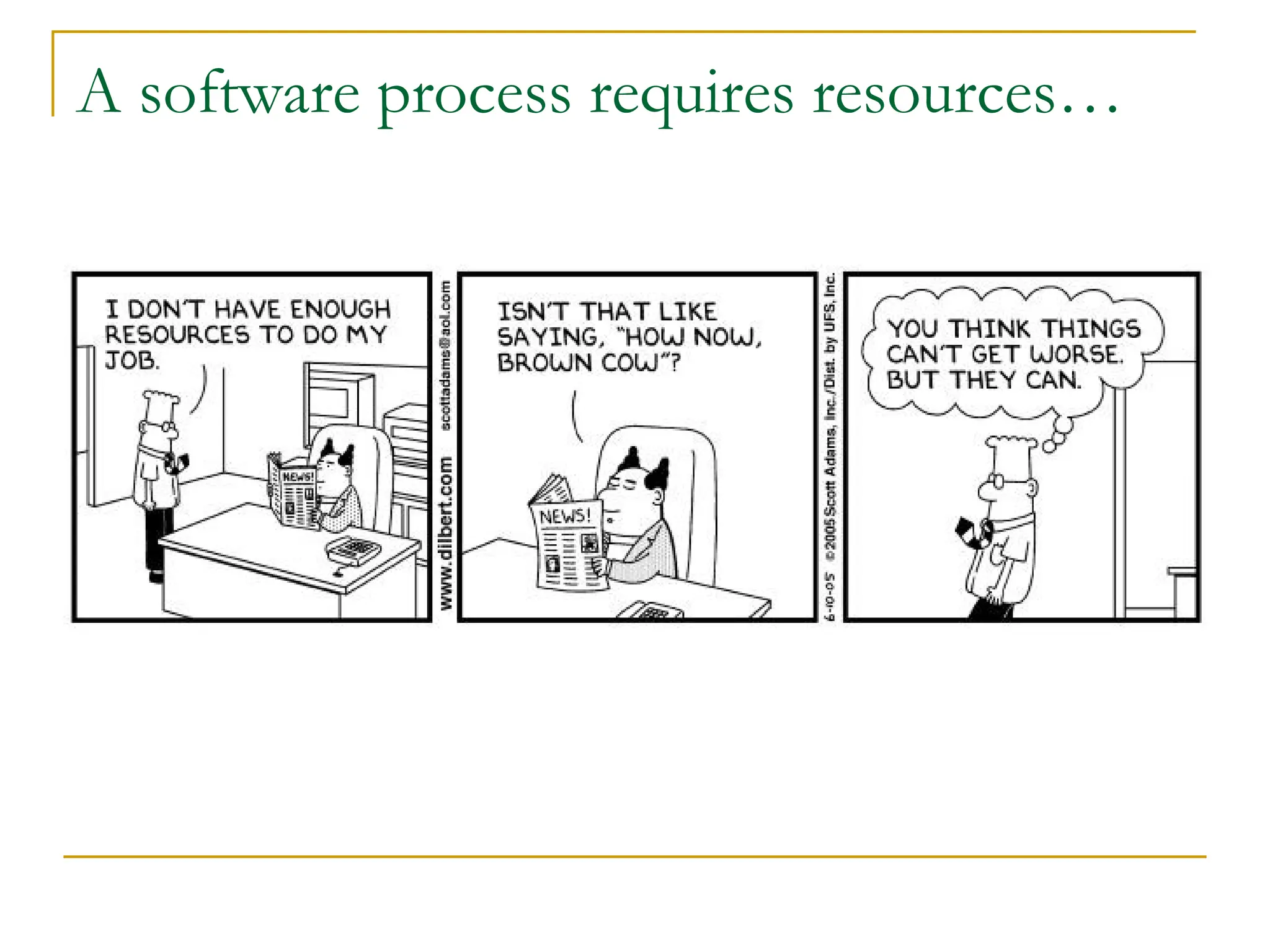
A software process requires resources…
A software life cycle is a process
 A process involves activities, constraints and
resources that produce an intended output.
 Each process activity, e.g., design,
must have entry and exit criteria—why?
 A process uses resources, subject to constraints
(e.g., a schedule or a budget)
 A process is organized in some order or sequence,
structuring activities as a whole
 A process has a set of guiding principles or criteria
that explain the goals of each activity
Waterfall model of software process
 Multimedia: stages in the process
 Cascades from one stage down to the next, in
stately, lockstep, glorious order.
 Gravity only allows the waterfall to go downstream;
 it’s very hard to swim upstream
 Department of Defense contracts prescribed
this model for software deliverables for many
years, in DOD Standard 2167-A.
Why would corporate manager types like
the waterfall life cycle model?
 Minimizes change, maximizes predictability
 Costs and risks are more predictable
 Each stage has milestones and deliverables:
project managers can use to gauge how close
project is to completion
 Sets up division of labor: many software shops
associate different people with different stages:
 Systems analyst does analysis,
 Architect does design,
 Programmers code,
 Testers validate, etc.
Testing in the waterfall model
 Let’s look at more Pfleeger’s version of waterfall model
 Many waterfall models show 5 stages—why more here?
 What’s the difference between unit and system testing?
 Between system and acceptance testing?
 What kind of arrows are missing?
 Is this diagram a more realistic picture?
 Is this view of the process a good idea?
 The reality is that not only does software change,
but change happens during the process
 Realistic models are not strictly linear, but allow for cycles
 Bear in mind, however, that more cycles mean more costs
More drawbacks of the waterfall model
 Offers no insight into how how does each activity transform one
artifacts (documents) of one stage into another
 For example, requirements specification  design documents?
 Fails to treat software a problem-solving process
 Unlike hardware, software development is not a manufacturing
but a creative process
 Manufacturing processes really can be linear sequences,
but creative processes usually involve back-and-forth activities
such as revisions
 Software development involves a lot of communication between
various human stakeholders
 Nevertheless, more complex models often embellish the waterfall,
 incorporating feedback loops and additional activities
Prototyping
 This model adds prototyping as sub-process
 A prototype is a partially developed product that
enables customers and developers to examine some
aspect of a proposed system and decide if it is
suitable for a finished product
 Why add prototypes to the life cycle?
 Used to explore the risky aspects of the system:
 Risk of developing the “wrong” system (what customer
doesn’t want), can be a user interface without functionality
 Other technical risks – e.g. performance, using a new
technology, alternative algorithms, etc.
 Prototype may be thrown away or evolve into product
V model
 Developed by the German Ministry of Defense
 What does this model highlight?
 Unit and system testing verify the program design, ensuring
that parts and whole work correctly
 Acceptance testing, conducted by the customer rather than
developers, validates the requirements, tying each system
function meets a particular requirement in the specification
 How does this model account for cycles?
 If problems are found during verification or validation, then
re-execute left side of V to make fixes and improvements
 While the waterfall emphasizes documents and artifacts,
the V model emphasizes activities and correctness
Balzer’s transformational model
 Tries to reduce error in most software processes by:
 eliminating development steps,
 emphasizing formal specifications,
 and using automated support to facilitate transformations from
specification to deliverable system
 Hitch: the need for a formal specification precise
enough for automated transformations
 We’ll see that even semi-formal specifications can
help with other software life cycles
Phased development
 Nowadays, customers are less willing to wait years for a software
system to be ready
 So it’s necessary to reduce the cycle time of software products
 In 1996, 80% of HP’s revenues derived from products developed
in previous two years
 How is this accelerated cycle time made possible?
 Phased development reduces cycle time
 Design a system so it can be delivered in pieces, letting users
have some functionality while the rest is under development
 So there are usually two or more systems in parallel:
 The operational or production system in use by customers
 The development system which will replace the current release
 As users use Release n, developers are building Release n + 1
Iterative and incremental process
 Incremental development partitions a system by functionality
 Early release starts with small, functional subsystem, later releases
add functionality
 Top part of this figure shows how incremental development builds
up to full functionality
 Iterative development improves overall system in each release
 Delivers a full system in the first release, then changes the
functionality of each subsystem with each new release
 Suppose a customer wants to develop a word processing package
 Incremental approach: provide just Creation functions in Release 1,
then both Creation and Organization in Release 2,
finally add Formatting in Release 3, …
 Iterative approach: provide primitive forms of all three functions in
Release 1, then enhance (making them faster, improving the
interface, etc.) in subsequent releases
 Pros and cons of these two approaches?
 Many organizations combine iterative and incremental approaches
Quiz!
Quiz!
 What are drawbacks of Waterfall Model?
 Can prototypes alleviate these drawbacks?
Why or why not?
 Is the V model more realistic? Is it realistic enough?
 Why do many software development shops prefer
phased and/or iterative & incremental models?
 Does this discussion motivate you learn to avoid
just hacking?
Rational Unified Process (RUP)
 Developed by “three amigos” at Rational Software (IBM)
 Grady Booch, Ivar Jacobson, and Jim Rumbaugh
 Unified Modeling Language (UML) is a set of graphical and
linguistic notations for modeling systems, not a process or method
 The three amigos also developed Rational Unified Process (RUP)
 You don’t have to use RUP to use UML
 Interestingly different from the traditional waterfall model
 Highly iterative and incremental process
 Software product is not released in one big bang at end of project
 Instead, developed and released in pieces (prototypes, partial releases,
beta, etc.)
Agile Methods
 Typically lightweight
 WRT commitment to phases and documentation
 Versus waterfall models which require “heavy”
documentation of each phase before
proceeding
 Flexible, Adaptable, Iterative
 Examples: RUP or UP, Extreme
Programming (XP), Scrum
How do traditional stages iterate?
Workflows look traditional, but they iterate in four phases
Lifecycle Phases
Lifecycle Phases
 Inception – “Daydream”
 Elaboration – “Design/Details”
 Construction – “Do it”
 Transition – “Deploy it”
 Phases are not the classical requirements/
design/coding/implementation processes
 Phases iterate over many cycles
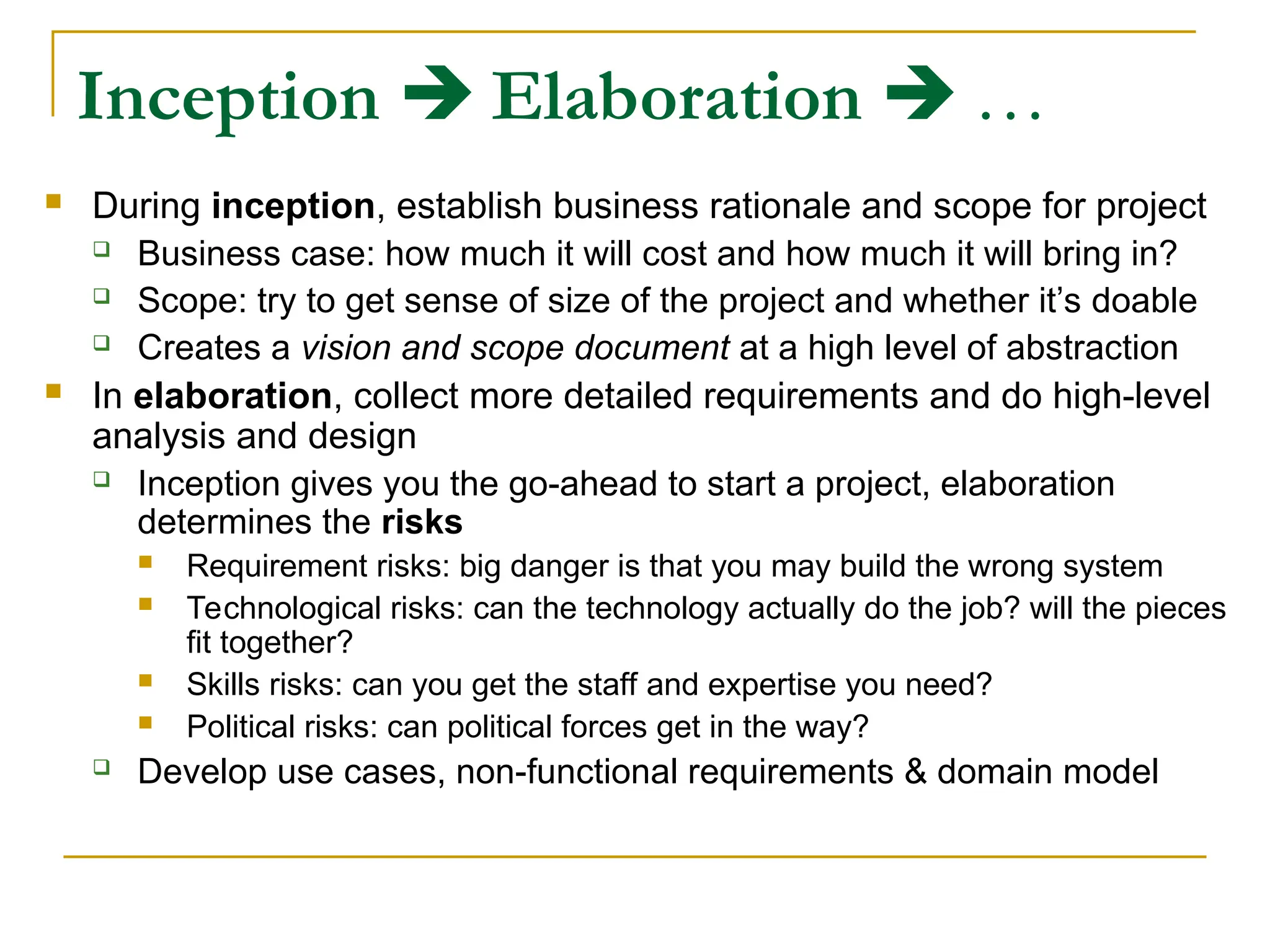
Inception  Elaboration  …
 During inception, establish business rationale and scope for project
 Business case: how much it will cost and how much it will bring in?
 Scope: try to get sense of size of the project and whether it’s doable
 Creates a vision and scope document at a high level of abstraction
 In elaboration, collect more detailed requirements and do high-level
analysis and design
 Inception gives you the go-ahead to start a project, elaboration
determines the risks
 Requirement risks: big danger is that you may build the wrong system
 Technological risks: can the technology actually do the job? will the pieces
fit together?
 Skills risks: can you get the staff and expertise you need?
 Political risks: can political forces get in the way?
 Develop use cases, non-functional requirements & domain model
…  Construction  Transition
 Construction builds production-quality software in
many increments, tested and integrated, each
satisfying a subset of the requirements of the project
 Delivery may be to external, early users, or purely internal
 Each iteration contains usual life-cycle phases of analysis,
design, implementation and testing
 Planning is crucial: use cases and other UML documents
 Transition activities include beta testing,
performance tuning (optimization) and user training
 No new functionality unless it’s small and essential
 Bug fixes are OK
inc. elaboration construction transition
iteration phase
development cycle
UP phases are iterative & incremental
 Inception
 Feasibility phase and approximate vision
 Elaboration
 Core architecture implementation, high risk resolution
 Construction
 Implementation of remaining elements
 Transition
 Beta tests, deployment
UP artifacts
 The UP describes work activities,
which result in work products called artifacts
 Examples of artifacts:
 Vision, scope and business case descriptions
 Use cases (describe scenarios for user-system interactions)
 UML diagrams for domain modeling, system modeling
 Source code (and source code documentation)
 Web graphics
 Database schema
Milestone for first Elaboration
 At start of elaboration, identify part of the project
to design & implement, then do so.
 A typical and crucial scenario (from a use case)
 Can then provide estimates for rest of project
 Significant risks are identified and understood
 How is such a milestone different from a stage
in the waterfall model?
Process disciplines or workflows
• Requirements analysis
• Design: architectural and class levels
• Implementation
• Testing
• Management
– Configuration and change
– Project
• Most of the process workflows occur during
each iteration
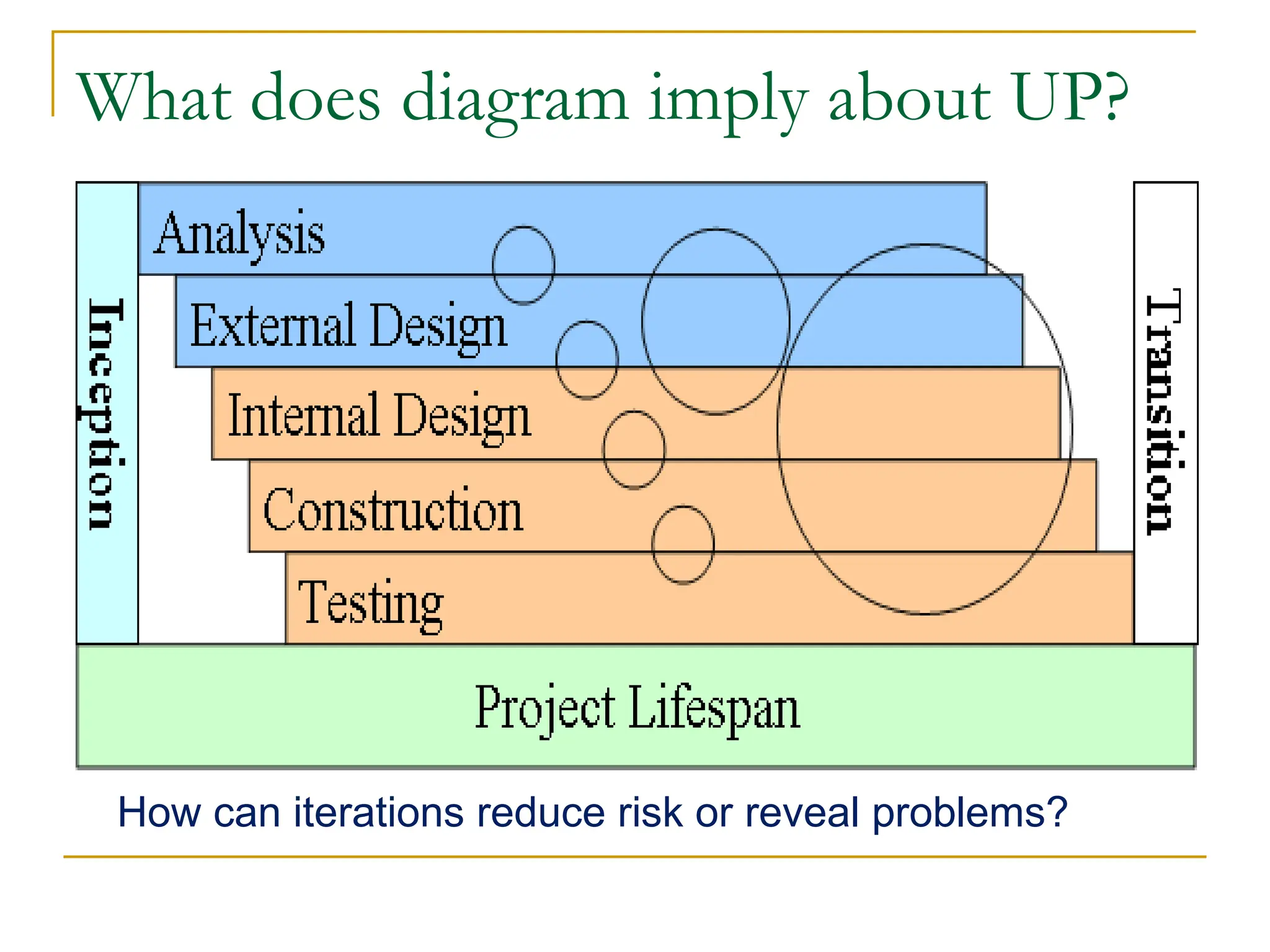
What does diagram imply about UP?
How can iterations reduce risk or reveal problems?
Another Quiz!
Another Quiz!
 What are the four lifecycle phases of UP?
 What happens in each?
 What are the process disciplines?
 What are some major differences between
UP and the waterfall model?
Changes are free?

01lifecycles(system development life cycle).ppt

  • 1.
    Software process lifecycles CSE 432: Object-Oriented Software Engineering
  • 2.
    Software and entropy A virtue of software: relatively easy to change  Otherwise it might as well be hardware  Nevertheless, the more complex a software system gets, the harder it is to change--why?  Larger software systems are harder to understand  The more changes get introduced into a system, the more it tends toward entropy  I.e., its internal order breaks down  Multimedia: http:// www.cse.lehigh.edu/~cimel/prototype.html
  • 3.
    Planning for change How can good comments facilitate and reduce the cost of software maintenance?  Hint: think about invariants, things that don’t change.  Comments describe meaning of code  Assuming programmers maintain comments when they change the code!  How can modularity help manage change?  Modules help to isolate and localize change
  • 4.
    A software processrequires resources…
  • 5.
    A software lifecycle is a process  A process involves activities, constraints and resources that produce an intended output.  Each process activity, e.g., design, must have entry and exit criteria—why?  A process uses resources, subject to constraints (e.g., a schedule or a budget)  A process is organized in some order or sequence, structuring activities as a whole  A process has a set of guiding principles or criteria that explain the goals of each activity
  • 6.
    Waterfall model ofsoftware process  Multimedia: stages in the process  Cascades from one stage down to the next, in stately, lockstep, glorious order.  Gravity only allows the waterfall to go downstream;  it’s very hard to swim upstream  Department of Defense contracts prescribed this model for software deliverables for many years, in DOD Standard 2167-A.
  • 7.
    Why would corporatemanager types like the waterfall life cycle model?  Minimizes change, maximizes predictability  Costs and risks are more predictable  Each stage has milestones and deliverables: project managers can use to gauge how close project is to completion  Sets up division of labor: many software shops associate different people with different stages:  Systems analyst does analysis,  Architect does design,  Programmers code,  Testers validate, etc.
  • 8.
    Testing in thewaterfall model  Let’s look at more Pfleeger’s version of waterfall model  Many waterfall models show 5 stages—why more here?  What’s the difference between unit and system testing?  Between system and acceptance testing?  What kind of arrows are missing?  Is this diagram a more realistic picture?  Is this view of the process a good idea?  The reality is that not only does software change, but change happens during the process  Realistic models are not strictly linear, but allow for cycles  Bear in mind, however, that more cycles mean more costs
  • 9.
    More drawbacks ofthe waterfall model  Offers no insight into how how does each activity transform one artifacts (documents) of one stage into another  For example, requirements specification  design documents?  Fails to treat software a problem-solving process  Unlike hardware, software development is not a manufacturing but a creative process  Manufacturing processes really can be linear sequences, but creative processes usually involve back-and-forth activities such as revisions  Software development involves a lot of communication between various human stakeholders  Nevertheless, more complex models often embellish the waterfall,  incorporating feedback loops and additional activities
  • 10.
    Prototyping  This modeladds prototyping as sub-process  A prototype is a partially developed product that enables customers and developers to examine some aspect of a proposed system and decide if it is suitable for a finished product  Why add prototypes to the life cycle?  Used to explore the risky aspects of the system:  Risk of developing the “wrong” system (what customer doesn’t want), can be a user interface without functionality  Other technical risks – e.g. performance, using a new technology, alternative algorithms, etc.  Prototype may be thrown away or evolve into product
  • 11.
    V model  Developedby the German Ministry of Defense  What does this model highlight?  Unit and system testing verify the program design, ensuring that parts and whole work correctly  Acceptance testing, conducted by the customer rather than developers, validates the requirements, tying each system function meets a particular requirement in the specification  How does this model account for cycles?  If problems are found during verification or validation, then re-execute left side of V to make fixes and improvements  While the waterfall emphasizes documents and artifacts, the V model emphasizes activities and correctness
  • 12.
    Balzer’s transformational model Tries to reduce error in most software processes by:  eliminating development steps,  emphasizing formal specifications,  and using automated support to facilitate transformations from specification to deliverable system  Hitch: the need for a formal specification precise enough for automated transformations  We’ll see that even semi-formal specifications can help with other software life cycles
  • 13.
    Phased development  Nowadays,customers are less willing to wait years for a software system to be ready  So it’s necessary to reduce the cycle time of software products  In 1996, 80% of HP’s revenues derived from products developed in previous two years  How is this accelerated cycle time made possible?  Phased development reduces cycle time  Design a system so it can be delivered in pieces, letting users have some functionality while the rest is under development  So there are usually two or more systems in parallel:  The operational or production system in use by customers  The development system which will replace the current release  As users use Release n, developers are building Release n + 1
  • 14.
    Iterative and incrementalprocess  Incremental development partitions a system by functionality  Early release starts with small, functional subsystem, later releases add functionality  Top part of this figure shows how incremental development builds up to full functionality  Iterative development improves overall system in each release  Delivers a full system in the first release, then changes the functionality of each subsystem with each new release  Suppose a customer wants to develop a word processing package  Incremental approach: provide just Creation functions in Release 1, then both Creation and Organization in Release 2, finally add Formatting in Release 3, …  Iterative approach: provide primitive forms of all three functions in Release 1, then enhance (making them faster, improving the interface, etc.) in subsequent releases  Pros and cons of these two approaches?  Many organizations combine iterative and incremental approaches
  • 15.
    Quiz! Quiz!  What aredrawbacks of Waterfall Model?  Can prototypes alleviate these drawbacks? Why or why not?  Is the V model more realistic? Is it realistic enough?  Why do many software development shops prefer phased and/or iterative & incremental models?  Does this discussion motivate you learn to avoid just hacking?
  • 16.
    Rational Unified Process(RUP)  Developed by “three amigos” at Rational Software (IBM)  Grady Booch, Ivar Jacobson, and Jim Rumbaugh  Unified Modeling Language (UML) is a set of graphical and linguistic notations for modeling systems, not a process or method  The three amigos also developed Rational Unified Process (RUP)  You don’t have to use RUP to use UML  Interestingly different from the traditional waterfall model  Highly iterative and incremental process  Software product is not released in one big bang at end of project  Instead, developed and released in pieces (prototypes, partial releases, beta, etc.)
  • 17.
    Agile Methods  Typicallylightweight  WRT commitment to phases and documentation  Versus waterfall models which require “heavy” documentation of each phase before proceeding  Flexible, Adaptable, Iterative  Examples: RUP or UP, Extreme Programming (XP), Scrum
  • 18.
    How do traditionalstages iterate? Workflows look traditional, but they iterate in four phases
  • 19.
    Lifecycle Phases Lifecycle Phases Inception – “Daydream”  Elaboration – “Design/Details”  Construction – “Do it”  Transition – “Deploy it”  Phases are not the classical requirements/ design/coding/implementation processes  Phases iterate over many cycles
  • 20.
    Inception  Elaboration …  During inception, establish business rationale and scope for project  Business case: how much it will cost and how much it will bring in?  Scope: try to get sense of size of the project and whether it’s doable  Creates a vision and scope document at a high level of abstraction  In elaboration, collect more detailed requirements and do high-level analysis and design  Inception gives you the go-ahead to start a project, elaboration determines the risks  Requirement risks: big danger is that you may build the wrong system  Technological risks: can the technology actually do the job? will the pieces fit together?  Skills risks: can you get the staff and expertise you need?  Political risks: can political forces get in the way?  Develop use cases, non-functional requirements & domain model
  • 21.
    …  Construction Transition  Construction builds production-quality software in many increments, tested and integrated, each satisfying a subset of the requirements of the project  Delivery may be to external, early users, or purely internal  Each iteration contains usual life-cycle phases of analysis, design, implementation and testing  Planning is crucial: use cases and other UML documents  Transition activities include beta testing, performance tuning (optimization) and user training  No new functionality unless it’s small and essential  Bug fixes are OK
  • 22.
    inc. elaboration constructiontransition iteration phase development cycle UP phases are iterative & incremental  Inception  Feasibility phase and approximate vision  Elaboration  Core architecture implementation, high risk resolution  Construction  Implementation of remaining elements  Transition  Beta tests, deployment
  • 23.
    UP artifacts  TheUP describes work activities, which result in work products called artifacts  Examples of artifacts:  Vision, scope and business case descriptions  Use cases (describe scenarios for user-system interactions)  UML diagrams for domain modeling, system modeling  Source code (and source code documentation)  Web graphics  Database schema
  • 24.
    Milestone for firstElaboration Milestone for first Elaboration  At start of elaboration, identify part of the project to design & implement, then do so.  A typical and crucial scenario (from a use case)  Can then provide estimates for rest of project  Significant risks are identified and understood  How is such a milestone different from a stage in the waterfall model?
  • 25.
    Process disciplines orworkflows Process disciplines or workflows • Requirements analysis • Design: architectural and class levels • Implementation • Testing • Management – Configuration and change – Project • Most of the process workflows occur during each iteration
  • 26.
    What does diagramimply about UP? How can iterations reduce risk or reveal problems?
  • 27.
    Another Quiz! Another Quiz! What are the four lifecycle phases of UP?  What happens in each?  What are the process disciplines?  What are some major differences between UP and the waterfall model?
  • 28.