OvierviewPrivate Cloud InfrastructureSon VuEPG Technical Specialisti-sonvu@microsoft.comwww.CaoSonBlog.comMicrosoft Vietnam
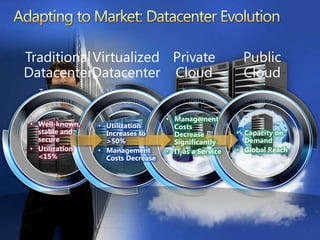
Adapting to Market: Datacenter EvolutionPrivateCloudPublicCloudPrivateCloudPublicCloudManagement Costs Decrease Significantly
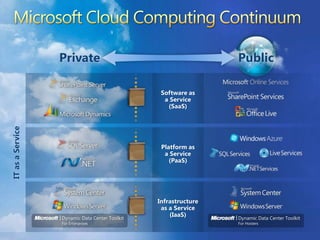
IT as a Service
Well-known, stable and secure
Utilization
Utilization Increases to >50%
Management Costs Decrease
Capacity on Demand
Global ReachTraditionalDatacenterVirtualizedDatacenterTraditionalDatacenterVirtualizedDatacenter
The Case for Private CloudAnalyst View“Private Cloud Computing is Real – Get Over It”  					- Tom Bittman – GartnerMore than half of enterprises plan on leveraging IaaS clouds in the next 2-3 years -Forrester
The Case for Private CloudCustomer View“Management doesn’t trust Amazon. Instead, they have built an internal cloud using VMware/BladeLogic for dev/test, basic production - AutodeskInterested in Amazon-like infrastructure… but fundamentally we trust internal infrastructures. Don’t trust external infrastructures. – BP“Departments.. want to leverage [cloud] to avoid HW purchases for dev/test/QA.” 		– Proctor & GambleNeed to be more agile to serve internal customers. Enable self-service etc. 			         -IntelWe need services-oriented mgmt where IT manages apps, not boxes.” - ChevronStrictly Microsoft Confidential

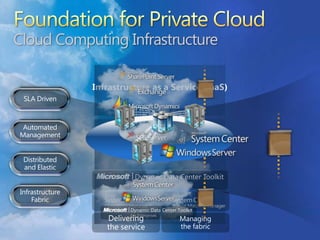
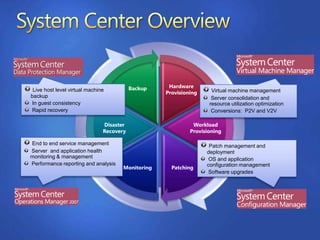
Microsoft Private Cloud Computing

Editor's Notes

  • #4 Sales target:Corp Inside Acct. Managed (CIAM) - ~1100 accountsCorp Program Managed (CPM) - ~21,000 accounts
  • #5 Sales target:Corp Inside Acct. Managed (CIAM) - ~1100 accountsCorp Program Managed (CPM) - ~21,000 accounts
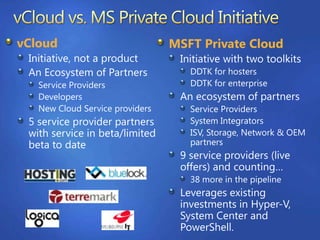
  • #6 To enterprise:Runs any application cost effectively and predictably in a shared, on-premise or off-premise infrastructure cloud.Through hosters:A common set of cloud computing services move your applications seamlessly from your datacenter into the VMware vCloud ecosystem and back.
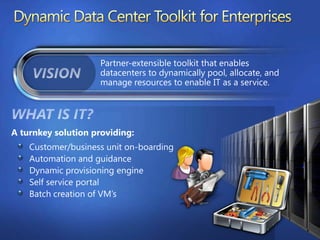
  • #9 Clean up the two graphics. We want to express “we’re providing you the tools and products to give you the agility of a private cloud”
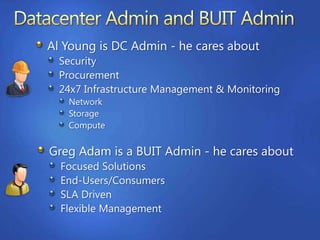
  • #10 Needs pop and make it shinny. Keep text
  • #12 ----------------Operational Efficiency Ease and speed up provisioning drastically Less specific planning on managing infrastructure resourcesReduction of risk because of less human errorsSave on energy costsReduces the need of extensive IT staffCapital EfficiencyServer consolidation and optimizationLower floor space needsService Manager/LOB owner - FlexibilitySelf Service PortalManage groups of VMs
  • #13 Gain operational efficienciesSimplified access to resourcesAgile and flexible IT
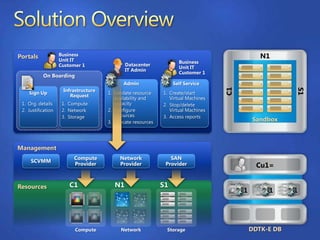
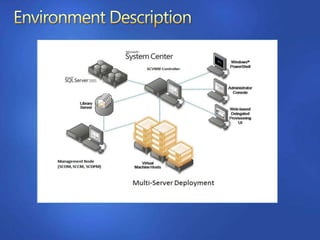
  • #14 We need this one polished and cleaned up so it’s not so busy.Speaker NotesThis is essentially the architecture of the solution that we are planning to build. There are several things that this tool will require to be in the fabric, such as Hyper-V, VMM, etc. The components within the dashed rectangle are the ones we are providing. We have a portal component to provide the admin, on boarding and self service functionalities. The self service portal has a set of predefined what we call virtual machine actions. For example, create VM. An action contains 1 or more tasks and a task is associated with a PS 2.0 scripts and its properties. The portal obtains configuration and store data on the db. We have a light weight engine which essentially host several core technologies such as WF and PS 2.0. The portal essentially make asynchronous requests to the engine and the engine will handle all of the batching, queuing and execution of the action. Now, from customer and partner’s point of view, our extensibility point is an XML file. It is within this XML that partner can configure the different tasks for different VM actions and also associate each task with specific PS script. The admin portion of the UI will have a basic authoring for the XML file. We need to have this to reduce error prone and to make it easier to bind script parameters so that they can be pass with the right runtime values during engine execution.
  • #16 This one really needs to be cleaned up. I think we talked about this one yesterday as “the football play”. Customer 1 signs up using the on-boarding portal - submitting details about his/her organization (BUIT name, justification, Dept Code, etc)Once sign up request is approved by Admin, customer 1 can then use on-boarding portal to submit infrastructure request to request quota for Compute, Network and Storage resources to admin – i.e. CPU, Storage Size, Memory size, new network VLAN, etcAdmin would then need to validate availability of the physical resources capacity (using different resources provider UI/application – F5 UI, Compellent UI, etc) to determine whether appropriate resources are available – i.e, is new VLAN needed?, Does new LUN need to be created? New physical host need to be added?Once admin validates availability, he/she can then configure each of these resources using the different resources provider UI (VLAN creation, LUN creation, Host creation, etc)Once physical resources are available and configured, Admin uses Admin portal to allocate and associate proper resources boundary to Customer 1 (IP ranges 10.1.1.1 – 10.1.2.20, VLAN ID = 2048, Host group = ProductionHostGroup, etcOnce #5 is completed, Admin can then approve Customer 1’s infrastructure requestOnce the infra request is approved, Customer 1 can access SSP and hydrate their environment (using the predefined VM actions – i.e. create VM), within the provided resources boundary