
Cloud vs. Data Center:
What’s the difference?
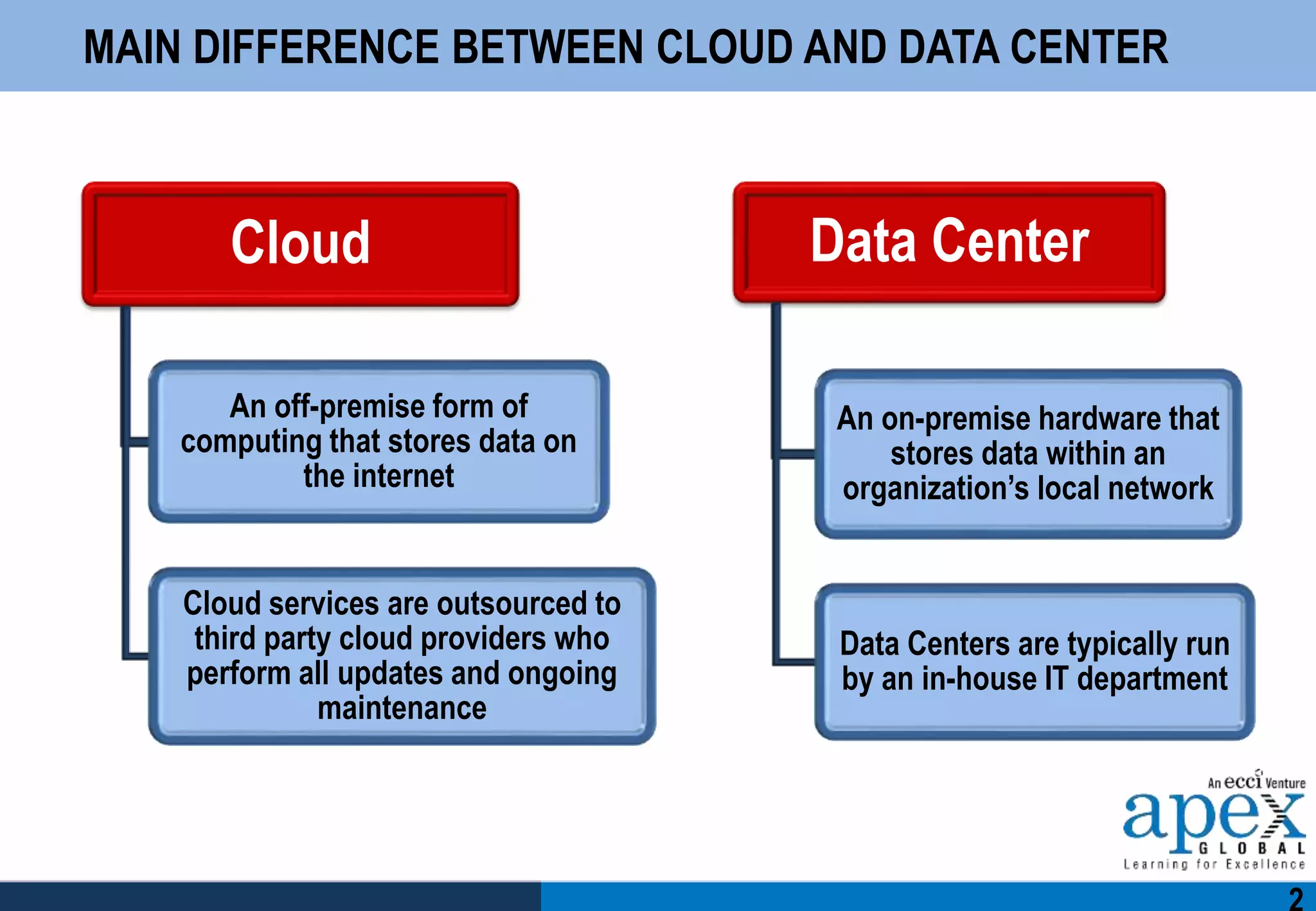
Cloud
An off-premise form of
computing that stores data on
the internet
Cloud services are outsourced to
third party cloud providers who
perform all updates and ongoing
maintenance
Data Center
An on-premise hardware that
stores data within an
organization’s local network
Data Centers are typically run
by an in-house IT department
MAIN DIFFERENCE BETWEEN CLOUD AND DATA CENTER
Both types of computing systems can store data, as a physical unit, but only a data
center can store servers and other equipment.
Cloud service providers use data centers to house cloud services and cloud-based
resources.
For cloud-hosting purposes, vendors also often own multiple data centers in several
geographic locations to safeguard data availability during outages and other data
center failures.
STORAGE
DOES YOUR BUSINESS NEED A CLOUD OR A DATA CENTER?
However, once you build a data center, you
will not be able to change the amount of
storage and workload it can withstand without
purchasing and installing more equipment
Data center is ideal for
companies that need a
customized, dedicated system
that gives them full control over
their data and equipment
Data center is also more
suitable for organizations that
run many different types of
applications and complex
workloads
DOES YOUR BUSINESS NEED A CLOUD OR A DATA CENTER?
A cloud system is scalable
to business needs and has
potentially unlimited
capacity, based on vendor's
offerings and service plans
One disadvantage of the
cloud is that it will not have
as much control as a data
center, since a third party is
managing the system
Furthermore, unless you
have a private cloud within
the company network, you
will be sharing resources
with other cloud users in
your provider's public cloud
CLOUD SECURITY vs. DATA CENTER SECURITY
Being an external form of
computing, a cloud may be
less secure or take more
work to secure than a data
center.
In case of cloud you will be
entrusting your data to a
third-party provider that may or
may not have the most
up-to-date security
certifications.
Being internal, there is no
security threat from external
factors.
In case of data centers
you are responsible for your
own security.
CLOUD SECURITY vs. DATA CENTER SECURITY
The cloud is accessible by anyone
with the proper credentials anywhere
there is an Internet connection
which opens a wide array of entry and
exit points, all of which need
to be protected to ensure that
data transmissions from these points
are secure.
If your cloud resides on several data
centers in different locations, each
location will need the proper
security measures.
A data center is physically
connected to a local network,
which makes it easier to ensure that
only those with company-approved
credentials and equipment
can access stored apps and
information.
CLOUD vs. DATA CENTER COSTS
• For most small businesses, the cloud is a
more cost-effective option as you will be
building an infrastructure from the ground up
and will be responsible for your own
maintenance and administration.
• Cloud computing does not require time or
capital to get up and running. Instead,
most cloud providers offer a range of
affordable subscription plans to meet your
budget and scale the service to your
performance needs.
• A data center takes much longer to get
started and can cost businesses $10 million
to $25 million per year to operate.
• Data centers take time to build, depending on
your provider, cloud services are available
for use almost immediately after registration
Source:
www.businessnewsdaily.com

Cloud vs.data center

  • 1.
    Cloud vs. DataCenter: What’s the difference?
  • 2.
    Cloud An off-premise formof computing that stores data on the internet Cloud services are outsourced to third party cloud providers who perform all updates and ongoing maintenance Data Center An on-premise hardware that stores data within an organization’s local network Data Centers are typically run by an in-house IT department MAIN DIFFERENCE BETWEEN CLOUD AND DATA CENTER
  • 3.
    Both types ofcomputing systems can store data, as a physical unit, but only a data center can store servers and other equipment. Cloud service providers use data centers to house cloud services and cloud-based resources. For cloud-hosting purposes, vendors also often own multiple data centers in several geographic locations to safeguard data availability during outages and other data center failures. STORAGE
  • 4.
    DOES YOUR BUSINESSNEED A CLOUD OR A DATA CENTER? However, once you build a data center, you will not be able to change the amount of storage and workload it can withstand without purchasing and installing more equipment Data center is ideal for companies that need a customized, dedicated system that gives them full control over their data and equipment Data center is also more suitable for organizations that run many different types of applications and complex workloads
  • 5.
    DOES YOUR BUSINESSNEED A CLOUD OR A DATA CENTER? A cloud system is scalable to business needs and has potentially unlimited capacity, based on vendor's offerings and service plans One disadvantage of the cloud is that it will not have as much control as a data center, since a third party is managing the system Furthermore, unless you have a private cloud within the company network, you will be sharing resources with other cloud users in your provider's public cloud
  • 6.
    CLOUD SECURITY vs.DATA CENTER SECURITY Being an external form of computing, a cloud may be less secure or take more work to secure than a data center. In case of cloud you will be entrusting your data to a third-party provider that may or may not have the most up-to-date security certifications. Being internal, there is no security threat from external factors. In case of data centers you are responsible for your own security.
  • 7.
    CLOUD SECURITY vs.DATA CENTER SECURITY The cloud is accessible by anyone with the proper credentials anywhere there is an Internet connection which opens a wide array of entry and exit points, all of which need to be protected to ensure that data transmissions from these points are secure. If your cloud resides on several data centers in different locations, each location will need the proper security measures. A data center is physically connected to a local network, which makes it easier to ensure that only those with company-approved credentials and equipment can access stored apps and information.
  • 8.
    CLOUD vs. DATACENTER COSTS • For most small businesses, the cloud is a more cost-effective option as you will be building an infrastructure from the ground up and will be responsible for your own maintenance and administration. • Cloud computing does not require time or capital to get up and running. Instead, most cloud providers offer a range of affordable subscription plans to meet your budget and scale the service to your performance needs. • A data center takes much longer to get started and can cost businesses $10 million to $25 million per year to operate. • Data centers take time to build, depending on your provider, cloud services are available for use almost immediately after registration
  • 9.