Roadmap to Cloud ComputingRoadmap to Cloud Computing
AgendaCloud computingMyths & Facts Service ModelsSecurity Challenges & AdvantagesSlide 2
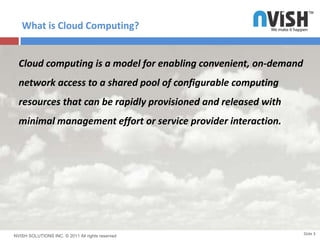
What is Cloud Computing?Slide 3Cloud computing is a model for enabling convenient, on-demand network access to a shared pool of configurable computing resources that can be rapidly provisioned and released with minimal management effort or service provider interaction.
Five Essential Cloud CharacteristicsSlide 4Allows business units to get the computing resources they need without having to go through IT for equipment.Enables applications to be built in ways that align with how businesses operate today - mobile, multi-device, etc.Allows for pooling of computing resources to serve multiple consumers. Allows for quick scalability or downsizing of resources depending on demand.Business units only pay for the computational resources they use. 
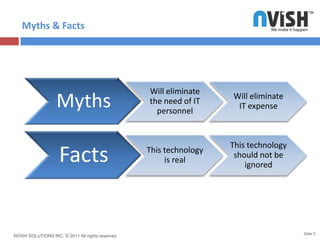
Myths & FactsSlide 5
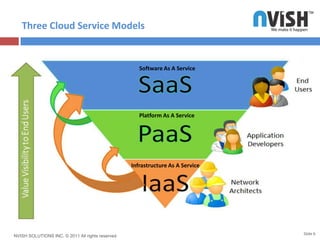
Three Cloud Service ModelsSlide 6Software As A ServicePlatform As A ServiceInfrastructure As A Service
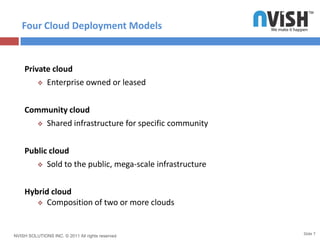
Four Cloud Deployment ModelsSlide 7Private cloud Enterprise owned or leasedCommunity cloudShared infrastructure for specific communityPublic cloudSold to the public, mega-scale infrastructureHybrid cloudComposition of two or more cloudsHybrid Cloud
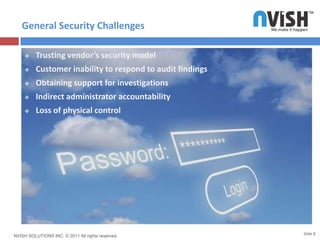
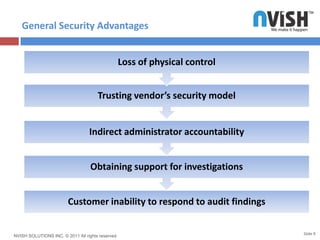
General Security ChallengesSlide 8Trusting vendor’s security model
Customer inability to respond to audit findings
Obtaining support for investigations

Roadmap to Cloud Computing

  • 1.
    Roadmap to CloudComputingRoadmap to Cloud Computing
  • 2.
    AgendaCloud computingMyths &Facts Service ModelsSecurity Challenges & AdvantagesSlide 2
  • 3.
    What is CloudComputing?Slide 3Cloud computing is a model for enabling convenient, on-demand network access to a shared pool of configurable computing resources that can be rapidly provisioned and released with minimal management effort or service provider interaction.
  • 4.
    Five Essential CloudCharacteristicsSlide 4Allows business units to get the computing resources they need without having to go through IT for equipment.Enables applications to be built in ways that align with how businesses operate today - mobile, multi-device, etc.Allows for pooling of computing resources to serve multiple consumers. Allows for quick scalability or downsizing of resources depending on demand.Business units only pay for the computational resources they use. 
  • 5.
  • 6.
    Three Cloud ServiceModelsSlide 6Software As A ServicePlatform As A ServiceInfrastructure As A Service
  • 7.
    Four Cloud DeploymentModelsSlide 7Private cloud Enterprise owned or leasedCommunity cloudShared infrastructure for specific communityPublic cloudSold to the public, mega-scale infrastructureHybrid cloudComposition of two or more cloudsHybrid Cloud
  • 8.
    General Security ChallengesSlide8Trusting vendor’s security model
  • 9.
    Customer inability torespond to audit findings
  • 10.
    Obtaining support forinvestigations

Editor's Notes

  • #4 Ipreffered this one.