
















by Bert Ertman
Those who stand for nothing,
fall for anything - Alexander
Hamilton
Microservices

Gone Wrong!
@BertErtman
• Fellow, Director of Technology
Outreach at Luminis
• Background in all things Java
since 1995
• Java Champion, JavaOne
Rockstar Speaker, and a Duke’s
Choice Award Winner
• Involved in architecting and
implementing dozens of large
scale systems over the past 20
years or so
• Book author for O’Reilly, speaker
at many conferences
Cheaper
Better
Faster
Stronger{ Most problems in
Computer Science have
already been solved in
the 60/70s
Say what?
The term "Microservice Architecture" has sprung up over the last few
years to describe a particular way of designing software applications
as suites of independently deployable services. While there is no
precise definition of this architectural style, there are certain common
characteristics around organization around business capability,
automated deployment, intelligence in the endpoints, and
decentralized control of languages and data.
Source: http://martinfowler.com/articles/microservices.html
Where did it come from?
• Microservices-style architectures are a response to adjust software
architecture to an ever-evolving spectrum. It addresses Business
Agility through technology:
• Usage of cloud-based infrastructure and services
• DevOps
• The need to scale up the number of people/teams
• Client-side revolution both in technologies and devices
Microservices
are about
Business Agility
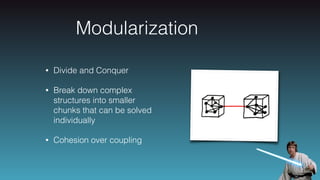
Modularization
• Divide and Conquer
• Break down complex
structures into smaller
chunks that can be solved
individually
• Cohesion over coupling
How small is micro?
• Small as in “single responsibility”
• Each service only does one thing, and one thing well
• Not about lines of code, but “small enough to fit in your head”
• Maybe even small enough that you can throw them away – Rewrite
over Maintain
Are Microservices a better SOA?
Services
• Provide a public, versioned contract for a component
• Have their own life cycle, so they can be 

separately deployed
• Hide all implementation details
Comparing with SOA
• SOA: dumb endpoints, smart routes
• Endpoint is merely a remote procedure call
• Routing done through ESBs providing location transparency and
transformations
Comparing with SOA
• Microservices: Dumb pipes, smart endpoints
• Pipes: usually REST via HTTP(S)
• No intelligence in the route, or at least no more than simple
(persistent) queues
SOA is about Reuse
Microservices are
NOT about Reuse
What can we learn from Amazon/Netflix?
• They are not optimized for (saving) costs or overly structured
• Focus on opportunities ahead instead of cost savings
• Focus on speed to market (first mover advantage)
• Organized like nature to facilitate insane growth
• Cloud is their strategic advantage!
Why shouldn’t we pretend to be Amazon/Netflix?
• Most normal companies ARE looking for cost savings and
restructuring
• Most normal companies don’t have the scale of Amazon/Netflix
• Most normal companies see cloud still as a way to save costs
• If you pretend you are…you get all of their infrastructural problems
for free
Companies that have successfully adopted
Microservices have…
• …determined that they are an IT company which happen to offer
financial/healthcare/trading/shopping… services
• …embraced Cloud (technologies) as a strategic advantage
• …established solid CI/CD practices, and deploy to production
multiple times per day
Microservices require DevOps
*correction*
Microservices require
BizDevOpsSec
Conway’s Law
“Organizations which design systems ... are 

constrained to produce designs which are copies of 

the communication structures of these organizations"
—M. Conway 1968
What it actually means…
• Make sure the organization is compatible with the software architecture
• If your (microservices) architecture does not reflect the way your
organization is structured, don’t even bother going that way!
• It also means that your teams should be cross-functional. Everyone you
need to build, maintain and get it into production must be part of the
team
This is hard!
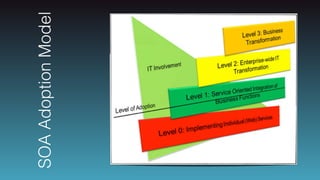
SOAAdoptionModel
So what should you do?
• Transform the organization along with the landscape
• Microservices boundaries must be drawn around organizational
capabilities
• Alternatively, they could be drawn around particular development
teams / features
There is no single way to do
microservices right!
There are many ways to do
microservices wrong!
Many wrong ways to do
microservices there are!
Struggles
• Data Strategy
• Orchestration vs Choreography
• Re-use Traps
• Test Strategy
• Dealing with Failure
Resilience
• The ability of a system to handle unexpected situations
• without the user noticing it (best case)
• with graceful degradation of service (worst case)
Anti-fragility
Isolation
Loose-coupling
Latency
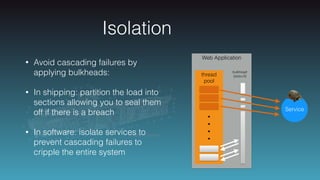
Isolation
• Avoid cascading failures by
applying bulkheads:
• In shipping: partition the load into
sections allowing you to seal them
off if there is a breach
• In software: isolate services to
prevent cascading failures to
cripple the entire system
Web Application
thread
pool
•
•
•
•
Service
bulkhead
(size=3)
Loose-coupling
• Reduce coupling between failure units through:
• asynchronous communication
• location transparency
• relaxed temporal constraints
• idempotency
• self-containment
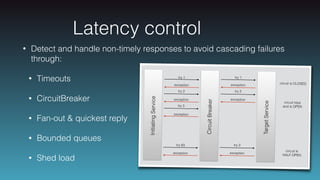
Latency control
• Detect and handle non-timely responses to avoid cascading failures
through:
• Timeouts
• CircuitBreaker
• Fan-out & quickest reply
• Bounded queues
• Shed load
InitiatingService
CircuitBreaker
TargetService
try 1
try 2
try 3
try 83
exception
exception
exception
exception
try 1
try 2
try 3
exception
exception
exception
circuit is CLOSED
circuit trips
and is OPEN
circuit is
HALF-OPEN
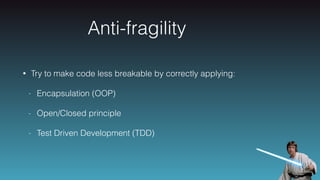
Anti-fragility
• Try to make code less breakable by correctly applying:
- Encapsulation (OOP)
- Open/Closed principle
- Test Driven Development (TDD)
summary
Microservices are NOT the logical
next step for enterprise architecture
in every organization
Microservices
• ..are suites of independently deployable services, organized around business
capabilities
• ..are small enough so they can ‘fit in your head’ and you can throw them away
• ..are all about promoting modularity at the system level
• ..are thriving on continuous deployment, DevOps, and infrastructure automation
• ..are a legitimate way of achieving business agility in some organizations
• ..will cause nightmares forever, when applied for the wrong reasons!
Microservices Gone
Wrong!
Thank you!
@BertErtman

Microservices Gone Wrong!

  • 1.
    by Bert Ertman Thosewho stand for nothing, fall for anything - Alexander Hamilton Microservices
 Gone Wrong! @BertErtman
  • 2.
    • Fellow, Directorof Technology Outreach at Luminis • Background in all things Java since 1995 • Java Champion, JavaOne Rockstar Speaker, and a Duke’s Choice Award Winner • Involved in architecting and implementing dozens of large scale systems over the past 20 years or so • Book author for O’Reilly, speaker at many conferences
  • 3.
    Cheaper Better Faster Stronger{ Most problemsin Computer Science have already been solved in the 60/70s
  • 5.
    Say what? The term"Microservice Architecture" has sprung up over the last few years to describe a particular way of designing software applications as suites of independently deployable services. While there is no precise definition of this architectural style, there are certain common characteristics around organization around business capability, automated deployment, intelligence in the endpoints, and decentralized control of languages and data. Source: http://martinfowler.com/articles/microservices.html
  • 6.
    Where did itcome from? • Microservices-style architectures are a response to adjust software architecture to an ever-evolving spectrum. It addresses Business Agility through technology: • Usage of cloud-based infrastructure and services • DevOps • The need to scale up the number of people/teams • Client-side revolution both in technologies and devices
  • 7.
  • 8.
    Modularization • Divide andConquer • Break down complex structures into smaller chunks that can be solved individually • Cohesion over coupling
  • 9.
    How small ismicro? • Small as in “single responsibility” • Each service only does one thing, and one thing well • Not about lines of code, but “small enough to fit in your head” • Maybe even small enough that you can throw them away – Rewrite over Maintain
  • 10.
  • 11.
    Services • Provide apublic, versioned contract for a component • Have their own life cycle, so they can be 
 separately deployed • Hide all implementation details
  • 12.
    Comparing with SOA •SOA: dumb endpoints, smart routes • Endpoint is merely a remote procedure call • Routing done through ESBs providing location transparency and transformations
  • 13.
    Comparing with SOA •Microservices: Dumb pipes, smart endpoints • Pipes: usually REST via HTTP(S) • No intelligence in the route, or at least no more than simple (persistent) queues
  • 14.
    SOA is aboutReuse Microservices are NOT about Reuse
  • 15.
    What can welearn from Amazon/Netflix? • They are not optimized for (saving) costs or overly structured • Focus on opportunities ahead instead of cost savings • Focus on speed to market (first mover advantage) • Organized like nature to facilitate insane growth • Cloud is their strategic advantage!
  • 16.
    Why shouldn’t wepretend to be Amazon/Netflix? • Most normal companies ARE looking for cost savings and restructuring • Most normal companies don’t have the scale of Amazon/Netflix • Most normal companies see cloud still as a way to save costs • If you pretend you are…you get all of their infrastructural problems for free
  • 17.
    Companies that havesuccessfully adopted Microservices have… • …determined that they are an IT company which happen to offer financial/healthcare/trading/shopping… services • …embraced Cloud (technologies) as a strategic advantage • …established solid CI/CD practices, and deploy to production multiple times per day
  • 18.
  • 19.
  • 20.
  • 21.
    Conway’s Law “Organizations whichdesign systems ... are 
 constrained to produce designs which are copies of 
 the communication structures of these organizations" —M. Conway 1968
  • 22.
    What it actuallymeans… • Make sure the organization is compatible with the software architecture • If your (microservices) architecture does not reflect the way your organization is structured, don’t even bother going that way! • It also means that your teams should be cross-functional. Everyone you need to build, maintain and get it into production must be part of the team
  • 23.
  • 24.
  • 25.
    So what shouldyou do? • Transform the organization along with the landscape • Microservices boundaries must be drawn around organizational capabilities • Alternatively, they could be drawn around particular development teams / features
  • 26.
    There is nosingle way to do microservices right!
  • 27.
    There are manyways to do microservices wrong!
  • 28.
    Many wrong waysto do microservices there are!
  • 29.
    Struggles • Data Strategy •Orchestration vs Choreography • Re-use Traps • Test Strategy • Dealing with Failure
  • 30.
    Resilience • The abilityof a system to handle unexpected situations • without the user noticing it (best case) • with graceful degradation of service (worst case)
  • 31.
  • 32.
    Isolation • Avoid cascadingfailures by applying bulkheads: • In shipping: partition the load into sections allowing you to seal them off if there is a breach • In software: isolate services to prevent cascading failures to cripple the entire system Web Application thread pool • • • • Service bulkhead (size=3)
  • 33.
    Loose-coupling • Reduce couplingbetween failure units through: • asynchronous communication • location transparency • relaxed temporal constraints • idempotency • self-containment
  • 34.
    Latency control • Detectand handle non-timely responses to avoid cascading failures through: • Timeouts • CircuitBreaker • Fan-out & quickest reply • Bounded queues • Shed load InitiatingService CircuitBreaker TargetService try 1 try 2 try 3 try 83 exception exception exception exception try 1 try 2 try 3 exception exception exception circuit is CLOSED circuit trips and is OPEN circuit is HALF-OPEN
  • 35.
    Anti-fragility • Try tomake code less breakable by correctly applying: - Encapsulation (OOP) - Open/Closed principle - Test Driven Development (TDD)
  • 36.
  • 37.
    Microservices are NOTthe logical next step for enterprise architecture in every organization
  • 38.
    Microservices • ..are suitesof independently deployable services, organized around business capabilities • ..are small enough so they can ‘fit in your head’ and you can throw them away • ..are all about promoting modularity at the system level • ..are thriving on continuous deployment, DevOps, and infrastructure automation • ..are a legitimate way of achieving business agility in some organizations • ..will cause nightmares forever, when applied for the wrong reasons!
  • 39.