Microscopy for Beekeepers
Chris Cardew 31st January 2015
Content
• What is microscopy?
• Types of microscope
– How to set up the light microscope.
– How to make slides
• What to look at
– Pollen
– Bee biology
– Bee parasites
• Where next
What is Microscopy
• Microscopy is the technical field of using
microscopes to view objects and areas of
objects that cannot be seen with the naked
eye
• There are three well-known branches
of microscopy: optical (light), electron, and
scanning probe microscopy.
Types of microscope
• Optical or Light Microscopy
– Dissecting x40 times magnification
– Compound up to x 1000 times
• Electron Beam
– Scanning electron microscope
• Up to x 250,000
– Transmission electron microscopy
• Up to x 1,000 higher magnification than light
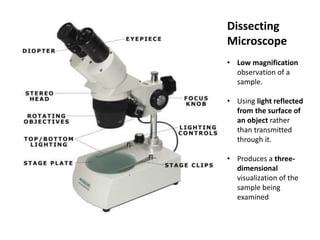
Dissecting
Microscope
• Low magnification
observation of a
sample.
• Using light reflected
from the surface of
an object rather
than transmitted
through it.
• Produces a three-
dimensional
visualization of the
sample being
examined
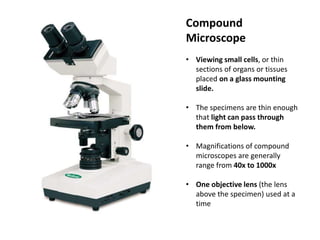
Compound
Microscope
• Viewing small cells, or thin
sections of organs or tissues
placed on a glass mounting
slide.
• The specimens are thin enough
that light can pass through
them from below.
• Magnifications of compound
microscopes are generally
range from 40x to 1000x
• One objective lens (the lens
above the specimen) used at a
time
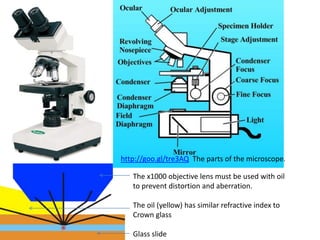
The x1000 objective lens must be used with oil
to prevent distortion and aberration.
The oil (yellow) has similar refractive index to
Crown glass
Glass slide
http://goo.gl/tre3AQ The parts of the microscope.
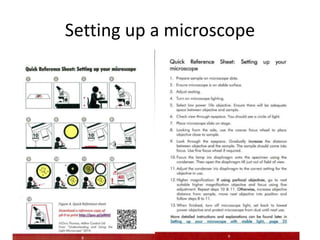
Setting up a microscope
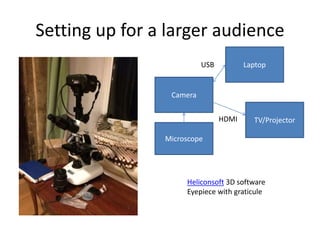
Setting up for a larger audience
Camera
Microscope
Laptop
TV/Projector
USB
HDMI
Heliconsoft 3D software
Eyepiece with graticule
What to look at and why?
• Pollen
– Monitor the flowers that bees visit
– Identify honey
– Make reference slides and photographs
• Bee biology
• Compare to other insects e.g wasp,
bumblebee, solitary bees
• Bee parasites
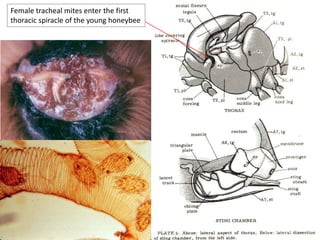
– Tracheal mite, Varroa
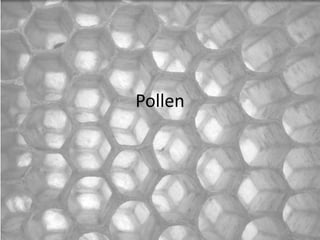
Pollen
Identifying Pollen - flower
• Pollen from the flower anther
– Pick the flower with anther
– Add gelatine to a slide, brush the anther onto the
gelatine.
– (Take a blob of gelatine on some tweezers and
brush it over the flower anther then place the
blob onto a slide)
– Place a cover slip over the pollen.
– Place the slide on a heating plate
– The gelatine will spread out under the cover slip
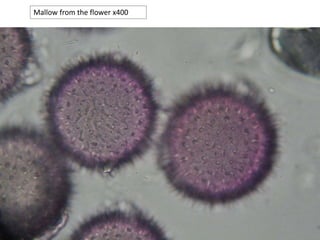
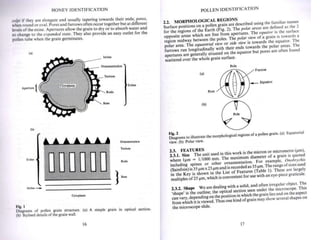
Mallow from the flower x400
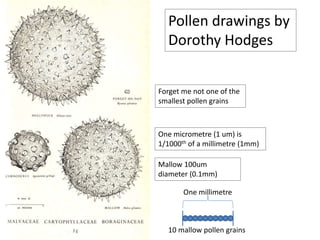
Mallow 100um
diameter (0.1mm)
Pollen drawings by
Dorothy Hodges
Forget me not one of the
smallest pollen grains
One micrometre (1 um) is
1/1000th of a millimetre (1mm)
One millimetre
10 mallow pollen grains
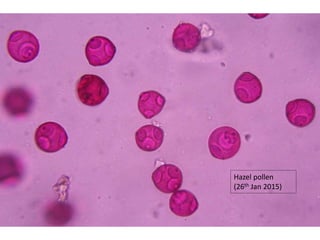
Hazel pollen
(26th Jan 2015)
Identifying pollen - Bee
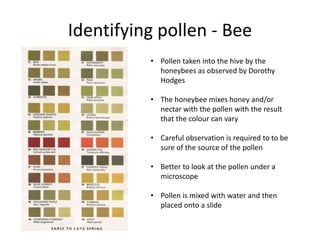
• Pollen taken into the hive by the
honeybees as observed by Dorothy
Hodges
• The honeybee mixes honey and/or
nectar with the pollen with the result
that the colour can vary
• Careful observation is required to to be
sure of the source of the pollen
• Better to look at the pollen under a
microscope
• Pollen is mixed with water and then
placed onto a slide
Identifying pollen- Honey
• Extracting pollen from honey
• centrifuge and sedimentation.
• Take 10g of honey (centre of the jar)
• Make slide as for flower
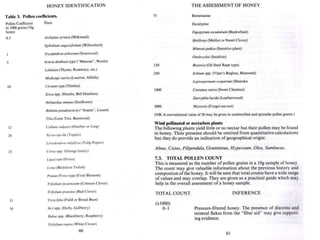
• Pollen concentrations
• These change by pollen type
• Pollen coefficients were introduced to help with honey
identification (more detail later)
• Eva Crane – A book of Honey
• Other methods of identifying honey include:
– Conduction
– Refractive index.
• Mellissopalynology
• The study of pollen contained in honey
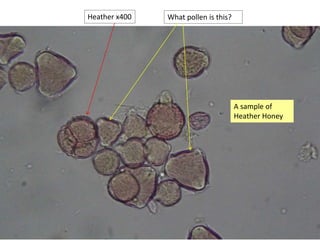
Heather x400 What pollen is this?
A sample of
Heather Honey
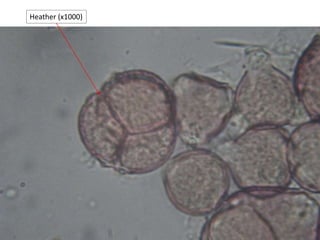
Heather (x1000)
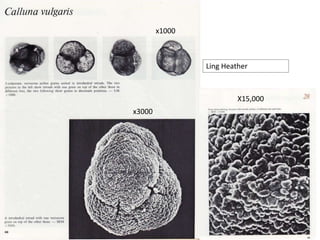
Ling Heather
x1000
x3000
X15,000
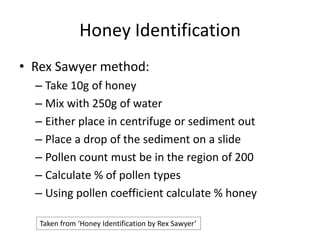
Honey Identification
• Rex Sawyer method:
– Take 10g of honey
– Mix with 250g of water
– Either place in centrifuge or sediment out
– Place a drop of the sediment on a slide
– Pollen count must be in the region of 200
– Calculate % of pollen types
– Using pollen coefficient calculate % honey
Taken from ‘Honey Identification by Rex Sawyer’
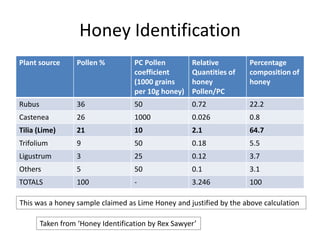
Honey Identification
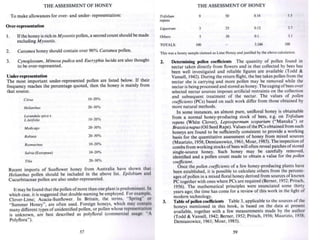
Plant source Pollen % PC Pollen
coefficient
(1000 grains
per 10g honey)
Relative
Quantities of
honey
Pollen/PC
Percentage
composition of
honey
Rubus 36 50 0.72 22.2
Castenea 26 1000 0.026 0.8
Tilia (Lime) 21 10 2.1 64.7
Trifolium 9 50 0.18 5.5
Ligustrum 3 25 0.12 3.7
Others 5 50 0.1 3.1
TOTALS 100 - 3.246 100
This was a honey sample claimed as Lime Honey and justified by the above calculation
Taken from ‘Honey Identification by Rex Sawyer’
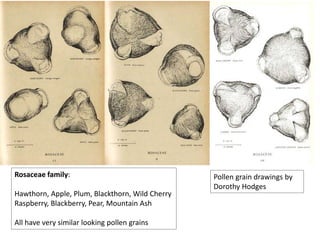
Rosaceae family:
Hawthorn, Apple, Plum, Blackthorn, Wild Cherry
Raspberry, Blackberry, Pear, Mountain Ash
All have very similar looking pollen grains
Pollen grain drawings by
Dorothy Hodges
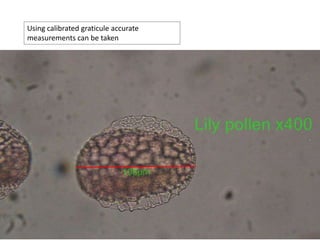
Using calibrated graticule accurate
measurements can be taken
Honey identification
• Summary
– Identify the pollen grains in the honey sample
– Calculate the % pollen in the sample
– Calculate the % honey using the pollen coefficient
– Use technology to accurately measure the pollen
grains to help with identification.
– Make reference slides directly from the flowers to
compare with the pollen in the honey
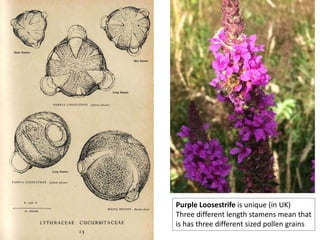
Purple Loosestrife is unique (in UK)
Three different length stamens mean that
is has three different sized pollen grains
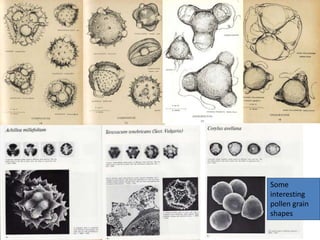
Some
interesting
pollen grain
shapes
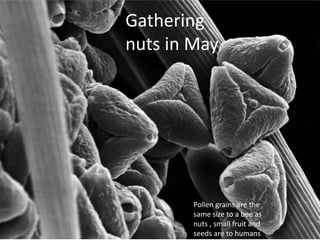
Gathering
nuts in May
Pollen grains are the
same size to a bee as
nuts , small fruit and
seeds are to humans
Bee Biology
Bee biology
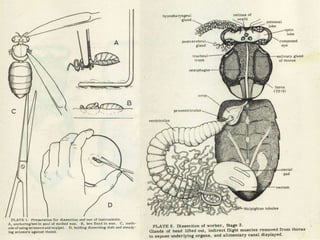
• Bee dissection – the dissecting microscope
• Looking at bee legs
• Looking at bee wings
• Comparing the bee to other insects
Chemicals for slide preparation
• Numount
• Final mounting of bee parts onto a slide
• Glycerine Jelly
• Mounting of pollen and other very small parts onto a slide
• Sodium Hydroxide
• Softening of bee parts for slide mounting e.g. leg
• Acetic Acid
• Decalcification of bee parts for slide mounting
• Isopropyl Alcohol (IPA)
• Preservation (fixing) of bee parts
• Toluene
• Dehydrating and clearing of bee parts (process with IPA)
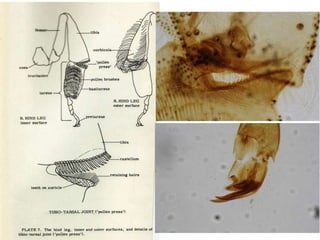
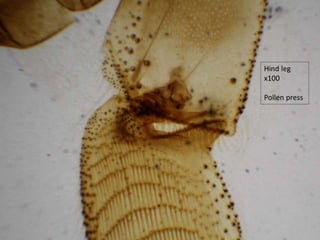
Hind leg
x100
Pollen press
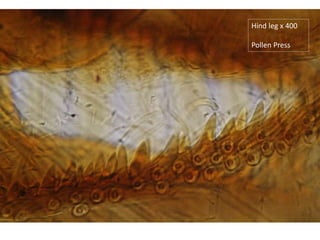
Hind leg x 400
Pollen Press
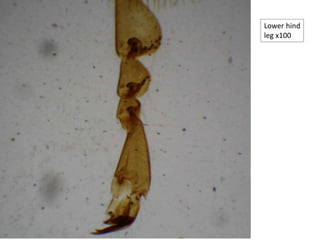
Lower hind
leg x100
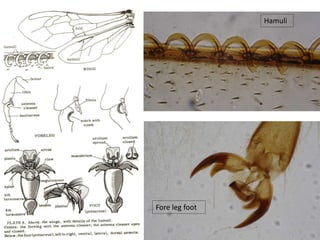
Hamuli
Fore leg foot
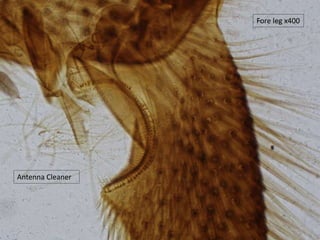
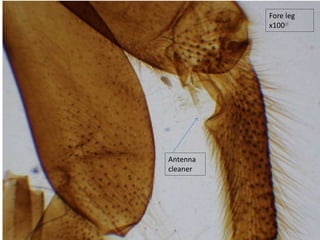
Fore leg
x100
Antenna
cleaner
Fore leg x400
Antenna Cleaner
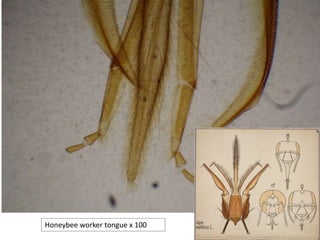
Honeybee worker tongue x 100
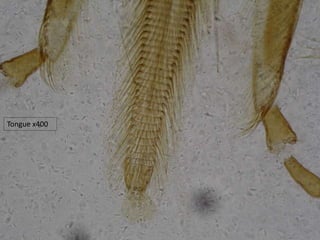
Tongue x400
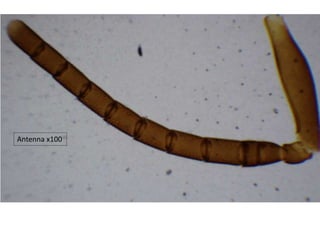
Antenna x100
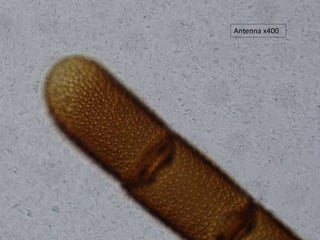
Antenna x400
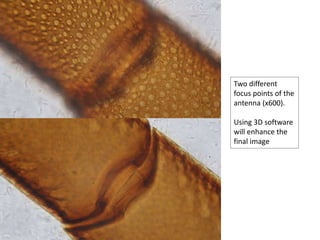
Two different
focus points of the
antenna (x600).
Using 3D software
will enhance the
final image
Bee Parasites
Bee disease and parasites
• Viruses (for example Sacbrood) cannot be seen with a
light microscope.
• Bacteria can be seen at magnifications of x1000.
– However there are only two physical shapes that bacteria
can have, either ‘sausage’ shape - bacillus, or ‘ball’ shaped
coccus.
– This applies to disease causing bacteria as well as the
many normal strains, therefore using shape alone the
strain of bacteria cannot be identified.
– This is really the area of professional laboratories
• http://www.brunelmicroscopes.co.uk/apiculturebeeke
eping.html
Female tracheal mites enter the first
thoracic spiracle of the young honeybee
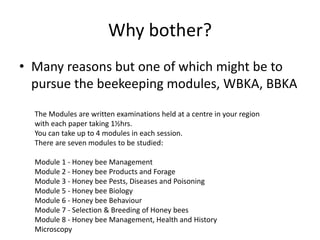
Why bother?
• Many reasons but one of which might be to
pursue the beekeeping modules, WBKA, BBKA
The Modules are written examinations held at a centre in your region
with each paper taking 1½hrs.
You can take up to 4 modules in each session.
There are seven modules to be studied:
Module 1 - Honey bee Management
Module 2 - Honey bee Products and Forage
Module 3 - Honey bee Pests, Diseases and Poisoning
Module 5 - Honey bee Biology
Module 6 - Honey bee Behaviour
Module 7 - Selection & Breeding of Honey bees
Module 8 - Honey bee Management, Health and History
Microscopy
Where next
• Series of seminars in the autumn.
– Microscopy
– Bee disease
– Bee biology
– Husbandry
– Product presentation
– ???
• Interest groups;
– pollen
– bee biology
– looking at wasps and bumblebees
References
• Honey Identification
• Rex Sawyer. Northern Books
• Pollen Loads of the Honey Bee
• Dorothy Hodges
• Anatomy and Dissection of the Honeybee
• Harry Arthur Dade
• Bee
• Rose Lynn Fisher. Princeton Architectural Press
• A Book of Honey
• Eva Crane
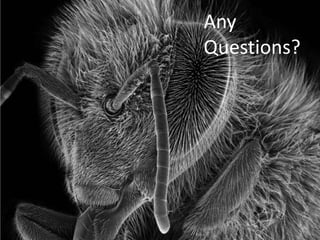
Any
Questions?
Microscopy for beekeepers

Microscopy for beekeepers

  • 1.
    Microscopy for Beekeepers ChrisCardew 31st January 2015
  • 2.
    Content • What ismicroscopy? • Types of microscope – How to set up the light microscope. – How to make slides • What to look at – Pollen – Bee biology – Bee parasites • Where next
  • 3.
    What is Microscopy •Microscopy is the technical field of using microscopes to view objects and areas of objects that cannot be seen with the naked eye • There are three well-known branches of microscopy: optical (light), electron, and scanning probe microscopy.
  • 4.
    Types of microscope •Optical or Light Microscopy – Dissecting x40 times magnification – Compound up to x 1000 times • Electron Beam – Scanning electron microscope • Up to x 250,000 – Transmission electron microscopy • Up to x 1,000 higher magnification than light
  • 5.
    Dissecting Microscope • Low magnification observationof a sample. • Using light reflected from the surface of an object rather than transmitted through it. • Produces a three- dimensional visualization of the sample being examined
  • 6.
    Compound Microscope • Viewing smallcells, or thin sections of organs or tissues placed on a glass mounting slide. • The specimens are thin enough that light can pass through them from below. • Magnifications of compound microscopes are generally range from 40x to 1000x • One objective lens (the lens above the specimen) used at a time
  • 7.
    The x1000 objectivelens must be used with oil to prevent distortion and aberration. The oil (yellow) has similar refractive index to Crown glass Glass slide http://goo.gl/tre3AQ The parts of the microscope.
  • 8.
    Setting up amicroscope
  • 9.
    Setting up fora larger audience Camera Microscope Laptop TV/Projector USB HDMI Heliconsoft 3D software Eyepiece with graticule
  • 10.
    What to lookat and why? • Pollen – Monitor the flowers that bees visit – Identify honey – Make reference slides and photographs • Bee biology • Compare to other insects e.g wasp, bumblebee, solitary bees • Bee parasites – Tracheal mite, Varroa
  • 11.
  • 12.
    Identifying Pollen -flower • Pollen from the flower anther – Pick the flower with anther – Add gelatine to a slide, brush the anther onto the gelatine. – (Take a blob of gelatine on some tweezers and brush it over the flower anther then place the blob onto a slide) – Place a cover slip over the pollen. – Place the slide on a heating plate – The gelatine will spread out under the cover slip
  • 13.
    Mallow from theflower x400
  • 14.
    Mallow 100um diameter (0.1mm) Pollendrawings by Dorothy Hodges Forget me not one of the smallest pollen grains One micrometre (1 um) is 1/1000th of a millimetre (1mm) One millimetre 10 mallow pollen grains
  • 15.
  • 16.
    Identifying pollen -Bee • Pollen taken into the hive by the honeybees as observed by Dorothy Hodges • The honeybee mixes honey and/or nectar with the pollen with the result that the colour can vary • Careful observation is required to to be sure of the source of the pollen • Better to look at the pollen under a microscope • Pollen is mixed with water and then placed onto a slide
  • 17.
    Identifying pollen- Honey •Extracting pollen from honey • centrifuge and sedimentation. • Take 10g of honey (centre of the jar) • Make slide as for flower • Pollen concentrations • These change by pollen type • Pollen coefficients were introduced to help with honey identification (more detail later) • Eva Crane – A book of Honey • Other methods of identifying honey include: – Conduction – Refractive index. • Mellissopalynology • The study of pollen contained in honey
  • 18.
    Heather x400 Whatpollen is this? A sample of Heather Honey
  • 19.
  • 20.
  • 21.
    Honey Identification • RexSawyer method: – Take 10g of honey – Mix with 250g of water – Either place in centrifuge or sediment out – Place a drop of the sediment on a slide – Pollen count must be in the region of 200 – Calculate % of pollen types – Using pollen coefficient calculate % honey Taken from ‘Honey Identification by Rex Sawyer’
  • 22.
    Honey Identification Plant sourcePollen % PC Pollen coefficient (1000 grains per 10g honey) Relative Quantities of honey Pollen/PC Percentage composition of honey Rubus 36 50 0.72 22.2 Castenea 26 1000 0.026 0.8 Tilia (Lime) 21 10 2.1 64.7 Trifolium 9 50 0.18 5.5 Ligustrum 3 25 0.12 3.7 Others 5 50 0.1 3.1 TOTALS 100 - 3.246 100 This was a honey sample claimed as Lime Honey and justified by the above calculation Taken from ‘Honey Identification by Rex Sawyer’
  • 23.
    Rosaceae family: Hawthorn, Apple,Plum, Blackthorn, Wild Cherry Raspberry, Blackberry, Pear, Mountain Ash All have very similar looking pollen grains Pollen grain drawings by Dorothy Hodges
  • 24.
    Using calibrated graticuleaccurate measurements can be taken
  • 25.
    Honey identification • Summary –Identify the pollen grains in the honey sample – Calculate the % pollen in the sample – Calculate the % honey using the pollen coefficient – Use technology to accurately measure the pollen grains to help with identification. – Make reference slides directly from the flowers to compare with the pollen in the honey
  • 26.
    Purple Loosestrife isunique (in UK) Three different length stamens mean that is has three different sized pollen grains
  • 27.
  • 28.
    Gathering nuts in May Pollengrains are the same size to a bee as nuts , small fruit and seeds are to humans
  • 29.
  • 30.
    Bee biology • Beedissection – the dissecting microscope • Looking at bee legs • Looking at bee wings • Comparing the bee to other insects
  • 31.
    Chemicals for slidepreparation • Numount • Final mounting of bee parts onto a slide • Glycerine Jelly • Mounting of pollen and other very small parts onto a slide • Sodium Hydroxide • Softening of bee parts for slide mounting e.g. leg • Acetic Acid • Decalcification of bee parts for slide mounting • Isopropyl Alcohol (IPA) • Preservation (fixing) of bee parts • Toluene • Dehydrating and clearing of bee parts (process with IPA)
  • 34.
  • 35.
    Hind leg x400 Pollen Press
  • 36.
  • 37.
  • 38.
  • 39.
  • 40.
  • 41.
  • 42.
  • 43.
  • 44.
    Two different focus pointsof the antenna (x600). Using 3D software will enhance the final image
  • 45.
  • 46.
    Bee disease andparasites • Viruses (for example Sacbrood) cannot be seen with a light microscope. • Bacteria can be seen at magnifications of x1000. – However there are only two physical shapes that bacteria can have, either ‘sausage’ shape - bacillus, or ‘ball’ shaped coccus. – This applies to disease causing bacteria as well as the many normal strains, therefore using shape alone the strain of bacteria cannot be identified. – This is really the area of professional laboratories • http://www.brunelmicroscopes.co.uk/apiculturebeeke eping.html
  • 47.
    Female tracheal mitesenter the first thoracic spiracle of the young honeybee
  • 48.
    Why bother? • Manyreasons but one of which might be to pursue the beekeeping modules, WBKA, BBKA The Modules are written examinations held at a centre in your region with each paper taking 1½hrs. You can take up to 4 modules in each session. There are seven modules to be studied: Module 1 - Honey bee Management Module 2 - Honey bee Products and Forage Module 3 - Honey bee Pests, Diseases and Poisoning Module 5 - Honey bee Biology Module 6 - Honey bee Behaviour Module 7 - Selection & Breeding of Honey bees Module 8 - Honey bee Management, Health and History Microscopy
  • 49.
    Where next • Seriesof seminars in the autumn. – Microscopy – Bee disease – Bee biology – Husbandry – Product presentation – ??? • Interest groups; – pollen – bee biology – looking at wasps and bumblebees
  • 50.
    References • Honey Identification •Rex Sawyer. Northern Books • Pollen Loads of the Honey Bee • Dorothy Hodges • Anatomy and Dissection of the Honeybee • Harry Arthur Dade • Bee • Rose Lynn Fisher. Princeton Architectural Press • A Book of Honey • Eva Crane
  • 51.